Happy to have my paper, "Technology-Facilitated Gender-Based Violence, Hate Speech, and Terrorism: A Risk Assessment on the Rise of the Incel Rebellion in Canada", published with @VAWJournal.
Read it here: https://t.co/HJuBN45kZ0
#politicalscience#cdnpoli
According to @eslichan (PhD Candidate, Expert on Extremism & Gender), "Normalization of the underlying ideology is particularly harmful for youth who are viewing Clav's content because it can affirm rigid notions of how masculinity should be performed, reinforcing toxic ideals."
Data from the Centre's Media Ecosystem Observatory shows that 'looksmaxxing' is on the rise in Canada's online ecosystem, peaking in February following a viral video of Kick streamer Clavicular "getting brutally framemogged by an ASU frat leader." 🧵 @eslichan@bendavidsteel
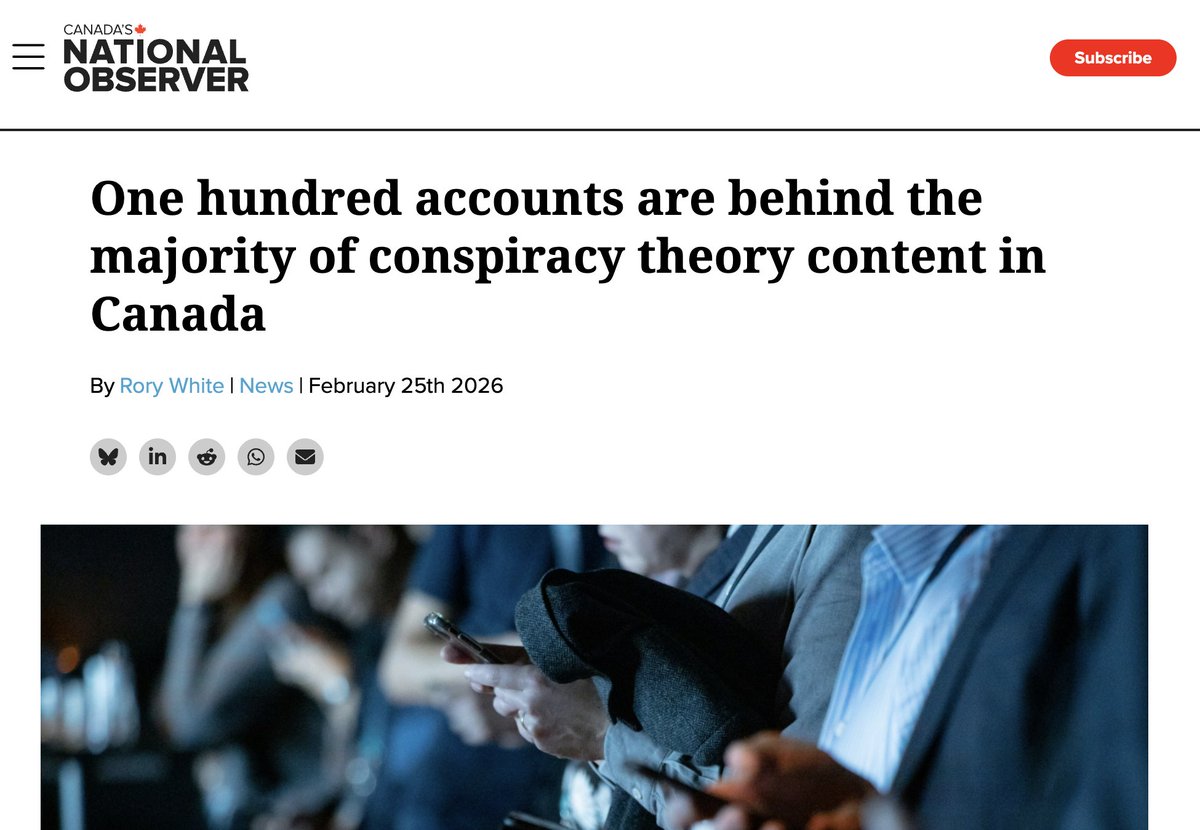
Just 100 users were responsible for almost 70% of online conspiracy posts from influential accounts they examined in Canada.
An analysis of over 14 million social media posts from accounts in Canada found that 87% of conspiratorial claims come from these influencers. But this tiny minority of true believers can have a momentous impact on local politics, influencing what people view as normal and acceptable and leads to self-censoring to avoid attacks from conspiracy theorists.
https://t.co/ZAnPLyxsVE
These extremists create what we call "the funhouse mirror" effect of social media, where a small number of users create misperceptions of social norms. https://t.co/mvLZWozQVv
MEO researcher @eslichan spoke about our latest conspiracy brief on yesterday's episode of @iHeartRadioCA's The Andrew Carter Morning Show! Have a listen here: https://t.co/jvNSfF7nLw
Our newest brief, “Conspiratorial Claims and Institutional Distrust in Canada’s Online Ecosystem,” examines how anti-institutional conspiracy theories circulate online and how widely they resonate with Canadians.🧵 #cdnpoli
Key findings of the brief:
1. Canadians understand of the risks that AI chatbots pose to young people.
2. Canadians assign clear responsibility to AI companies.
3. Canadians support specific, operationalizable interventions mapping onto proven regulatory frameworks.
How do Canadians feel about governing AI chatbots?
Our new policy brief draws on nationally representative survey data from 1,454 Canadians, demonstrating overwhelming public concern across all surveyed risk categories and clear attribution of risk to AI companies.🧵 #cdnpoli
"'AI' is not your friend. Nor is it an intelligent tutor, an empathetic ear, or a helpful assistant. It can not 'make up' facts, and it does not make 'mistakes'. It does not actually answer your questions. Such anthropomorphizing language, however, permeates the public discussion of so-called artificial intelligence technologies. The problem with anthropomorphic descriptions is that they risk masking important limitations of probabilistic automation systems, which make them fundamentally different from human cognition."
Important essay by @emilymbender and @NannaInie. Link below.
@TheTyee Drawing on original public opinion data from the @MediaEcosystem, I highlight the continued public uncertainty around #youthengagement with #AI and its social consequences.
Read it here: https://t.co/2lu72OKOVn
SmarterChild MSN walked so today’s AI companion #chatbots could run. 🤖🏃🏻♀️
While companion chatbots can offer a place for self-understanding/expression, they also risk fostering emotional dependency. 🧵
It can leave youth less prepared to navigate the complexities of real-world relationships.
In my latest op-ed for @TheTyee, I examine the potential harms and benefits of AI companionship for young boys and men.
Influencers are the internet's new information brokers, setting the pace for political conversation that traditional outlets and organizations struggle to match. Our latest brief maps these creators' role in Canada's digital landscape between Jan. 2024–July 2025. 🧵
#cdnpoli
To learn more about reactions to the #CharlieKirk incident in Canada and abroad, check out the full incident update from @ZPehlivan and @eslichan here: https://t.co/gSgfYzOusJ
In September, online talk of Charlie Kirk's death spread far beyond the U.S. The CDMRN launched an incident response to study the spillover effects on Canada's information ecosystem. Here's how Canadians reacted on X. 🧵
#CharlieKirk#cdnpoli#media@ZPehlivan@eslichan
Ultimately, addressing online gendered hate requires not only rethinking #contentmoderation and regulation, but addressing our very relationship with digital capitalism.
Pleased to share that my book chapter, “Toxic Monetization and Amplification in Digital Platform Design: The Case of Online Gendered Hate”, has been published in Hate Crime Perpetrators: News Perspectives from Theory, Research, and Practice. https://t.co/Izh3khI9GC 🧵
I explore these dynamics in case studies on #YouTube’s algorithmic bias, #Tradwife content, the incel community on Reddit, and ‘alpha male’ podcasts on Spotify.