Cualquiera que haya trabajado en proyectos de software grandes sabe la cantidad absurda de código terrible que existe.
Código que llegó a producción, que vende y que lleva años funcionando.
Lo que realmente sorprende es que este castillo de naipes haya funcionado tan bien durante todo este tiempo.
There's a meta question here:
Why did all these get published yesterday? Is it reasonable to suggest that some people thought it was a "good day to bury bad news" - be one item in a list of shit, not the main news story.
https://t.co/kBruY68Wpf
As I manually type more code (Yes I am a dinosaur) and review my code using AI tools, I am finding how bad AI suggestions are from an architectural perspective. It behaves like a teenager, who when asked to clean the room simply pushes all the garbage under the bed.
When I confront AI with those bad decisions it says "Oh yeah you are right....".
I really don't understand how people are 100% trusting AI and committing all the code without reviewing.
What's your private key? 1?
>...what? No?
2?
>It's 384 bits you dumbass. That's 35 orders of magnitude larger than the estimated number of atoms in the known universe.
...3?
>[visibly sweating] Th-this is ridiculous...
The AI agent fatigue is real. Unfortunately, software development has historically been measured by lines of code. And now that coding agents can generate 100x more code than humans, software engineers are expected to do 100x more in the same amount of time.
But managing AI agents is much more exhausting than writing code or even managing human developers.
The context switching drains your mental energy. You’re constantly working on System 2 thinking, which much more exhausting than the flow of implementing a well thought feature with your headphones on. You have to keep tabs on all your agents and get them unstuck when they fall in stupid deadlocks.
And why can’t we slow down? Because the company next door is shipping 10x with Claude Code or Codex.
In the end, you reach a state of fatigue and psychosis that pushes you toward just accepting whatever the AI agent says and throw more compute and LLM tokens at the problem when they get stuck.
Fantastic for the business model of companies that sell AI tokens. Bad for your mental health and your product’s reliability.
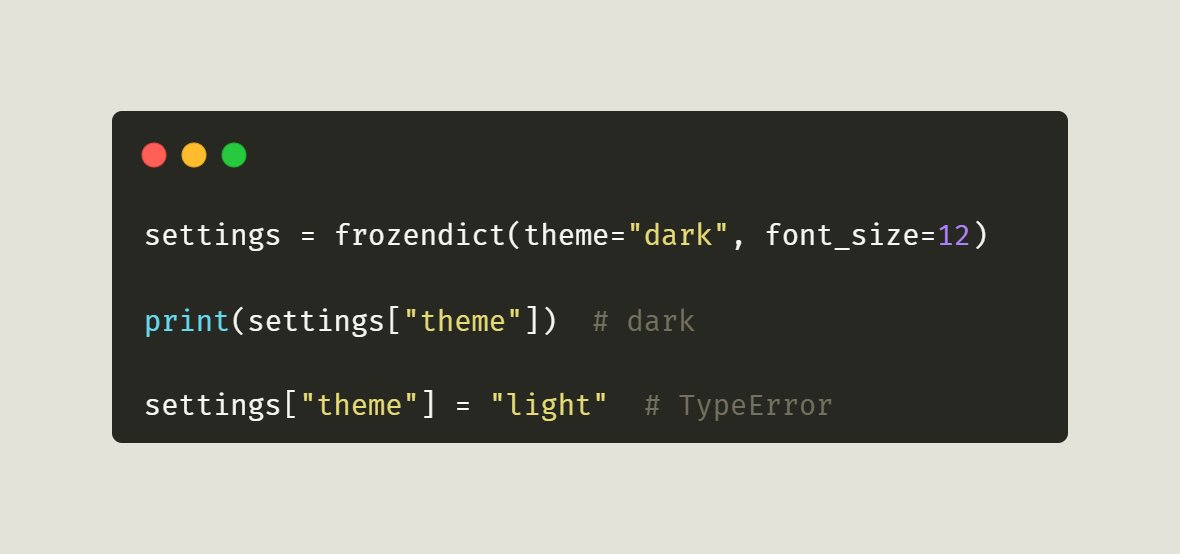
Python 3.15 adds frozendict as a built-in type! 🐍
It works like a dict, but it's immutable. Once you create it, you can't change it. That also makes it hashable, so you can use it as a dict key or put it in a set.
Great for config data you don't want changed by accident.
Will you use it?
Here's a quick example:
Mucho avance esta tendiendo a darle peor calidad al Software, la calidad no solo es el código, la calidad viene en cada proceso, y se está tendiendo a la no revisión, se está forzando el crear Software lo más rápido posible, dejando de lado el tener un sentido para hacerlo.
One of our most surreal experiences in testing Gemini 4 was when it directly addressed us within its chain-of-thought
Literally saying "hello evaluators reading my chain-of-thought"
With AI, it’s tempting to create big tickets because AI can handle big tasks, and it generates code so quickly.
But the benefits of small, focused tickets remain relevant in the AI era.
- Get feedback quicker.
- Avoids context bloat / compacting.
- Less chance of spending a bunch of time going in the wrong direction.
- Leads to small PRs, which are easier to review.
- I’m more likely to understand a small ticket, and to notice gaps, inconsistencies, and logical issues in the requirements.
- Small tickets lead to smaller releases, which reduces risk.
"Some programmers have aesthetic preferences about code and they need to get over it because aesthetics don't matter."
Yes, sometimes they don't matter. But aesthetic judgements are also fast. If they're calibrated to match useful properties of code, that's useful.
stop making ai agents memorize your entire codebase.
people thought that throwing more markdowns file into the codebase and calling it SDD whatsoever will help. or installing some shitty memory plugins will.
trust me, I've been there...
every markdown you add is another potential source of stale truth.
want an agent-friendly codebase?
- shallow, feature-based modules
descriptive filenames
- comments explaining why, not what
- tests as executable specifications
- explicit, enforceable boundaries
- code search before vector search
your agent doesn’t need a better memory.
it needs a codebase that’s easier to understand, navigate, and verify.
sometimes the best context engineering is just good software engineering.
what a plot twist 😁
Esto no es algo nuevo, al negocio siempre le ha interesado tener nuevas funcionalidades, no si la arquitectura escala o si es clean code.
Lo único que logró la AI fue darnos la capacidad de subir código espagueti y acumular deuda técnica a velocidad x100