Gas molecules are always moving, but not all at the same speed.
The Maxwell–Boltzmann distribution shows how those speeds are spread out.
Heat the gas ��� more molecules move faster, and the speed range becomes broader.
Cool it → speeds cluster more tightly at lower values.
Temperature changes the whole distribution, not every molecule in the same way.
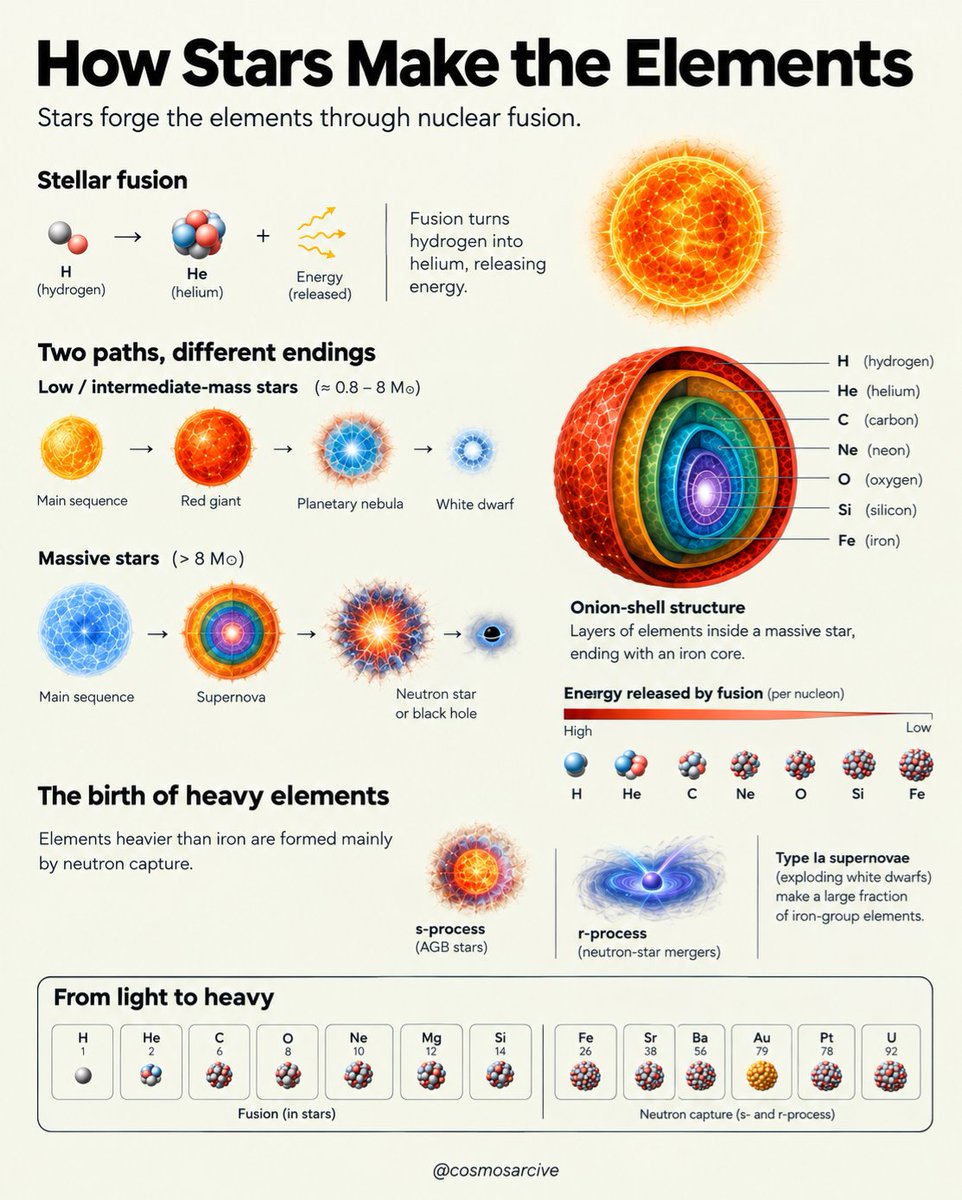
Stars are element factories, but fusion has a limit.
Hydrogen becomes helium, then carbon, oxygen, neon and silicon in increasingly massive stars. Fusion can build nuclei up to iron, where further fusion no longer releases energy. Heavier elements such as gold and uranium need neutron capture instead, through processes such as the s process and r process.
The iron in your blood and the heavier elements around us were made through these different cosmic processes. The periodic table is, in many ways, a record of stellar history.
A laser begins with a random photon. One excited atom emits it spontaneously, and that photon can trigger another excited atom to emit an identical photon. But first, the laser needs population inversion: more atoms in the excited state than the lower state.
The photons then bounce between the mirrors, multiplying through stimulated emission. The energy of each emitted photon is set by
E₂ − E₁ = hν
A small fraction escapes through the partially reflecting mirror as the laser beam. The key idea: a laser does not simply produce bright light; it turns atomic energy into highly organized light.
The periodic table is really a map of repeating chemical behavior.
A 3D spiral offers another way to see that pattern. Instead of ending each period in a flat row, the elements continue outward in successive layers, bringing elements with recurring properties into a continuous structure.
Mendeleev’s key insight was periodicity: arrange the elements by atomic weight, and their properties begin to repeat. The modern table refined that idea around atomic number.
The important part is not the shape of the table. It is the repeating pattern hidden within the elements.
Özel Ders Parası Ödemeden Her Dersi Öğreten 50 Ücretsiz Kaynak
1.) https://t.co/dv9sXgBvLp → BBC'nin ücretsiz ders özetleri
2.) https://t.co/CDQ550zEuG → Waterloo'nun yarışma soru arşivi
3.) https://t.co/ST7f6J52SH → Uluslararası olimpiyat soruları
4.) https://t.co/3UAtLIIPt7 → İngiltere matematik yarışma arşivi
5.) https://t.co/I551pfxfpf → Üniversite matematik destek kaynakları
6.) https://t.co/1TV9GAL0NJ → Matematik kavram ansiklopedisi
7.) https://t.co/q7XUvfCdrR → Fen ve matematik video dersleri
8.) https://t.co/uRbIOTWDX6 → Fen konularının video anlatımı
9.) https://t.co/w5Q8P02btS → Temel bilgisayar ve yazma dersleri
10.) https://t.co/UG1IIDHlEf → Ücretsiz lise ders kitapları
11.) https://t.co/qsb2fjTVKh → Cebiri adım adım öğrenme
12.) https://t.co/YunINRQI5m → Etkileşimli matematik kitabı
13.) https://t.co/4UyPNsG7Ol → Günlük matematik alıştırması
14.) https://t.co/c1oM8NjS2n → Konu bazlı soru bankası
15.) https://t.co/JqCz9Jbchi → Ücretsiz matematik platformu
16.) https://t.co/hRZCYDnHIL → Video çözümlü matematik
17.) https://t.co/pnM5duRW3a → Konu özetleri ve soru arşivi
18.) https://t.co/8Mw6tM8Kym → Olimpiyat matematik topluluğu
19.) https://t.co/W5KjWTEg9U → Takıldığın soruya uzman cevabı
20.) https://t.co/Z3J5lrq3f2 → Adım adım çözüm gösterimi
21.) https://t.co/Yu1A6WXEjA → Matematik video dersleri
22.) https://t.co/uKFTFBKdTL → Kimyanın açık anlatımı
23.) https://t.co/i4blxxDBpH → Sanal kimya laboratuvarı
24.) https://t.co/G70VRbmtDI → Etkileşimli periyodik tablo
25.) https://t.co/gHB3O9GeLT → Fizik konu anlatımı
26.) https://t.co/hGji9BF6MN → Fizik simülasyonları
27.) https://t.co/vOvOrDhz4m → Biyoloji video dersleri
28.) https://t.co/kxx1LVETOc → Biyoloji çalışma kağıtları
29.) https://t.co/Joks63pCnA → Genetiğin baştan sona anlatımı
30.) https://t.co/iLQUcEM4Mg → Dünya tarihi ansiklopedisi
31.) https://t.co/5FCk8aYVQw → Harita ezberleme oyunu
32.) https://t.co/fqPeJ0HBn3 → Ülke ve coğrafya bilgileri
33.) https://t.co/a4Zx6d6gMC → İngilizce dilbilgisi anlatımı
34.) https://t.co/3hHmzB67Vt → Zaman ve yapı alıştırmaları
35.) https://t.co/IcSqv2dTgE → Dilbilgisi ve kelime arşivi
36.) https://t.co/gfYDmhxOfT → Hazır kavram ve kelime kartları
37.) https://t.co/bM7Liwd5al → Aralıklı tekrarla kalıcı ezber
38.) https://t.co/gEwx0HEhUo → Yapay zekalı tekrar platformu
39.) https://t.co/GLSb20CyVl → Konu özet notları
40.) https://t.co/aYM2snU3js → Lise dersleri video arşivi
41.) https://t.co/8kQ1fczCm1 → Açık kaynak ders kitapları
42.) https://t.co/NcJkHlpHMu → Bilimsel çalışma teknikleri
43.) https://t.co/ZzOmlCzLfl → Hatırlama yöntemi rehberi
44.) https://t.co/5WS3NgEVPV → Odaklanma zamanlayıcısı
45.) https://t.co/aykw3gpwex → Sanal birlikte çalışma odası
46.) https://t.co/yJLsnonzci → Zihin haritası çıkarma
47.) https://t.co/HWgEWePpAt → Konu şeması çizme
48.) https://t.co/hf6t3Nc7Jh → SAT resmi deneme sınavları
49.) https://t.co/ybMVRJS7V3 → TOEFL ve GRE örnek soruları
50.) https://t.co/mFrYbYiyUy → IELTS örnek sınavları
Özel ders pahalı. En iyi kaynaklar ücretsiz. Sadece kimse söylemiyor.
Kaydedin, lazım olur.
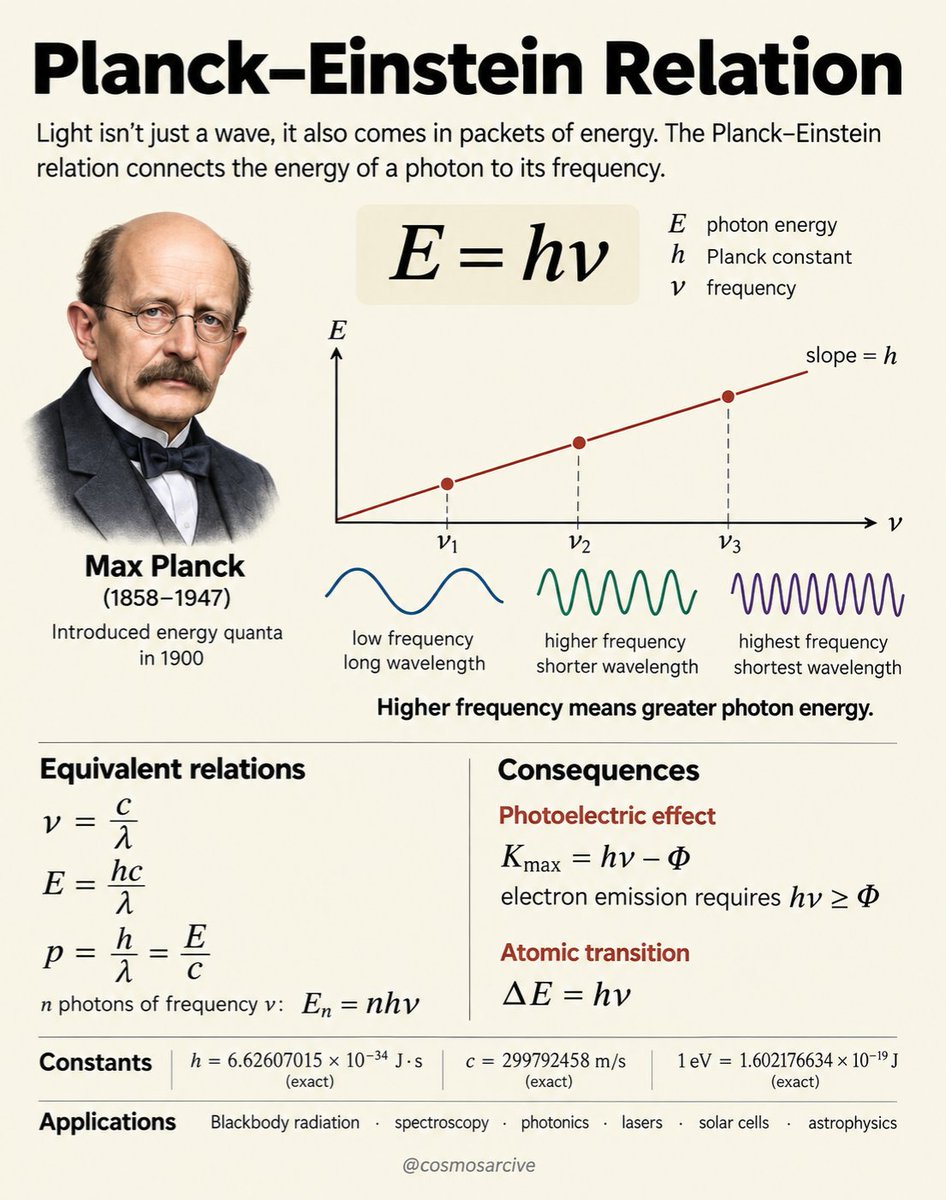
Light carries energy in discrete packets called photons, and their energy is set by frequency.
In 1900, Max Planck introduced the quantum idea that led to
E = hν
Einstein later used it to explain the photoelectric effect. A higher frequency means each photon carries more energy. That simple relation is at the heart of quantum physics.
Magnetic behavior starts with electrons. If an atom has unpaired electrons, their magnetic moments can produce a net magnetic response. If the electrons are paired, their magnetic moments largely cancel.
Paramagnetic: Unpaired electrons → weakly attracted to a magnetic field. Examples: Al, Pt and U.
Diamagnetic: Paired electrons → weakly repelled by a magnetic field. Examples: Cu, Ag, Au, Hg and graphite.
The important detail: every material has a diamagnetic contribution. The observed behavior depends on which magnetic effect is stronger.
PHYSICS ALL IN ONE:
A little bit of everything, from projectile motion and optics to electricity and radioactivity. So many different things to understand, all under one subject.
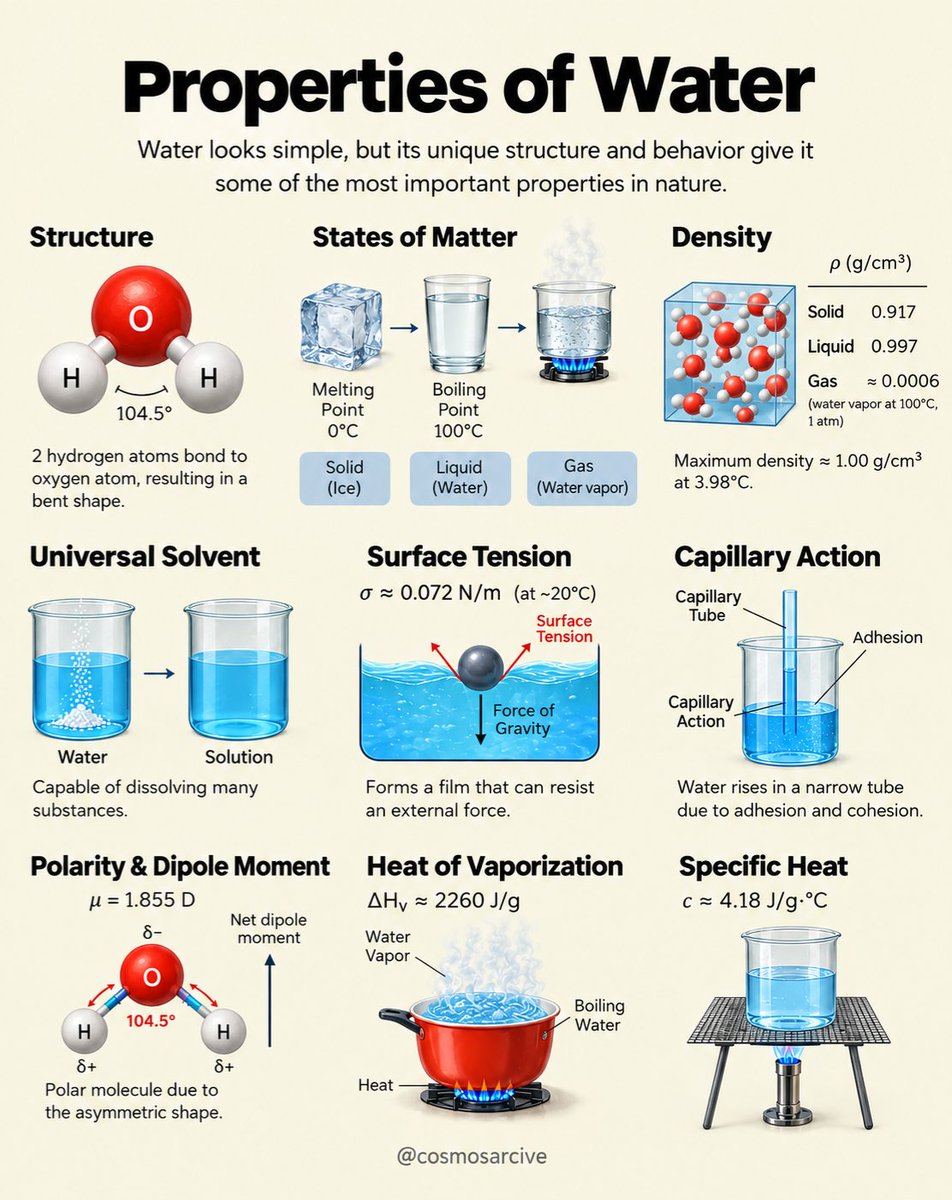
Water is far stranger than it looks. Its bent H₂O structure creates polarity, hydrogen bonding, and an unusually high specific heat of 4.18 J/g·°C. Even ice is less dense than liquid water, which is why it floats.
Water has a strange exception built into its phase diagram: increasing pressure can actually lower its melting point.
That happens because ice is less dense than liquid water, so pressure favors the denser liquid phase. The result is a solid liquid boundary with a negative slope, unlike most substances.
The other key landmarks are the triple point at 0.01 °C and 611 Pa, and the critical point at about 374 °C and 22.1 MPa.
Water’s phase diagram is a reminder that even familiar substances can behave in surprisingly nonintuitive ways.
(a + b)² = a² + 2ab + b² is first a fact about tiling.
A square whose side is the sum of two segments splits cleanly into a square of the first, a square of the second, and two rectangles that share those lengths.
The identical dissection with a minus sign produces the twin identity (a − b)² = a² − 2ab + b².
Both rest on the same principle that later rearranges the region a² − b² into the single rectangle (a + b)(a − b).
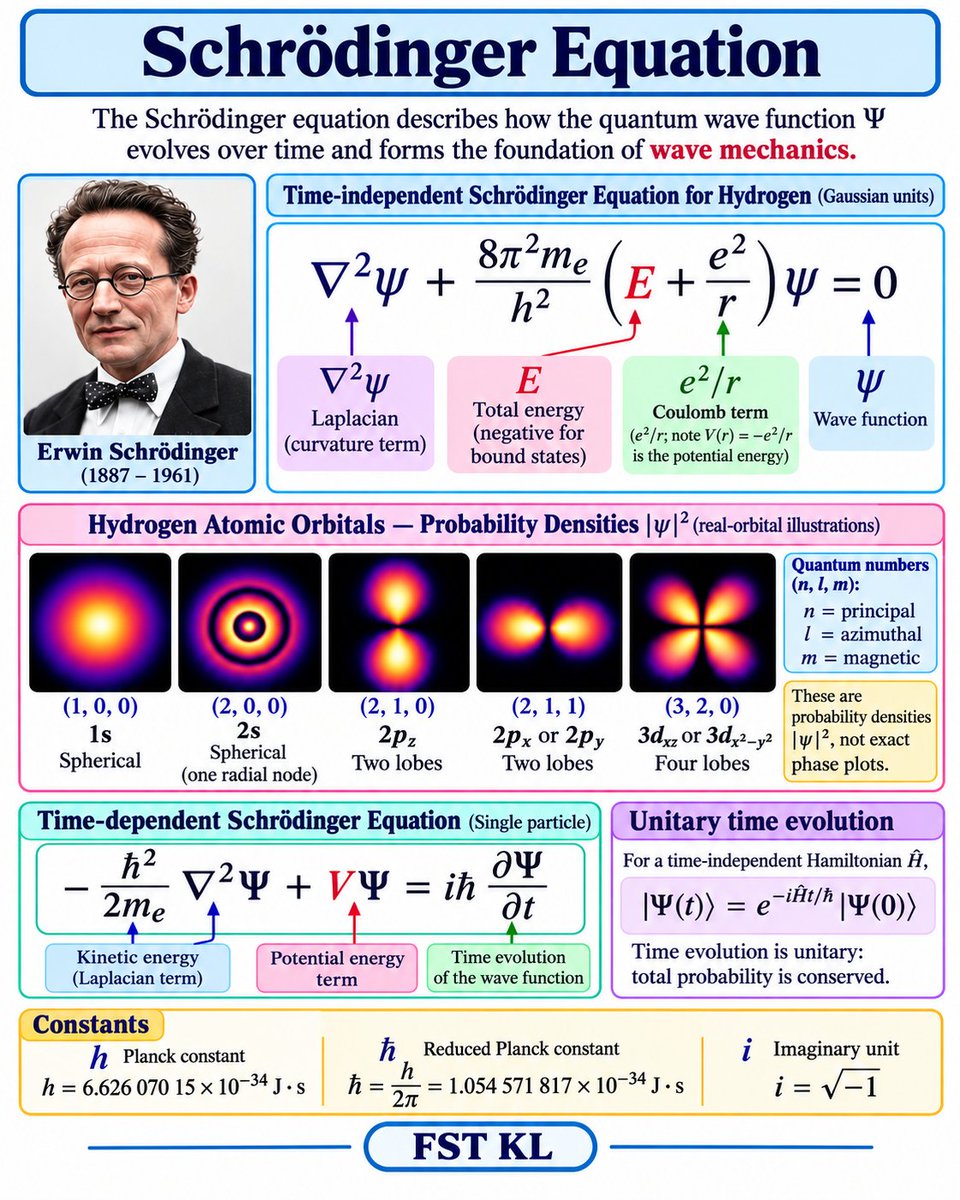
Hydrogen’s spectrum is not a continuum. Electrons occupy fixed levels
Eₙ = −13.6 eV / n².
Jumps between them emit light only at wavelengths given by
1/λ = R_H (1/n_f² − 1/n_i²)
R_H = 1.097 × 10⁷ m⁻¹
producing the precise Lyman, Balmer, Paschen… series.
This single integer pattern founded quantum mechanics and lets astronomers read the composition of stars light-years away.
The word “radiation” covers some very different physical phenomena.
An alpha particle is essentially a helium nucleus. Beta radiation consists of electrons or positrons. Gamma rays and X-rays are electromagnetic radiation, while neutrons are uncharged particles. That difference in what they actually are determines how they interact with matter, how far they travel, and what kind of shielding works best.
What we call radio, visible light, X-rays and gamma rays are all part of the same electromagnetic phenomenon.
The visible range is just a tiny window our eyes happen to detect.