Had a conversation with someone at my company who was a senior tech leader at @SpaceX . Has worked closely with Elon, a real smart guy. When I brought up $ASTS he had never heard of it. His response was basically - @SpaceX will have more satellites and they'll figure it out. That reaction is exactly the problem. And I think a lot of people watching the roadshow this week have the same confusion. So let me break it down again for anyone interested in $SPCX
@Starlink and $ASTS are not in the same business.
Starlink is a broadband internet service. Dish on your roof. $120/month. Competes with Comcast and fiber. 10,400 satellites in orbit. V3 coming with 1 Tbps per satellite - monster specs. This is what the IPO is really about and SpaceX is crushing it here. No debate.
Starlink Mobile is their D2D add-on. 650 satellites. Currently texting and basic data on T-Mobile's band. 3-7 Mbps outdoors. Their V2 D2D satellites promising 150 Mbps haven't launched yet. Their owned 65 MHz mid-band spectrum - current phones don't support it. Commercial launch mid-2027 at the earliest.
$ASTS is carrier broadband from space. 98.9 Mbps already proven. Operates on carrier low-band 700/800 MHz - the same frequencies your phone already uses. Works indoors. No new hardware. No new phone needed. All 3 US carriers formed a JV around it.
The part my ex-SpaceX colleague didn't understand - and I think most people watching the roadshow won't either is that more satellites don't solve the spectrum problem. SpaceX has zero low-band spectrum. None. No path to get it. Low-band is what goes through walls, buildings, and cars. That's physics. You don't iterate your way around physics no matter how many satellites you launch.
SpaceX will dominate broadband internet from space. That market is theirs. The carrier D2D market - where your existing phone connects to a satellite through your existing carrier on your existing plan - that's where $ASTS leads. And the carriers themselves are telling you this by forming a JV and investing equity.
Two different products. Two different markets. Both can win. But only one is a $40B company in a market SpaceX themselves sized at $740B.
$ASTS 🛰️
The Blue Origin explosion scared people off $ASTS.
The two biggest catalysts in this company's history are now both right around the corner and barely anyone is talking about it.
Catalyst one. The first ever batch launch.
BlueBirds 8, 9, and 10 going up together on a SpaceX Falcon 9 in mid-June. And the satellites are already there. BlueBirds 8 and 10 have arrived at Cape Canaveral. BlueBird 9 is en route from Texas. This is not a promise. The hardware is on the ground waiting for the pad.
Why this is the biggest launch catalyst in the story. Up to now the constellation went up one satellite at a time. A batch changes the entire trajectory. Three at once, then monthly launches behind it.
BlueBirds 11 through 33 already in advanced production with phased arrays done through 28. Manufacturing running at up to six satellites per month.
That is the path from 6 satellites today toward 45 to 60 by year end. And the multi provider strategy means SpaceX carries this batch regardless of the Blue Origin setback.
Catalyst two. The SpaceX IPO.
SpaceX filed its IPO prospectus on May 20 and is heading toward a listing at a $1.75 trillion target valuation. That single event reprices the entire space sector.
Every analyst and every retail investor is about to pour into space stocks for the first time. And $ASTS is the highest quality pure play space connectivity name on the public market.
When the SpaceX IPO dominates every headline the money that cannot get allocated shares looks for the next best thing. That trail leads directly here.
Two catalysts. Both within weeks. A batch launch that proves the constellation can scale and an IPO that floods the entire sector with capital and attention.
While everyone fixates on the rocket that exploded, the two events that actually move $ASTS are both right around the corner.
$ASTS AST SPACEMOBILE AUTHORISED FOR 10X10 USAGE IN BRAZIL
Scott Wisniewski confirmed to William Blair that they were authorised for 10x10 spectrum usage in Brazil.
$ASTS --- The U.S. Federal Communications Commission (FCC) has formally granted AST SpaceMobile a commercial operating license, clearing the firm to roll out direct-to-device (D2D) cellular broadband service across the U.S. that connects regular smartphones straight to its satellites. This ruling removes the biggest regulatory roadblock standing in the way of full commercialization.
The company maintains deep strategic partnerships with U.S. telecom heavyweights AT&T and Verizon, and inked a collaboration deal with Canada’s industry leader TELUS back in March this year. Its global roster of partnered mobile network operators (MNOs) now unlocks access to billions of prospective end users, with management guiding full-year 2026 revenue between $150 million and $200 million, driven primarily by U.S. government contracts and monetization from finalized commercial trials.
1. Disruptive Core Technology: True Direct-to-Cell Connectivity
Unlike SpaceX’s Starlink, which mandates proprietary ground dish receivers for signal access, ASTS’s proprietary technology turns orbiting satellites into floating cell towers in space. End users require no upgraded 5G handsets or supplementary external hardware to tap into satellite-powered broadband, even in dead-zone locales including remote deserts, open oceans and rugged mountain terrain. The solution seamlessly fills critical coverage gaps plaguing conventional terrestrial cellular networks.
2. One-of-a-Kind B2B2C Business Model
ASTS bypasses direct-to-consumer subscription sales entirely, instead partnering with established carrier operators such as AT&T and Vodafone. These telecom providers package AST’s satellite coverage as a seamless add-on premium service for their existing billions of subscribers and split resulting revenue with ASTS. This framework keeps customer acquisition costs (CAC) at a bare minimum; once the full satellite constellation reaches operational completion, marginal production costs trend near zero, paving the path for robust gross profit margins.
3. First-Mover Moat via Space Infrastructure Timing Barriers
Orbital spectrum allotments and viable orbital slots are finite global resources, paired with extreme engineering hurdles surrounding the production of its oversized deployable antenna arrays. ASTS has successfully completed voice and high-speed broadband validation testing with its BW3 prototype satellite and secured groundbreaking FCC commercial approval ahead of competitors. In this capital-intensive deep tech vertical that demands billions in funding and multi-year development cycles, the firm boasts an insurmountable early-entry competitive edge.
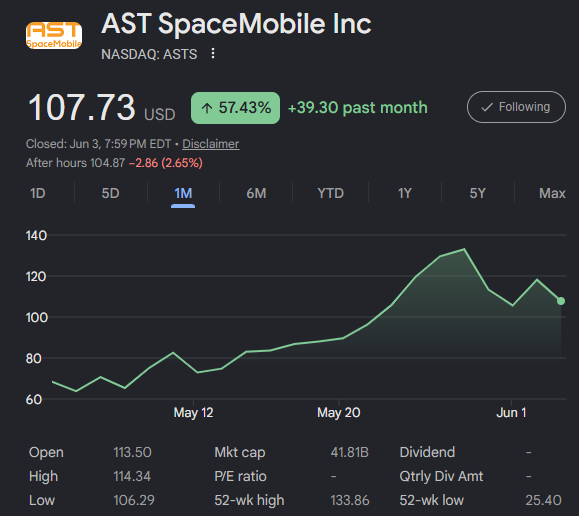
@blueorigin 's New Glenn just exploded during a static fire at LC-36. $ASTS is down 6% after hours. Before you do anything, read this.
No $ASTS satellite was on this rocket. This was a test firing with no payload.
BB8, BB9, BB10 are launching mid-June on a @SpaceX Falcon 9. Different rocket. Different pad. Completely unaffected. The most important near-term catalyst hasn't changed.
The 45-satellite target for 2026 does not depend on New Glenn. ASTS can hit it on Falcon 9 alone.
What IS a legitimate concern: $ASTS wanted multiple launch providers to avoid depending on @SpaceX - who is also their competitor. New Glenn being grounded again means more reliance on @SpaceX for future launches. That's not ideal but it's manageable. ULA Vulcan and ISRO remain alternatives.
What IS NOT a concern: the next launch, the constellation timeline, or the fundamental thesis. Nothing about tonight changes the $740B D2D TAM, the carrier JV, the EU sovereignty decision, or the SpaceX S-1 repricing.
Algo and some retail will see "Blue Origin explosion" and panic-sell $ASTS because of the BB7 association. That's emotion, not analysis.
The thesis hasn't changed. The June launch hasn't changed. Breathe.
$ASTS 🛰️