Our brain isn’t just made of neurons. It runs on a whole neighborhood of cells that can either protect your mind or quietly push it toward inflammation.
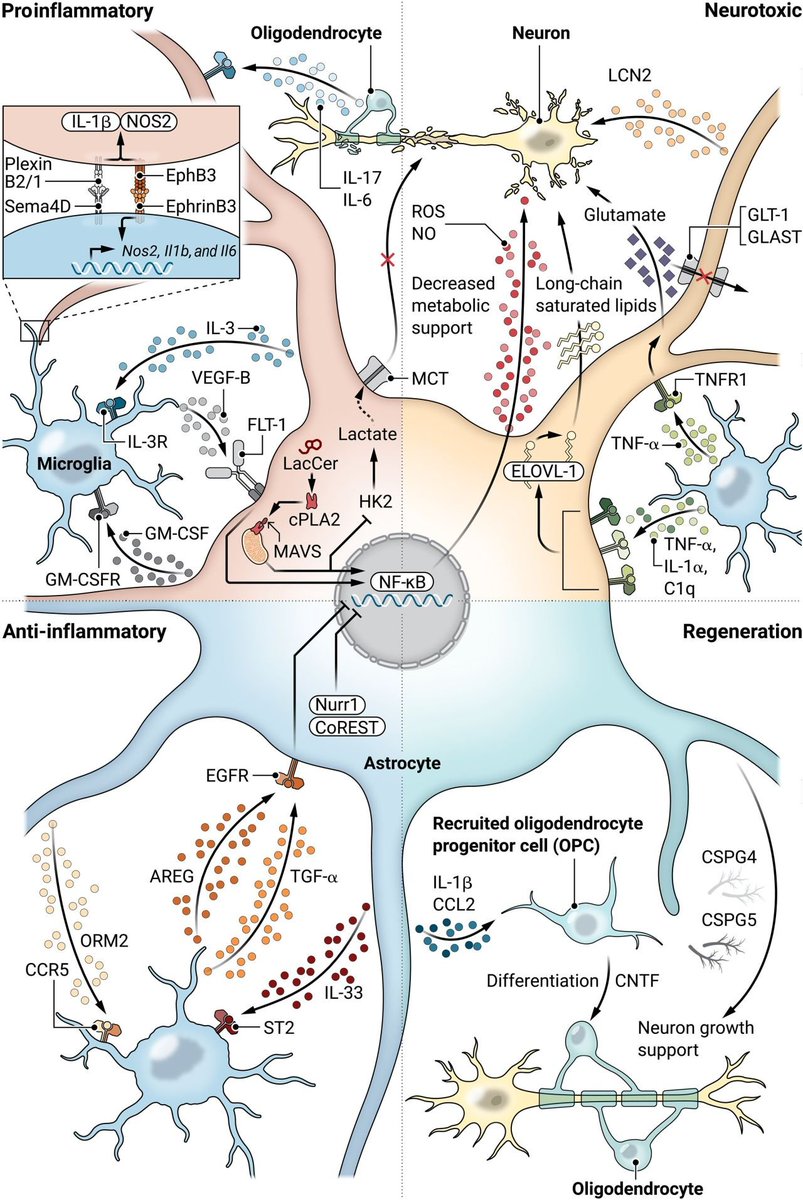
This diagram reveals how astrocytes, microglia, neurons and oligodendrocytes talk to each other during stress, illness, and injury. Their conversations shape memory, mood, cognition, and long-term brain resilience.
Here is what this graphic shows in plain language:
🧠 Astrocytes act as the central switchboard
They decide whether the brain environment becomes supportive or inflammatory. When they sense danger signals, they activate NF kappa B and release molecules that influence the other cells around them. When conditions are safe, they release factors that help neurons grow and help new oligodendrocytes mature.
🔥 Microglia can protect or damage depending on the signals they receive
They can release IL 1 beta, GM CSF, and other proinflammatory signals, or they can shift to a more supportive state depending on what they detect from astrocytes and neurons.
⚡ Neurons suffer when inflammation rises
Oxidative stress, nitric oxide, and loss of metabolic support weaken them. Glutamate handling becomes impaired, which increases excitotoxic stress.
🧩 Oligodendrocytes and their precursor cells respond to what the environment tells them
Inflammatory signals slow their support for neurons, while regenerative signals encourage new myelin formation and better neuron stability.
The health of your brain depends on how these cells interact, not just on neurons alone.
doi: 10.1126/scitranslmed.adi7828
❌Sin ciencia, no hay futuro
"Tenemos un PIB mínimo dedicado a la ciencia"
"Queremos conseguir trabajos estables"
Ya no es que se reconozca a los científicos, es que con precariedad e inseguridad laboral se pueden ver obligados a abandonar los proyectos o irse a otros países
Pues nada, otra vez a cambiar los libros de texto! Nuevo orgánulo descubierto en algas marinas: el nitroplasto, que fija nitrógeno en estos organismos ayudado por el ATP que producen las mitocondrias, gracias al consumo de los azúcares generados en los cloroplastos.
Excited to announce that our paper on activity- and potassium-mediated metabolic coupling between oligodendrocytes and axons is now published @NatureNeuro congrats to Zoe Looser, @zainabfaik, the whole team and co-authors for this achievement!
https://t.co/qVVa2ZI4yW
Yesterday, @estersanchezmar and I were part of the #ScienceWeek2023, explaining our research lines. It was exciting to bring neuroscience closer to all types of audience and have the opportunity to show the role of women in this field! #ZientziaAstea
First Mato/Marsicano joint lab retreat about to end! Spent almost a whole week sharing exciting science in the beautiful Basque country 🏞️ @SusanaMato13
It was a great pleasure to attend and take part in the first Severo Ochoa Conference. Learning and sharing glial/neuronal metabolic works! #ISOConference@SEBBM_es
Hoy hace 33 años que se obtuvo la que, probablemente, es la imagen más icónica de la historia de la astronomía. The Pale Blue Dot—el punto azul palido—como la bautizó Carl Sagan, el impulsor de que se hiciera. La obtuvo la sonda Voyager 1 el 14/2/1990
📸NASA/JPL-Caltech.