✍️ Signing up to our newsletter is the best way to stay in-the-loop with the latest ETC Group news.
Join our subscribers fighting for food sovereignty, peasant agriculture, climate justice, digital justice, and human rights.
Subscribe here 👇
https://t.co/9ACvjZNyfp
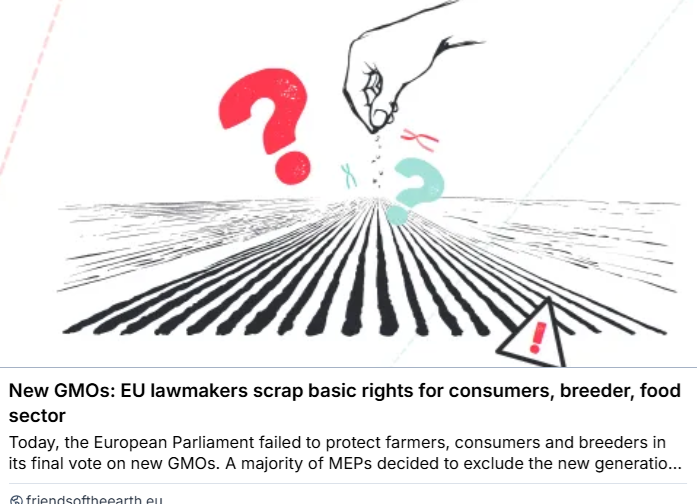
📢BREAKING NEWS: the European Parliament just scrapped basic rights for consumers, breeders, farmers, the food sector. Here's the full reaction from @foeeurope 👉https://t.co/XpvYKTnPNG
𝗧𝗵𝗲 𝗕𝗮𝘁𝘁𝗹𝗲 𝗳𝗼𝗿 𝗔𝗳𝗿𝗶𝗰𝗮𝗻 𝗔𝗴𝗿𝗶𝗰𝘂𝗹𝘁𝘂𝗿𝗲 𝗣𝗼𝗱𝗰𝗮𝘀𝘁 || 𝗘𝗽𝗶𝘀𝗼𝗱𝗲 𝟮𝟴 - 𝗪𝗶𝘁𝗵 𝗣𝗮𝘁 𝗠𝗼𝗼𝗻𝗲𝘆 - 𝗣����𝗿𝘁 𝟯
In this episode of The Battle for African Agriculture, the third part of a three part series, Dr. Million Belay speaks with Pat Mooney about what the current geopolitical rupture means for food sovereignty movements and how civil society can respond. Returning to the Long Food Movement report, Pat argues that while the world is in an extremely hazardous moment, marked by chaos in world trade and deep instability in the UN system, it is still too soon to draw final conclusions. For him, the key task is not despair but agility: to remain flexible, read shifting conditions carefully, and recognize that moments of crisis also create openings for territorial food systems, stronger local resilience, and new possibilities for institutional reform.
The conversation then turns to agroecology, which Pat describes as absolutely central, both as science and as movement. He argues that the case for agroecology is easier to make today because governments and communities are increasingly experiencing the fragility of long supply chains and the failures of corporate controlled systems. At the same time, he insists that agroecology must deepen its innovation, build stronger links across regions, and refuse the illusion that digital giants or transnational corporations can solve food crises on behalf of farmers. He warns that companies with enormous market value, greater even than the GDP of entire continents, will never see Africa as central except as a secondary market, and he stresses that food systems cannot be safely entrusted to supply chains so vulnerable to geopolitical shocks such as fertilizer dependence and disruptions in strategic trade routes.
Pat Mooney also places strong emphasis on movement strategy. He argues that food sovereignty cannot advance in isolation and must build deeper relationships with health, labor, human rights, climate, and biodiversity movements, while also paying much closer attention to the governance of multilateral institutions.
The conversation closes on a message to young activists: do not mistake a lost battle for a lost war, do not panic over tipping points as if all space for action has vanished, and do not stop scanning the horizon, not only forward, but sideways across movements and backward into history, where past defeats have often laid the groundwork for future victories.
Listen to the full conversation 👇
YouTube
https://t.co/fzrPKgQLFi
Spotify
https://t.co/NVfRZJvUif
Apple Podcast
https://t.co/fgQ9ZD0vh0
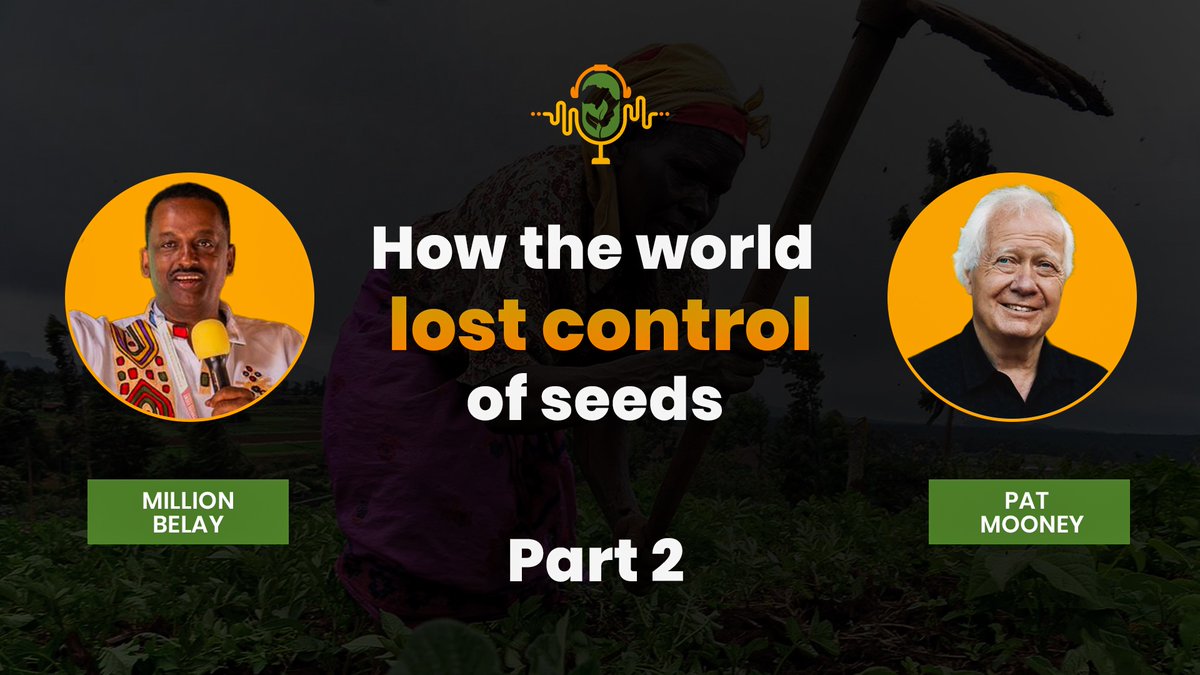
In this episode of The Battle for African Agriculture, the second part of a three part series, Dr. Million Belay speaks with Pat Mooney, member of the IPES-Food, co founder and former director of ETC Group - Action Group on Erosion, Technology and Concentration, IFOAM Ambassador, and chair of the Institute for Agriculture and Trade Policy. Continuing their conversation, Pat reflects on how new technologies are repeatedly introduced as solutions while often creating new forms of dependence. He argues that this is not accidental but part of the economic logic of capitalism, where each new technology is designed not only to replace an older one but also to maintain control over markets and customers. From that perspective, he sees gene editing not as a genuine break from GMOs, but as a logical extension of the same trajectory of manipulating life for commercial control.
The discussion then turns to Africa, where Pat Mooney warns that governments are under pressure to loosen biosafety laws and open the door to technologies presented as modern and necessary. He links this pressure to Africa’s land, climatic diversity, rich genetic resources, and rapidly growing population, all of which make the continent attractive to powerful commercial interests. He also addresses synthetic biology and the growing ability of companies to replace crops such as vanilla, cocoa, coffee, and tea with laboratory produced substitutes, shifting value away from farmers in the South toward industrial production in the North. For Pat, the core issue is not simply the novelty of the technologies themselves, but who controls them, who benefits from them, and who gets to decide whether they are safe, useful, or harmful.
Pat Mooney also offers a wider critic of digital agriculture and the growing role of big tech companies in farming, warning that firms such as Google, Amazon, and Microsoft approach agriculture not as a living system but as another field of data to capture, process, and monetize. At the same time, he insists that digital tools could still be useful if they remain in the hands of farmers and communities, helping them share knowledge, monitor weather, respond to pests, and strengthen agroecological systems. He contrasts this with what he calls “high tech,” controlled from above, and “wide tech,” rooted in the collective intelligence of farmers working within their own ecosystems. The episode closes with a powerful story of resistance, as he recounts the global campaign against Terminator seeds, where farmers, civil society, and social movements came together to defend the moratorium and stop a technology that would have forced farmers to buy seed every season.
Listen to the full conversation:
YouTube:
https://t.co/6KAuolb4HI
Spotify: https://t.co/t4IUSKrJUy
Apple Podcast:
https://t.co/fMiIg08fG2
Science has warned that its methods will instead:
🚨Lead to ocean de-oxygenation,
🚨Impact marine organisms, and
🚨Disturb the ocean’s natural ecosystems.
Our oceans are not a testing ground for profit-driven experiments or carbon-market gambling!
In this video, Prof. Raymond Pierrehumbert discusses his strong opposition to the UK’s ARIA agency funding £45M in #SolarGeoengineering, including outdoor experiments. He & Prof. Michael Mann recently coauthored a Guardian article on the issue (Mar 12).
https://t.co/d9ud2S5M48
We reported on UK funding for outdoor #geoengineering experiments. Now, an investigation by @guardian & Democracy for Sale confirms £50m+ of UK public money going to US firms. The accountability deficit at @ARIA_research is in the spotlight. https://t.co/L4Ekx4LOTs @AishaKDown
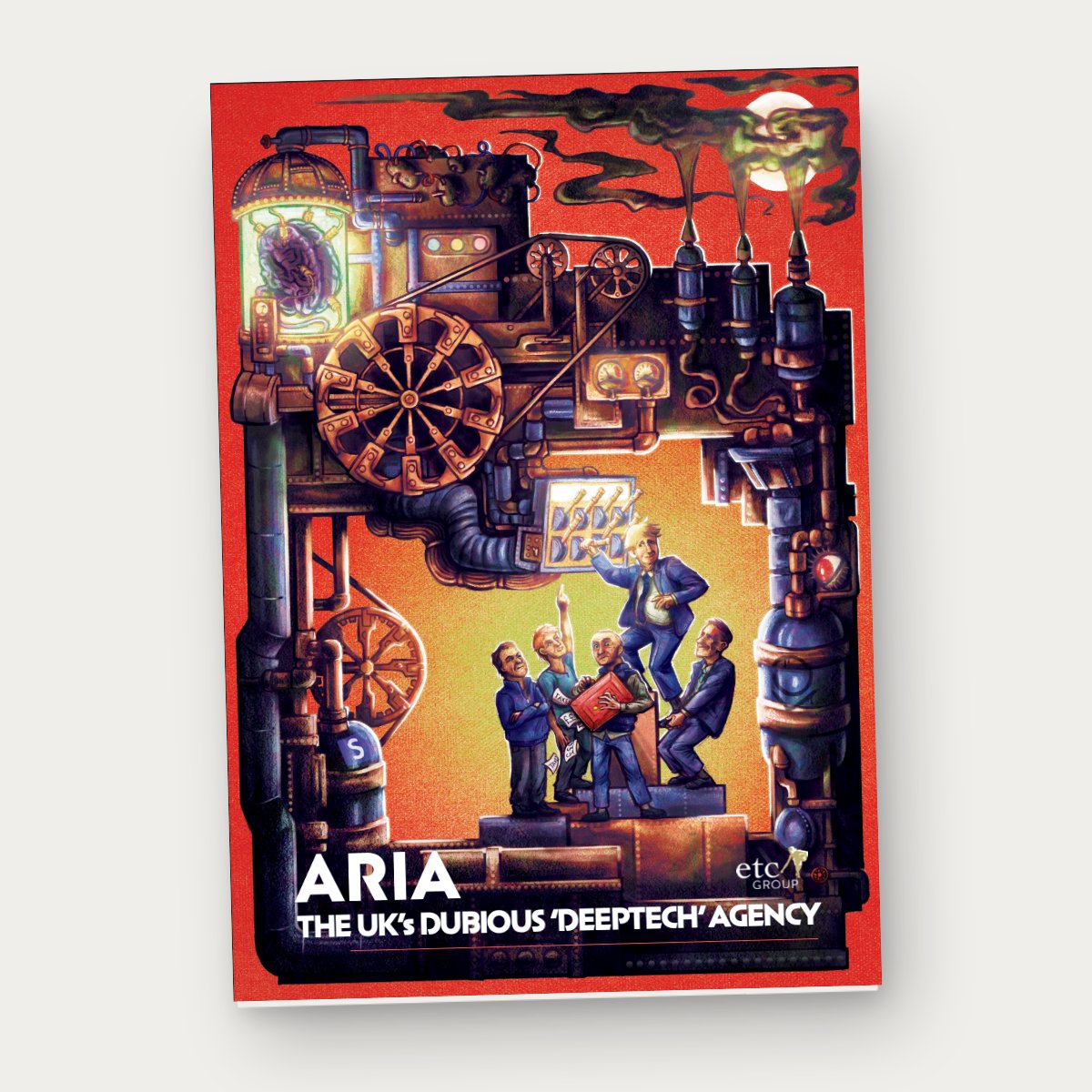
ARIA: the UK "deeptech" agency exempt from the precautionary principle, conflict of interest rules & the UK’s FOI act. Legally protected from being dissolved by the UK Government for 10 years.
Our report:
https://t.co/L4Ekx4LOTs
@ZackPolanski@_BoldPolitics@podsavetheuk
What is ARIA?
We looked into the UK’s £1billion ‘deeptech’ agency, bringing Silicon Valley's ‘move fast and break things’ ethos to some of the highest-risk technologies on Earth.
Read the report: https://t.co/L4Ekx4LOTs
@natalieben@Cat_Early76@HOMEAlliance_@BylineTimes
𝐓𝐡𝐞 𝐁𝐚𝐭𝐭𝐥𝐞 𝐟𝐨𝐫 𝐀𝐟𝐫𝐢𝐜𝐚𝐧 𝐀𝐠𝐫𝐢𝐜𝐮𝐥𝐭𝐮𝐫𝐞 𝐏𝐨𝐝𝐜𝐚𝐬𝐭 || 𝐄𝐩𝐢𝐬𝐨𝐝𝐞 𝟐𝟑 - 𝐖𝐢𝐭𝐡 𝐉𝐞𝐧𝐧𝐢𝐟𝐞𝐫 𝐂𝐥𝐚𝐩𝐩 (𝐏𝐫𝐨𝐟.)
In this episode of The Battle for African Agriculture, Dr. Million Belay speaks with Professor Jennifer Clapp, Canada Research Chair & Professor, School of Environment, Resources and Sustainability at the University of Waterloo and a leading scholar in the political economy of global food systems. She reflects on her intellectual journey, shaped by early exposure to questions of inequality, hunger, and public action, and explains how her work has focused on understanding the structures that shape food systems, from corporate concentration to global trade and governance.
Drawing from her book Titans of Industrial Agriculture, Jennifer Clapp explains how a handful of corporations came to dominate seeds, fertilizers, pesticides, and machinery. She highlights how this concentration is not simply the result of innovation, but of historical advantages including access to finance, patent protections, and strong state support. These forces created technological “lock-ins,” where inputs such as machinery, hybrid seeds, fertilizers, and pesticides became interconnected into a single industrial system that is difficult for farmers to exit, reinforcing monocultures and large-scale production while displacing smaller producers.
She further discusses how corporate concentration, financialization, and global trade rules shape agriculture, particularly in the Global South. These dynamics reduce farmers’ choices, increase dependency on external inputs, and expose them to volatile markets, while undermining biodiversity, local knowledge, and food sovereignty. Jennifer Clapp emphasizes that addressing these challenges requires confronting corporate power, strengthening public policy, and supporting alternatives such as agroecology and territorial markets. Despite current geopolitical challenges, she underscores the importance of collective action, inclusive knowledge, and grassroots movements in building more just and sustainable food systems.
Listen to the full conversation on YouTube, Apple Podcasts, Spotify and across all our social media platforms.
Subscribe. Share. Engage.
YouTube
https://t.co/bLPWYqEJHx
Spotify
https://t.co/bkekA6rRxW
Apple Podcast
https://t.co/188M9eECOv
📢 Join us next week for an important webinar where experts breakdown who is bankrolling solar geoengineering research.
🗓️ 26 Mar
🕐 2-3 PM UTC
📍 https://t.co/GKKJkyZvj3
🌐 EN, ES, FR
The industrial food system depends on synthetic fertilizers, fossil fuels, and volatile global supply chains, concentrated into the hands of just a few huge companies.
Every crisis exposes how vulnerable this model really is.
Read our statement: https://t.co/066X4wGrYM