The fact that everyone is so up in arms about property price having fallen 2.0% from their peak but still being 27.9% higher over the past five years and 70.7% higher over the past decade indicates to me something is deeply wrong with us as a society.
The market appears to have completely lost touch with reality and their seems to be an expectation that no matter how unaffordable it gets prices should just continue to rise.
@bowtiedstocks The number of impacted new build apartments quoted here have to be grossly exaggerated? Given that prior to the tax changes approx 80% of investor activity was in existing housing stock
It's very interesting that housing price falls are positioned as being a terrible thing rather than being part of a natural cycle, an opportunity for affordability to improve, an opportunity for new buyers to come into the market.
Furthermore, if you are selling and buying in the same market it can actually be a great opportunity to move. If you are thinking of shifting from a high cost market to a lower cost one it can be a great opportunity too.
Every other asset class has periods of prices rising and prices falling, why should housing be any different?
@bowtiedstocks I tend to lean that way too but just thinking about the other possibilities (and trying to be glass half full RE the future). They have to make a deal with someone in the senate to get it through anyway, it will be interesting who it will be (please god, not the greens)
If dwelling prices fell 10% nationally we'd fall back to a level seen in early 2025, a fall of 20% would be early 2023, Dwelling prices rose 48% since 2020. So what is the big deal?
Unless someone can show me that this near 50% gain brought Australia unmatched prosperity that offsets the societal and economic damage that making household formation so difficult for FHBs why does it matter so much. It would actually be the one thing that unambiguously improves housing affordability. It might also discourage negative gearing and make more space for FHB in the market.
this budget should be applauded for its bold changes to shake us out of housing complacency. hell, we've been crying out for this kind of vision.
but without tweaks, it risks undermining the very foundations of the australian spirit.
trying, failing and winning isn’t just the domain of our athletes. it is a serious story we tell ourselves. it is what our national psyche and shared prosperity are built on.
it is australians with the ambition to have a go, from inventors and engineers to tradies, cafe owners, retailers and panel beaters. small business owners, some of whom grow into very large businesses and underwrite much of our future prosperity through job creation, tax revenue and wage growth.
it’s kids saving for a home, putting their time and money into productive assets — shares, ETFs and employee share ownership plans — to grow the pie for all of us.
as a nation, we need to be mature enough to believe that when some of us win, we all win.
anyway, i wrote an op-ed:
@jason_king72@Potstirrer111@bowtiedstocks Even at current prices there’s a feasibility problem making substantial building unlikely in the short term. However I’d argue it’s long overdue for governments to abandon the notion that price increases are always necessary regardless of the economic and societal consequences.
@jason_king72@TaxPawspective@PeteWargent How do you think this ends up shaking out once their models do? Do you expect much of a decrease in borrowing capacity?
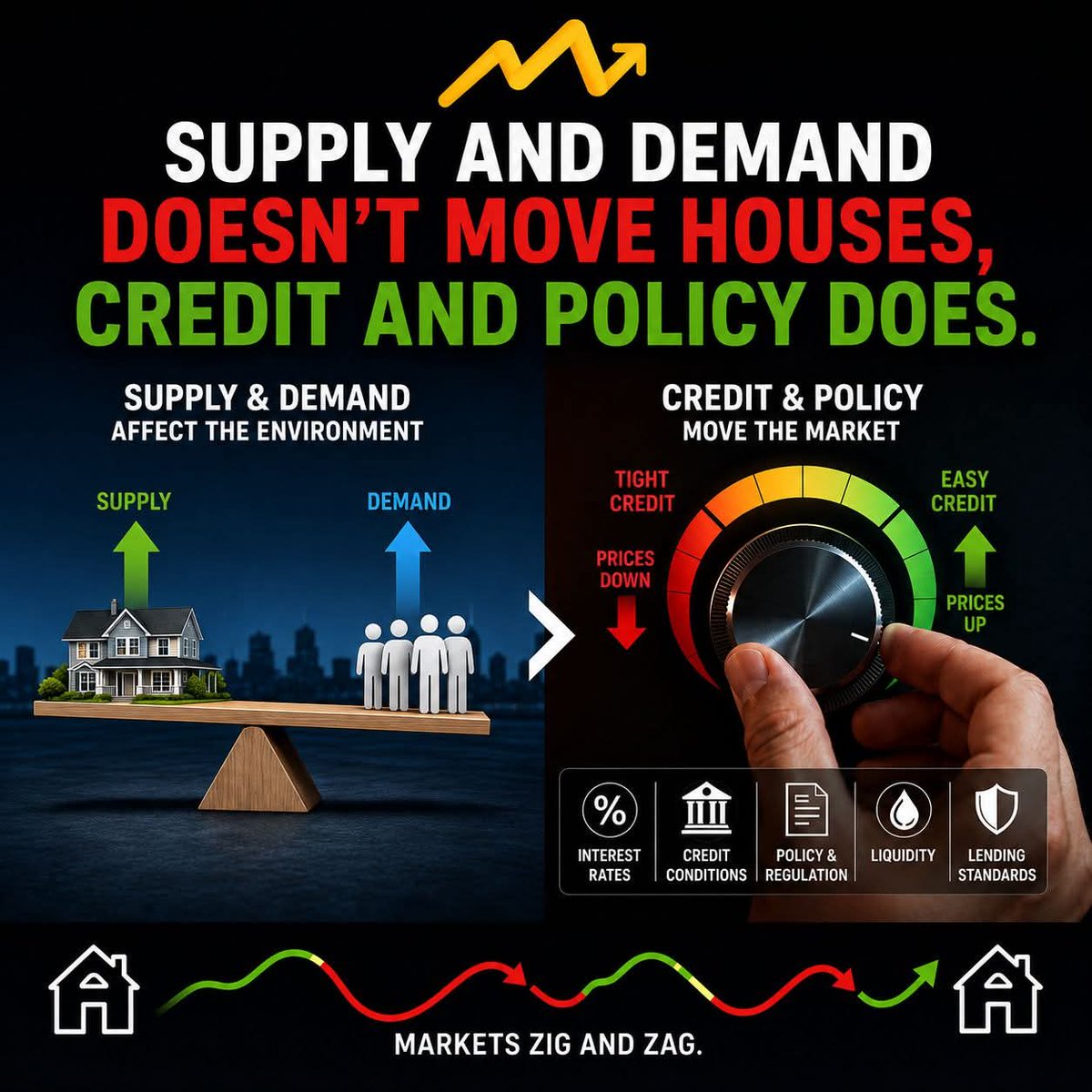
One of the biggest myths in Australia is that housing only moves because of supply and demand.
People repeat the same arguments constantly:
“There aren’t enough houses.” “Immigration is too strong.” “Australian property can never fall.”
But if you actually study market history, you’ll realise something pretty quickly:
Supply and demand explains the long-term trend. Credit and policy drive the cycles within it. And those cycles are what create booms, slowdowns, corrections, and crashes. Housing is a leveraged asset. People aren’t buying homes with cash. They’re buying borrowing capacity.
That’s why markets are priced at the margin.
A small rise in interest rates or tighter lending standards can wipe hundreds of thousands off what buyers can borrow overnight.
Example:
A family qualifies for a $1.5M loan. Rates rise. Banks tighten lending. Policy changes. Now suddenly they only qualify for $1.1M. Nothing changed about immigration. Nothing changed about housing shortages. Nothing changed about Australia being desirable. But the marginal buyer just lost $400k in purchasing power.
That’s how cycles turn.
We’ve seen it repeatedly:
- Australia in 2018 after APRA tightening
- Australia in 2022 during rapid rate hikes
- US housing crash in 2008
- Ireland post-GFC
- Sweden during 2022-23 tightening
- Canada after aggressive hikes
- Japan after the late 80s bubble
- China once credit expansion slowed
The common denominator?
Credit contraction. Liquidity tightening. Policy changes.
Not suddenly “nobody needed houses anymore.”
This is the part most people miss:
Supply and demand itself is affected by these things. Demand is not just “people exist.”
Demand depends on:
- access to credit
- interest rates
- confidence
- liquidity
- lending standards
- employment conditions
- government policy
Those are the micro forces constantly shifting supply and demand underneath the surface.
But the macro forces are what determine whether you get:
- booms
- slowdowns
- corrections
- crashes
That’s why serious macro investors focus heavily on:
- central banks
- credit growth
- liquidity
- debt cycles
- policy shifts
- interest rates
Because every asset market in history moves in cycles. Nothing moves in a straight line forever. Markets zig and zag.Expand and contract.Boom and mean revert.
Property is no different.
It’s not magical. It’s not immune to cycles. And it’s definitely not disconnected from credit. Eventually, that lack of understanding gets people absolutely slaughtered.
@Potstirrer111@ChrisEconomist@E61Institute Would love for someone to point out what incentive there is for anyone under 35 to be more productive, when the choices they're currently being given is a lifetime of renting or a lifetime of debt servitude
Completely ridiculous...the ideal case for who?
The IMO best case overall is high supply, lower migration, low unemployment, price growth matching income growth at a maximum, no high LVR loans but FHB advantaged in the market and start to treat home ownership as something the underpins the economy and society and is not an asset class.
I suspect that FHB would think price falls are better...
@LouiChristopher@PeteWargent What SHOULD happen is state governments going all in on building non-market housing until market conditions and feasibility improve. What they WILL do though is a combination of sitting on their hands and throwing money at the private sector which will make conditions much worse
Abul, a useful piece, but I think the argument rests on some assumptions the data don't yet support.
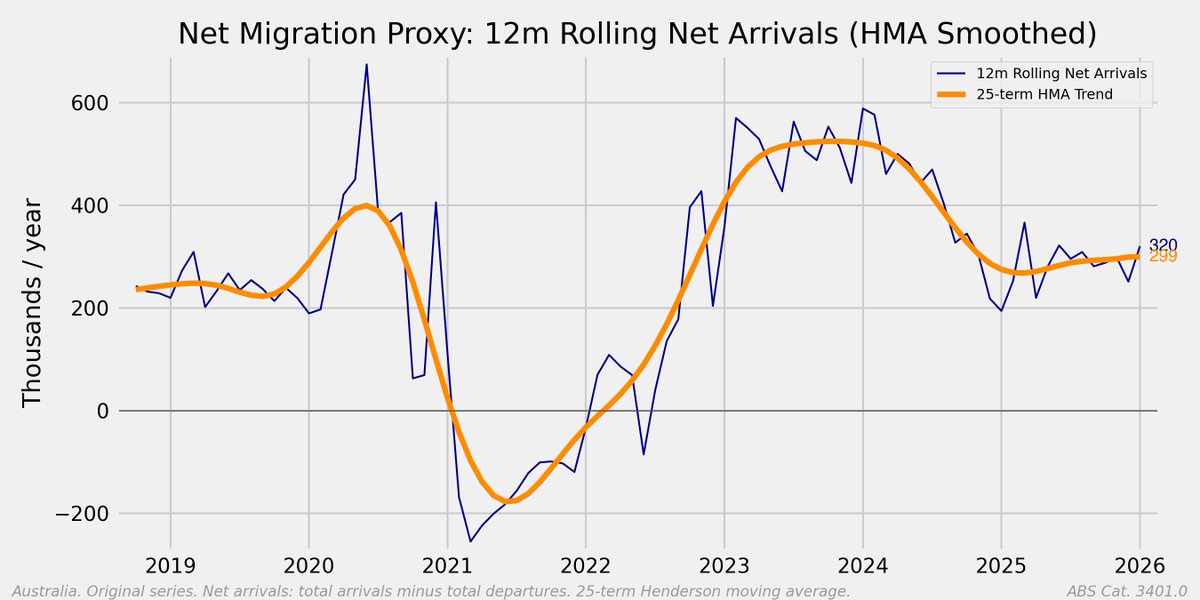
On migration: the net arrivals proxy and implied ERP migration are both still running around 300,000 plus. Migration has fallen from the 2023 peak, but it has plateaued materially above the 260,000 and 225,000 assumptions your later conclusion depends on. The tightening measures announced from late 2025 may not be sufficient to get there, and the track record of announced tightening delivering the intended numbers is mixed at best.
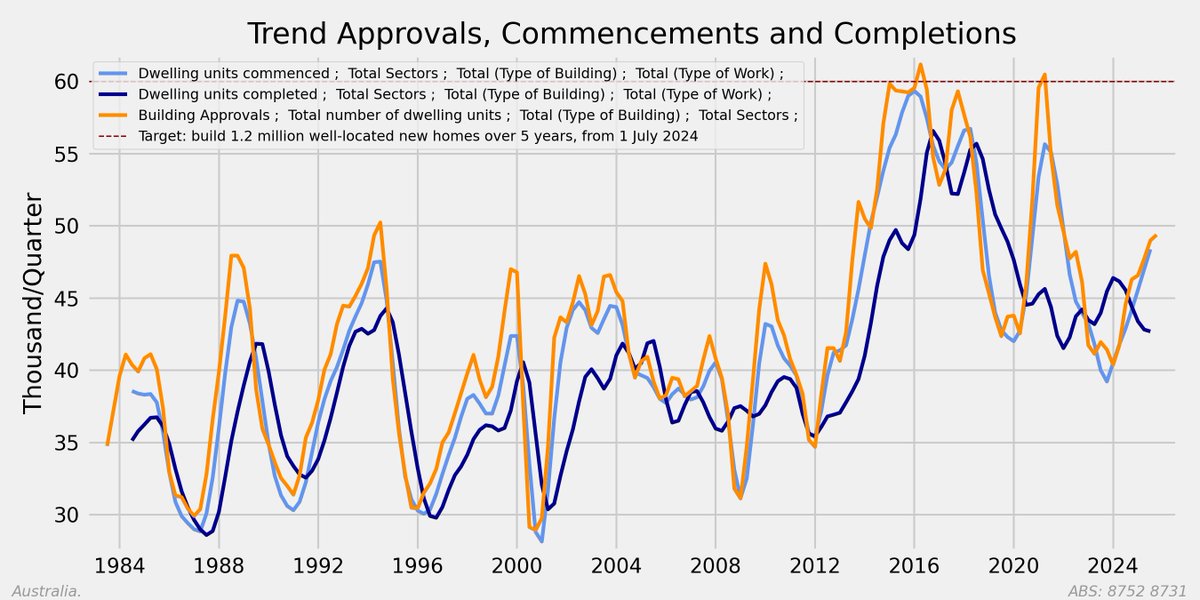
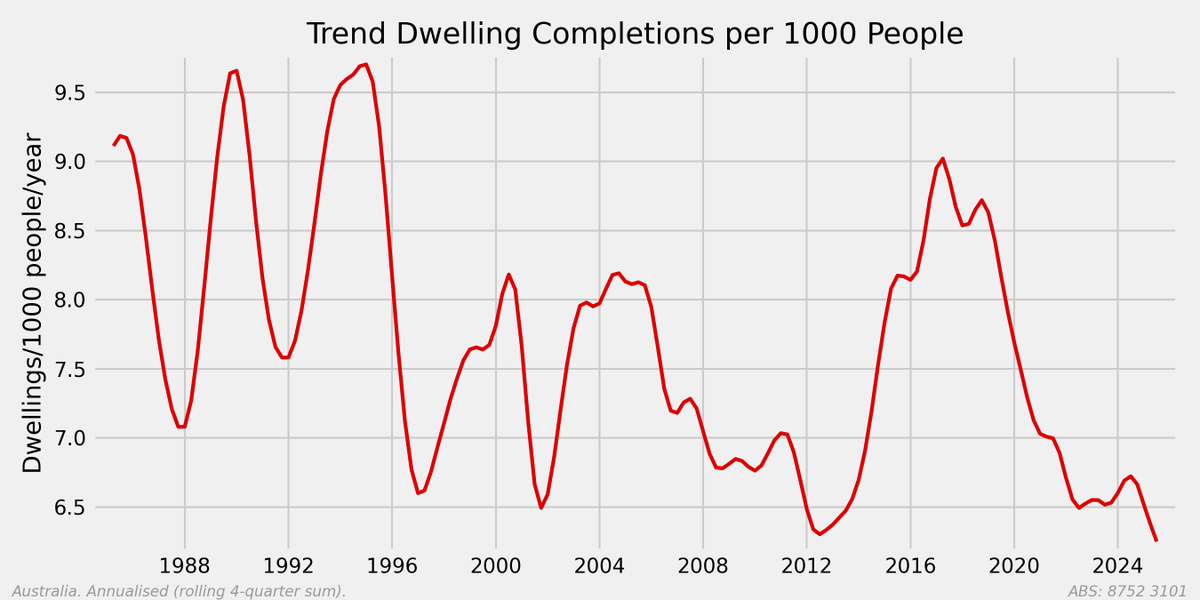
On housing supply: the 1.2 million homes target requires around 60,000 completions per quarter. Current approvals are still below that level, commencements are below that, and completions are well below that, and that is before accounting for pipeline leakage. Not every approval commences, and not every commencement completes. In a period of construction insolvencies, cost blowouts and financing stress, that conversion rate cannot be assumed. Completions per capita are around a 40-year low. That is evidence of chronic structural weakness, not of an imminent catch-up.
The demand arithmetic also understates the problem. Household size is not stable. Crowding has already risen above the pre-COVID trajectory. Adults per dwelling and population per dwelling are both tracking above where the pre-COVID trend would put them. That means the existing dwelling stock is already absorbing more people than it was designed to, and any honest accounting of housing need has to include unwinding that backlog, not just matching new population growth from here.
The deeper issue is that your conclusion, that we might see completions substantially exceed population growth from 2027, requires migration to hit target, completions to rise sharply, pipeline leakage to remain limited, and industry capacity to improve despite persistent cost and labour pressures. That is a demanding combination of favourable assumptions.
And it addresses the wrong threshold. Even if completions did overtake population growth, that would only mean the shortage stops growing. Given the crowding already embedded in the data, housing conditions would not meaningfully normalise until completions substantially exceeded population growth for an extended period. That is a much higher bar than the one the piece sets.
More charts follow.