My report for the @ChicagoCouncil on Taiwan’s defense policy and politics is finally out! Not a day too late given recent news of the unity ticket between the KMT and TPP. 1/3 https://t.co/N6MCKN7s60
There is a Kissinger revival because Kissinger was trying to answer the same question many people believe we face today: “what should American diplomacy look like in an age when America is in decline?”
@JesusFerna7026 The Soviet Union and China were not socialist countries as Marx envisioned because they were not advanced capitalist countries first. This is true regardless of what the majority of non-Trotskyists during the Cold War believed, no?
Enjoyed Brendan Greely's big story on petrodollars -- which debunks a lot of dated theorizing about the role oil plays in the dollars global role.
He is right -- the offshore dollar system predates the arrival of "petro" dollars and has continued just fine w/o an oil driven flow
1/
@teortaxesTex Will be interesting to see how much this accelerates investment into conversion kits for substitute long-range precision capability. Action-reaction https://t.co/orxMrwFoy9
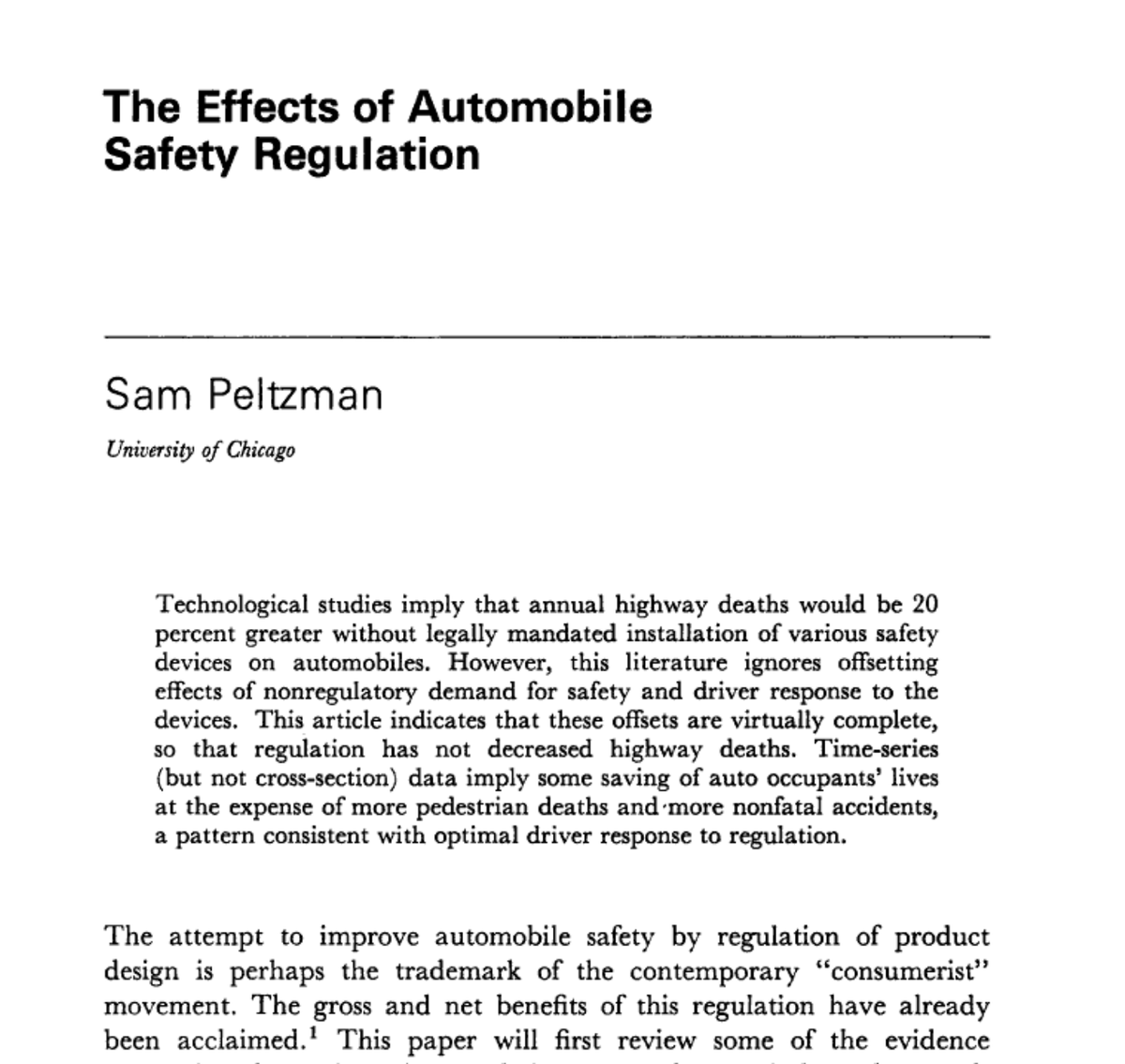
Sam Peltzman famously argued in 1975 that the effect of safer cars on total traffic deaths is ambiguous: Safer cars mean that drivers take more risks.
I am afraid that the effect of LLMs on email will be the same. We are promised that we will spend less time handling email thanks to autonomous agents.
My fear? As the cost of sending and processing emails goes down, more emails will be sent.
Everyone has incentives to do so. An administrator at the dean’s office (one of the most dangerous people in the U.S. right now) will feel they can send many more emails requesting information from faculty. A colleague at another department might reach out to you with questions. You name it.
The bottom line? Yesterday I got nearly 200 emails (without counting spam). Let’s call it the Peltzman effect of LLMs.
I know this might sound a bit harsh to China analysts, but I don’t really think this should be all that surprising.
Russia already has a robust and gargantuan defense ecosystem, and Chinese defense tech is increasingly more compatible with NATO standard systems and platforms than Soviet legacy ones (remember, the PLA switched to using 155mm shells in recent years).
China’s defense industrial base really just couldn’t inject RusMil with military equipment at scale without having to undergo a massive (partially redundant) retooling process.
With Iran’s militaries, they don’t really have that problem — and if they’re willing to cut corners re financing, Iran’s militaries might very well end up being a mirror image of the PLA.
@ssphinxe@Scholars_Stage …the continuation of the trend (and the Tech Republic’s/Tanner’s target) since then also lies in the absence of a war on the scale of those between Civ War and Vietnam — a phenomenon Gaddis famously explained with nukes and satellites https://t.co/mcHuhRSqQq
@ssphinxe@Scholars_Stage Social context is important, war is central — similar lessons in Gaddis. Intellectuals pursuing truth always risk critiquing the power that funds their leisure, but it reaches full tenor during Vietnam bc of the GI bill->mass college ed, acc. to Strategies of Containment. But…
I keep seeing people here insist that the answer to the Navy’s problems is more shipyard capacity. I get the sentiment. We all want more ships.
We haven’t delivered a major shipbuilding program on time and in budget in decades.
But the part that gets missed is that extra capacity will not produce much if the programs feeding that capacity are broken at the requirement level.
The Navy rarely has a firm idea of what it wants to build, and the requirement set drifts until the design becomes unmanageable.
Take the Constellation class as a recent example. The original promise was to base it on the existing FREMM design with around 85 % commonality; fewer changes, faster build, lower risk. Let me emphasize once more that the baseline ship was already a real ship in service with the Italia navy.
As of recent reports, the commonality has dropped to about 15 % because of added propulsion, sensor, survivability, hull, and combat-system requirements. The shipyard isn’t the root cause of the delay; the design evolution is.
Other programs are the same story. The Littoral Combat Ship collapsed under a lack of clear mission definition. The Zumwalt became a tech-showcase instead of a combatant. The Ford class carrier stacked first-of-kind systems together and absorbed every new requirement.
In each case, yards couldn’t build fast because the target kept shifting. Shipbuilders only gain rhythm and scale when design is fixed, repetition begins, and there’s a stable baseline.
@shashj Every time McPherson brings up the filibusters you think it’s the last time and then there’s another attempted Cuba annexation like 2 pages later