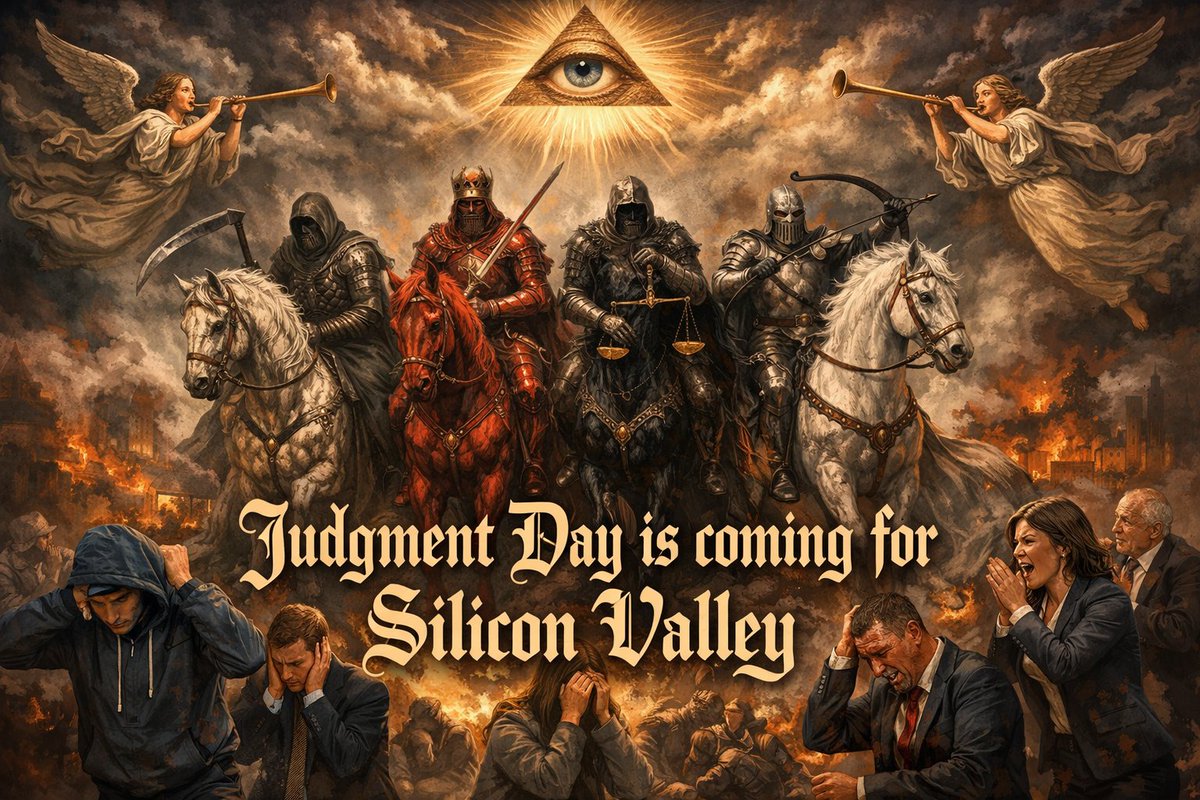
Judgment Day is coming for Silicon Valley
Figma, once a Silicon Valley darling and a proud YC company, has become a warning sign. The stock has dropped more than 80% from its IPO peak. In the lending market, Reuters reported that software companies are facing higher borrowing costs and tougher scrutiny from lenders, and JPMorgan said it is “watching the space very closely.” Funding for SaaS is getting blocked like the Strait of Hormuz.
The SaaS model is breaking down in plain sight. When software becomes cheap to build, easy to clone, and impossible to defend, the economics that powered the last two decades of venture-backed startups stop working.
Silicon Valley wants to believe AI will save it. It won’t. For most startups and many VCs, AI is not the rescue. It is the final reckoning before Judgment Day.
The industry is committing the same original sin at massive scale: building the same products on top of the same foundation models. Everyone is automating the same categories: coding, legal, accounting, healthcare, marketing, compliance, customer service, and everything in between. As Ilya Sutskever put it, we are now in a world with “more companies than ideas by quite a bit.”
That is why Judgment Day is coming.
In the Book of Revelation, Judgment Day arrives with the Four Horsemen of the Apocalypse: Famine, Pestilence, War, and Death. For us in Silicon Valley, they are showing up as:
Famine — market fragmentation destroys the economic base needed to sustain venture-scale startups
Pestilence — agentic coding wipes out technical moats and crushes switching costs
War — frontier labs will march into every major software market
Death — the old venture-backed SaaS model can no longer hold
Let’s start with Famine.
It used to be enough to find a niche and dominate it. That era is over. Every so-called niche gets flooded immediately, because the underlying models are available to everyone and the barriers to entry keep collapsing. What used to be a niche is now just another overcrowded lane.
You need to find a niche within a niche. That means market is fragmenting. Instead of one company owning a category, ten or twenty companies split the same demand into pieces too small to support venture outcomes. These markets may still support profitable businesses. But they do not support an army of unicorns.
I personally know two YC startups doing AI marketing. Too many ideas look great on the surface because they are low-hanging fruit. There will be demand. There may even be revenue. But the category is crowded. Revenue gets sliced thinner and thinner across lookalike companies until the economics no longer make sense for venture. It’s not even a secret that YC keeps funding the same exact ideas again and again across different batches.
A fragmented market can support disciplined, cash-flow-positive businesses. It cannot support a venture ecosystem built on the assumption that every promising category can produce a multi-billion-dollar winner. Most of these startups are not starving because there is no demand. They are starving because too many companies are feeding from the same pool while burning cash on compute, customer acquisition, and headcount.
Next comes Pestilence.
The plague is agentic coding. For years, software companies defended themselves by shipping features faster than competitors. That defense is collapsing. When code can be generated, iterated, and cloned at near-zero marginal cost, features stop being a moat. A startup ships something on Monday and a competitor ships a version of it on Tuesday.
And the deeper problem is that even before AI, companies already loved building internal tools whenever a workflow mattered enough. Every software engineer knows this instinct. We love the word migration. We love taking a workflow off a third-party product and moving it into an internal tool so we can “control our destiny.”
AI only makes that instinct stronger.
Now the customer’s question becomes much more dangerous: why am I paying a vendor for this if I can build a version of it internally, own the data, own the evals, and tailor it to my own workflow?
The tech community on X says the value is in the agent harness around the model: orchestration, memory, evals, tooling, permissions, and workflow design. That is right. But it still does not save the old software model. The harness is still code. And code is becoming a commodity. What remains defensible is not the wrapper. The cost of creating software is collapsing toward zero. The cost of switching to a competing product or migrating to an internal solution is also collapsing toward zero.
Then comes War.
War is what happens when the model layer stops acting like infrastructure and starts invading the application layer.
The frontier labs are not trying to become neutral utilities. They are trying to become empires. They cannot justify those valuations by selling raw model access alone. They have to keep moving up the stack into coding, design, productivity, finance, support, and every other category large enough to matter. Reuters has already described Anthropic’s push into coding and business plug-ins for areas like design, HR, wealth management, investment banking, and private equity, while OpenAI’s own $852 billion valuation reflects the scale of the prize.
That creates a brutal trap for startups. If a market is small, it is too fragmented to produce venture-scale returns. If a market is large, it becomes a target for the labs. Either way, the startup gets squeezed.
Finally, it comes Death.
Death is what happens when Famine, Pestilence, and War reinforce each other. Markets fragment. Moats disappear. Giants invade. Capital gets nervous. Startups fail. Those failures scare investors even more, which causes more capital to retreat, which causes more startups to die.
At that point, the problem is no longer isolated to a few companies. The venture-backed software model itself starts to crack.
The issue is not that business opportunities are disappearing. The issue is that the value curve has moved. It is no longer centered in the middle where classic SaaS investing thrived.
The value is moving toward two extremes.
On one end are the frontier labs and the infrastructure giants that can capture massive markets. On the other end is a fragmented long tail of niche operators that can absolutely make money, but usually not at venture scale.
The middle is dying.
That is exactly where venture capital used to work best: large enough markets to matter, weak enough incumbents to disrupt, strong enough moats to protect margins, and scalable software economics to justify the risk. AI is dismantling that setup. The software layer is commoditizing from below while the frontier labs are crushing it from above.
This is not the death of entrepreneurship. It is the collapse of the old math that made venture-backed SaaS work.
But this is not the end of business. It is the end of a delusion.
The winning formula is changing. If software is becoming a commodity, then the real differentiators are brand, trust, distribution, and service.
In a commodity market, brand matters more, not less. Think about Coca-Cola and Pepsi. The product itself is commoditized. The brand is what carries the margin, the trust, and the staying power. When the underlying product gets easier to copy, the brand matters even more, because the brand tells customers who to trust.
And if you do not have brand yet, then you win through service.
That is the part Silicon Valley still does not want to admit. The customer does not care about your prompt stack. They do not care about your orchestration layer. They do not care how elegant your agent architecture is. They care whether the system works, whether it solves their problem, and whether someone will show up when it fails.
This is why Sequoia is reframing it to “Service as a software”: the next great AI company may not sell software at all. It may sell work. If you sell a copilot, you are competing with every new model release. But if you sell the outcome — books closed, contracts reviewed, claims handled, compliance completed — then every new model improvement makes your margins better instead of making your product obsolete.
That is the real shift. The SaaS era was about capturing the software dollar. The AI era is about capturing the services dollar at software margins. Not “AI for accountants.” The AI accounting firm. Not “AI for lawyers.” The AI law firm.
That is why the businesses that endure will look less like pure SaaS vendors and more like high-performance service firms rebuilt on software infrastructure. They will use AI internally to operate at software-like margins, but what they sell externally is confidence, execution, and outcomes. That model looks a lot closer to Goldman Sachs or McKinsey than to the old fantasy of a self-serve SaaS company printing money forever.
And that shift has two major implications for venture-backed businesses.
First, company formation moves from capital-first to revenue-first.
The old model was simple: raise money, hire a team, build a product, and then go find customers. That model makes less and less sense when code is cheap and the real value lies in implementation, trust, and workflow ownership.
The new model is the reverse. Win customers first. Secure contracts first. Prove demand first. Then use that revenue to expand.
That changes the financing equation. More startups will bootstrap. Some will use private credit or bank financing. Others will raise much less equity than Silicon Valley has trained founders to expect. If the product is no longer the hard part and the value comes from delivering the outcome, then many of the best AI businesses will be capital-light and revenue-led, not capital-heavy and speculation-led. VCs have to rethink their role in that world.
Second, talent compensation moves from employee upside to partner upside.
If the winning company looks more like an elite service firm, then the most valuable people are not just engineers. They are the people who can win trust, close deals, scope the work, and deliver the outcome.
Those people will not be satisfied with a salary plus a lottery-ticket equity grant. They will want commissions. They will want a cut of the profit they bring it. Because they are not just building the business, they are directly creating revenue for it.
Silicon Valley is slowly rediscovering the importance of this role: someone who can work directly with clients. Today, they call them forward-deployed engineers. But the industry needs to go a step further. It needs to adopt the partnership model that law firms, banks, and consultancies have used for decades. The new sexy title is not cofounder or member of technical staff. It is partner.
As Sequoia partner Julien Bek put it, the next $1 trillion company will be a software company masquerading as a services firm.
Judgment Day is coming for Silicon Valley. Not because innovation is ending. Not because software is dead. But because the old religion of venture-backed SaaS is collapsing.
The Four Horsemen are already here. Famine is starving overcrowded markets. Pestilence is wiping out software moats. War is coming from the labs. Death is coming for the old model.
The survivors will not be the ones clinging to startup mythology from the 2010s. They will be the ones who accept the new reality early: software is becoming a commodity, brand is becoming the moat, and service is becoming the business model.
In the next era, the companies that win will not win because they sell code. They will win because they are selling “service as a software”.
Few observations from this week:
1. Microsoft is releasing 7 models. Looks like they are decoupling from OpenAI.
2. Meta is releasing Meta Business Agent in WhatsApp and other products. This is going to empower many SMBs.
3. Google is raising $80 billion in equity.
4. OpenAI is betting big on robotics.
5. Anthropic is going to IPO.
So yes, the competition is more intense than ever. And we still see no big moves from Apple.
That’s why we need to practice Retardmaxxing.
I love Forrest Gump, and I still think it’s the greatest movie of all time. He is simple-minded. But he always moves FORWARD.
People overthink too much.
They think about every negative consequence and what’s going to happen 10 years from now. Then they get stuck in a thinking loop, and it only creates more anxiety.
That leaves no room for planning the actionable path forward.
They spend too much time asking:
“What are all the things I can do?”
“What are all the things that can go wrong?”
Instead of:
“What’s the next step on the golden path?”
You have to learn how to be more simple.
Be more naive. Be more stupid. Be like Gump.
Yes, I’m going to hit a wall. So what?
Run. Forrest. Run.
Again, it’s dangerous because the AI is pretending to be a human user. The OS doesn’t know whether a human or an AI is running a command. So now everyone is trying to build sandboxes to restrict the AI.
Right now the company designing the OS and the company designing the sandbox often don’t talk to each other. That is not the best way to build an AI computer for users.
I’m not saying an AI OS should be non-deterministic. The core OS layer should still be deterministic. But there should be an AI layer sitting on top of it, and users should be able to interact directly with that layer.
Now the OS knows these commands are being run by an AI. And the core OS team can work tightly with the AI layer team to design much better safeguards and features.
You can still install your own LLMs if you want to. But for most non-technical users, they shouldn’t have to think about it. It should just ship with the OS.
On top of that, the entire ecosystem is a mess right now. Some apps can use local models. Some apps are now CLIs or MCPs that you run through your LLM. Some apps require you to buy subscriptions because they run their own LLMs. There is no universal way for apps to tap into the model on your laptop.
If apps could tap into your device’s AI instead of each charging you for their own subscriptions, it would lead to an explosion of AI apps.
Rethinking how AI should be an *integrated* part of the stack is the right way forward.
Microsoft moved forward its timeline to achieving a scalable quantum computer by 2029. This is why AI is going to accelerate technological growth across all fields. It’s not just about making chatbots better. AI can help scientists and engineers move faster in quantum computing, biology, robotics, energy, and many other areas.
And this is also a lesson on how to use AI. Don’t obsess over automating everything. Just find one area in your life or work where applying AI can 10x or even 100x the output.
Announced today at #MSBuild: Microsoft unveiled Majorana 2, a next-generation topological quantum chip developed with the help of Microsoft Discovery’s agentic AI. https://t.co/esVcmeWdgh
@kunchenguid Thanks for the video. It’s full of great info!
One small feedback, you usually don’t need the background music after the hook. Or maybe choose a softer soundtrack.
I have a different theory.
To understand why Anthropic kept up its fear campaign, we have to look at social media companies. They were criticized for growth at all costs, stealing data, blatantly disregarding privacy, ruining attention spans, and damaging people’s mental health. They let the media portray a very negative image of them and could never turn it around.
So Anthropic saw this and wanted to be the “responsible” company. They want to keep warning people and control the narrative so they don’t get blamed for the negative consequences later.
I don’t know if this is a good or bad strategy. I’m just saying this is what they’ve learned from the last tech wave.
It’s all about the PR.
For all the AI founders moving to SF, don’t forget to explore California’s amazing nature!
This is Kings Canyon, right next to Sequoia National Park, where Sequoia the VC firm got its name!
@dflieb@ycombinator Explosion of AI video products.
It’s still expensive to create AI videos. But if we manage to cut the cost, there will be many different kinds of AI video products.
It’s funny how many people are mocking them, while also arguing that “people who don’t learn AI are going to get replaced by people who do.”
The same logic applies to companies.
If you outsource too much of your AI workflow to third-party vendors, you’ll never become AI-native. You’ll lose to AI-native companies that run on agents, proprietary workflows, and in-house AI muscle.
Yes, and that’s why SaaS stocks are getting hit hard.
It’s not that these workflows are impossible to vibe code. It’s that the way we interact with computers has changed.
We went from clicking around on laptop and mobile screens to simply telling an AI what we want and expecting it to handle the work.
That’s why a lot of people are caught off guard. They’re still clinging to the idea that the user must see the screen, click the button, and generate the chart themselves, instead of just typing into a chat box and getting the result.
It’s not moronic. It’s brilliant.
If you don’t own the core technology, you never build the muscle for it. Walmart built its own site and now ecommerce drives roughly 25% of revenue.
For clients this big, the math is obvious. They can work directly with OpenAI and Anthropic, cut out the AI-for-X middleman, and build the capability in-house.
The labs are aiming for trillion-dollar valuations, maybe more. There’s no way they stop at being infrastructure. They’re coming for every industry.
“AI for X” is not a moat when your biggest customers can go straight to the labs.
@Techmeme Good move. Your proprietary data is too important, and most of the value is still created by the foundation model.
The “harness” everyone is raving about is mostly just code that can be vibecoded.