@nibeshrestha2@aniketpkate 📍 Wednesday, April 29, 10:15–10:45
I’ll also present “Five Minutes of DDoS Brings down Tor: DDoS Attacks on the Tor Directory Protocol and Mitigations”, joint work with @zhtluo Akshat Neerati, and @aniketpkate. Paper link: https://t.co/OIhrTMkFj7
📍 Tuesday, April 28, 15:45–17:30 (Track B)
I’ll present “Towards Improving Throughput and Scalability of DAG-based BFT SMR” on behalf of @nibeshrestha2 and @aniketpkate. Paper link: https://t.co/wbYpt4PAZt
Exciting news! I have joined the world-leading team at @Mysten_Labs.
I am working on distributed systems & crypto projects led by @GDanezis, @kostascrypto, n @0x4252. It is great to be part of this highly-productive team with academic thinking & startup-level execution speed...
Introducing Project Glasswing: an urgent initiative to help secure the world’s most critical software.
It’s powered by our newest frontier model, Claude Mythos Preview, which can find software vulnerabilities better than all but the most skilled humans.
https://t.co/NQ7IfEtYk7
Introducing EVMbench—a new benchmark that measures how well AI agents can detect, exploit, and patch high-severity smart contract vulnerabilities. https://t.co/op5zufgAGH
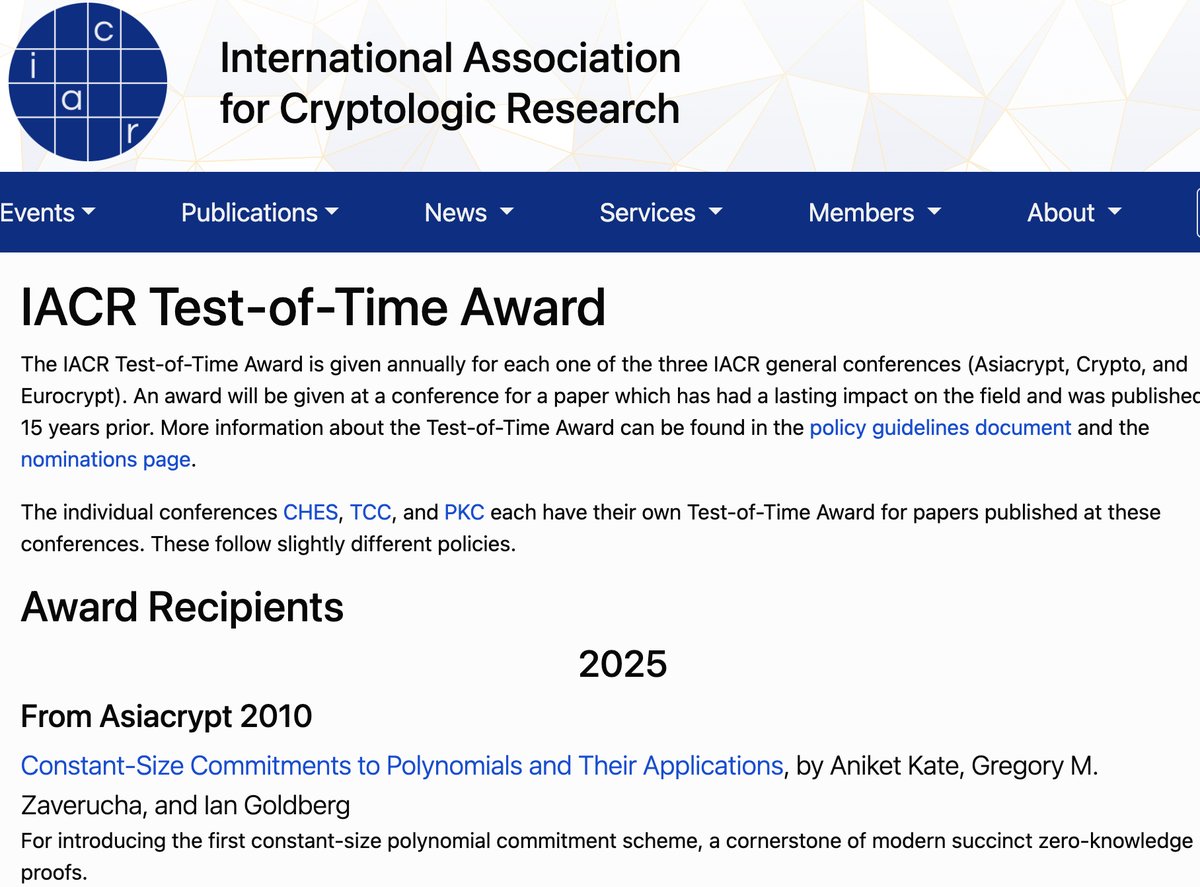
KZG polynomial commitment paper has received the 2025 IACR Test-of-Time award for Asiacrypt 2010!🎉
Greg, Ian, and I are honored and grateful to receive the award. Thanks to @IACR_News for the selection.
This award was only possible because of the efforts and interest from many researchers and developers in the blockchain and (zk)snarks space in the last ten years. So, thanks to all who have built their solutions on polynomial commitments.
Let's keep making verification succinct!
Happy to share that our work on Hydrangea, a new consensus protocol from @SUPRA_Labs , has been accepted at USENIX Security' 26.
Hydrangea achieves optimistic two-round commit with stronger fault resilience than prior work. For a system with n=3f+2c+k+1, it commits in two rounds with up to p~=(c+k)/2 faults, and in three rounds with up to f Byzantine and c crash faults.
We also show this resilience is (nearly) optimal for optimistic two-round commit.
Paper Link: https://t.co/iKyuli0lix
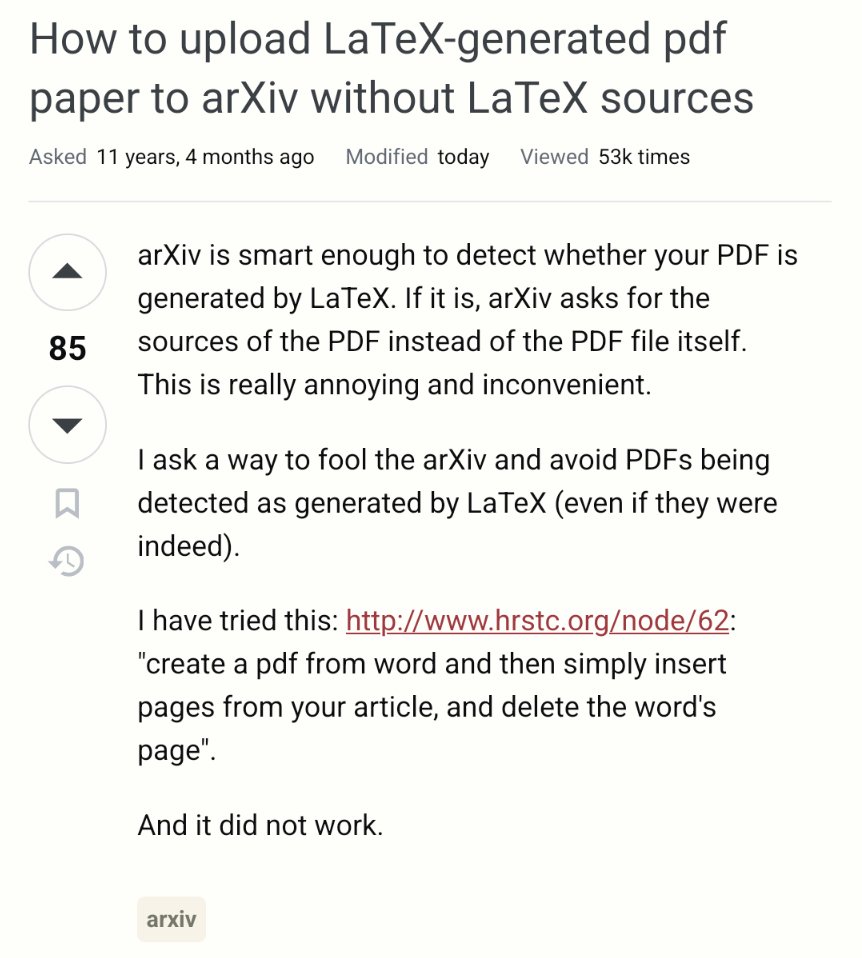
It does feel uniquely research-y to write a paper to settle a Stack Overflow question probably nobody actually cared about...
All Our TeX Source Are Not Belong to You: PDF Obfuscation against arXiv's TeX Source Policies
https://t.co/jj3apfoVli
Decentralization underpins permissionless blockchains, but what about geography? 🌍 Our new study explores this often-overlooked dimension of crypto. (1/n)
MPC can be ready for your confidentiality apps now!
Secure Multi-Party computation (MPC) protocols are crucial tools in security-critical distributed systems, including blockchains. They represent a strict generalization of FHE, and are now ripe to be integrated into the blockchain space.
Crypto literature employed Information-Theoretic cryptography to design protocols, which incurs a high communication cost. Subsequent literature improved communication costs using public-key cryptography; however, these protocols incur a large computational cost from expensive public-key operations, which inhibits scalability.
We address this bottleneck by designing protocols using lightweight cryptography - cryptographic Hash functions and Symmetric Key Encryption. These primitives are 1000x faster than public-key-based primitives, and they are also friendly to the Post-Quantum world. However, as these tools lack the transcript homomorphism offered by public-key-based tools, we employ novel distributed computing techniques to limit the increase in communication compared to public-key-based protocols.
The project is led by @akhilsai2712. Joint work w/@bagchi_saurabh, @_hermitsage_, Xiaoyu Ji, Soham Jog, @chendaLiu, Daniel Pöllmann, @mk_reiter, Yifan Song
@esnie17 is presenting Recovering from Excessive Faults for blockchains this week
at Usenix Security 2026.
w/ @kartik1507 and @AndrewLewisPye
(Url: https://t.co/MkJoBPRxJZ)
--------------------
Blockchains rely on consensus/SMR/Atomic broadcast protocols to make sure all the nodes in the network agree on the transaction ordering.
What’s the Problem?
These protocols can only handle a certain number of bad or faulty nodes (called Byzantine faults). But what happens if more nodes than expected go bad — more than the system was designed to handle?
Until now, most blockchains would just fail or get stuck. That's a big problem.
What does this work achieve?
We created an extensive fix for this problem — a repair method that helps blockchains recover from too many bad nodes after the fact.
Here’s how it works:
Using signature-based trails, we can detect which nodes are acting badly, without blaming the good ones.
This helps the blockchain "heal" itself and return to normal operation. It may not work as smoothly as if everything were perfect, but it’s still way better than failing completely.
Real-World Test
We built this system into the HotStuff consensus protocol and demonstrated that system performance went back to normal after recovery.
With 30 nodes, there was only a small slowdown (4.3%).
On average, transactions took a bit longer to process (about 12.87% more delay), but the system stayed alive and functional.
We also made versions tailored to specific protocols like Tendermint and HotStuff, making them faster and more efficient.
Better Fault Detection
We also worked on better ways to detect up to n-2 bad nodes in any blockchain that uses BFT. We created a new detection method that works without needing extra messages between nodes
Why This Matters
Now, our blockchain networks could survive and recover even when more nodes go rogue than expected. You get better tools to detect and isolate bad actors. This adds a layer of resilience and reliability to blockchain systems, helping prevent costly downtimes or attacks.
--------------------
Looking forward to attending SBC in Berkeley next week.
I will be speaking about Threshold AI Oracles at the Summit on Decentralization and AI (https://t.co/RaaMjabRuV) on Sunday.
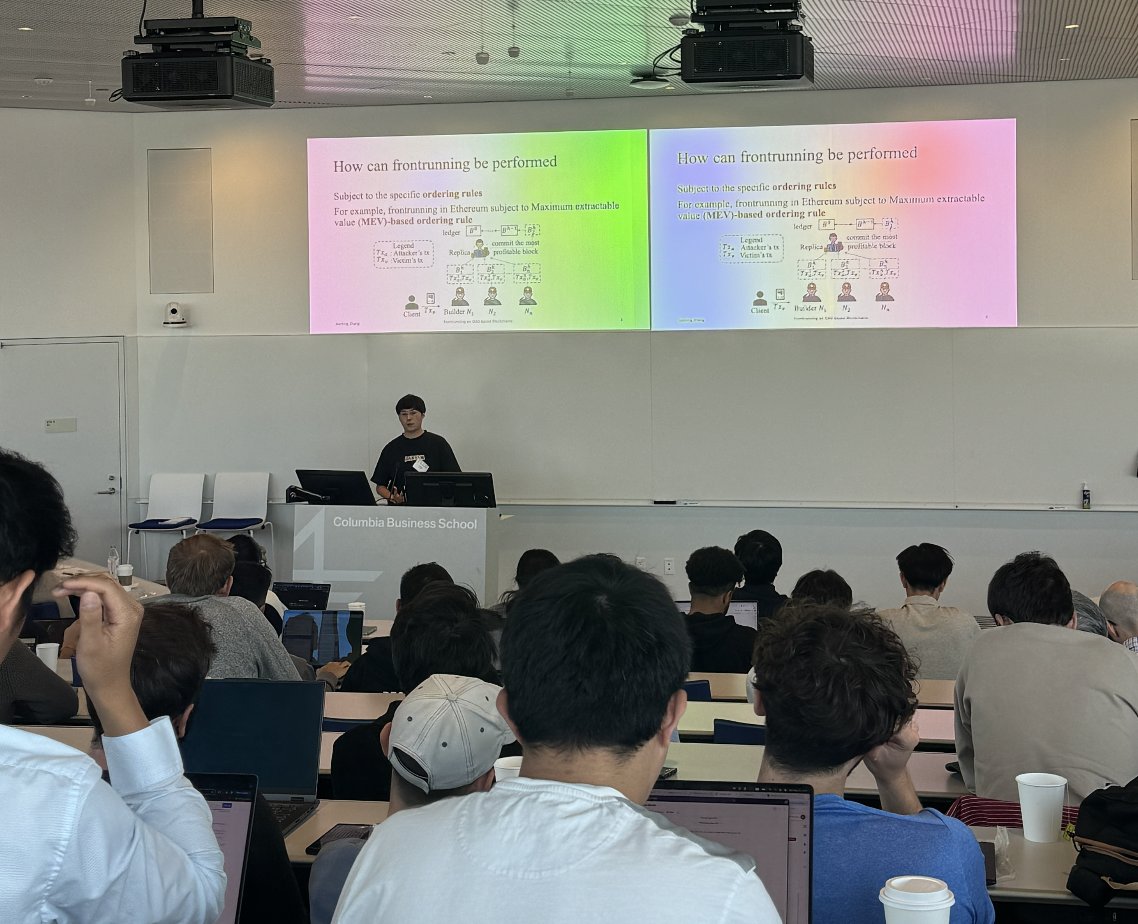
@EtherCS will present Frontrunning on DAG-based Blockchains at SBC on Tuesday.
Today, we introduce a new thesis: MEV has become the dominant limit to scaling blockchains.
Spectacularly wasteful onchain searching is starting to consume most of the capacity of most high-throughput blockchains.
This is a market failure we can no longer ignore.
Thank you to the co-author. Our paper on learned indexes has been accepted by VLDB 2025.
We will offer a special bonus through Happy-Sci to others who also got papers accepted by VLDB 2025. Feel free to contact me.
我们将会有笔特殊的奖金通过Happy-Sci发给同样中稿VLDB 2025的同学,欢迎联系我😄
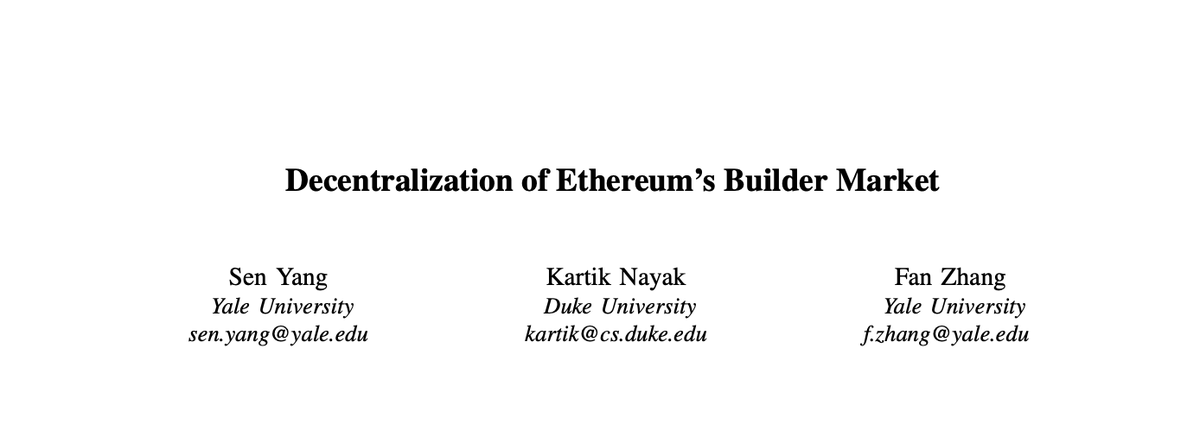
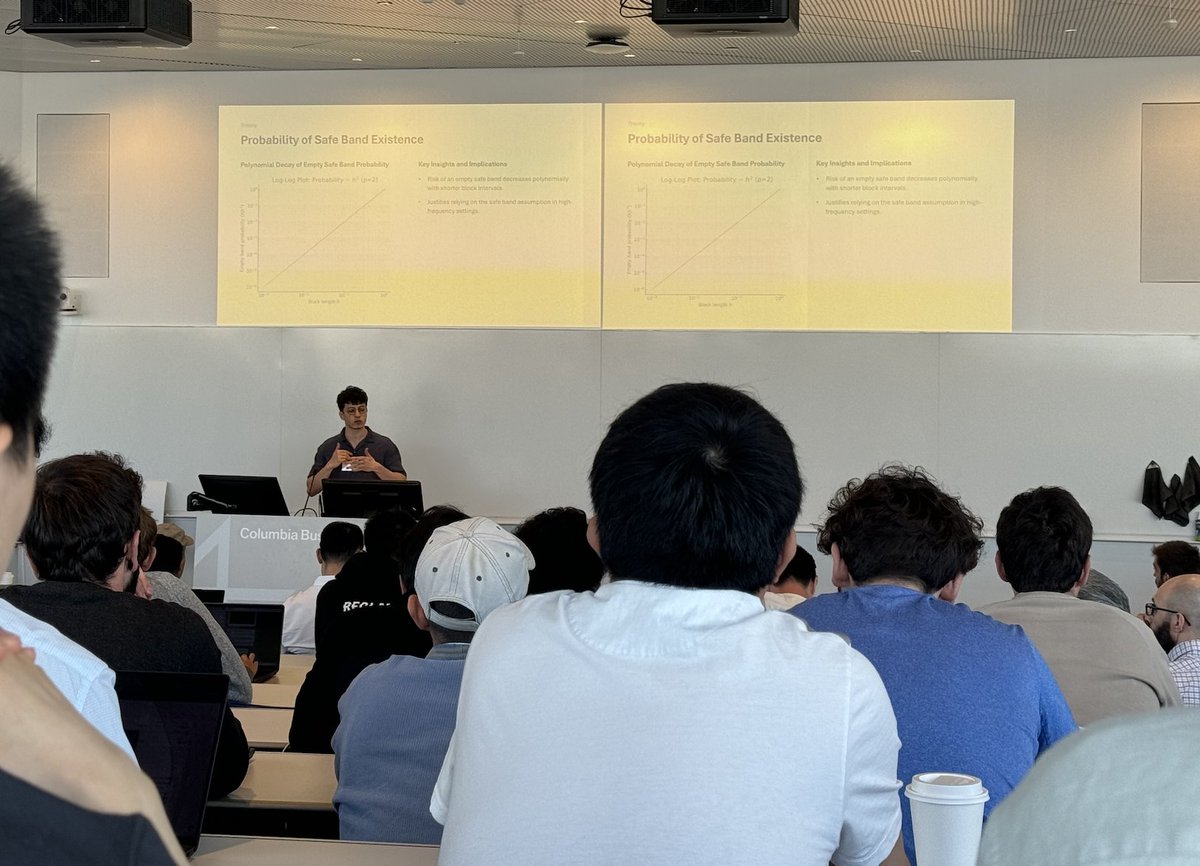
Excited to present our paper Decentralization of Ethereum's Builder Market at @IEEESSP this week! Catch it in Session 1, Track 2: Blockchain I on May 13. If you are attending, feel free to come chat—happy to discuss anything related to blockchain/security!
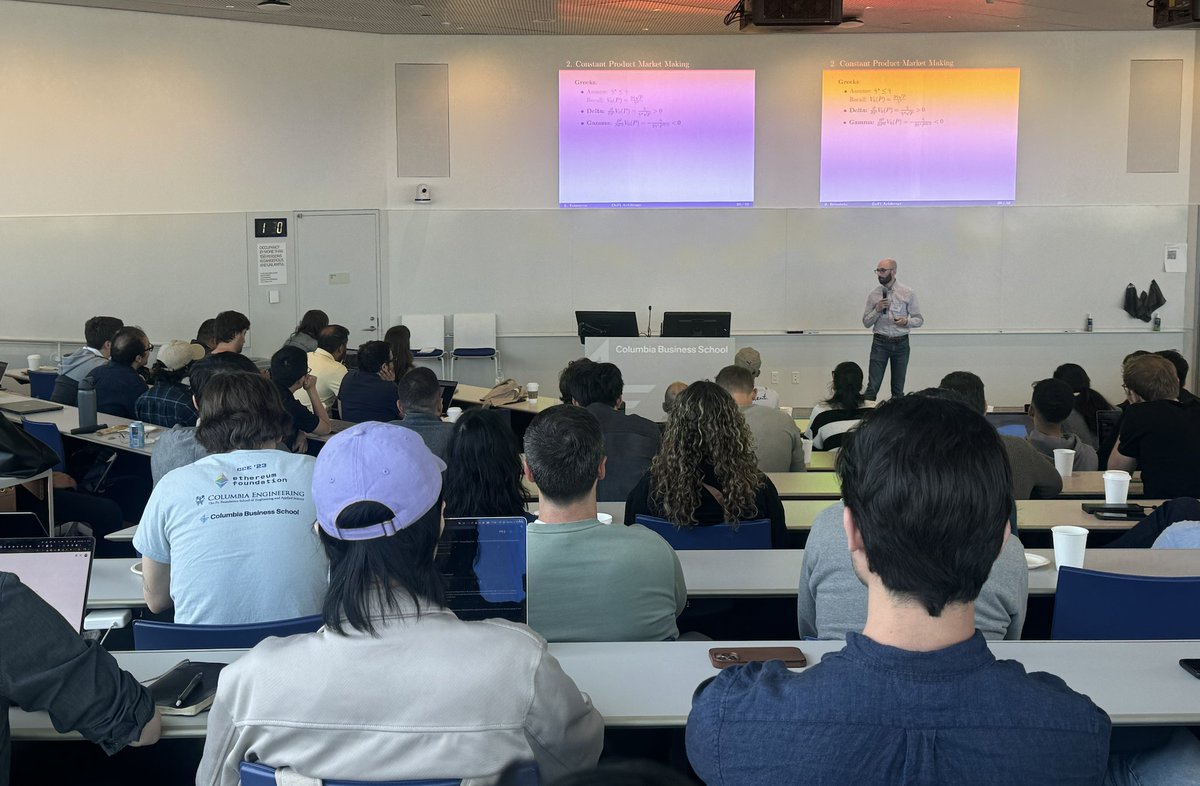
🌟 Session number 1 is complete!
→ DeFi Arbitrage in Hedged Liquidity Tokens
@FictionomicsSIT
→ No Fish Is Too Big for Flash Boys! by @EtherCS
→ Dynamic Geometric Mean Market Makers by TLDR Fellow Adam Bouabda