The 16-year-old, who cannot be named for legal reasons, faces three child sex offences and is due to appear before Swindon Magistrates Court on Wednesday (8 July).
He faces charges of rape, sexual touching and causing or inciting a girl to engage in sexual activity in 2025.
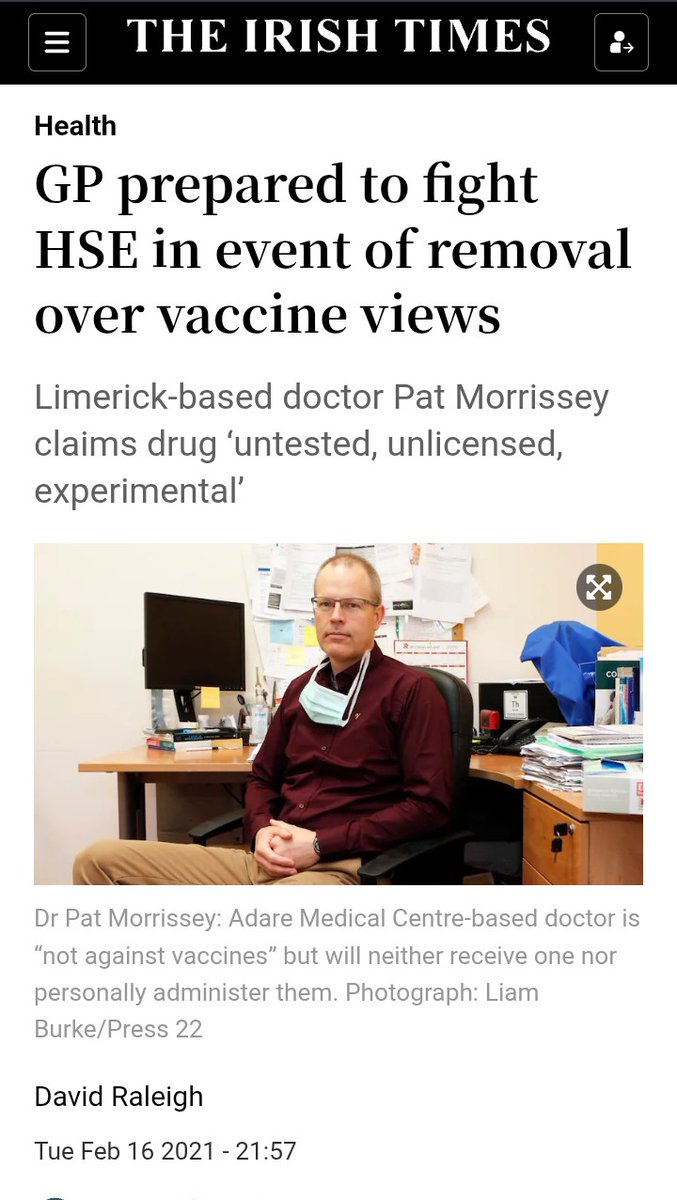
On 20th July: Dr Pat Morrisey, a GP in Adare -will face a Fittness to Practice Hearing before the Irish Medical Council for failing to promote Covid Vaccines and Covid Policies.
Like myself, Dr Morrisey was placed under investigation 5yrs ago for publicly criticising the same vaccine and policies that have since been shown to have caused so much unnecessary death and harm to our society.
It is Tony Holohan and Simon Harris who should be on trial.
Our country is so corrupt. It is truly sickening -Pharmaceutical Companies are in complete control of Ireland’s health policies and the regulator. How can the Minister for Health allow these sham hearings to continue?
These hearings are at least, a good reflection of how our health system functions behind the scenes, and it should at less be clear who exactly is pulling the strings.
I will be at the Medical Council on 20/7/26 at 10am, to show my support for a brave colleague who stood firm and always spoke the TRUTH.
The Minister and the Medical Profession in Ireland should be deeply ashamed of what is occurring here.
See you on the 20th
Marcus
For a great many months now, Ethical Approach UK has examined Operation Talla through a constitutional lens. Not by asking whether particular operational decisions were right or wrong, but by asking broader questions concerning....
• policing governance;
• operational decision-making;
• public accountability;
• transparency; and
• public confidence.
People have sometimes suggested that these are niche issues or matters lacking wider public significance.
Today however, the National Police Chiefs' Council (@PoliceChiefs) has said something rather different.
In its latest Internal Review, the NPCC states....
"I accept that issues concerning policing governance, operational decision-making and public accountability can engage legitimate public interest considerations."
It continues....
"The NPCC has not characterised your request as lacking seriousness or public interest."
Those words matter.
They do not mean that the NPCC necessarily agrees with my conclusions and they do not mean that it necessarily accepts my interpretation of the documentary record.
However, they do represent an important point of common ground.
The constitutional questions themselves are recognised as legitimate.
The present disagreement is therefore not whether policing governance, operational decision-making and public accountability deserve public examination - It is about where the documentary evidence ultimately leads.
That is exactly where informed public debate should be.
Evidence first. Conclusions afterwards.
If nothing else, I welcome the fact that we can at least agree on this....
The constitutional questions are real, they are legitimate and they deserve careful public consideration.
The question raised by my latest paper is not simply about a document. It is about constitutional governance.
Chapter 2 examines Assistant (now Deputy) Chief Constable Alan Speirs' place within Operation Talla's oversight framework.
The official record shows him not only as Operation Talla Silver Commander, but also as the senior officer responsible for Professionalism and Assurance.
His responsibilities extended beyond operational command, to include organisational assurance, governance, accountability and learning.
The same documentary record explains that the Independent Advisory Group (IAG) was supported by Operation Talla Information, Collation, Assurance and Liaison (OpTICAL) - a mechanism established to gather, collate and provide operational information in support of assurance activities.
Those facts are not controversial. They come directly from the official record. They also explain why later questions concerning the January 2022 operational reporting policy (the Speirs Directive) are constitutionally significant.
This is not about personalities. It is about understanding how systems of oversight, assurance and operational decision-making interacted during the UK's nationally coordinated policing response to Covid-19.
If we are to maintain confidence in constitutional policing, those relationships should be capable of being understood through the documentary record and Chapter 2 explains why.
"The IAG Question - Transparency, Protest Policing and the Missing Discussion"
is available to read and download here:
https://t.co/YB9t91s9D3
If you believe evidence-led constitutional analysis contributes to public accountability, I would be grateful if you would read the paper and share it with others.
For a great many months now, Ethical Approach UK has examined Operation Talla through a constitutional lens. Not by asking whether particular operational decisions were right or wrong, but by asking broader questions concerning....
• policing governance;
• operational decision-making;
• public accountability;
• transparency; and
• public confidence.
People have sometimes suggested that these are niche issues or matters lacking wider public significance.
Today however, the National Police Chiefs' Council (@PoliceChiefs) has said something rather different.
In its latest Internal Review, the NPCC states....
"I accept that issues concerning policing governance, operational decision-making and public accountability can engage legitimate public interest considerations."
It continues....
"The NPCC has not characterised your request as lacking seriousness or public interest."
Those words matter.
They do not mean that the NPCC necessarily agrees with my conclusions and they do not mean that it necessarily accepts my interpretation of the documentary record.
However, they do represent an important point of common ground.
The constitutional questions themselves are recognised as legitimate.
The present disagreement is therefore not whether policing governance, operational decision-making and public accountability deserve public examination - It is about where the documentary evidence ultimately leads.
That is exactly where informed public debate should be.
Evidence first. Conclusions afterwards.
If nothing else, I welcome the fact that we can at least agree on this....
The constitutional questions are real, they are legitimate and they deserve careful public consideration.
Sometimes the most revealing documents are not operational manuals. They are strategic planning documents.
In 2020, the College of Policing published Policing in England and Wales: Future Operating Environment 2040.
It is not a Covid document. It is something arguably more important.
It sets out how policing believed the next twenty years would evolve, identifying the strategic challenges which police leaders believed would increasingly shape policing.
Among those challenges are:
• artificial intelligence and surveillance;
• digital disinformation;
• declining trust in institutions;
• increasing societal complexity;
• climate change;
• technological convergence;
• growing influence of non-state actors;
• social fragmentation;
• expanding information spaces; and;
• the need for new models of governance.
One passage particularly caught my attention - The report states that policing's existing structures are essentially modelled on the early industrial period - vertical, hierarchical, fragmented and bureaucratic and questions whether incremental change will be sufficient.
It suggests policing may ultimately need radically different models of leadership, governance, citizen engagement and service delivery.
Elsewhere it acknowledges that future policing will face profound questions concerning AI, surveillance, disinformation, legitimacy and public trust.
It repeatedly emphasises that governance must develop alongside capability.
Read that alongside the documentary record which has now emerged concerning Operation Talla.
Compare it with the NPCC guidance.
Compare it with the Speirs Directive.
Compare it with the growing body of FOI disclosures from multiple public authorities.
Whether one ultimately agrees or disagrees with any particular conclusion is almost secondary.
The more important observation is this....
Britain was not simply policing events. It was operating within a sophisticated strategic environment in which governance, information, technology, legitimacy, public confidence and national coordination were already recognised as defining issues for the future.
The documentary record deserves to be read as a whole, not as isolated documents. Only then does the larger constitutional picture begin to emerge and make sense easily.
The report is well worth reading - Here's a link:
https://t.co/Hgxaxrvwe8
OPERATION HEXAGON EXPOSED
There is a police operation neither Andy Burnham or his Greater Manchester Police force will talk about. For years the public was allowed to believe it existed to hunt the men who gang raped and trafficked Oldham's children. It carried a Gold command structure, the apparatus reserved for terror attacks and major disasters, and it ran for years in near total secrecy.
The documents tell a different story. Deployed by Greater Manchester Police in partnership with Oldham Council and the cooperation of Andy Burnham’s team, this operation was hunting the people exposing the cover up of the rape gangs.
Here is the evidence. Read it and you will understand why the ANDY BURNHAM refuses to issue a statement on Operation Hexagon.
https://t.co/decV7hqDUr
_________
Imagine dragging the Prime Minister in front of a national inquiry, forcing him to testify under oath about his role in covering up the Pakistani grooming gangs scandal.
We can make this a reality. But I need your help.
For 8 years, I've exposed the cover-up of Pakistani rape gangs by police and politicians. Our campaign in Oldham forced a national inquiry. Now, we must compel this inquiry to investigate a place it wants to avoid: Andy Burnham's record.
As Mayor of Greater Manchester, Burnham fronted sham "assurance reviews". They were nothing more than a cover-up of the cover-up. He would have succeeded if not for us. We fought for a national inquiry despite his efforts to bury the truth.
The inquiry won't examine Burnham's actions unless we demand it. The clock is ticking. He's poised to become Prime Minister within weeks. Once he's in Downing Street, the establishment will shield him. Institutions will dodge accountability. The press will look away. Only we can carry the truth.
That's why Red Wall and the Rabble must become more than a one-man operation. To replicate our Oldham success nationwide, we need:
- A professional website to reach millions
- Video editing for accessible, viral content
- Dedicated researchers to chase every lead
- Training events to create citizen journalists
- Resources to gather evidence and report from failed communities
Before Burnham reaches Number 10, help us gain 2,000 new paid subscribers. So far we're at 370.
Sign up here:
https://t.co/mZBZnScays
With your support, we can send complicit politicians to prison. Isn't that prospect alone worth backing?
Raja Miah MBE
Well this slipped in rather quietly
Massive change to the criteria for commencing criminal proceedings in Scotland, particularly at summary level
https://t.co/HYGkGoJbyN
The documentary record continues to grow.
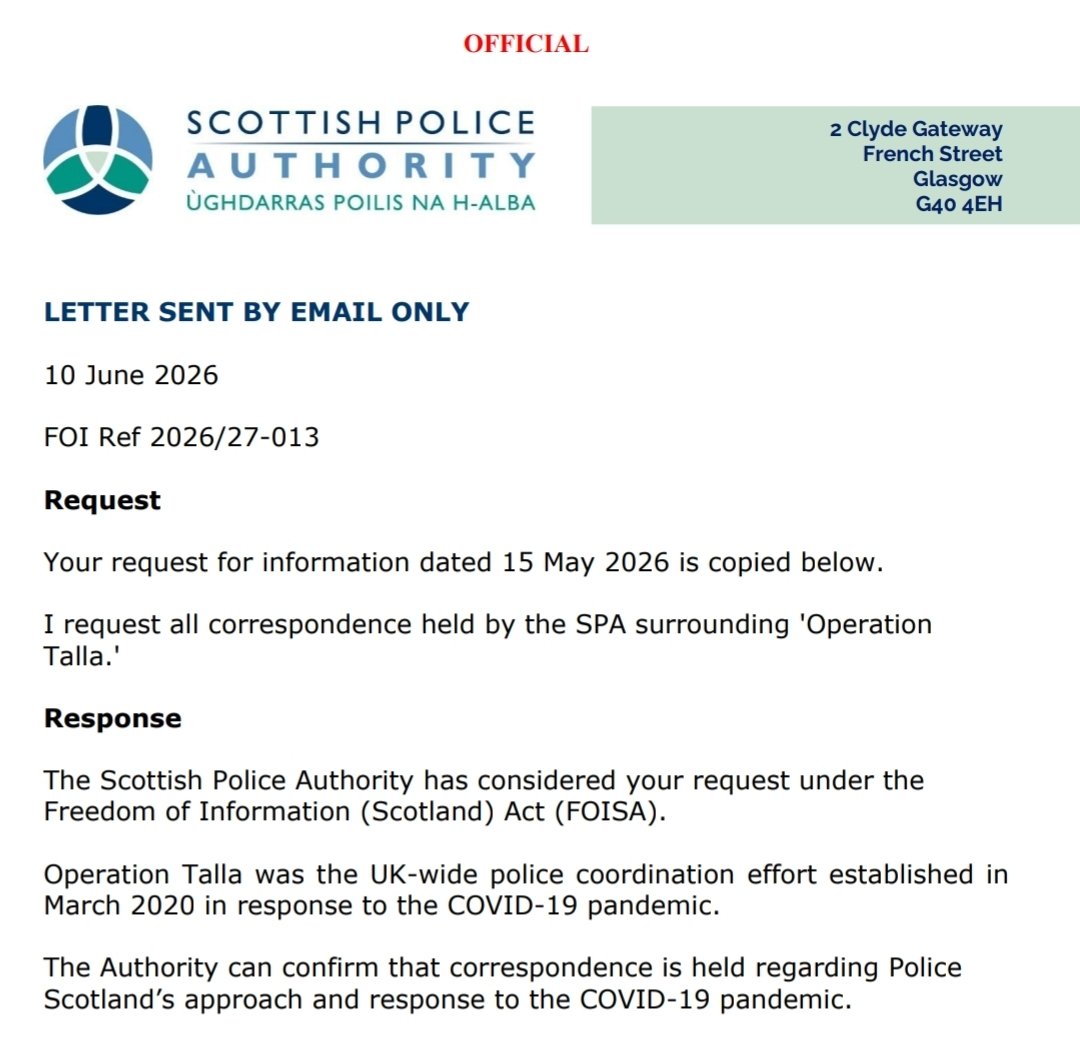
The Scottish Police Authority has disclosed a 122-page Operation Talla correspondence bundle following an FOI request (not mine).
It contains correspondence between the Scottish Police Authority, Police Scotland, HMICS, Scottish Ministers, the Scottish Parliament, the Independent Advisory Group, human rights organisations and others spanning the Covid period.
Whatever conclusions people ultimately reach, one thing is becoming increasingly clear - Operation Talla was never simply about operational policing. It involved governance, oversight, scrutiny, human rights, ministerial engagement, parliamentary correspondence and strategic coordination at multiple levels.
Much of Ethical Approach UK's independent investigation has pointed towards precisely that wider picture.
As further official disclosures emerge from different public authorities, the documentary record becomes richer, allowing comparisons to be made across institutions rather than relying upon isolated documents.
That is exactly how evidence-led public interest investigation should work.
The full disclosure bundle is now available for anyone wishing to examine it for themselves.
Here is a link:
https://t.co/7ARJ47yKWJ
Read the documents. Compare them with other official disclosures and each your own conclusions.
Evidence should always speak louder than opinion.
@lensiseethrough@ClareCraigPath And silence on operation Talla police suppression as documented by @EthicalApproach from FOIR . Note all police constables broke the Oaths to comply with the directive to not record claims let alone investigate, simply silence and denial.
Independent oversight is one of the constitutional safeguards upon which public confidence in policing depends.
During the Covid-19 era, Scotland established an extensive framework of governance around Operation Talla.
• The Scottish Police Authority.
• HM Inspectorate of Constabulary in Scotland.
• The Independent Advisory Group (IAG).
• Human rights bodies.
• Academic advisers.
• Senior Police Scotland leadership.
Collectively, they sought to ensure transparency, proportionality, accountability and public confidence throughout one of the most challenging periods in modern policing.
Those arrangements deserve recognition.
However, constitutional scrutiny requires more than acknowledging what is present.
It also requires asking whether the documentary record is complete.
My latest paper examines a narrow but important question arising from official documents.
A January 2022 Police Scotland operational publication (now commonly known as the Speirs Directive) directed how certain Covid-related reports from members of the public were to be handled.
That publication referred to the Metropolitan Police's handling of CRN 6029679/21.
Police Scotland later confirmed, in response to a Freedom of Information request, that the publication was issued on NPCC advice and that "the decision to issue the directive came via the Gold Command." Yet the presently disclosed oversight record appears to contain little or no discussion of that operational reporting policy.
This paper does not suggest that the Independent Advisory Group approved or even knew of the January 2022 guidance.
Instead, it asks a constitutional question which the documentary record itself gives rise to...
How does an extensive framework of independent oversight relate to a later-disclosed operational policy which appears to be absent from the publicly available oversight record?
In any mature constitutional democracy, questions of governance, transparency and accountability should be answered through evidence, not assumption.
If this paper contributes to a thoughtful and evidence-led discussion of those issues, then it will have served its purpose.
I hope you will take the time to read it.
If, having done so, you consider that the questions it raises deserve wider public consideration, I would be grateful if you would share it.
"The IAG Question - Transparency, Protest Policing and the Missing Discussion"
may now be read and downloaded here:
https://t.co/KOgPpdLy2p