Cannes wraps today.
Yesterday EVA hosted its second Validator Symposium and the room showed up.
Validators, staking operators, the EF, and protocol stakeholders spent the evening on the topics that matter to the people actually running the infrastructure. Economics, governance, the EIPs that affect their operations directly. People came with data and strong positions and the debates were truly engaging.
Buenos Aires last November was the first time this group had a table. Cannes was the second. The conversations got sharper. One thing we kept hearing was that operators want a way to weigh in on EIPs without waiting for the next event. So we showed them EVA Hub, our stake-weighted signaling platform where validators can connect via the deposit contract and vote on active proposals. Individual signals stay private, only aggregate sentiment gets published.
Every other stakeholder group in Ethereum has a place to coordinate. Validators didn't, until EVA started these conversations. The people securing $140B+ in staked ETH deserve a seat when protocol decisions get made.
We'll publish notes from the symposium on https://t.co/tJg1J2mgAK. If you operate validators or staking infrastructure and want in on future events, follow along.
Thank you to everyone who came to Cannes..@EthCC
There's a 55-day line to become an Ethereum validator right now. 3.2M ETH is waiting in it. Only 87K is trying to leave.
Staking just hit an all-time high, about a third of all supply.
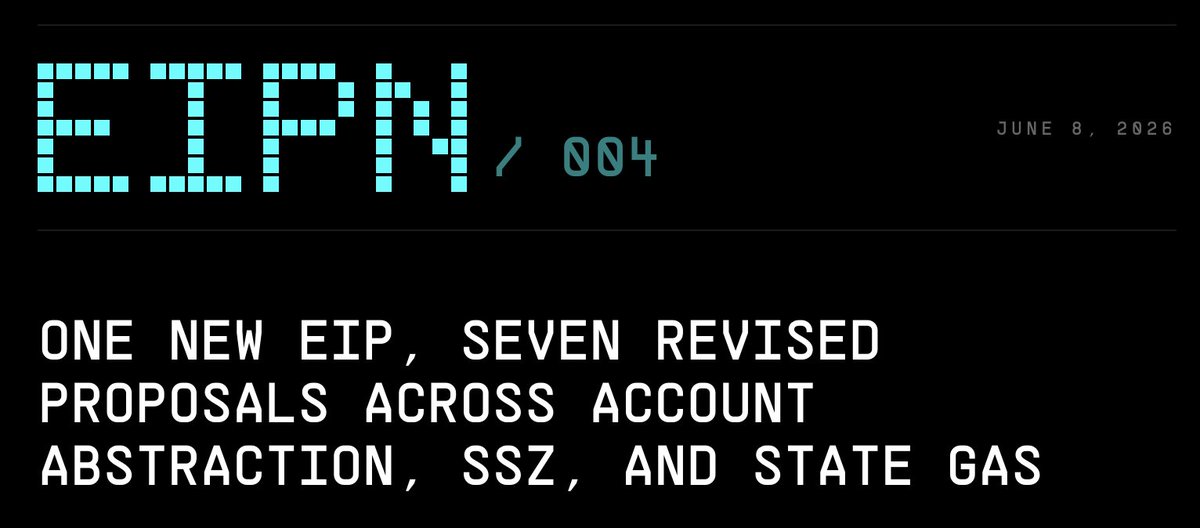
Five new Core EIPs were drafted this week.
Highlights include storage roots in block access lists, expiring nonces for Frame Transactions, a gas limit scheduling system, capped deposit requests per block, and a nonce bump for zero-nonce storage accounts.
Read about them here:
https://t.co/0YHbhaGl6v
Ethereum's validator set was still growing. 🖼️
Today: a different picture. 🖼️
Here's where consolidation toward the 128k target stands, what changed, who's moving, and why issuance keeps coming up. 🧵
Thanks @nixorokish for reviewing 🥰
1/8
Excited to be collaborating with @devanshmehta on the technical implementation of this.
Aligning validator incentives so funding public goods becomes economically rational rather than altruistic.
Looking forward to putting it in front of validators for signaling on the hub.
Given the graveyard of in-protocol funding EIPs, this was a talk @clesaege & i went into with some trepidation 🤞
the clever part is it doesn't affect issuance amount so much as redirect it to attain the following nash equilibrium,
loss of staking revenue = E [Extra Value to ETH]
our plan is to put this proposal forth as an EIP.
the next sections tackle the how, why and what next
[A] how would it work?
an ethereum hard fork where operators are required to signal 3 things;
(1) the amount of gas limit they can handle (already exists)
(2) the amount of staking rewards redirected to ethereum growth
(3) the recipient addresses they want to redirect it to
if a majority puts up their flag for a non-zero amount in (2), then all validators must give up that share of staking rewards to prevent free riding
condorcet voting then gets applied to the preferences indicated in (3) to arrive at
- the final list of addresses receiving funding from validators and
- the amounts they each get
this is set & forget voting, which only needs updating by operators if their preferences on recipient addresses and amount redirected changes
[B] Why will it be used?
1. Improve operator UX: common feedback we heard from validators is that operator UX is terrible.
collectively using a share of staking rewards to fund developer teams that propose solutions lowering the costs of being a staker is an economically rational decision
2. Increase value of principal: most validators care about the value of their underlying 32 ETH more than the yield they get from staking it
so if redirecting a part of staking rewards to projects like quantum resistance, lean ethereum, etc increases the value of ETH, it is rational for them to do so
3. Competitive Pressures: Currently, validators choose staking operators purely on a financial basis of risk vs return. With this change, they would begin choosing based on factors like redirect amounts and who it is being sent to, forcing operators to adapt to demands from their customers
[C] What Next?
- Over the next month, we plan on a technical implementation of the idea in collaboration with the @ethvaorg
- we would then put it forth as a formal EIP for debate & discussion, along with asking validators to signal support or distrust for the EIP on the ethva hub.
- unless serious issues are raised, argue for its inclusion in the hard fork after Hegota (early 2027), which is currently seeking ideas for improving ETH issuance acc to the strawmap
get in touch if you have ideas or want to help!
Given the graveyard of in-protocol funding EIPs, this was a talk @clesaege & i went into with some trepidation 🤞
the clever part is it doesn't affect issuance amount so much as redirect it to attain the following nash equilibrium,
loss of staking revenue = E [Extra Value to ETH]
our plan is to put this proposal forth as an EIP.
the next sections tackle the how, why and what next
[A] how would it work?
an ethereum hard fork where operators are required to signal 3 things;
(1) the amount of gas limit they can handle (already exists)
(2) the amount of staking rewards redirected to ethereum growth
(3) the recipient addresses they want to redirect it to
if a majority puts up their flag for a non-zero amount in (2), then all validators must give up that share of staking rewards to prevent free riding
condorcet voting then gets applied to the preferences indicated in (3) to arrive at
- the final list of addresses receiving funding from validators and
- the amounts they each get
this is set & forget voting, which only needs updating by operators if their preferences on recipient addresses and amount redirected changes
[B] Why will it be used?
1. Improve operator UX: common feedback we heard from validators is that operator UX is terrible.
collectively using a share of staking rewards to fund developer teams that propose solutions lowering the costs of being a staker is an economically rational decision
2. Increase value of principal: most validators care about the value of their underlying 32 ETH more than the yield they get from staking it
so if redirecting a part of staking rewards to projects like quantum resistance, lean ethereum, etc increases the value of ETH, it is rational for them to do so
3. Competitive Pressures: Currently, validators choose staking operators purely on a financial basis of risk vs return. With this change, they would begin choosing based on factors like redirect amounts and who it is being sent to, forcing operators to adapt to demands from their customers
[C] What Next?
- Over the next month, we plan on a technical implementation of the idea in collaboration with the @ethvaorg
- we would then put it forth as a formal EIP for debate & discussion, along with asking validators to signal support or distrust for the EIP on the ethva hub.
- unless serious issues are raised, argue for its inclusion in the hard fork after Hegota (early 2027), which is currently seeking ideas for improving ETH issuance acc to the strawmap
get in touch if you have ideas or want to help!
Privacy is enforced at the API layer, not cryptographically. Individual signals are stored with wallet addresses and signatures in our database, but no public endpoint ever exposes them. Only aggregate totals (stake-weighted sentiment, participant counts) are published. A wallet can only retrieve its own signal history via an authenticated endpoint.
ZK-based signal attestation is something we're actively looking at as a path to stronger, trust-minimized privacy.
Had a great time chatting with validators, the EF, and users who are trying to make @ethereum a better space.
Special thanks to the @ethvaorg and the @ethcforg for putting tonight’s event together.
Look below for the
Tomorrow in Cannes,
EVA hosts its second Validator Symposium, bringing validators, staking operators, and protocol stakeholders together to discuss validator economics, institutional staking realities, and the EIPs shaping what comes next.
Speakers:
@patmilkgallon — @ethcforg / EVA
Lukasz Kadziela & Yves Holenstein — Bitcoin Suisse
@ralexstokes — Ethereum Foundation
Invite only. Doors at 4:30 PM. Programming at 5:00 PM.
Buenos Aires showed what happens when validators have a real forum and Cannes continues it.
Over 2 million validators secure $eth and yet they've never had collective representation in protocol decisions that directly impact their operations and economics.
The @ethvaorg exists to make sure they have one. Tomorrow in Cannes, round two.
Tomorrow in Cannes,
EVA hosts its second Validator Symposium, bringing validators, staking operators, and protocol stakeholders together to discuss validator economics, institutional staking realities, and the EIPs shaping what comes next.
Speakers:
@patmilkgallon — @ethcforg / EVA
Lukasz Kadziela & Yves Holenstein — Bitcoin Suisse
@ralexstokes — Ethereum Foundation
Invite only. Doors at 4:30 PM. Programming at 5:00 PM.
Buenos Aires showed what happens when validators have a real forum and Cannes continues it.


![devanshmehta's tweet photo. Given the graveyard of in-protocol funding EIPs, this was a talk @clesaege & i went into with some trepidation 🤞
the clever part is it doesn't affect issuance amount so much as redirect it to attain the following nash equilibrium,
loss of staking revenue = E [Extra Value to ETH]
our plan is to put this proposal forth as an EIP.
the next sections tackle the how, why and what next
[A] how would it work?
an ethereum hard fork where operators are required to signal 3 things;
(1) the amount of gas limit they can handle (already exists)
(2) the amount of staking rewards redirected to ethereum growth
(3) the recipient addresses they want to redirect it to
if a majority puts up their flag for a non-zero amount in (2), then all validators must give up that share of staking rewards to prevent free riding
condorcet voting then gets applied to the preferences indicated in (3) to arrive at
- the final list of addresses receiving funding from validators and
- the amounts they each get
this is set & forget voting, which only needs updating by operators if their preferences on recipient addresses and amount redirected changes
[B] Why will it be used?
1. Improve operator UX: common feedback we heard from validators is that operator UX is terrible.
collectively using a share of staking rewards to fund developer teams that propose solutions lowering the costs of being a staker is an economically rational decision
2. Increase value of principal: most validators care about the value of their underlying 32 ETH more than the yield they get from staking it
so if redirecting a part of staking rewards to projects like quantum resistance, lean ethereum, etc increases the value of ETH, it is rational for them to do so
3. Competitive Pressures: Currently, validators choose staking operators purely on a financial basis of risk vs return. With this change, they would begin choosing based on factors like redirect amounts and who it is being sent to, forcing operators to adapt to demands from their customers
[C] What Next?
- Over the next month, we plan on a technical implementation of the idea in collaboration with the @ethvaorg
- we would then put it forth as a formal EIP for debate & discussion, along with asking validators to signal support or distrust for the EIP on the ethva hub.
- unless serious issues are raised, argue for its inclusion in the hard fork after Hegota (early 2027), which is currently seeking ideas for improving ETH issuance acc to the strawmap
get in touch if you have ideas or want to help!](https://pbs.twimg.com/media/HFjCLY2a8AEM-8z.jpg)
![devanshmehta's tweet photo. Given the graveyard of in-protocol funding EIPs, this was a talk @clesaege & i went into with some trepidation 🤞
the clever part is it doesn't affect issuance amount so much as redirect it to attain the following nash equilibrium,
loss of staking revenue = E [Extra Value to ETH]
our plan is to put this proposal forth as an EIP.
the next sections tackle the how, why and what next
[A] how would it work?
an ethereum hard fork where operators are required to signal 3 things;
(1) the amount of gas limit they can handle (already exists)
(2) the amount of staking rewards redirected to ethereum growth
(3) the recipient addresses they want to redirect it to
if a majority puts up their flag for a non-zero amount in (2), then all validators must give up that share of staking rewards to prevent free riding
condorcet voting then gets applied to the preferences indicated in (3) to arrive at
- the final list of addresses receiving funding from validators and
- the amounts they each get
this is set & forget voting, which only needs updating by operators if their preferences on recipient addresses and amount redirected changes
[B] Why will it be used?
1. Improve operator UX: common feedback we heard from validators is that operator UX is terrible.
collectively using a share of staking rewards to fund developer teams that propose solutions lowering the costs of being a staker is an economically rational decision
2. Increase value of principal: most validators care about the value of their underlying 32 ETH more than the yield they get from staking it
so if redirecting a part of staking rewards to projects like quantum resistance, lean ethereum, etc increases the value of ETH, it is rational for them to do so
3. Competitive Pressures: Currently, validators choose staking operators purely on a financial basis of risk vs return. With this change, they would begin choosing based on factors like redirect amounts and who it is being sent to, forcing operators to adapt to demands from their customers
[C] What Next?
- Over the next month, we plan on a technical implementation of the idea in collaboration with the @ethvaorg
- we would then put it forth as a formal EIP for debate & discussion, along with asking validators to signal support or distrust for the EIP on the ethva hub.
- unless serious issues are raised, argue for its inclusion in the hard fork after Hegota (early 2027), which is currently seeking ideas for improving ETH issuance acc to the strawmap
get in touch if you have ideas or want to help!](https://pbs.twimg.com/media/HFjAEnkakAQBwgx.jpg)
![devanshmehta's tweet photo. Given the graveyard of in-protocol funding EIPs, this was a talk @clesaege & i went into with some trepidation 🤞
the clever part is it doesn't affect issuance amount so much as redirect it to attain the following nash equilibrium,
loss of staking revenue = E [Extra Value to ETH]
our plan is to put this proposal forth as an EIP.
the next sections tackle the how, why and what next
[A] how would it work?
an ethereum hard fork where operators are required to signal 3 things;
(1) the amount of gas limit they can handle (already exists)
(2) the amount of staking rewards redirected to ethereum growth
(3) the recipient addresses they want to redirect it to
if a majority puts up their flag for a non-zero amount in (2), then all validators must give up that share of staking rewards to prevent free riding
condorcet voting then gets applied to the preferences indicated in (3) to arrive at
- the final list of addresses receiving funding from validators and
- the amounts they each get
this is set & forget voting, which only needs updating by operators if their preferences on recipient addresses and amount redirected changes
[B] Why will it be used?
1. Improve operator UX: common feedback we heard from validators is that operator UX is terrible.
collectively using a share of staking rewards to fund developer teams that propose solutions lowering the costs of being a staker is an economically rational decision
2. Increase value of principal: most validators care about the value of their underlying 32 ETH more than the yield they get from staking it
so if redirecting a part of staking rewards to projects like quantum resistance, lean ethereum, etc increases the value of ETH, it is rational for them to do so
3. Competitive Pressures: Currently, validators choose staking operators purely on a financial basis of risk vs return. With this change, they would begin choosing based on factors like redirect amounts and who it is being sent to, forcing operators to adapt to demands from their customers
[C] What Next?
- Over the next month, we plan on a technical implementation of the idea in collaboration with the @ethvaorg
- we would then put it forth as a formal EIP for debate & discussion, along with asking validators to signal support or distrust for the EIP on the ethva hub.
- unless serious issues are raised, argue for its inclusion in the hard fork after Hegota (early 2027), which is currently seeking ideas for improving ETH issuance acc to the strawmap
get in touch if you have ideas or want to help!](https://pbs.twimg.com/media/HFjAEnbakAMDPE6.jpg)











![devanshmehta's tweet photo. Given the graveyard of in-protocol funding EIPs, this was a talk @clesaege & i went into with some trepidation 🤞
the clever part is it doesn't affect issuance amount so much as redirect it to attain the following nash equilibrium,
loss of staking revenue = E [Extra Value to ETH]
our plan is to put this proposal forth as an EIP.
the next sections tackle the how, why and what next
[A] how would it work?
an ethereum hard fork where operators are required to signal 3 things;
(1) the amount of gas limit they can handle (already exists)
(2) the amount of staking rewards redirected to ethereum growth
(3) the recipient addresses they want to redirect it to
if a majority puts up their flag for a non-zero amount in (2), then all validators must give up that share of staking rewards to prevent free riding
condorcet voting then gets applied to the preferences indicated in (3) to arrive at
- the final list of addresses receiving funding from validators and
- the amounts they each get
this is set & forget voting, which only needs updating by operators if their preferences on recipient addresses and amount redirected changes
[B] Why will it be used?
1. Improve operator UX: common feedback we heard from validators is that operator UX is terrible.
collectively using a share of staking rewards to fund developer teams that propose solutions lowering the costs of being a staker is an economically rational decision
2. Increase value of principal: most validators care about the value of their underlying 32 ETH more than the yield they get from staking it
so if redirecting a part of staking rewards to projects like quantum resistance, lean ethereum, etc increases the value of ETH, it is rational for them to do so
3. Competitive Pressures: Currently, validators choose staking operators purely on a financial basis of risk vs return. With this change, they would begin choosing based on factors like redirect amounts and who it is being sent to, forcing operators to adapt to demands from their customers
[C] What Next?
- Over the next month, we plan on a technical implementation of the idea in collaboration with the @ethvaorg
- we would then put it forth as a formal EIP for debate & discussion, along with asking validators to signal support or distrust for the EIP on the ethva hub.
- unless serious issues are raised, argue for its inclusion in the hard fork after Hegota (early 2027), which is currently seeking ideas for improving ETH issuance acc to the strawmap
get in touch if you have ideas or want to help!](https://pbs.twimg.com/media/HFjCNl8agAA6Bxy.jpg)