🛑 [New] 9-Year-Old Linux Kernel Bug = Local Root on Default Debian, Ubuntu & Fedora.
https://t.co/eluZfH76j8
CVE-2026-46333 (ssh-keysign-pwn) lets any unprivileged user steal /etc/shadow + SSH host keys and run commands as root.
🔸 Public PoC available
🔸 Patch your kernel NOW
🔸 Quick temp fix - sysctl kernel.yama.ptrace_scope=2
⚡ Not via a fancy zero-day... #GitHub confirmed its internal repositories were breached after an employee device installed a poisoned Nx Console VS Code extension.
https://t.co/ERmMV4gwUl
TeamPCP exfiltrated ~3,800 repos in an 18-minute window.
The extension deployed a credential stealer targeting 1Password, GitHub tokens, AWS, and more via auto-updates.
We are investigating unauthorized access to GitHub’s internal repositories. While we currently have no evidence of impact to customer information stored outside of GitHub’s internal repositories (such as our customers’ enterprises, organizations, and repositories), we are closely monitoring our infrastructure for follow-on activity.
⚠️ Microsoft Edge Stores All Saved Passwords in Cleartext Process Memory at Launch
Source: https://t.co/ROEbnQ9syu
Microsoft Edge decrypts every stored password into process memory the moment the browser launches and keeps them there as cleartext, regardless of whether the user ever visits those sites.
A researcher who systematically tested every major Chromium-based browser for credential memory handling behavior. Edge was the only browser that exhibited this behavior, loading the entire password vault into plaintext process memory at startup and retaining it for the duration of the session.
In a published proof-of-concept video accompanying the disclosure, a compromised administrator account was used to successfully extract stored credentials.
#cybersecuritynews
⚡ The internet took a beating this week.
• cPanel servers wiped
• Linux 100% kernel hack
• TeamPCP supply chain storm
• GitHub one-push RCE
• AI-powered phishing kits
• Ransomware +389%
• Scattered Spider arrest
...and many MORE STORIES.
Full recap 👇 https://t.co/T2tfz7WYC1
⚠️ UPDATE: #cPanel flaw now tracked as CVE-2026-41940 (CVSS 9.8)—an auth bypass granting unauthenticated admin access.
Reportedly exploited as a 0-day, with activity observed for at least 30 days before disclosure. Root cause: CRLF injection enabling session forgery.
🔗 Exploit mechanics and real-world impact → https://t.co/8mHLoqywHY
CISA has ordered U.S. federal agencies to patch a Microsoft Defender privilege escalation flaw (dubbed BlueHammer) that has been exploited in zero-day attacks.
https://t.co/isROAzx5Az
Bitwarden identified and contained a malicious package briefly distributed through the npm delivery path for the Bitwarden CLI in connection with the broader Checkmarx supply chain incident. No user vault data or production systems were compromised or at-risk. Additional details and updates are available here: https://t.co/9xRzNxmCOS
🚨 Password manager Bitwarden CLI v2026.4.0 was compromised in the ongoing Checkmarx supply chain campaign.
Attackers abused a GitHub Action in Bitwarden's CI/CD pipeline to ship malicious code.
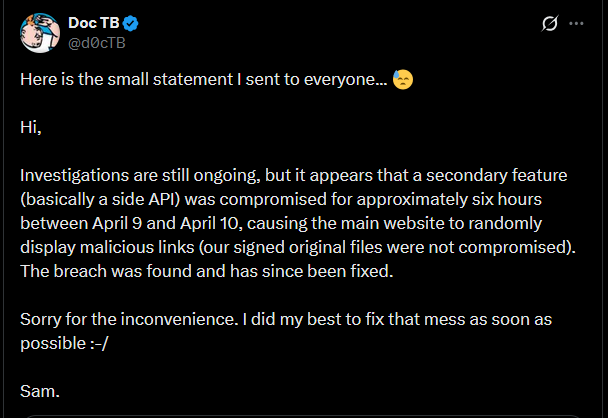
CPU-Z and HWMonitor nerd (@d0cTB) put out a statement.
Compromise was present for approx. 6 hours. This is an extremely short period of time.
Also, extremely fast response by the nerds at cpuid.
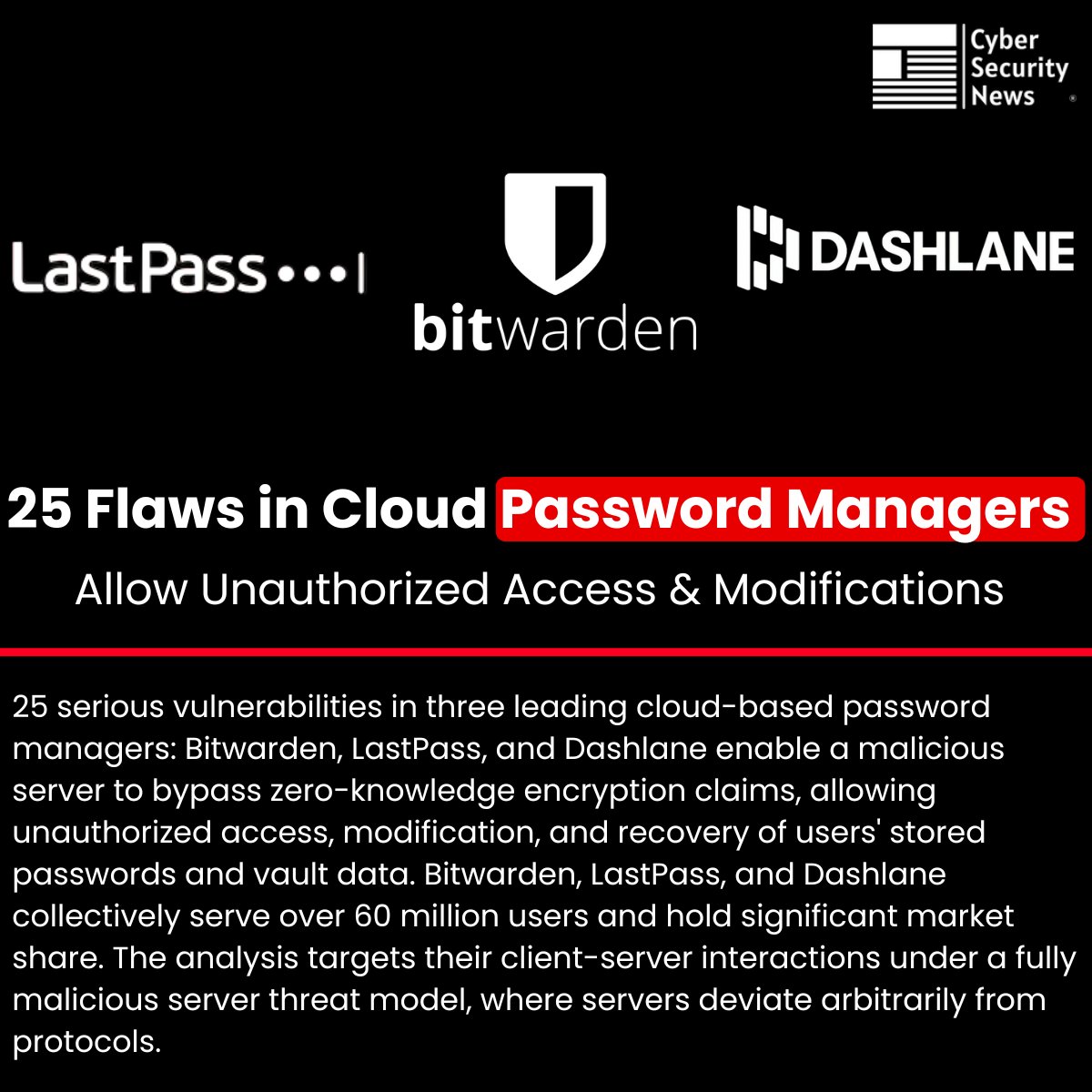
🔑25 Vulnerabilities in Cloud Password Managers Allow Unauthorized Access and Modifications
Source: https://t.co/Rs3dMe48zf
25 critical vulnerabilities in three leading cloud-based password managers: Bitwarden, LastPass, and Dashlane enable a malicious server to bypass zero-knowledge encryption claims, allowing unauthorized access, modification, and recovery of users' stored passwords and vault data.
Bitwarden, LastPass, and Dashlane collectively serve over 60 million users and hold significant market share. The analysis targets their client-server interactions under a fully malicious server threat model, where servers deviate arbitrarily from protocols.
#cybersecuritynews #passwordmanagers
❗️🇨🇭 Researchers at ETH Zürich have discovered serious vulnerabilities in cloud-based password managers that allowed viewing and modifying stored passwords.
1Password, Bitwarden, Dashlane, and LastPass were all affected by critical vulnerabilities.