Loops vs. Graphs, clearly explained!
loops are great, and they have a ceiling you can watch happen:
a loop goes around. it produces, checks, corrects, and goes around again.
after six passes you have one job, done very well.
after six hundred passes you still have one job, done very well.
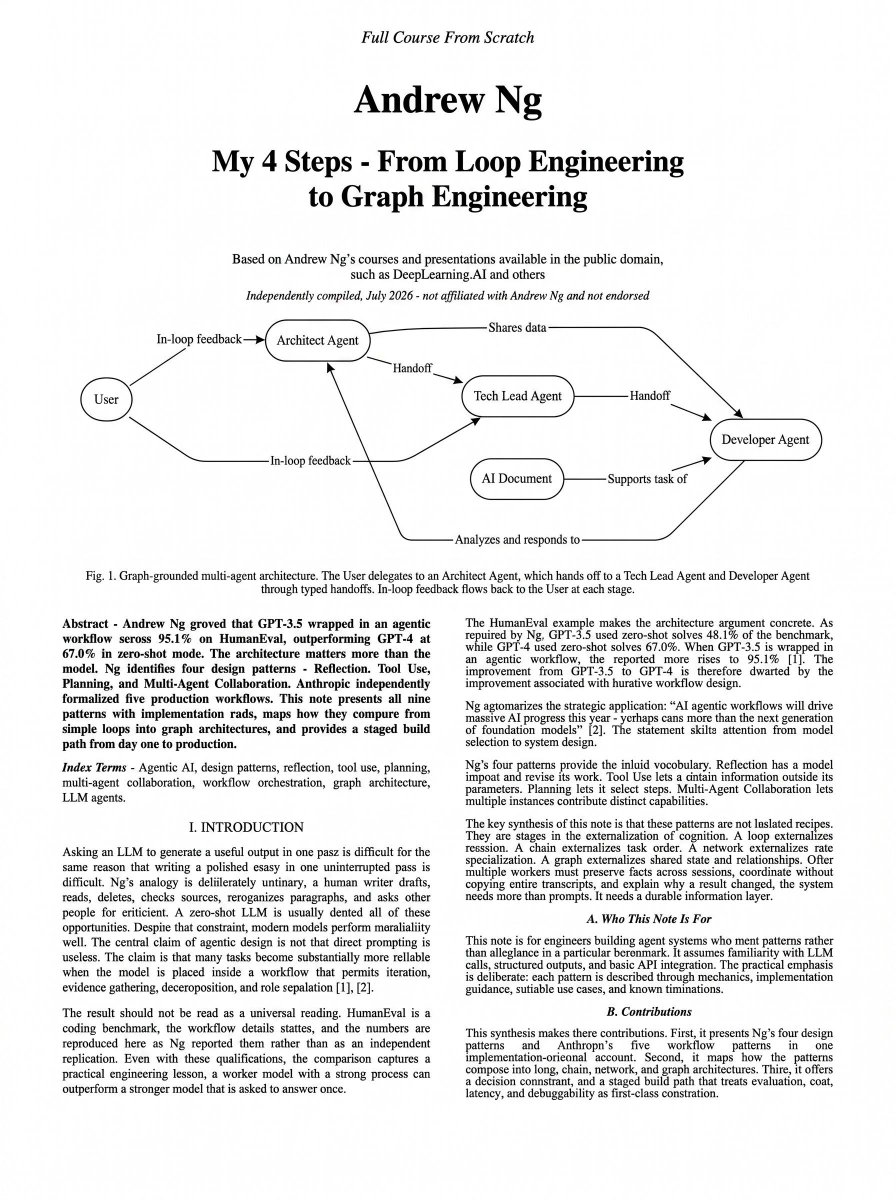
Graph engineering fixes this by moving the decision up a layer: not how well one job gets done, but which jobs exist to be done at all.
you need both, and here is the sentence that resolves the whole confusion:
the loop lives inside a node. the graph lives between them.
↳ inside one unit: produce, check, correct, repeat until green
↳ between units: split, fan out, merge, gate, send back
Prompts → Context → Harness → Loops → Graphs
the loop does not go away when you build a graph.
it moves inside, and now there are three of them running at once on three things you would never have thought to run.
the trick is being selective about what becomes a node.
only spend a model where judgment lives.
merging, ranking, deduping and schema checks are edges, and edges are code. free, instant, and they cannot be argued out of a verdict.
one thing to know before you scale it.
a loop that cannot fail is not a loop, it is a repeat with a bill attached.
and the check people write is almost always the wrong kind.
↳ the test suite exits 0 is a check. the diff touches only the files in the plan is a check
↳ the output looks good, the model says it is confident, no errors were raised, none of those are checks
that last one catches careful people.
absence of an error is not evidence of correctness, and a loop built on it will confidently repeat a mistake until the budget runs out, with a clean log the whole way.
and the one that eats whole nights: when a unit fails, return that unit, not the batch.
send back four slices because one failed and you have just rewritten three correct ones. do it twice in a run and the run never converges.
below i have quoted my full guide on graph engineering. it covers the three topologies, the verifier patterns, and where the gate should actually open.
save this and read it below ↓
this is f*cking gold
Andrej Karpathy joined Anthropic to lead a team pointing Claude at Anthropic's own pretraining research
a model helping design the model that comes after it
that part is confirmed
the line going around - "two Anthropic seniors made his loop 1000x better with graph engineering" - nobody can source it
I'm not inventing a quote to make the number bigger
what is real and public: Anthropic's own Claude cookbook on knowledge graph construction
> extract - pull entities and claims out of raw text
> resolve - decide which mentions point to the same thing
> assemble - connect them with typed edges
> query - ask questions no single document could answer
four steps, published, free, sitting in the repo while the timeline quotes a rumor
learn them and you can build the thing that rumor was describing
read the cookbook first. then decide if the article below earned the click
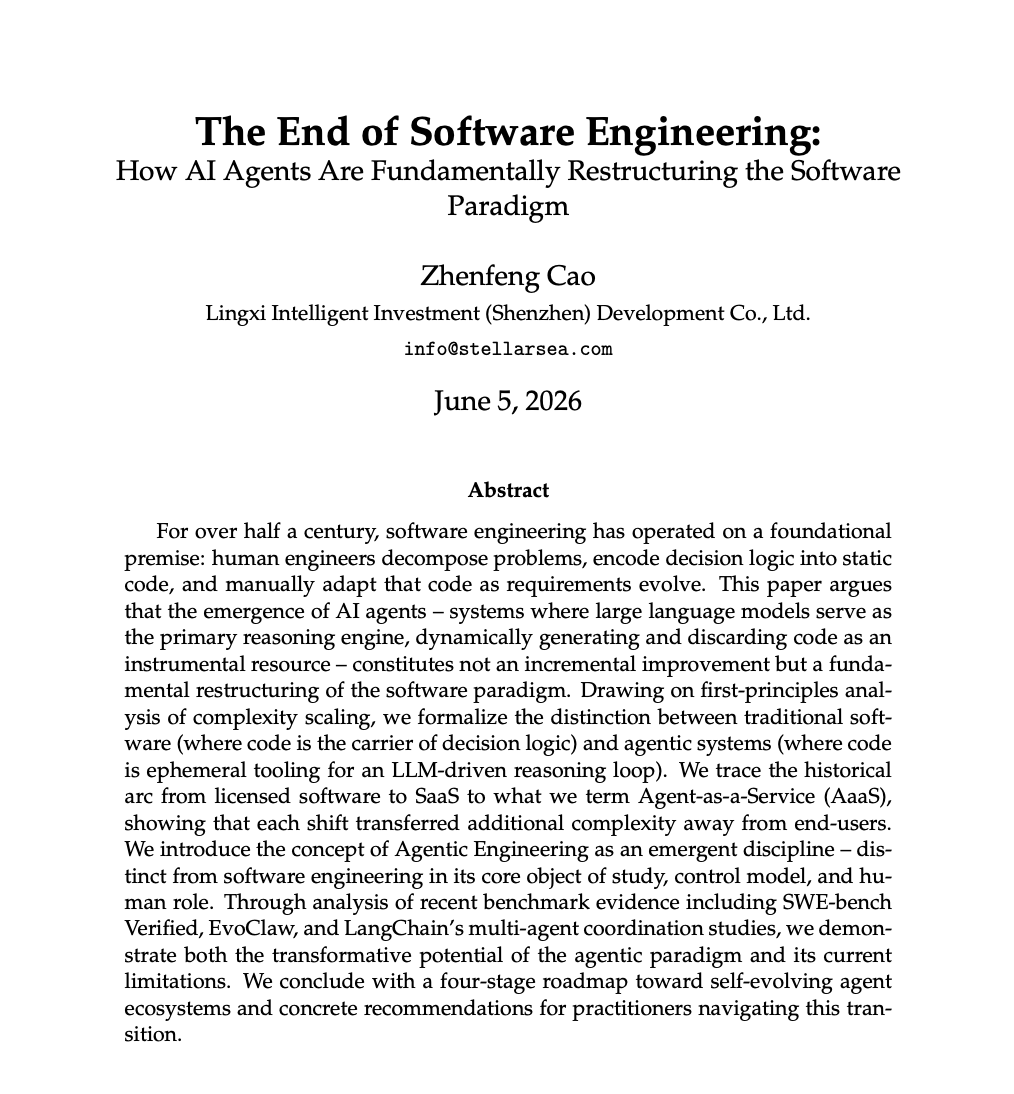
Chinese researchers published a paper with a devastating title: "The End of Software Engineering”
it argues software engineering is finished.
In traditional software, code is the carrier of pre-written human logic.
In agentic software, the AI agent is the software.
Code is no longer a permanent monument built by human hands. It is completely ephemeral, dynamically generated, executed, and discarded on the fly by an LLM-driven reasoning loop.
Think about how software delivery has evolved:
• Era 1: On-premise licensed software (you installed it locally)
• Era 2: SaaS (hosted in the cloud, managed by vendors)
• Era 3: Agent-as-a-Service (AaaS)
Each historical shift transferred complexity away from the user. But this latest shift transfers something entirely different.
It transfers decision-making complexity itself.
The paper argues that traditional engineering is hitting a hard complexity wall. Human brains can only hold so much state, manage so many dependencies, and debug so many lines at once.
LLM-based agents scale non-linearly.
They don't just write functions faster. They navigate architectural complexity by outsourcing reasoning to models that improve every single month.
Which means the role of the developer is permanently changing.
You are no longer a code author typing syntax line by line.
You are an intent architect.
Your job is no longer writing the implementation. It is specifying goals, designing multi-agent coordination loops, and auditing outcomes.
Hoy se cruzó un umbral raro en IA:
Ya puedes generar video más rápido de lo que lo ves.
Usando Minimax H3 Max, un usuario en X armó un livestream infinito, bajo la tematica de Rick y Morty cambiando de canal y la tele generando shows interdimensionales en vivo.
Y es que ahora puedes generar 15 segundos de video en 9 segundos. Antes tardaba 2–5 minutos.
Eso habilita livestreams que no se acaban nunca.
Y otro usuario (@levelsio ) también ha creado su livestream donde pueden probarlo por ustedes mismos, usando este enlace: https://t.co/Hq7addbBbk
Train in sim. Run it for real. Teach it new tricks. 🦆
This is the sim2real loop that powers Microduck.
RL stack open source here : https://t.co/mveM7y5fYa
Buy it here : https://t.co/Rmk8F4vpKd
Git : https://t.co/kcoCKdBi52
Join our community : https://t.co/TcX5uaf0yL
TU AGENTE DE CÓDIGO AHORA DIBUJA ARQUITECTURAS DE VERDAD
Archify es un skill open source que convierte una descripción o un repositorio en un diagrama de arquitectura interactivo.
No es Mermaid.
No es un screenshot feo de Excalidraw.
Es un HTML auto-contenido con:
→ Diagramas de arquitectura, workflow, sequence, data-flow y lifecycle
→ Motion y trazado de rutas
→ Búsqueda y focus de nodos
→ Export PNG / SVG / WebM
→ Cards listas para compartir (1200×630)
Lo más importante:
Todo está validado.
No inventa conexiones.
Usa un JSON IR tipado + checks atómicos.
Funciona con Cursor, Claude Code, Codex y OpenCode.
16k estrellas.
Guárdalo. Es de los skills más útiles que han salido este año.
Repoo 👇👇