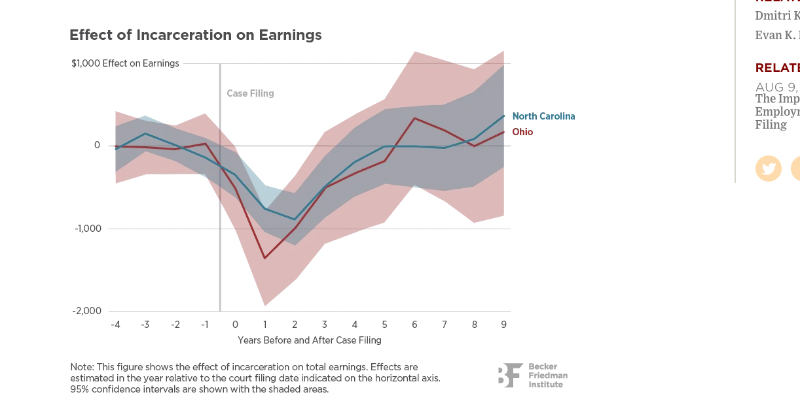
How does going to prison affect your earnings and employment?
Happy to have this working paper with @andy_garin, @dkoust, @sambnorris, @Jeff_Weaver_ , Carl, Matt, and @yotamshemtov with available now.
https://t.co/UDRVMFON5q
A short(ish) thread 🧵
Incarceration causes dips in economic activity, but limited long-run impacts. Why? Most defendants’ challenges begin before they enter prison.
From @evankrose (@uchi_economics), @andy_garin, @dkoust, @sambnorris, @Jeff_Weaver_, Carl McPherson, Matthew Pecenco, & Yotam Shem-Tov.
📢 Call for Papers: 2026 Interactions Conference
Bringing together econometrics & applied micro to improve modern empirical practice.
📍 May 15–16, 2026 | David Rubenstein Forum
🗓 Submissions due Feb. 15, 2026 https://t.co/PdRhDmP33B
Downtime before the New Year is the perfect time to submit to our upcoming conference on AI in the workplace!
https://t.co/v26WPfVM4z
Come interact with leading experts from Gemini, Anthropic, Microsoft, OpenAI, and private sector firms on the implementation frontier.
We are hosting a research-meets-industry conference on AI in the workplace this Spring! @ChenhaoTan@Econ_4_Everyone@AndersPHumlum
Come present your work in front of the scientists and practitioners putting these tools into use.
Submit here by Feb 15: https://t.co/GshMJLFVMP
We are hosting a research-meets-industry conference on AI in the workplace this Spring! @ChenhaoTan@Econ_4_Everyone@AndersPHumlum
Come present your work in front of the scientists and practitioners putting these tools into use.
Submit here by Feb 15: https://t.co/GshMJLFVMP
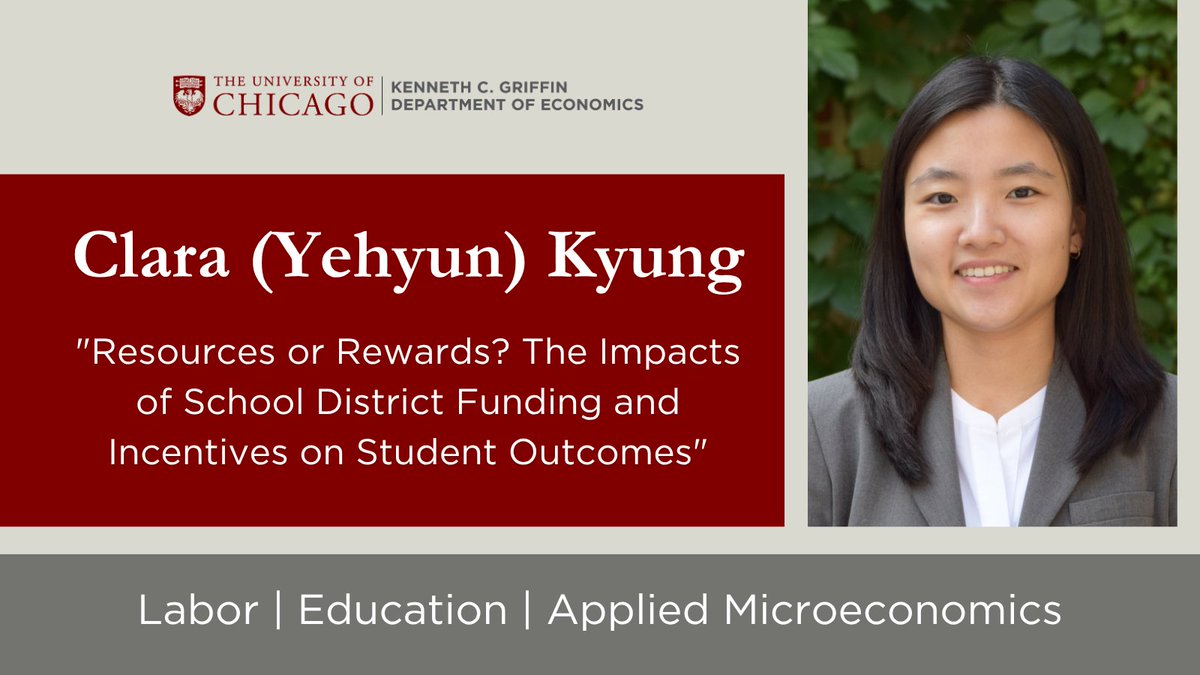
My awesome student @kyung_clara’s paper is a fascinating look at the benefits and (somewhat unanticipated) costs of accountability systems targeting students’ long-run outcomes. Check it out!
@kyung_clara works in labor and education. In her JMP, she studies the impacts of a reform that introduced financial bonuses for school districts based on graduates' outcomes. Learn more at https://t.co/h3m41zjP1K.
Read more: https://t.co/VBkyTa43GB
#UChicago#EconJobMarket
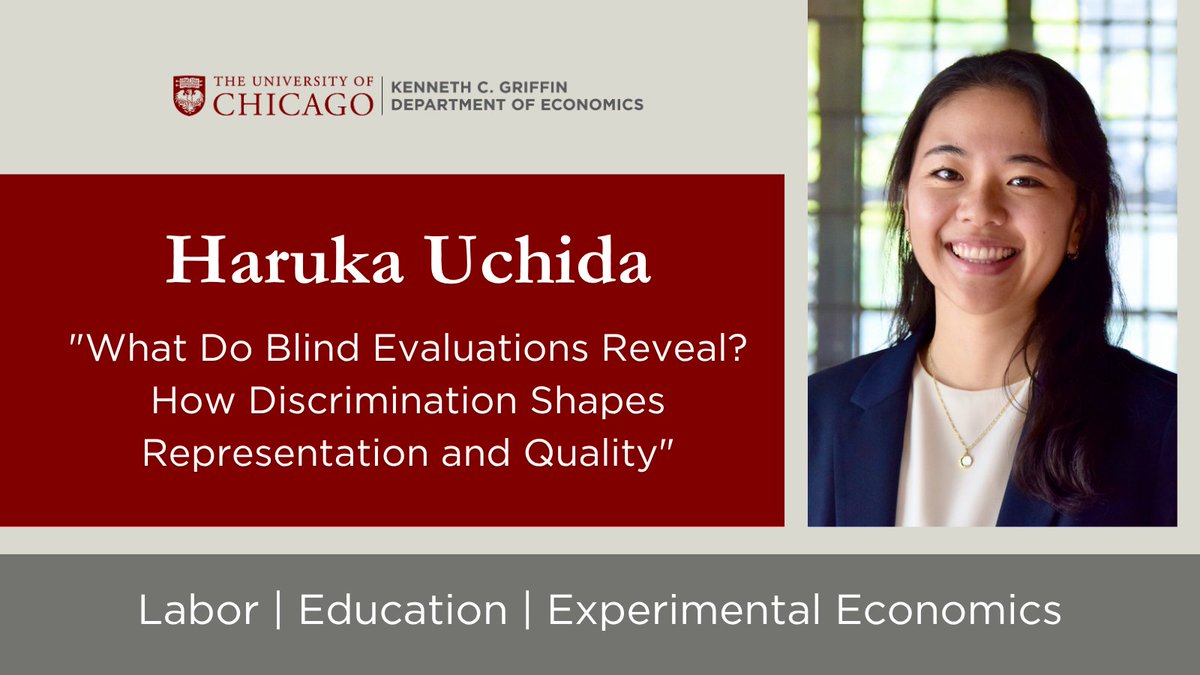
@haruka__uchida studies labor & education. Her JMP runs 2 field experiments to measure & disentangle forms of discrimination. She finds that hiding applicant names changes representation without reducing quality.
Read more: https://t.co/DzSnXBT0FZ
#UChicago#EconJobMarket
Want to run experiments on how AI will transform the workplace?
Come join a community of scholars at Chicago tackling this issue. Fellows will visit this Spring and receive generous support.
Early-career faculty especially encouraged!
Deadline Nov 30: https://t.co/EVL1rucZGX
Come work with me at Chicago. We have a great program that provides a ton of opportunities to learn in a very fun environment.
Candidates from all backgrounds are encouraged to apply.
@econ_ra
https://t.co/vovqXUUeFy
Chicago labor/public folks (including me) are hiring new research professionals! We have a great program that provides a ton of opportunities to learn in a very fun environment.
Candidates from all backgrounds are encouraged to apply.
@econ_ra
Details: https://t.co/A689E24Leb
We're hosting a causal inference conference for students at Chicago this March!
A great opportunity for students (including JMCs) to present research in empirical micro and applied metrics. We'll buy your flight and hotel.
Deadline is Nov. 30: https://t.co/AxmoNcS5dU
You guys! Our hiatus is over! I'm excited to bring you this interview w @evankrose, about the costs & benefits of using incarceration as a consequence for breaking probation rules. He measures the effect of a NC reform that ended such revocations. Important policy implications!
You guys! Our hiatus is over! I'm excited to bring you this interview w @evankrose, about the costs & benefits of using incarceration as a consequence for breaking probation rules. He measures the effect of a NC reform that ended such revocations. Important policy implications!
Stepping back, because most defendants are so disadvantaged, you can think of LFOs as a very regressive transfer to the average taxpayer.
We view their extensive use as yet more evidence of the low welfare weights society places on people who interact with the justice system.
A conviction typically comes with hundreds of dollars in fines and fees. A lot of recent work (e.g. https://t.co/otXZagIFOv) has questioned what this practice achieves.
New paper with @sambnorris looks at when lowering fees would be unambiguously better for everyone.
🧵
Decreasing criminal justice fees and fines benefits both the most disadvantaged defendants and local governments, from @sambnorris and @evankrose https://t.co/aJKlHcm1IJ
Our takeaway: LFOs are high mostly because they raise more revenue that way.
Reducing them would have fiscal costs, although more careful personalization could both increase revenue and decrease the burden on defendants.