Strategy has a PR problem: it looks like chatting.
The needle takes longer to find, but once you find it you need a lot less thread. I'd rather spend three weeks talking to people and ship four things that land than ship forty someone has to explain away in the board meeting.
The marketing JD that covers five departments and doesn't crack six figures.
Someone writes down everything marketing touches because they don't know how many jobs hide inside that word.
What they actually hire is a triage person who does whatever came up in Monday's meeting.
Handing a senior marketing hire a to-do list in week one tells you how the next six months will go.
Give them two weeks with no list. Let them talk to customers, read sales calls, come back with what they'd change.
If it matches your list, great. It usually won't.
Someone in my comments said founders equate thinking with waiting, and I haven't stopped turning it over.
The fix: report decisions, not deliverables. What we're doing, who it's for, what we're skipping, and why.
A strategy deck nobody asked for is its own kind of graphic.
Ghostwriting means making you sound like yourself on a good day.
The most common problem in ghostwritten content is polish. Every sentence is smooth and nobody would ever say one out loud. Readers can't name what's wrong. They just feel it and keep scrolling.
I get asked about paid ads a lot by founders who haven't figured out what they're saying yet.
My answer is usually to wait. Ads are an expensive way to find out your message doesn't work. Organic posting is a cheap way to find out the same thing, with the added benefit that nobody bills you per failure.
Run the ideas organically first. Watch which ones people argue with, save and forward to a colleague. Then put money behind the things that already proved they can hold a stranger's attention for more than a second.
Founders tend to hate this advice because it's slower and doesn't come with a dashboard. I get it. A dashboard feels like progress even when it's measuring the wrong thing, and organic testing mostly feels like waiting while your competitor's ad follows you around the internet.
Built online communities since age 7. By 15, a gaming site with 200K monthly visitors on an allowance budget.
If I were CMO needing community-led growth, I'd start with 20 people. The best program I've run started that size and hit $500K+ in 90 days.
Then give it two years.
"A lot of views" means something different depending on what you sell.
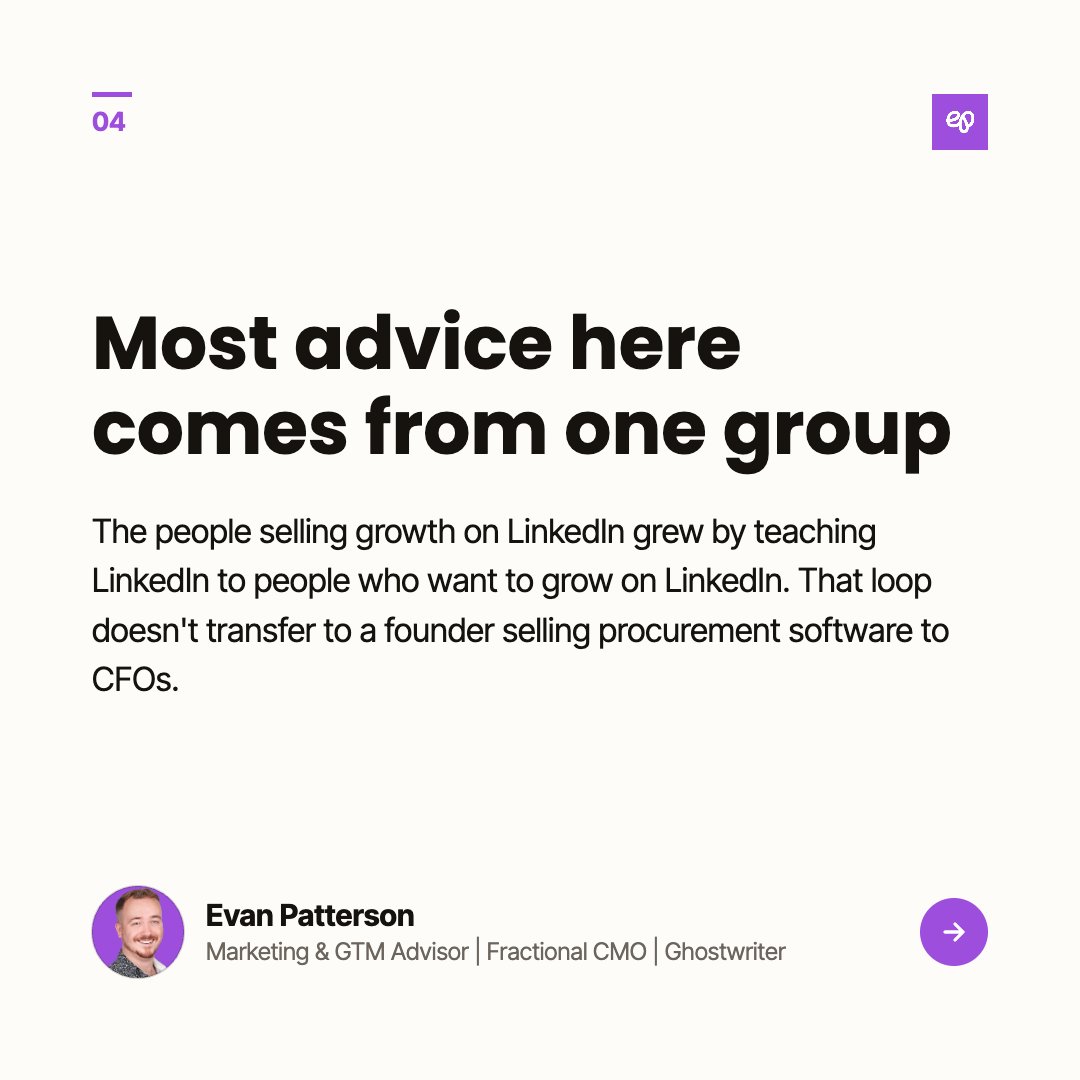
LinkedIn growth coaches grew by teaching LinkedIn growth. That loop doesn't transfer to a founder selling procurement software to CFOs. Figure out what one view is worth before chasing more.
Most of my career has been at the zero-to-one stage, where decisions get made fast, often in a room marketing hasn't been invited into yet.
The price changes. A new service line gets approved. Someone decides the company is going upmarket. Then a calendar invite shows up with a title like "GTM sync," and the question on the agenda is how we should promote it.
By then the useful questions are gone. Whether anyone wants this at this price. Whether we have the credibility to sell it. Who already owns this position in the customer's head. What the customer can see that we can't from inside the building. Those were marketing's questions, and they got answered by default because nobody asked them out loud.
I don't think marketing should make every call. I do think the market deserves a seat in the room, and marketing is usually the one holding its chair. The thing I'm still practicing is inviting myself in earlier, which is awkward the first couple of times and then just becomes part of how I work.
A lot of founders start posting on LinkedIn by giving advice, and I understand why. Advice feels safe and sounds expert. It also puts you in direct competition with every account that has more followers and a better headshot saying the same thing.
The readers you want don't need a sixth person telling them to know their ICP. What they can't get anywhere else is you: the specific decision you made, what it cost, and the opinion you hold that your cofounder thinks is a little much.
That's where I start with clients. Story and point of view first, for a few months if that's what it takes. The teaching comes later, and it lands better because by then people know whose advice it is.
I'm aware of the irony of giving advice about not giving advice. I've decided to allow it this once.
The most common reason I lose deals is a compliment.
"You're overqualified for where we are."
I've heard some version of it enough times that I now read it as feedback about my offer instead of my résumé. A seed-stage founder looks at 15 years in marketing, sales and go-to-market, does the math on what that must cost, and most of the time they're right to be nervous.
The pattern I kept running into was frustrating. The founders who most need help sorting out their offer, price and pipeline were usually the ones least able to pay for a full engagement, and the ones with budget often didn't have the problem.
So I built smaller ways in. A paid diagnostic, a set of free tools, a newsletter. Some people will use those and never hire me, which is fine by me. Some will get far enough to need me, and by then they'll already know what I'm like.
I'd still rather be overqualified than the alternative. It just pays less than you'd think.
Marketing doesn't make money. Marketing makes making money possible.
At least in B2B, it seldomly does so directly.
I say some version of that a lot, usually right around the moment a founder asks how many leads they'll see in month one.
It's also why marketing gets cut first. When cash gets tight, the spreadsheet can see the marketing invoice and can't see what it was holding up. Sales has a quota. Product has a roadmap. Marketing has a budget line that looks optional right up until the pipeline thins out two quarters later, and by then nobody remembers who made the call.
I've watched this happen to clients more than once, and it rarely goes the way the spreadsheet promised.
Sometimes the spend deserved to go. Plenty of marketing budgets are paying for things nobody would miss. What worries me is when the cut takes out the work that explains who you're for and why they should care, and then everyone wonders why sales calls got harder. Shrink the channels if you have to. I'd fight much harder for the positioning work, mostly because it's cheap and it's the part nobody remembers doing until it's gone.
Telling people "we'd miss you" is not suicide prevention.
Living wages are. Healthcare is. Affordable housing is. Clean air is. Media literacy is.
The conditions that make life livable are the only intervention that works.
Founders who tell me they have nothing interesting to say will then spend 40 minutes on the customer who almost churned, the hire they got wrong, the pricing call they still replay in the shower.
The material is there. They just can't see it because they lived it.
When I was fifteen I ran a gaming community site that pulled 200,000 visitors a month, and the entire operation was funded by my allowance. It remains the leanest marketing budget I've ever managed, and I've worked at startups.
I'd been building online communities since I was seven. By sixteen someone was paying me to do marketing, which felt a lot like getting paid to breathe.
What took me most of my career to figure out is that traffic was the easy part. I had traffic at fifteen. What I didn't have was a reason for any of it: something to sell, a price, a person on the other end ready to buy.
I think about that kid when founders show me their dashboards. Impressions up, followers up, a lovely curve on the analytics page, and a pipeline that looks exactly like it did in March. They've done the part I figured out as a teenager and skipped the part that pays rent.
Growth is an input. It should be sized to the business it feeds, and most of the time that business needs a clear offer and a price long before it needs another 10,000 views. I've been trying to work out how to teach that second part without turning it into a course, which would be a very on-brand way to miss the point.
I tell clients to ship it ugly. Fix it in public. Stop polishing something nobody's seen yet.
I've given that advice a hundred times. I believe it.
I have a document done enough a week ago. Still sitting there because one paragraph doesn't sound like me yet.
(It's shipping.)
Hiring someone and then hovering is management theater.
You're paying for judgment you won't use. The hire learns their judgment doesn't count. Six months later you're exhausted and they're job hunting.
"Doing it yourself" stopped being a necessity and became a personality.
I'm rebuilding my business into something that's going to look strange next to my old headline.
Less "marketer," more go-to-market and revenue. Some of it hands-on, some of it advisory by the hour, some of it help with the offer and the product itself, because I keep finding that the marketing was never the problem. The thing being marketed was.
I also want more than one way in. High-touch for the founders who need it. Something in the middle. Webinars you can buy a ticket to. Tools and assets and a book you can use without ever talking to me. Options for wherever someone is financially, so the answer to "can I work with you" stops being "only if you have five figures a month."
It's a lot. I'm building it in order, which is a sentence I've had to repeat to myself several times this week.
My objection to selling a small, cheap offer was that it would eat my time and not pay my bills.
I still think the second part is true. Nobody's covering rent with a $100 product. The first part I had backwards.
The person who buys the small thing is, in a lot of cases, the big client, early. They buy the small thing, use it to make a little more money, and now they can afford the medium thing, and a year later they can afford me. I was asking strangers to go from a post to several thousand dollars a month in one jump, and calling it a demand problem when they didn't.
So the small door is the on-ramp. It's also how I get to work with people I like before they can afford to hire me, which, it turns out, was the part I was missing most.