Top of the Democratic agenda on day 1 needs to be a pause on advanced AI development, regulation of this out of control industry, and a ban on artificial superintelligence.
BREAKING: An American shipyard that was once shutting down is now producing autonomous ships following @Saronic takeover.
Saronic has launched its second 180-foot Marauder autonomous ship from its shipyard in Franklin, Louisiana. The second ship required 8% fewer labor hours to build than the first, with plans to scale production to 20 Marauders annually.
@elonmusk 1. It absolutely can be, and is actively being jammed in many regions. I can share the I/Q if needed.
2. Space is a contested domain. Your constellation is no safer than ICEYE’s birds.
3. The aggressor chooses to prolong this. Don’t blame the victims for defending themselves.
If an attacker parks outside your building with a $1,500 software-defined radio, a 5G smartphone will still drop its connection, connect to a fake 1991-era GSM tower, and hand over its permanent hardware identity in cleartext.
Every modern baseband modem still carries legacy 2G silicon for backward compatibility, and that 2G stack has no way to verify if a cell tower is real.
1. The architectural flaw: One-way tower trust
In 4G (LTE) and 5G, mobile networks enforce mutual authentication after the initial attach.
When your phone connects to an LTE tower, the network sends a random cryptographic challenge (RAND) alongside an Authentication Token (AUTN). Inside your SIM card, a secure processor checks that token against a 128-bit secret root key (K) burned in at the factory. If the tower cannot prove it shares that key with your carrier, the baseband drops the connection before any voice or text data flows.
In 2G (GSM), that check only runs in one direction.
When GSM was standardized in 1991, commercial software-defined radios did not exist. The protocol was built so the tower authenticates the SIM card to stop billing fraud, while the SIM card never authenticates the tower.
A 2G baseband processor will connect to any transmitter broadcasting a valid Mobile Country Code and a stronger signal (RXLev) than the surrounding towers.
2. How rogue base stations force the downgrade
Because a rogue tower cannot forge a 4G cryptographic signature, it forces the phone's baseband to abandon 4G and 5G entirely.
An attacker using an Ettus USRP B210 and a 10-watt RF power amplifier triggers this fallback in two ways:
* Selective RF jamming: The radio floods local 4G and 5G downlink frequencies with noise while leaving a 2G GSM frequency clean. When the phone loses its LTE signal, the baseband's cell reselection state machine scans all supported bands and locks onto the attacker's clean 2G beacon.
* Protocol downgrade injection: The attacker broadcasts a rogue LTE signal just long enough to catch the phone's tracking area update, then replies with an unauthenticated Tracking Area Update Reject (EMM Cause #7: EPS services not allowed) or an RRCConnectionRelease redirecting the modem straight to a 2G frequency.
The baseband assumes you walked into a dead zone and switches to 2G in about 10 seconds without prompting the user.
3. Identity theft, A5/0, and the SMS relay catch
Once the phone camps on the rogue 2G station, the attacker sends a standard Identity Request packet. The phone replies in cleartext with its 15-digit International Mobile Subscriber Identity (IMSI) and its hardware IMEI.
Next comes encryption. Normal 2G traffic uses the 64-bit A5/1 stream cipher, which can already be cracked in seconds using 2TB Kraken rainbow tables. Worse, the 3GPP specification (TS 44.018) requires every phone to obey a Ciphering Mode Command set to A5/0 (null cipher).
When the rogue tower sends A5/0, the phone turns off air-interface encryption completely. Any outgoing SMS or call from the victim's phone travels to the attacker's laptop as unencrypted GSM 7-bit bytes.
To intercept incoming two-factor SMS codes from a bank, the attacker has to go one step further. Because a rogue SDR in a car is not wired into your real carrier's core network, the bank's SMS won't route to the attacker's laptop automatically. Either the attacker uses a second radio to relay your phone's handshake back to the real carrier's 2G tower and cracks the A5/1 downlink key, or they simply jam 4G so your phone drops onto the real carrier's 2G tower and passively crack the A5/1 air traffic in Wireshark.
4. The modern defense: Cutting legacy silicon
You cannot patch a 1991 radio handshake without breaking backward compatibility, so OS vendors finally gave users a kill switch for the baseband:
* Android 12+ 2G kill switch: Android added the setAllowedNetworkTypesForReason API to the Radio Interface Layer (RIL). Turning off "Allow 2G" instructs the modem firmware to disable its GSM stack at the silicon level. If 4G is jammed, the phone stays in "No Service" instead of dropping to 2G.
* Android 14 & 15 null-cipher locks: Android 14 added a modem toggle to reject A5/0 null-cipher connections outright on supported hardware, and Android 15 added live system alerts whenever a tower requests an unencrypted connection or cleartext IMSI.
* iOS Lockdown Mode: Turning on Lockdown Mode disables the 2G baseband stack on iPhones.
* 5G Standalone (5G SA) SUCI: Even on 4G LTE, a phone still sends its IMSI in cleartext during the very first attach request before encryption starts. Pure 5G Standalone fixes this last gap: the SIM card uses ECIES public-key cryptography to encrypt your IMSI into a Subscription Concealed Identifier (SUCI) before a single packet leaves the antenna.
I think at this point it doesn’t matter if it was malice (knowingly enabling surveillance/attack) or incompetence. Their roots should be untrusted and they should never be allowed to run a CA again.
To buy stuff, you can just take a picture of your credit card, drop it in the chat and Grok @Bot will scour the Internet for the best deal on the item you want and order it
Peace never comes through weakness. Today, representatives of the U.S. Congress were in Kyiv – a bipartisan delegation – and I am grateful to them for visiting Ukraine at such a difficult time. They asked: what is needed to end the war? The answer must be strong. There must be sanctions under the Lindsey Graham bill, there must be support for Ukraine in protecting lives, and there must be pressure on Russia for its war. And today, there was a conversation between the leaders of America and Russia. A conversation that leads to something different.
Recently, there was a European decision to lift sanctions on Russian oligarchs. Since then, Russian strikes and the torment of people have only increased. This past week alone, there was a brutal Russian missile strike on a residential building in Pryluky, aerial bombs were dropped on Kramatorsk – on ordinary city buses – and there have been constant attacks on Kyiv’s energy infrastructure and on the life-sustaining infrastructure in Dnipro, Kharkiv, Odesa, and our other cities. Dozens of people have been killed and hundreds wounded.
The Russians are compensating for their inability to achieve their objectives on the battlefield with this kind of terror. This year, Russia is weaker on the battlefield than at any other point in the war. That is why Putin is relying on terror. That is why he is relying on attempts to strike backroom deals to secure some form of pressure relief for Russia, in order to buy more time and more opportunities for war.
Any easing of sanctions against Russia without a clear and lasting de-escalation agreement with Russia is an obvious weakness. It plays into Russia’s hands – allowing it to kill more, wage war for longer, have even less respect for America, and inflict even greater losses and damage on the world.
Ukraine is ready to take symmetrical de-escalatory steps, and the American team knows our position. Our strikes on Russian oil refineries and other oil facilities are a response to Russia’s years-long campaign of terror against Ukraine’s energy sector. Ukraine will not set Russian oil refineries on fire if Russia does not destroy our energy infrastructure. This is the kind of agreement we are proposing to America, and we believe the United States has enough power to achieve such a compromise.
Gifts to Putin will not bring peace or any benefit to the civilized world. Russia will “repay” the diesel with further terror and perfidy. Allowing Russia to sell petroleum products is an investment in a war that must be ended, not prolonged. What is needed is real de-escalation with Russia on a reciprocal basis.
We count on America’s fair support for our defense of life, for our defense of people in Ukraine – and on the United States having a correspondingly strong conversation with Russia. A strong one, not a weak one.
🚨 Polish SIM cards were in some of the 30+ Russian drones that hit Poland in September 2025.
If any lingering doubts remain about whether that attack on Poland by Russian drones was intentional or not, the answer should now be clear to even the most fact-resistant observer.
I think it’s achievable in the next few years. Advances in edge AI, wireless connectivity, better batteries, and better actuators are all going to come together very quickly. The doctrine that governs human use of robots in combat, scaling manufacturing, and supply chain are the things slowing this down. These systems are not actually that complicated and can share a lot of common components to reduce development time and sustainment costs.
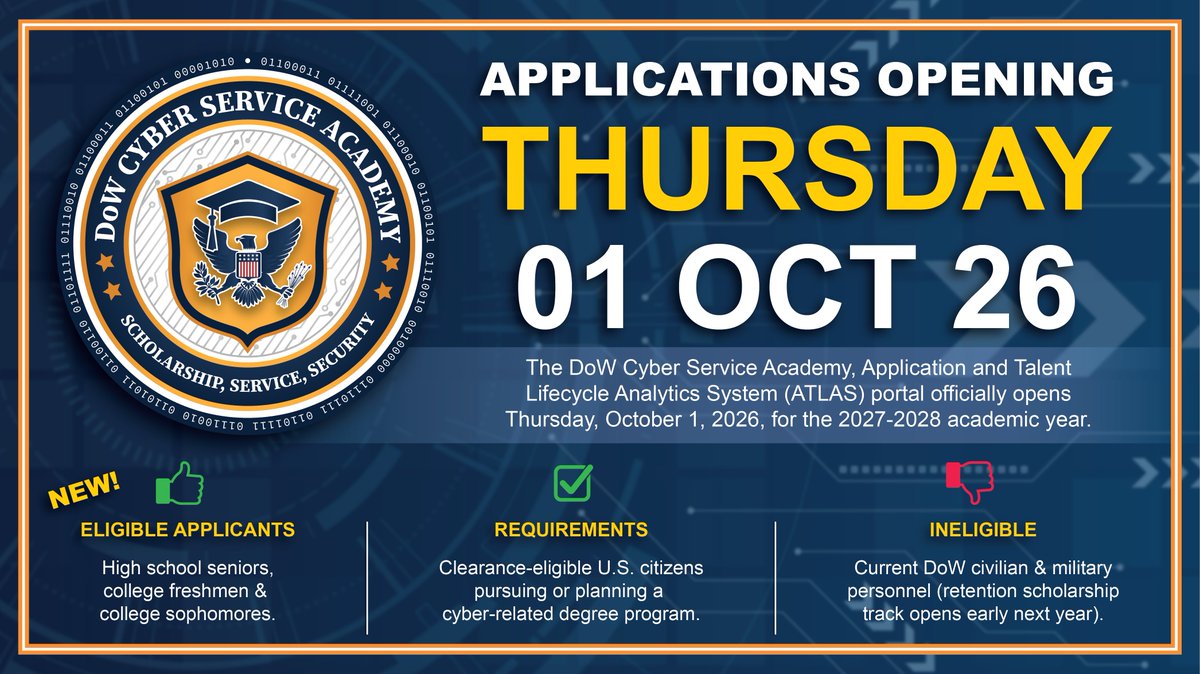
Get your applications ready! The @DeptofWar Cyber Service Academy scholarship program (CSA) will be accepting applications starting Oct. 1.
If you are accepted into the program, the DoW will provide you with tuition, room and board, a stipend, and paid summer internships, all while you study cyber! In return, you’ll be able to join the fight to safeguard our national interests and networks while meeting our adversaries head-on in the contested cyber landscape. Mark your calendar and don’t forget to apply!
https://t.co/PR9nfAxtJW