Introducing… Raster!
A new digital art marketplace from @0xmetaclass and @thefunnyguysNFT.
We’re making art collecting delightful by solving digital art's biggest headache: fragmentation.
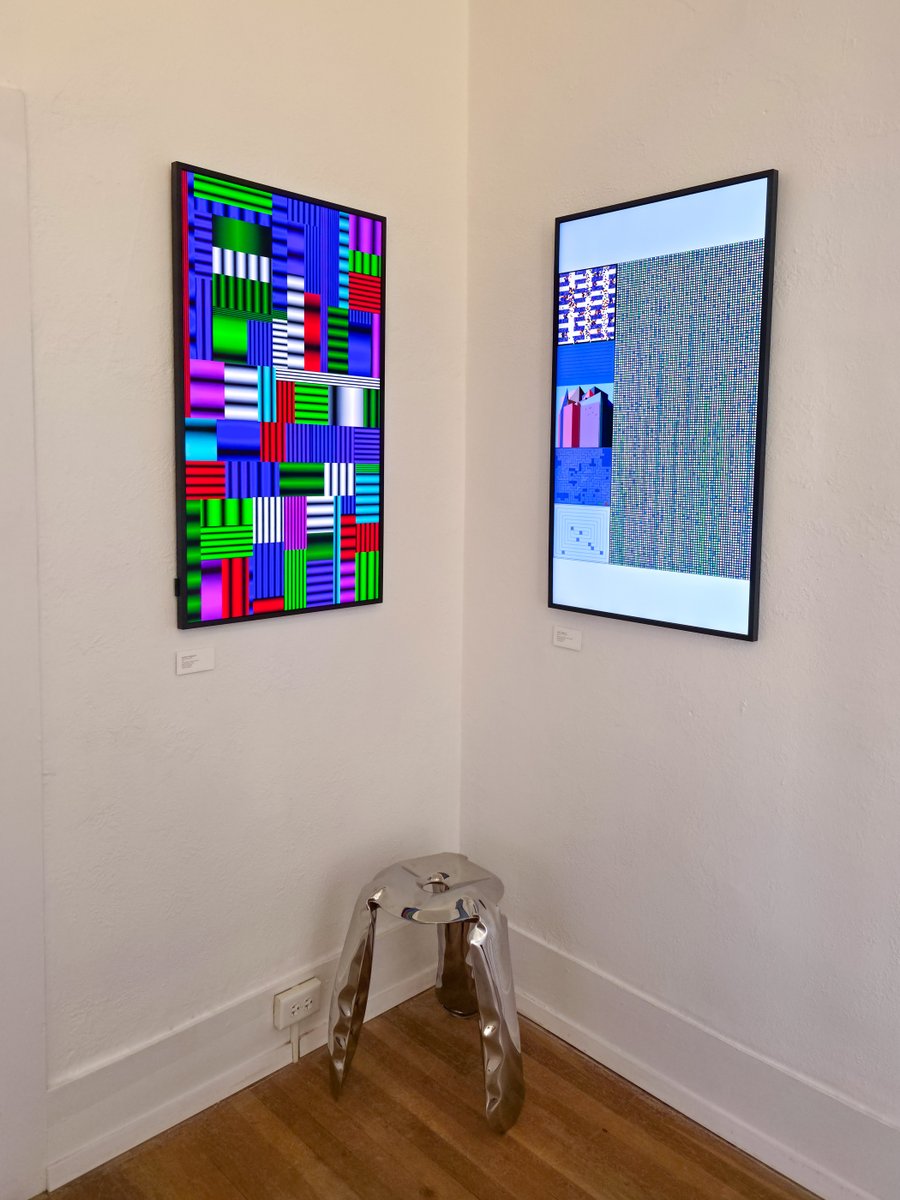
Generative Hardware: Past & Present
▫️‘LCD 1’ (2022) by Andreas Gysin | Produced with Kunsthalle Zürich
▫️'Color Panel v1.0' (1999) by John F. Simon, Jr. | SFMoMa, Whitney, Guggenheim, & Brooklyn Museum Collections
The first generations of two artworks - over 20 years apart.
ComplexCity having a moment in “Algorithmic Generations: A Genealogical Journey Through Generative Art” - the latest exhibit at Art Blocks Gallery in Marfa, Texas!
@CSA2D7 raises some points I have thought about for a long time. Searching latent space is the reality of image making Every Icon was reaching for 28 years ago and I am working there every day now finding amazing things.
In blockchain art, there is a strong conceptual connection between john f. simon jr.'s "every icon" and infinite images in latent space, that is waiting to be made / displayed? There's also a nice connection between every icon and pxl dex. Is "every icon" the most influential piece of blockchain art that is simultaneously recognized (in museums) and unrecognized by the market?
@dmitricherniak@CSA2D7 Although I couldn’t write it at the time, I imagined a program that would search this space more efficiently - search it in a way that would discover coherent icons in the vast noise rather than proceed by brute force counting. 25 years later I can do that in the latent space.
@dmitricherniak@CSA2D7@dmitricherniak - first let me say how much I admire your work and how much I enjoy the Ringers. Second, I think the distinction you make is true for how Every Icon was implemented. The code I wrote is a binary counter. But for me this was just a demo of possibility space.
Thank you @CSA2D7 - I just found out a selection of these NFTs, including Every Icon, will be exhibited this spring at Pom Pom Pompidou in Lille, France- as part of the Lille3000 festival - https://t.co/bDjJTti29v
Is there a better feeling for NFT collectors than recognition from the world’s best museums? From the Centre Pompidou’s Poetics of the Immaterial: Jill Magid, Jonas Lund, John F. Simon Jr., and John Gerrard
@Noahbolanowski Yes, @Noahbolanowski , the Guggenheim owns two of my works but the documentation on their website is not up to date. They own and exhibited Color Panel in "Seeing Double: Emulation in Theory and Practice,"
March 18–May 16, 2004, curated by Jon Ippolito
Thank you for the memories, @Noahbolanowski - putting together the Color Panel v1.0 edition cost around $12,000 in 1999 - about one year’s rent for me - and luckily Sandra Gering sold out the edition in two weeks. Buying 15+ laptops to rip apart was risky and fun #artappliance
The Most Institutionally Collected Digital Artwork: 'Color Panel v1.0' (1999) by John F. Simon, Jr.
"..a painting that would change continually & never repeat itself..an experiment in dynamic painting.”
Collected by SFMoMa, Whitney Museum, Guggenheim Museum, & Brooklyn Museum.
@Noahbolanowski There were no departments for digital works at museums in 1999 so the quick adoption surprised us. At the Whitney it was acquired by the Painting and Drawing committee, I think because of its references to color field painting.