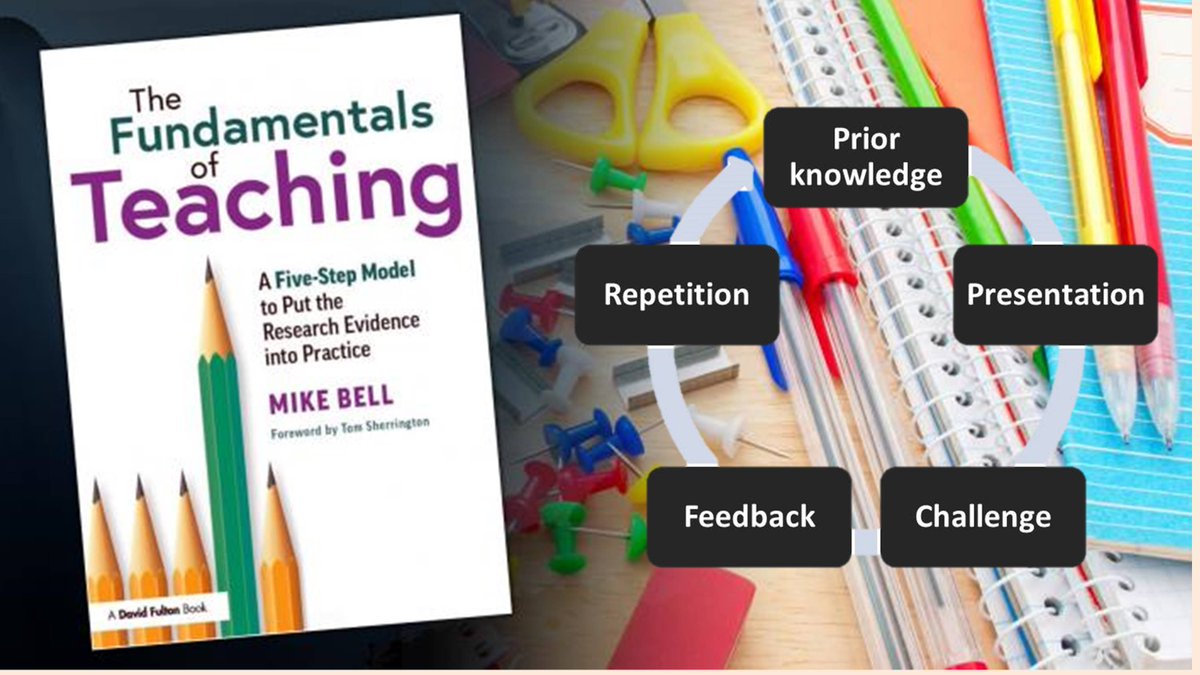
Practical and easy-to-follow guidance on how to apply research that is proven to work in the classroom.
Get your copy here: https://t.co/tQ95tQvenW
Find out more here: https://t.co/vsIfGJubkc
People may be talking about different parts of the learning process. In the classroom, undoubtedly., education needs to be about what the student DOES NOT know.
However, when it comes to testing, it should be about what they DO know.
This is particularly relevant where students are obliged to take exams which they are almost certain to fail.
One example is the UK requirement to retake GCSE English and Maths if a certain grade has not been achieved.
The low pass-rate on resits suggests that it would be better for the student to practice for and take a functional maths course which shows what they DO know.
It should not be controversial that every lesson put in front of students should first be logically analyzed against principles of effective instruction and field tested with small groups before it is disseminated to larger populations.
Most of what you say is true, but "Your brain cannot tell the difference between something happening and something you're vividly imagining happening.", is not.
You conscious mind can tell the difference. I think you are referring to the way some parts of the subconscious brain react.
@thecurioustales You are right.
Zen teaches us that nearly all the things that are making us unhappy are happening in our heads: regrets about the past and worries about the future.
We are taught how to 'arrive in the present moment' which, as we can all discover, is usually perfect.
The Aussies are finally getting it!
"The New South Wales Government has ditched the term 'toxic masculinity', warning it risks alienating young men and undermining efforts to address harmful behaviour."
https://t.co/VcLoPDqukp
What makes boys respond differently to school?
It's not simply about being "nice." Strong teacher-student relationships come from taking an interest in each pupil, offering support, and creating discipline that feels fair.
#education#boys#teachers#school#learning
Slight correction: 'A country ruled by a party which, while calling itself 'communist', presides over a vibrant market economy and accounts for almost three-quarters of global poverty reduction since 1981.'
Australia Confronts a Widening Divide Affecting Its Men and Boys (Press Release from the International Council for Men and Boys)
Across Australia, men and boys face stark gender gaps in education, health, family life, safety, and employment, with national statistics showing significantly poorer outcomes in several key areas.
Education:
Australian education data show a persistent gap disadvantaging boys. The Year 12 completion rate is 85.3% for girls, compared with 77.6% for boys. Among Australians aged 25–34, 53.3% of women held a bachelor’s degree or above, compared with 40.0% of men.
The gap continues in higher education. Women accounted for 62% of commencing domestic higher education students, compared with 38% of men. In 2025, 17.1% of Australian women aged 15–74 were currently enrolled in study, compared with 15.7% of men.
Health:
Life expectancy at birth is 81.1 years for males, compared with 85.1 years for females. The adult mortality rate is also substantially higher among men, at 72.6 deaths per 1,000 adults, compared with 41.6 among women.
Homicide:
Between 1 July 2024 and 30 June 2025, Australia recorded 279 homicide victims, of whom 80% were men.
Suicide:
In 2023, men died by suicide at a rate of 18.0 per 100,000, compared with 5.8 per 100,000 for women—more than three times the female rate—and consequently accounted for approximately 75% of all suicide deaths.
Shared Parenting:
Court proceedings in Australia show a substantial gender disparity in sole custody outcomes. Mothers receive sole custody in 45% of court proceedings, compared with just 11% in which fathers receive sole custody.
Domestic Violence:
Among people currently in a relationship, 12.0% of men reported experiencing physical abuse in the previous 12 months, compared with 5.9% of women, showing that men also experienced physical abuse at more than twice the rate reported by women.
Homelessness:
Males accounted for 55.9% of people experiencing homelessness, compared with 44.1% of females.
Workplace:
In 2024, men accounted for 96% of workers killed in work-related activities, representing 180 fatalities. Their fatality rate was also significantly higher, at 2.4 fatalities per 100,000 workers, compared with just 0.1 per 100,000 among women.
Conclusion:
Australia must act now to confront the struggles of men and boys because only by addressing these disparities can the country achieve true gender equality and build a more inclusive future for all.
The International Council for Men and Boys (ICMB) is a non-governmental organization working to celebrate the contributions of men to society and to end the 12 sex-based disparities affecting men and boys worldwide. ICMB has conducted analyses of male disadvantage in more than 50 countries, available at:
https://t.co/tTCHNMF1jy
This link below to the Press Release contains all sources and references, for the material above:
https://t.co/zsUIJ5i1by
@menandboysnet@CO_Resilience1@evidence_1st@DavidMaywald@thelawcenternet
Schools Eliminate Gender Learning Gaps for Boys at No Extra Cost or Funding (Press Release from International Council for Men and Boys)
https://t.co/QehXlfFcLC
17 August 2026 — Boys' education is in global crisis: they are more likely than girls to repeat grades, fall behind and leave school for good. The United Nations Educational, Scientific and Cultural Organization counts 140 million boys out of school, against 133 million girls.
The problem has been described for years without producing a remedy that schools can copy. Australia's House of Representatives Standing Committee on Education is now examining why attainment differs between and among boys and girls. ICMB Board Director David Maywald attended the inquiry's first hearing, where members pressed federal education agencies to name programs with strong evidence of success. "The inability to point towards proven, scalable interventions was striking," Maywald wrote.
Six secondary schools in England have done it, using the budgets and staff they already had. Their methods are documented in Yes He Can!, published by Routledge on August 3, and in free guidance online. Author Mike Bell led the research for the United Kingdom's 2023 parliamentary inquiry into boys' reputed "underachievement." Finding no proven solutions, he went to the schools that had already succeeded and recorded what they did.
The schools acted independently — they did not know one another or read the same research, yet arrived at nearly the same approach. For example, Balcarras School in Cheltenham had a gap above 20% in English and mathematics at its worst, in 2006, and none by 2022. Heathfield Community College closed a 25% gap in the same subjects and has held it three years.
The six schools' interventions include:
· Literacy first. Weak reading and vocabulary were treated as an urgent, solvable problem and attacked in the first year of secondary school.
· Equal standards. Internal observation exposed staff rewarding weaker work from boys and punishing them more harshly than girls for the same offense. Several schools found the bias endemic, and unconscious.
· Visible role models. Older boys were placed in leadership and paired as tutors with younger boys falling behind.
· Reliable discipline. No school calls its system strict. What they share is certainty and consistency, applied to both sexes.
Australia already has an example of its own. Balgowlah Boys Campus, a non-selective public school in Sydney, moved from seven points below comparable schools in standard senior English to nine points above them, crediting explicit teaching of writing and regular, actionable feedback.
Girls were not disadvantaged by these interventions. In no school did girls' results fall as boys' results rose. Maywald makes the same point. Improving boys' attainment "isn't about taking opportunities away from girls," but about "ensuring that every Australian child has the opportunity to reach their full potential."
At a minimum, ICMB urges lawmakers to:
· Require educational attainment be reported separately for boys and girls, school by school.
· Emphasize literacy screening and intervention as students enter secondary school.
· Require schools to audit reward and discipline records to eliminate unequal treatment of boys.
The International Council for Men and Boys is a non-governmental organization working to end the 12 sex disparities that affect men and boys worldwide. The ICMB is a leader of the emerging global movement to address these disparities.
https://t.co/tQ8SkAlXa1
@menandboysnet@evidence_1st
...and your point is?
The state cannot buy twice the level of tuition for every child.
What are you proposing?
Also, you are assuming that it's the money that makes the difference.
Maybe the boost is because the parents of the kids who are sent to private school set ambitions aspirations?
Who knows, .... unless we run a proper experiment.
One researcher observed the classrooms of a range of teachers whose students, year-on-year, were getting results well above the average.
The observers saw a huge diversity of approaches, but there was one thing in common: none of them stuck rigidly to the lesson-plan.
Teachers require regular feedback from their student so they can see how much has been learned and revisit missing parts.
If the teacher just 'bashes on', learning is less because new learning has to connect with existing knowledge...
@DaveBraith48502@C_Hendrick@the_culturist_@SirEvanAmato Central problem: the majority of teachers have not been evidence-trained. They are still in the 'seems like a good idea to me', or 'Professor X says so, so let's do that' or other pre-empirical mindsets.
Agreed. My visit to the SU in the early 1980s suggested to me that the problem was not so much the communist regime, but the way that regime blocked entrepreneurship.
This is reinforced by the Chinese experience - they have created a market economy in which enterprise and competion thrive while maintaining central control.
It's instructive to note that, while the Soviet system collapsed in 1989-90, the Chinese reforms under Deng Xiaoping had been in place several years earlier...but the Soviets did not learn from that.
One possibility is that, while the Deng reforms in China simply allowed the traditional enterprise culture to re-emerge, in the Russia there was no tradition of enterprise to fall back on.
We see how much better states like Poland have done who did have that tradition.
Hi all,
We have a new "Recognition Scheme". Each time you stay late marking or attend an unpaid twilight, SLT will send you an email saying "Well done for showing resilience". The email will arrive at 11:47pm and will require a reply by 7am confirming you feel valued.
Thanks x