Following KOL Pricer, our tweet pricing tool that hit 140K+ impressions, our team just launched our second super practical AI marketing tool: Social Listening!
Enter the X account of any product you're tracking, and within 30 seconds you'll get a full breakdown of what real X users are saying, including:
→ Sentiment analysis
→ Buzz trends with milestone context
→ Hot topics with suggested marketing moves
→ A market strategy report
→ AI Q&A
Want to monitor a product's social chatter in real time? Turn on "Smart Alert" and everything you're following gets pushed straight to your Telegram.
There are three reasons the JE Labs (@JELabs2024) team built this:
1/ Every time a client launches a big campaign, we watch social and community channels closely to gather user feedback and catch any PR issues early, so we can respond in time.
2/ When we design talking points for a project, we dig through user discussions to see how people naturally understand the product, what needs correcting, and what's worth amplifying. It gives us a solid foundation for the next iteration.
3/ We also track how discussion around a product trends over time, pinpointing the key moments that tell us what topics and features the market actually cares about.
For a long time though, we did all of this by hand. It was time-consuming, and the information we gathered wasn't always complete or timely. So we took the thesis from our own hands-on experience, broke down the information sources we follow and the angles we read them through, and built Social Listening to do it for us.
For marketers, it's a no-brainer tool for working faster. And for anyone trying to understand a product, whether you're a user or a researcher, it helps you get a read on real user feedback in just a few minutes.
WeLike Social Listening (@WeLikeHQ) is free to use right now. Go try it out and let us know what you think!
Calling all AI Agent builders, founders, and investors across the stack to our Friday Happy Hour.
AI Agent Builders Gathering brings together the full stack of the Agent ecosystem, from model layer to inference to frameworks to applications, for one night of real conversations.
No panels. No fluff. Just builders.
📅 May 8, 2026
🕕 6:00 – 9:00 PM
📍 San Francisco (exact location shared upon RSVP)
🔗 https://t.co/LEM0mvq1mR
⭐️We’re co-hosting an AI Agent Builders event on May 8th in San Francisco!
We welcome AI Agent builders, founders, and investors across the stack to explore what’s next.
Don't miss:
- Real conversations
- High-signal networking
- Fresh perspectives on the agent stack
Co-hosts
@CreaoAI@GoKiteAI@YottaLabs@kuseHQ
Event partners
@JELabs2024@CollovLabs@gptdaoglobal
Spots are limited
See you there
👉https://t.co/qS9BJqJUIP
o excited to find NUS alumni family in the Bay Area! 🦁🇸🇬
Even back when I was a student, NUS was a powerhouse for driving innovation and entrepreneurial programs.
Fast forward to today, stepping into the shoes of an alumna, I'm experiencing the university's incredible support for the AI and frontier tech ecosystem from a whole new perspective.
As more and more AI startups expand overseas and anchor their APAC operations in Singapore, I am beyond excited for the renewed energy and vitality flowing into the city 🫶🫶🫶
I’ve truly felt the gap between Vibe Coding and real product development:
With Vibe Coding, you can whip up a 70-point demo in just 3 hours.
But to bridge that extra 20-point gap and polish that demo into a finished product, it takes well over 30 hours.
That final 20% requires deeper industry know-how, sharper product sense, and much broader data sources...
Most projects are burning their hackathon budgets for minimal return.
After attending several recent events, my biggest takeaway is clear: Hackathons are an elite GTM channel for dev-tools, but only if you stop treating them as "offline-only" moments.
While they are unmatched for acquiring seed users and gathering raw feedback, the ceiling for an offline event is usually a few hundred people.
The real leverage? Digital amplification.
By bridging the gap between the venue and the feed, projects can 100x their ROI—turning 200 local impressions into 20,000+ global ones.
A few approaches I've seen work well:
1/ Pre-event Momentum: Don't just announce; build anticipation. @photon_hq set a great example by shooting a high-production promo for their Residency, resulting in 5x their average engagement.
2/ Capture the Energy: Use on-site interviews, rapid-fire Q&As, and BTS clips to make those not in the room feel the FOMO.
3/ Incentivize Distribution: Make "online visibility" a judging criterion. When participants are rewarded for sharing their builds, every hacker becomes a distribution node.
4/ The Long Tail: Winning demos shouldn't die on stage. Feature them as case studies and amplify them across official channels to prove long-term utility.
Offline is for depth; online is for scale. Don't leave 90% of potential ROI on the table.
Congratulations to the Creao AI team on completing 3 rounds of funding within a single year, raising a total of $30 million! 🎉
Recently, @CreaoAI's product updates and iterations have been incredibly fast—their 20-person team shipped 8 new features in just one day.
Furthermore, the paid conversion rate among overseas users is multiplying, and their ARPU is 6 to 7 times higher than that of regular 2C AI tools.
I believe this is all just the beginning. Stay tuned…👀
We just raised $10M led by Prosperity7 (Aramco Ventures).
$30M total in under a year.
We got here by being our own crash test dummies.
On the engineering side, the team rebuilt our entire codebase around AI. 99% of our production code is now written by agents. We ship daily. Features go live the same day they’re conceived. Bad ones get killed the same afternoon.
On the GTM side, the same thing happened. Google Ads audits, GA4 breakdowns, SEO gap analysis, content pipelines. All running on agents. A 20-person team doing what would normally take multiples of that headcount.
We didn’t bolt AI onto how we work. We redesigned how we work around AI. Engineering, product, marketing, growth. One system.
And honestly, it took us a while to get here. We killed our own product twice. Built something, realized it wasn’t enough, and started over. The thing that finally clicked was that AI has to build the tools and run them. Humans steer.
That’s CREAO.
After we shared Creao AI’s ambassador program the day before yesterday, the number of sign-ups jumped 5x.
Huge shoutout to @anorth_chen—Abei has been working tirelessly to stay in close touch with everyone.
This ambassador program will cover Chinese, Korean and English markets.
For the English segment, we prefer candidates based in the Bay Area. If you know anyone who might be interested, feel free to refer them! : )
Creao AI just opened their Ambassador Program — a rare chance to deeply engage with a fast-growing AI project:
1/ Building AI AgentOS. Their product lets AI run full workflows on behalf of users — from idea to execution in a single flow. Currently in rapid growth mode.
2/ Team has closed 3 rounds, raising tens of millions USD total, backed by top-tier funds like Hillhouse, Sequoia, and Matrix. Founders come from Meta, Alibaba, and other leading tech companies.
3/ This isn't a "just retweet us" kind of ambassador program. Participants get to co-build with the product team, directly connect with the core team, and receive early product access + monthly free credits.
4/ Real economic upside — base fee + 20% commission, plus merch and event reimbursements. Not just promises on a deck.
5/ First cohort only opens slots for Chinese, English, and Korean markets. Limited window — people who know are already moving.
Interested? Apply directly, or DM me for a referral!
Creao AI just opened their Ambassador Program — a rare chance to deeply engage with a fast-growing AI project:
1/ Building AI AgentOS. Their product lets AI run full workflows on behalf of users — from idea to execution in a single flow. Currently in rapid growth mode.
2/ Team has closed 3 rounds, raising tens of millions USD total, backed by top-tier funds like Hillhouse, Sequoia, and Matrix. Founders come from Meta, Alibaba, and other leading tech companies.
3/ This isn't a "just retweet us" kind of ambassador program. Participants get to co-build with the product team, directly connect with the core team, and receive early product access + monthly free credits.
4/ Real economic upside — base fee + 20% commission, plus merch and event reimbursements. Not just promises on a deck.
5/ First cohort only opens slots for Chinese, English, and Korean markets. Limited window — people who know are already moving.
Interested? Apply directly, or DM me for a referral!
After using 20+ Marketing SaaS platforms, my biggest takeaways:
1/ Claude + Skills can essentially replicate customized Marketing SaaS tools. From this angle, most SaaS features — content generation, GTM strategy — are still too thin.
2/ But from another angle, even GTM professionals with technical backgrounds rarely build a “GTM Agent Team” using Claude + Skills, because learning and understanding someone else’s Skills still has a real learning curve.
3/ The newer wave of Marketing SaaS companies are under serious revenue pressure — user onboarding costs are high, individual customers only pay a few thousand dollars, and legacy CRM platforms like HubSpot are also adding AI capabilities.
4/ Many SaaS products pitch the story of automating Creator collaborations, since that business model takes a cut of transactions — which drives more GMV than subscriptions. But in practice, influencer campaigns are still a people business and can’t be fully automated.
5/ There’s still room for SaaS platforms, because so many emerging tech companies lack GTM experience — especially pure-developer founding teams.
6/ To attract these users, beyond data, what matters more is the know-how your product conveys.
During GTC, JE Labs (@JELabs2024) team hosted a private event in Palo Alto, bringing together founders and builders from across the Bay Area.
We had great conversations about the new waves forming in AI and exchanged many valuable insights. Thanks to our partners for co-hosting the event, and to everyone who joined us🫶
Looking forward to catching up after GTC :)
GTC hasn’t officially started yet, but the AI buzz in the Bay Area is already heating up🔥
On March 15, we hosted a private event in Palo Alto, bringing together founders and builders from across the Bay Area. We had great conversations about the new waves forming in AI and exchanged many valuable insights.
Thanks to @SurfAI and @PanteraCapital for co-hosting the event, and to everyone who joined us🫶
JE Labs’ founder @0xEvieYang will also be attending GTC, looking forward to connecting with more friends during the week :)
Hosting a private event on Sunday with AI founders and top VCs.
If you're in the Bay Area and building in AI, DM me!
👐Co-host @SurfAI@PanteraCapital@JELabs2024
💡Sunday, March 15, 11:30-14:30
🌟Palo Alto, CA
🔗https://t.co/hWpg9TBrzh
Hosting a private event on Sunday with AI founders and top VCs.
If you're in the Bay Area and building in AI, DM me!
📅 Sunday, March 15, 11:30-14:30
✨Palo Alto, CA
https://t.co/hWpg9TBrzh
Coming to GTC next week? This is where you want to be this Sunday. Register now!
Hosted by @SurfAI@PanteraCapital@JELabs
📅 Sunday March 15, 11:30-14:30
📍 Palo Alto, CA
🔒 Invite only
https://t.co/wjEFtnHkh7
China's AI momentum is REAL.
A few signals from the past week:
1/ Lovable(@Lovable) hosted an offline event in Shanghai
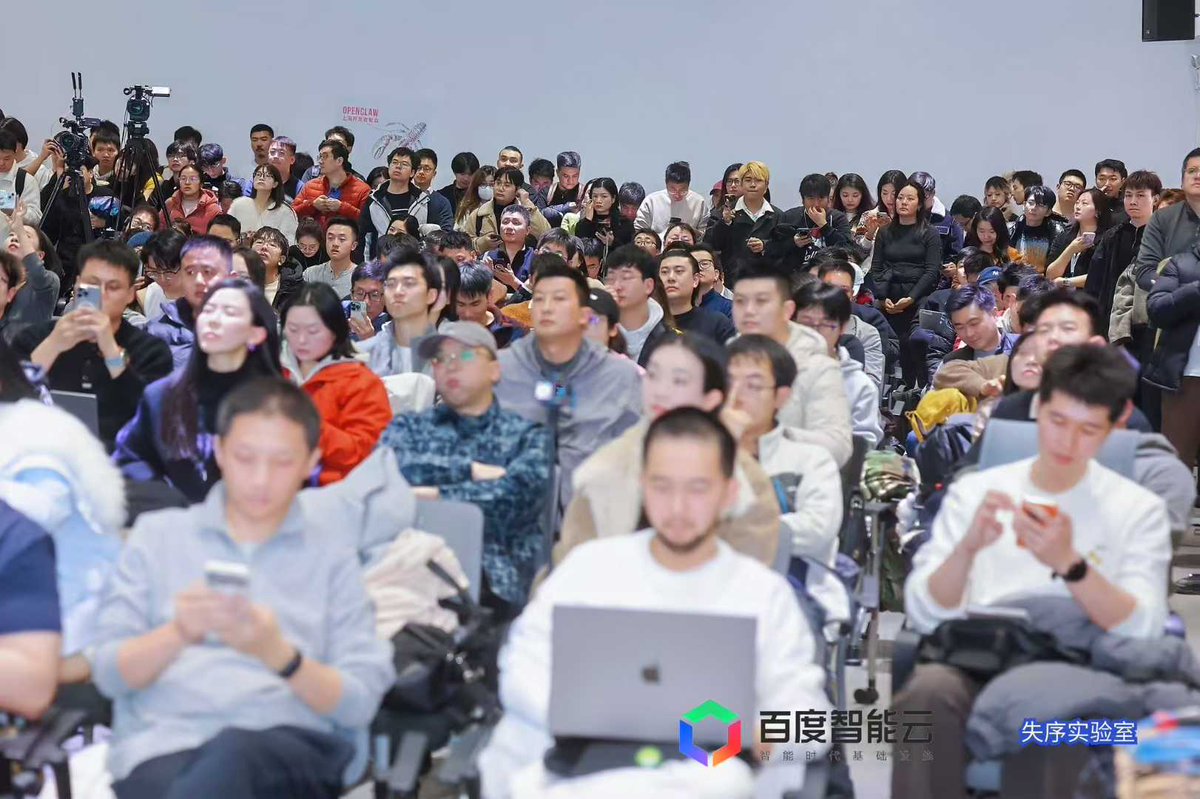
2/ The OpenClaw developer meetup in Shanghai (co-hosted by JE Labs @JELabs2024) saw 1,000+ registrations
3/ Shenzhen’s Longgang district just released a draft policy to support the OpenClaw & OPC ecosystem.
4/ ......
China has:
✓ 2B+ daily active users
✓ Fastest-growing dev ecosystem
✓ Government backing AI innovation
✓ Insane product velocity
Which is why China is quickly becoming one of the most important AI markets in Asia — both for builders and distribution.
We're seeing this firsthand through the builder communities we work with at JE Labs.
If you're exploring the China market, happy to share what we're seeing on the ground! : )
I've been chatting with some to-C AI companies lately, and honestly, with the current market maturity, achieving growth is indeed quite challenging:
1/ For consumer-facing apps, creating a breakout hit really tests a team's aesthetic sense and user insight—it's highly probabilistic and full of chance, making it hard to predict or replicate precisely.
2/ The market right now is pretty fragmented. For instance, it's tough for U.S. apps to break into China, and Chinese apps face heavy barriers entering overseas markets. For projects aiming to start with the English-speaking market, the traffic there is way more scattered compared to regional markets. You can't efficiently reach users through a single channel or strategy, which means projects need massive ad spend.
3/ Marketing costs aren't cheap these days. General KOLs (key opinion leaders) with broad audiences charge about 10% of their total follower count, while AI vertical niche KOLs demand a 2-4x premium. I checked, and Kimi's ad spend in 2025 is at the hundreds of millions level—that's way beyond what a startup with just tens of millions in funding can afford; their cash runway just isn't thick enough to sustain that burn.
4/ Products that demand high user AI literacy are essentially serving a "niche within a niche." Someone once said a lot of AI products today are just self-indulgent fun in small circles. I used to think it was a marketing issue with breaking out of those circles, but now I see it's more about the target audience size and their spending power.
Given this, if you're building to-C capabilities with limited budget and overall user base, the most viable way for an AI project to generate ARR might still be the "go after the whales" approach—target the groups with the clearest needs and strongest paying power first, then gradually expand. That means starting with to-B, to-Developer, to-professional audiences, and only later going broad with mass traffic.
As for why ARR matters so much: without it, projects struggle to raise a second round these days.
The Evolution of AI Distribution: The Rise of the New "Model Resellers"
The competitive landscape of LLMs has begun to solidify. On this foundation, we are seeing the emergence of a new generation of "Distributors" whose primary role is to move "tokens" for these massive models.
OpenRouter is a prime example of this AI-era distribution. They aggregate fragmented demand to gain collective bargaining power with upstream providers, offering downstream users more convenient payment options, stable interfaces, and a user-friendly UI.
Let’s Review the Internet’s Distribution Models First:
1. Cloud Service Resellers: Agencies buy capacity from tech giants (AWS, Azure, Alibaba Cloud) via "prepayment/rebate" models and resell to local enterprises. They bridge the gap in local business relations, invoicing, and basic technical delivery.
2. SaaS Value-Added Resellers (VARs): Beyond simple reselling, they help enterprises with customized implementation and integration.
3. Ad Agencies: These firms partner with brands by providing capital cushioning (financing), creative production, and campaign optimization, earning their margins through platform rebates.
4. Cross-border E-commerce & API Aggregators.
———
The New "AI Distribution Landscape":
Drawing parallels from traditional IT channels, the AI sector is evolving into its own unique distribution ecosystem:
1. Model Aggregators (The "Cloud Proxies"):
These distributors don't train models; they own the "inventory." By aggregating hundreds of fragmented APIs into a single unified billing system and interface—much like OpenRouter—they profit from the wholesale-to-retail price spread.
2. Vertical Domain Integrators (The "AI ISVs"):
Generic LLMs (like GPT) are often "capable but imprecise" in specialized fields like healthcare, law, or architecture. These integrators take base models and inject proprietary industry data through fine-tuning or RAG (Retrieval-Augmented Generation).
Example: A law firm doesn’t buy directly from OpenAI; instead, they purchase a finished product from a distributor that is pre-loaded with local regulations. The distributor earns through subscriptions and consulting fees.
3. AI Agent Distributors (The "Agent Marketplace"):
Similar to the App Store or "Tier-2 Distribution." Developers list their Agents on a platform, and the platform handles customer acquisition, payments, and support. Revenue is based on outcome-based performance splits.
4. "White-label" Model Resellers (The "OEMs"):
Distributors buy out or lease usage rights for open/closed-source models, rebrand them ("re-skinning"), and package them as a corporation’s proprietary internal brand. They profit from private deployment fees and brand premiums.
———
For this new generation of AI distributors, the "moat" remains remarkably similar to that of the traditional internet era: it boils down to Business Development (BD) & Marketing reach, compliance expertise, and capital/financing capabilities.
While the "product" has shifted to tokens and intelligence, the underlying commercial logic remains unchanged : )