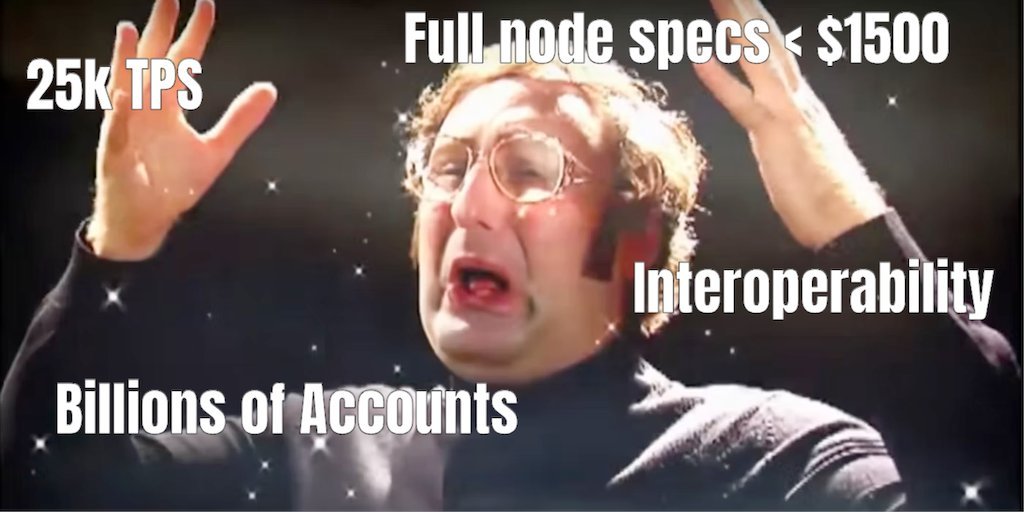
We've just released NOMT v1.0-preview. The new state database we've been working on for a year is just about ready for production. On hardware that costs less than $1200 we have achieved >50,000TPS with 100M accounts and >25k TPS with 1B accounts. Full post in next tweet.
Six Strawberry 🍓 @polkadot#JAM nodes each creating blocks in turn (by consensus). They announce new blocks by sending only the headers. The other nodes then request and store the full block, and finalize any block that has 5 or more children.
Dave promised himself he wouldn’t check the markets yesterday. Dave lied.
Now he’s watching Gav’s interview, scrolling ETF news, reading about native rollups—nodding like he gets it.
Let me break it down for Dave..🧵
JAM is exciting but it is still in the early research phase. Either it or its iterations might be the strongest candidate for Polkadot's endgame.
But today, Polkadot does not need JAM.
1⃣It has fulfilled its initial idea. From a multi-chain concept to a multi-core computer. Allowing it to process numerous blocks simultaneously in parallel, being a blockchain for blockchains —a rollup chain for rollups.
2⃣It has delivered sharding. Already different from Ethereum because it is actually doing execution sharding along with data sharding.
Polkadot validators are aware of its parachains/rollups and reexecute them. In Ethereum, you just post the data.
Therefore security levels are vastly different in the Ethereum layer2 rollup scene. It's an arena of a few multisigors relaying messages around, which we call interoperability today, ironically.
When blockchain tech succeeds in introducing and scaling real useful apps beyond token transferring for real life, it's a weak bet to chase interop in such a setup. The industry will require more robust alternatives elsewhere.
3⃣Polkadot has introduced Coretime starting on Kusama and will arrive imminently on Polkadot.
This gives builders the most flexible and efficient way of accessing blockspace, allowing them to consume blockspace as they need it and ensuring they pay only for the actual computation needed.
Builders now get cost-efficient but highly secure blockspace that also allows them to interoperate with each other, using common communication standards under the same level of shared security, unlike multisigs and smart contract dependencies elsewhere. This is akin to allowing builders to buy credits from Amazon Web Services.
4⃣Asyncbacking is here. This allows faster block times for rollups/parachains.
Before, if you missed the relay chain’s validation time for a block, you had to squeeze into the next one. With asyncbacking, whenever you finish building your block, you just send it out. This results in an 8x performance spike for parachains.
As a comparison, Ethereum would have to increase its block gas limit 10x to match the computational capacity of parachain blocks.
5⃣JAM is a strong proposition for replacing the relay chain, but in fact, it’s an extension to what it does. But what has changed with the relay chain during this time?
It allows you to transfer balances, stake, on-chain governance, and manage identity.
But for maximum efficiency, throughput, it's desired for the relay chain to do as little as possible.
So all these services are moving outside of the relay and becomes system chains.
Just like modern operating systems (OS) run various system servers in the background to support your computer's functions without your direct involvement, Polkadot operates on a similar principle. The system chains handle administrative tasks, freeing the relay chain from such responsibilities.
At its core, relay chain only dedicated to delivering one single thing: security, while leaving other functions to external sources.
Thereby, claiming reduced activity on Polkadot due to less relay traffic is a weak shot.
This is Polkadot becoming a supercomputer just like modern OS:
• Modular where modularity, flexibility and adaptability count,
• Vertically integrated where the coordination and consistency of different layers of the system, uniting DA, count.
6⃣Polkadot finally delivered Beefy, allowing it to trustlessly connect and interoperate with the Ethereum side of things via Snowbridge.
Hyperbridge leverages Beefy with zk light clients and even will solve trust issues among Ethereum rollups by using Polkadot’s security at the backend without these rollups and their apps noticing.
7⃣It has been a while since Polkadot introduced its on-chain governance, prioritizing this feature for ensuring long-term unstoppable operations.
In contrast, some other blockchain networks has been hesitant to incorporate on-chain governance into their decision-making processes and instead rely solely on social consensus and company-like spider organization developing.
Today, the Polkadot community is growing with pains as it has full responsibility for controlling and directing its network.
The failures and scars encountered serve as lessons toward greater resilience and efficiency, moving towards the goal of becoming a true decentralized autonomous organization without any central authority, ensuring continuous operation even in the worst case scenarios that blockchain space can encounter.
While many projects rely on CEOs and centralized decision-making structures for control, security, and coordination, the starfish model of self-organization bets on accelerated development pace once its main infra is established, once the arms of the starfish learn to make the best decisions and coordinate, potentially outperforming conventional hierarchical structures.
⭕️So believing in the value of Polkadot is a bet towards a future where all this blockchain tech will lead to really something meaningful and be able to scale to millions of real users that really require these services beyond charts, value extraction from each other, pumpamentals.
Polkadot doesn't also exist to kill any other chain and ecosystem that aligns with the ethos of less trust, more truth. And ideally wants to interop with other systems as well.
The contrarian bet here is:
Understanding the value of a multi-core decentralized world computer and recognize the significance and scarcity of secure, flexible blockspace for today and especially for tomorrow.
And knowing to access this computer's resources, you need DOT, representing its intrinsic value as the blockchain continues to scale and innovate.
Hey @Polkadot community! Pop Network is enabling smart(er) contracts on Polkadot, only using the $DOT token -- more smart contracts = more direct DOT usage!
We have opened a treasury discussion to bring a new wave of smart contracts and usage to DOT 🔥
https://t.co/SdjxW9mvfF
It's been a while but I've finally gotten around to writing some Rust again 🦀😋
Introducing EVM Glue ("Glue")🫠 an EVM assembler written in Rust:
https://t.co/6BaSzrU6DY
EVM Glue gives you an easy-to-use API to string together opcodes into bytecode.
(1/7) 👇️🧵