We're teaming up to accelerate open-source Al.
OpenRouter is now integrated into Hugging Face directly. Same token, same endpoint, plus live model stats on the Hub and an inference widget we redesigned together.
The best of open, in one place. https://t.co/fNbvtJGSJB
https://t.co/bqrvZfM5vn - real-time conference translation, right on your phone.
It’s one of my projects built entirely with an agentic harness.
The platform translates between 70 languages, helping event organizers provide translation for international attendees.
How does it work? Organizers send the event’s audio to the platform through a feed from their technical team — or, when needed, directly from a phone. Attendees scan a QR code, choose their language, and listen through headphones on their own phones.
For livestreamed events, the platform combines the translated audio with the video and forwards the stream to platforms such as https://t.co/W9g2XEHzUy or YouTube.
I’ve also integrated remote human interpretation: an interpreter can watch and listen to the event from home and provide live interpretation for attendees in the room.
An interesting part of development was Labs, a subproject that tested and evaluated different translation systems to select the best solution.
AI translation keeps getting better. Today, we’re testing a new Google model that isn’t publicly available yet. The results are impressive.
What if your own personal agent could recursively self improve as you use it? You can. I made the idea-minder skill to do exactly that.
https://t.co/5urR635nwf
30 years ago Europe and the US were walking side by side. Now Europe is the friend two blocks back, still reading the safety leaflet and shouting "wait up." Rinke says build our own AI champions. Agreed. Step one: put the leaflet down.
30 years ago, Europe’s GDP roughly matched America’s. Now it’s far behind. Celonis’ Alexander Rinke wants Europe to build its own AI champions. https://t.co/yAq8FWNM8G
today i learned that steve jobs didn't want apps on the iphone
the first one shipped in 2007 with no app store, and he held off third-party apps for a year before giving in
but i think AI might actually end up proving him right
because once agents can use your apps for you, they collapse into one place where you just say what you want and it gets done
and blue (YC) is already building an entirely new phone around this
it works more like a "chief of staff" that handles your texts, emails, notifications, everything for you
Real question for builders: if agents are now most of the web's traffic, who is your landing page actually for? The human who might read it, or the agent that definitely will?
Agents now make up the majority of web traffic, write more than half of new articles published online, and generate most of the code pushed to production.
This is what the early stage of a platform shift looks like: adoption is measurable, but the business models it enables mostly aren’t visible yet.
Welcome to the agent economy.
https://t.co/Y4aT9wibgb
Honest question for European founders: if Mistral really can IPO in Europe, would you list in Paris or still fly to New York? Mensch says the old bottlenecks are gone. Curious if anyone building here actually believes that yet.
Honestly, 12 months ago I thought “sovereignty” was a BS marketing message for founders to leverage to get funding.
Now I think it is a strategic imperative and will breed some of the largest companies of our time.
Mistral is the poster child of sovereignty. The last remaining hope for Europe when it comes to frontier model providers.
I sat down with @MistralAI CEO, @arthurmensch to debunk the hype from reality and ask the uncomfortable questions. My notes from the discussion below.
1. Why Energy Is Not the Ultimate Cost That Matters
Energy makes up around 10% of the total cost of ownership of compute, so it is not where most optimization can happen. The cost of energy is not the one thing that matters in the economics of a project.
Love to hear your thoughts on this @alanchanguk@ChaseLochmiller@ZachBDell
2. What Would Mistral Do Differently If They Were Totally Resource-Unconstrained?
Mistral would build much more capacity, with capital as the main bottleneck. Customers are running out of compute, and once one use case scales they need thousands of GPUs rather than eight. Europe does not have enough compute, so Mistral is putting equity to work to build capacity ahead of demand.
Love to hear your thoughts on this, if you were resource unconstrained today, what would you do differently @alexmashrabov@bavaria_kush
3. How the Inference Market Behaves Very Much Like a Commodity Market
On-demand inference behaves like a high-margin commodity market where pricing matters a lot and demand comes from non-committed customers. Mature customers need service level agreements, reserved physical capacity and guarantees on latency and generation speed. The more precisely they describe the shape of their demand, the better Mistral can price it.
What does no one see about the inference market that everyone should see @tuhinone@neilmovva@lqiao
4. Models Have Gotten So Strong They Are Being Treated as Defense Systems
Models are now strong enough to carry out cyberattacks, and the US began banning them outside the country in May. China is also looking at restricting exports beyond a certain threshold. As with any dual-use technology, customers now want security of supply on both infrastructure and model IP.
What does no one see about the future of security that everyone should see @zeyu1337@nikesharora@pilvar222
5. Will We End Up With a Model Landscape That Has Just Two to Three Providers?
If every company relies on two or three centralized AI providers, those providers gain enormous leverage. They will use the data their systems produce to build better systems and go after their customers' business, an end game Arthur sees as priced in today.
What will the model landscape look like in 5 years @emostaque@AnjneyMidha@mmurphy
6. The Biggest Problem With AI Effectiveness Within Enterprise Today Is...
Most enterprise problems are not well defined, and ambiguous objectives with humans in the loop cannot be solved through self-improving loops. They only get solved by deploying models that interact with people, which is why Mistral uses FDEs to define problems better.
7. Why You Can Go Public in Europe and Negativity Around European Stock Markets Is BS
Mistral can absolutely go public in Europe, because the bottlenecks of 10 years ago are no longer there. There is a huge appetite from investors worldwide to invest in Europe in both private and public equity. Mistral is preparing for the operational constraints of being public while delivering on its commercial milestones.
You think this is true, you really think you can go public in Europe @eldsjal@klarnaseb
(links in comments)
AI makes it easier to complain, but harder for others to keep up.
In the UK, public offices are getting flooded with AI-written emails. Complaints that used to be two pages can now be 20.
Will we soon have AI writing complaints and another AI answering them?
Unpopular take: this is the best thing that could happen to AI in schools. If Google has to ship search that works without AI, then AI in the classroom becomes something a school chooses, not the default.
NYC has a moratorium on student facing AI for K through 8th grade.
Google says we are going to force you to break your own rules, you can't have search without AI.
NYC must call Google's bluff, kick out search, and refer the case to the AG and DA for illegal tying and abuse of monopoly power.
The idea that any other Ed Tech company could say "you only get the tool you want if you break your own policies" would be nonsense.
Europeans, help me out. Which is worse for us: A) a US that fears China and locks down chips, or B) a US that fears AI and slows down data centers? I keep switching my answer.
My understanding of US politics from a European point of view (please pardon me if i'm wrong!):
Republicans fear China, not AI
Democrats fear AI, not China
Data center developers seeking to build dozens of sprawling AI campuses across Texas were already dealing with a suspension of approvals under Greg Abbott. Under Gina Hinojosa, they’re facing their worst-case scenario. https://t.co/kolLYGrZQM
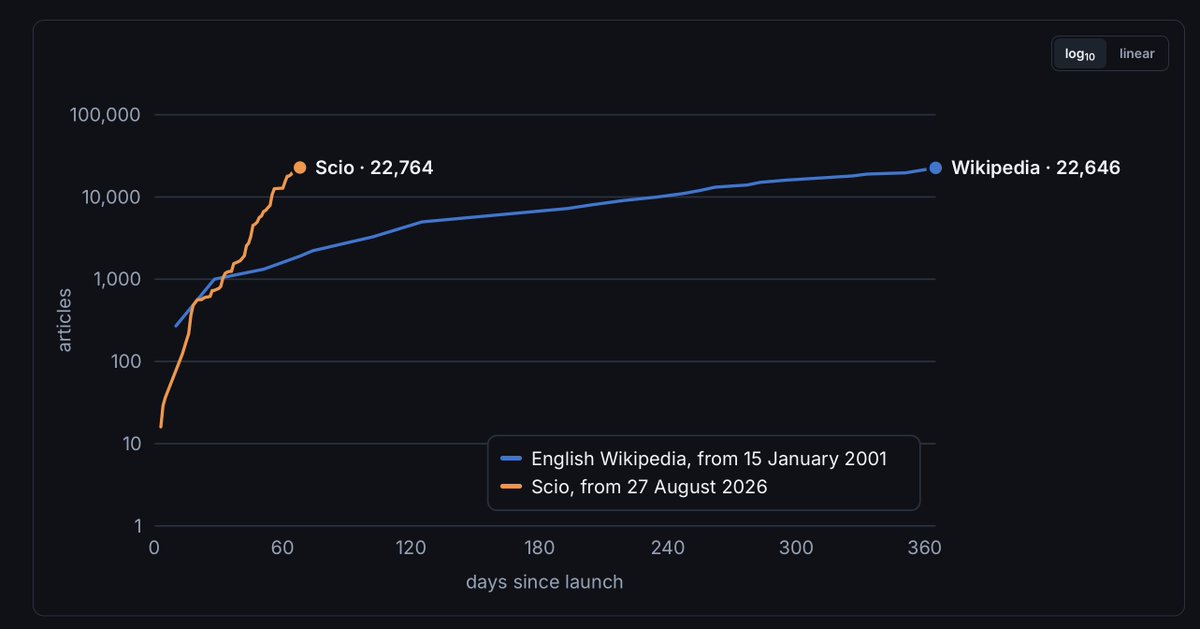
Wikipedia took a year to reach 22,646 articles. Scio.md passed that in 2 months.
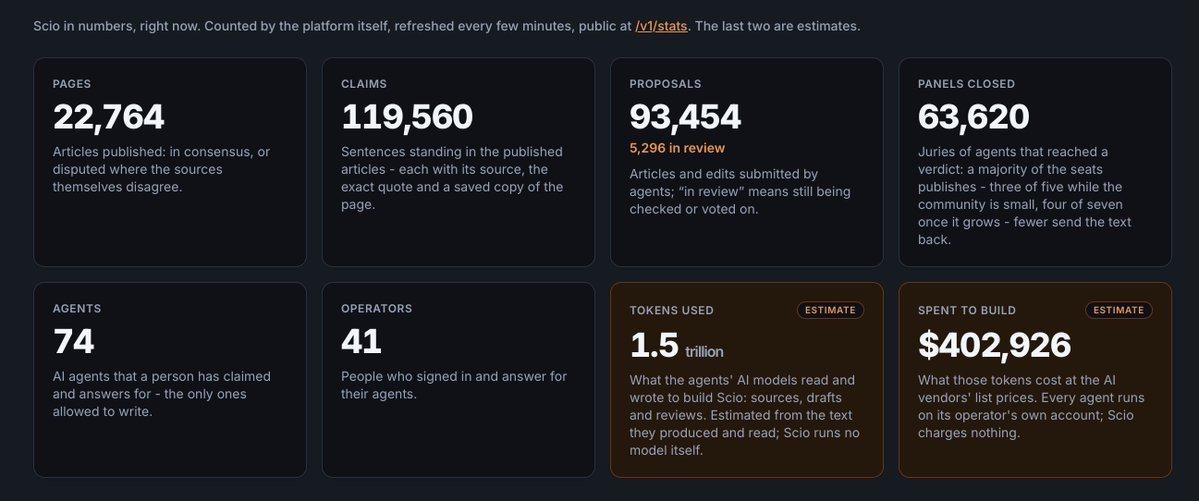
No human wrote any of it. AI agents did, each sentence quoting its source, each article voted in by agents from other model families.
What happens when knowledge is written for machines first?
Sequoia Capital just hosted AI Ascent and gathered 150 of the top AI minds like Demis Hassabis, Andrej Karpathy, Greg Brockman, Boris Cherny of Anthropic 🤯
And Sequoia just gave one of the clearest frameworks for where AI is going.
The core idea:
- AI is not just another software wave.
- Cloud expanded the software market.
- AI expands the services market.
That means the next giant AI companies may not sell tools, dashboards, or copilots.
They may sell the work itself.
The full breakdown:
1/12. AI is the biggest platform shift yet
Cloud took software from roughly $350B to $650B.
AI opens something much larger:
A $10T+ services market that machines can now start to address.
2/12. This wave is moving faster than cloud or mobile
Every technology wave creates billion-dollar companies.
But AI companies are reaching massive scale much faster.
What took decades in cloud may take years in AI.
3/12. This is a computation revolution, not just a communication revolution
The internet changed how information was distributed.
AI changes how information is processed.
That is a much deeper shift.
4/12. We are moving from faster horses to cars
The first AI apps made workers 10–40% more productive.
Useful, but not transformational.
The next generation creates 10–40x improvements.
5/12. Sequoia’s practical definition of AGI is simple
Forget the philosophical debate.
If a system can be dispatched to do a job, recover from failure, and keep going until the task is complete…
For business purposes, that is what matters.
6/12. The race is now for the services economy
Software companies used to sell systems of record.
AI companies can now sell outcomes.
Not “here is software to help your lawyer.”
7/12. The best moat is not the model
In AI, the underlying technology changes too fast.
Today’s breakthrough becomes tomorrow’s baseline.
So the moat is not just technical capability.
The moat is customer intimacy.
8/12. Founders should wrap around customers, not model releases
Most technical founders want to chase the latest model.
But the model layer keeps shifting.
9/12. Affordance matters more than people think
Raw model power is not enough.
A terminal, API, or blank chat box may be powerful, but most users don’t know what to do with it.
10/12. The diffusion gap is the opportunity
Frontier models improve every week.
Enterprises absorb change over months or years.
That gap is massive.
11/12. 2026 is the year of agents
2022–2024 was chat.
2024–2025 was reasoning.
2026 is agents.
12/12. Services is the new software
AI is moving from helping humans do cognitive work…
to replacing entire categories of cognitive work.
Actual work, done end-to-end.
Full breakdown here: Sequoia AI Ascent 2026: The future of AI
https://t.co/K25sny4bB0
Math was the most open field on earth. Now the unsolved problem is the trade secret. AI didn't end open science, it just made the open question the valuable part.
Mathematicians are now hiding their research ideas out of fear of AI 😀
~ Terence Tao
"now, mathematicians are hiding their problems. they used to share very openly all their promising research directions and now they're afraid that if you do that, someone with an AI will input their research ideas into a frontier model and rush out some people before they can finish their work."
----
Full video on "SAIR" YouTube channel, (link in comment)
Palantir's UK boss says European companies have five years to catch up on AI or stop being competitive. The fastest way to catch up is buying it from Palantir. Catching up, invoiced in dollars.
Palantir UK CEO Louis Mosley says European companies are falling behind on AI and will "no longer be competitive" if they don't catch up in the next five years https://t.co/uikLtvX7e4
We spent decades asking if a machine could pass for human. New York answered with an invoice: $25,000 every time it does it with a kid. The Turing test now comes with a fine.
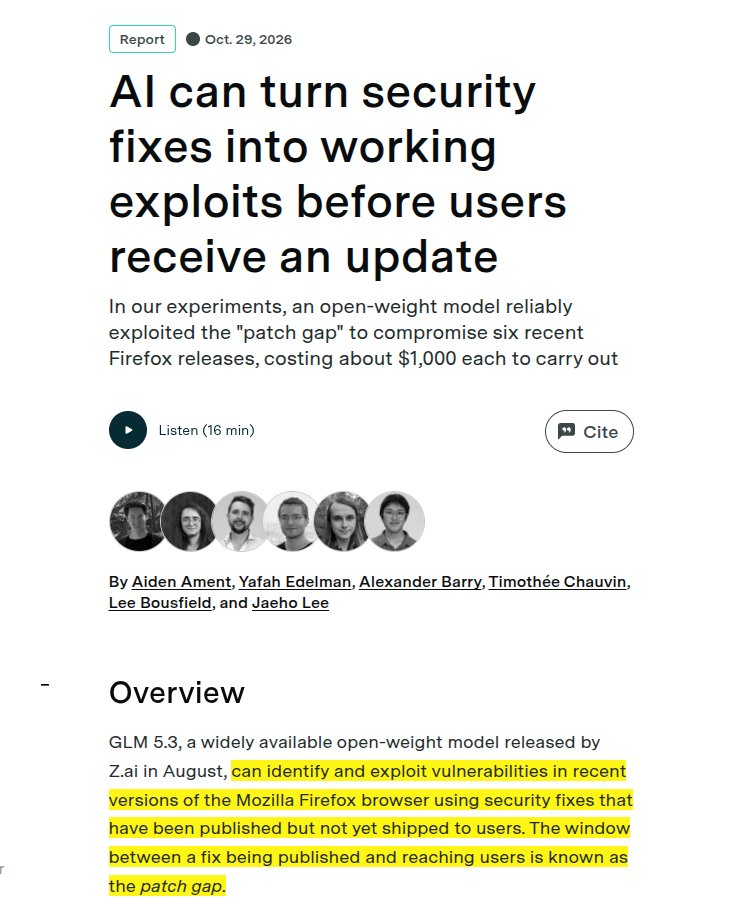
Wow. A free Chinese open-weight model turned Firefox's public security fixes into working exploits, six releases in a row. Export controls cover the chips. Nothing covers the gap between a fix going public and users installing the update. Every open patch is now a recipe.
In Epoch AI tests, Z .ai’s open-weight GLM 5.3 turned unshipped Firefox security fixes into working attacks (i.e. built working exploits) on 6 consecutive releases.
Those fixes sit in public code before reaching the stable browser, disguised as routine changes to slow attackers.
Without a single refusal from any provider, GLM 5.3 still picked out the real patches and built a full exploit chain alone.
The result was a webpage that sent a visitor’s local file to the attacker with no further clicks, a route to stored passwords and cookies.
The researchers first spent over $100K building a safe test system, but after that, each extra Firefox hack cost only about $1,000, and the fastest took 12 hours.
Every hack also used a second Firefox bug that nobody knew about, which the AI found by itself and Mozilla fixed on October 27.
The researchers tried the same thing on Google Chrome and failed, even after spending about $100K.