@ImpsFocus@ProSport You hit jackpot with this transfer . 2 years and you will sell Coubis for 20-25 mil . Well done ! He will be missed by U Cluj , great talent 👏🏻🇷🇴
In the next 6-12 months, your primary internet interface may become an agent.
This shift will fundamentally change how we build and use online services.
We're ready.
Which cryptocurrency project is better suited to become the world's stable financial system? Sorry, I'm limited to 4 options in the poll, feel free to comment your choice below.
Which cryptocurrency project is better suited to become the world's stable financial system? Sorry, I'm limited to 4 options in the poll, feel free to comment your choice below.
Supernova is live on Battle Net.
Here's what changed under the hood and why it matters.
The paradigm shift nobody's talking about:
Every blockchain in the industry is measured on two metrics: block time and throughput.
Faster blocks = better chain. More TPS = better chain.
----------
Supernova breaks this framing entirely.
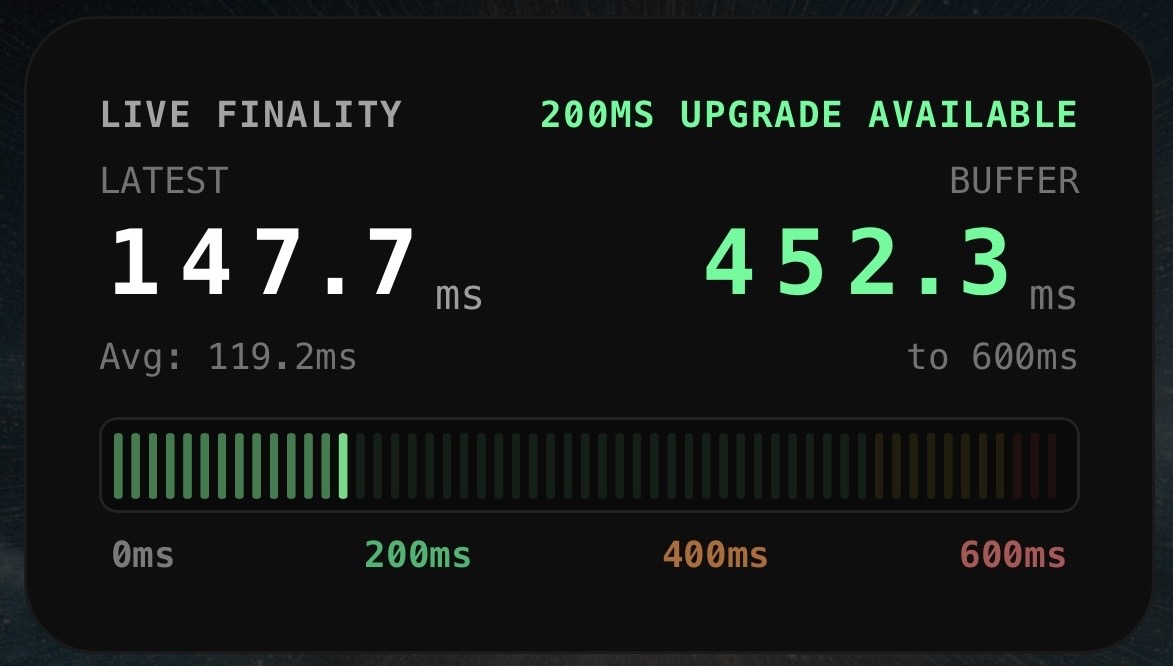
For the first time in the blockchain industry, block finality is faster than block slot allocation.
Let me explain what that means.
How every other blockchain works:
Traditional blockchains follow Execute → Propose → Vote. Validators must execute every transaction before proposing a block.
The block slot is the clock. Finality can never be faster than the slot, because execution is in the critical path.
Ethereum: 12.8s slot, ~12.8 minutes finality.
Solana: 400-600ms slot, 13 seconds finality.
Sui: variable, ~500 to 1000 ms for complex transactions.
In every case: finality ≥ block slot. This is treated as a law of physics.
It's not.
----------
How Supernova works:
We flipped the model to Propose/Vote → then Execute.
Consensus proceeds independently of execution. Validators agree on transaction ordering first. Execution results are notarized in subsequent block headers via inclusion proofs.
The inclusion proof is the key innovation: it allows a block to be finalized with cryptographic proof that its transactions will execute correctly, before the execution itself completes.
The virtual state tracker in the transaction pool maintains a deterministic view of account states (nonces, balances, pending transactions) so consensus can validate without waiting for full execution.
Result: the block is finalized faster than the block round itself.
88ms finality measured in testing. Sub-200ms under real-world conditions. On 600ms block slots.
Finality < block slot. First time in the industry.
----------
The throughput story:
With the same hardware specification as pre-Supernova mainnet, the network now achieves ~120,000 transactions per second in burst mode. Same nodes. Same machines. 10x the block production cadence.
This is the same validator infrastructure running fundamentally better software.
The backpressure system (Execution-Result Inclusion Estimator) ensures this scales safely - dynamically adjusting per-block gas limits if execution lags behind proposals, so minimum-spec nodes never get overwhelmed.
What this means in context:
- Block time: 6s → 600ms (10x)
- Finality: ~88ms measured (first blockchain where finality < slot time)
- Throughput: ~120,000 TPS burst mode (same hardware)
- Architecture: consensus fully decoupled from execution
- Sharding: 3 execution shards + metachain, fully preserved
- Validators: 3,200+ nodes, no hardware upgrade required
----------
Battle of Nodes is stress-testing all of this right now. $150K in prizes to find what breaks. Validators, security researchers, builders, and guilds pushing the limits.
If Supernova survives this, it ships to mainnet.
150,000 lines of new protocol code. 20 months of engineering. The most significant upgrade since genesis.
Supernova is live.
The largest network upgrade in MultiversX history has been activated on our Battle Net.
Over the next week, validators, developers, and community members will push it to its limits and harden its security.
Live, in public, with real stakes.
And Supernova is live on BoN!
Blocks being produced every 600 ms on all shards, with a large backlog of transactions consumed at activation like it was nothing.
Looking good!
Full-Stack AI Economies: Comparing NEAR, MultiversX, Virtuals and ASI
If AI agents are a trillion-dollar economy by 2030, then whoever owns compute + payments + coordination today is massively underpriced.
I’ve been mapping the Full-stack AI economy thesis this month, after that I think most people still misunderstand the game.
AI-native blockchains are evolving from single-purpose platforms into complete economic systems, stacking compute, payments, agent marketplaces, and coordination layers to enable autonomous agent activity.
So I put them in my framework, a real AI economy needs 4 layers:
[1] Compute sovereignty - where agents actually run.
[2] Native payments - how agents pay each other.
[3] Marketplace liquidity - where agents monetize.
[4] Coordination layer - how everything scales without friction.
Among the leaders, @NEARProtocol and @ASI_Alliance offer the most mature full stacks, with dedicated decentralized compute and agent runtimes tailored for agentic workflows.
@virtuals_io dominates agent tokenization and marketplaces but leans on external compute, while @MultiversX excels in agentic commerce standards via Google's Universal Commerce Protocol integrations.
Here’s I’ll share the details insights on each protocol, I also rank them consecutively:
1/ $NEAR – The Most Complete Stack
I’ll say it directly, I think NEAR is currently the most complete AI economy stack.
→ Compute - They launched confidential GPU infra + AI runtime. TEE-secured workloads, enterprise narrative, sub-30s attestations. That matters because agent economies without secure compute are just token casinos.
→ Payments - NEAR Intents + x402 integration. Cross-chain execution + revenue-sharing + fee switch with buybacks already live.
→ Agents Layer - ironClaw runtime + chain abstraction across 35+ chains. This is execution infra, not just marketplace UI.
→ Coordination - Nightshade + chain abstraction = scalable coordination. If agent traffic explodes, infra won’t choke.
Market cap ~$1.6B with strongest volume profile among the 4. I believe $NEAR looks like it wants to be AWS + Stripe + Shopify for AI agents.
2/ $ASI Alliance - The AGI Maximalist Bet
When ASI Alliance merged @Fetch_ai , @SingularityNET, and @oceanprotocol , I was skeptical, but strategically It makes sense.
They combine agents, model marketplace, data marketplace, decentralized compute.
ICYMI, this is an AGI infra bet.
Mcap is ~$347M → much smaller than $NEAR and liquidity is thinner.
However what stands out to me is conceptual alignment: data + models + compute + tokenized coordination.
If AI agents require composable intelligence markets, $ASI could become the clearinghouse.
The upside is ideological dominance if AI-native infra wins, eventually i think this is the long-volatility bet.
3/ $VIRTUAL - The Agent Tokenization King
Virtuals Protocol does financializes agents extremely well.
- ~$488M mcap.
- $100M trading volume relative to cap daily.
- Thousands of tokenized agents.
- aGDP framework tracking agent output.
From my perspective as someone who watches liquidity closely, Virtuals understands speculation is fuel deeply.
That’s why they turned agents into tradable, ownable assets with measurable economic identity.
If compute becomes vertically integrated by chains like NEAR or ASI, margins compress for marketplace-only models.
I see it as the Nasdaq for AI agents still very valuable.
4/ $EGLD - The Commerce Standards Play
MultiversX is underrated in this conversation, they focus on agentic commerce standards.
UCP, ACP, AP2, MCP → all commerce-native stack with gasless transactions and HTTP-native integration.
They push AI-native commerce rails even though the volume is lowest among the 4 so does the mcap ~$124M.
But if AI agents start doing real commerce such as subscriptions, APIs, autonomous purchasing, standards matter more than hype.
MultiversX feels like it’s building ISO standards for AI commerce while others fight over infra dominance.
My takeaways:
after surviving multiple cycles from GameFi, NFTs, airdrops, modular, restaking… I’ve learned that narratives are shortterm but economic architecture is longterm.
i think these 4 are building sovereign economic systems for autonomous agents.
that matters more than chasing hyped or flipping shortterm gains, market has matured so much that ppl realize they now want to invest in infra like this.
day 1 of documenting on @MultiversX
Supernova:
reading through MIP-27 and the transition docs. 6 seconds to 600ms is insane had to understand how they're actually achieving sub-second finality.
lots of assumed knowledge here terms used constantly but never actually explained🧵
The best time to plant a tree—or ship Ethereum 2.0—was in 2018.
The second best time? Today.
Here’s a thought: What would it be worth to Ethereum if full-blown ETH 2.0, with state-of-the-art specs (full state sharding, sub sec finality), were live and running by the end of 2025?
Would it unlock 100B, 500B, or 1T in cumulative value, relevance and momentum?
It can be done. I know a team.
This is what I’d call war mode.
Here to help.
@VitalikButerin@IOHK_Charles@ethereumJoseph@no__________end@tkstanczak
Soooo just in case it wasn't clear from my posts, @XoxnoNetwork will be launching the most advanced money market on MultiversX.
Think: the not even released AAVEv4, but even better!
If that doesn't get you hyped about DeFi, I don't know what will.




![Defi_Rocketeer's tweet photo. Full-Stack AI Economies: Comparing NEAR, MultiversX, Virtuals and ASI
If AI agents are a trillion-dollar economy by 2030, then whoever owns compute + payments + coordination today is massively underpriced.
I’ve been mapping the Full-stack AI economy thesis this month, after that I think most people still misunderstand the game.
AI-native blockchains are evolving from single-purpose platforms into complete economic systems, stacking compute, payments, agent marketplaces, and coordination layers to enable autonomous agent activity.
So I put them in my framework, a real AI economy needs 4 layers:
[1] Compute sovereignty - where agents actually run.
[2] Native payments - how agents pay each other.
[3] Marketplace liquidity - where agents monetize.
[4] Coordination layer - how everything scales without friction.
Among the leaders, @NEARProtocol and @ASI_Alliance offer the most mature full stacks, with dedicated decentralized compute and agent runtimes tailored for agentic workflows.
@virtuals_io dominates agent tokenization and marketplaces but leans on external compute, while @MultiversX excels in agentic commerce standards via Google's Universal Commerce Protocol integrations.
Here’s I’ll share the details insights on each protocol, I also rank them consecutively:
1/ $NEAR – The Most Complete Stack
I’ll say it directly, I think NEAR is currently the most complete AI economy stack.
→ Compute - They launched confidential GPU infra + AI runtime. TEE-secured workloads, enterprise narrative, sub-30s attestations. That matters because agent economies without secure compute are just token casinos.
→ Payments - NEAR Intents + x402 integration. Cross-chain execution + revenue-sharing + fee switch with buybacks already live.
→ Agents Layer - ironClaw runtime + chain abstraction across 35+ chains. This is execution infra, not just marketplace UI.
→ Coordination - Nightshade + chain abstraction = scalable coordination. If agent traffic explodes, infra won’t choke.
Market cap ~$1.6B with strongest volume profile among the 4. I believe $NEAR looks like it wants to be AWS + Stripe + Shopify for AI agents.
2/ $ASI Alliance - The AGI Maximalist Bet
When ASI Alliance merged @Fetch_ai , @SingularityNET, and @oceanprotocol , I was skeptical, but strategically It makes sense.
They combine agents, model marketplace, data marketplace, decentralized compute.
ICYMI, this is an AGI infra bet.
Mcap is ~$347M → much smaller than $NEAR and liquidity is thinner.
However what stands out to me is conceptual alignment: data + models + compute + tokenized coordination.
If AI agents require composable intelligence markets, $ASI could become the clearinghouse.
The upside is ideological dominance if AI-native infra wins, eventually i think this is the long-volatility bet.
3/ $VIRTUAL - The Agent Tokenization King
Virtuals Protocol does financializes agents extremely well.
- ~$488M mcap.
- $100M trading volume relative to cap daily.
- Thousands of tokenized agents.
- aGDP framework tracking agent output.
From my perspective as someone who watches liquidity closely, Virtuals understands speculation is fuel deeply.
That’s why they turned agents into tradable, ownable assets with measurable economic identity.
If compute becomes vertically integrated by chains like NEAR or ASI, margins compress for marketplace-only models.
I see it as the Nasdaq for AI agents still very valuable.
4/ $EGLD - The Commerce Standards Play
MultiversX is underrated in this conversation, they focus on agentic commerce standards.
UCP, ACP, AP2, MCP → all commerce-native stack with gasless transactions and HTTP-native integration.
They push AI-native commerce rails even though the volume is lowest among the 4 so does the mcap ~$124M.
But if AI agents start doing real commerce such as subscriptions, APIs, autonomous purchasing, standards matter more than hype.
MultiversX feels like it’s building ISO standards for AI commerce while others fight over infra dominance.
My takeaways:
after surviving multiple cycles from GameFi, NFTs, airdrops, modular, restaking… I’ve learned that narratives are shortterm but economic architecture is longterm.
i think these 4 are building sovereign economic systems for autonomous agents.
that matters more than chasing hyped or flipping shortterm gains, market has matured so much that ppl realize they now want to invest in infra like this.](https://pbs.twimg.com/media/HC8e4wCbkAAaCFF.jpg)


