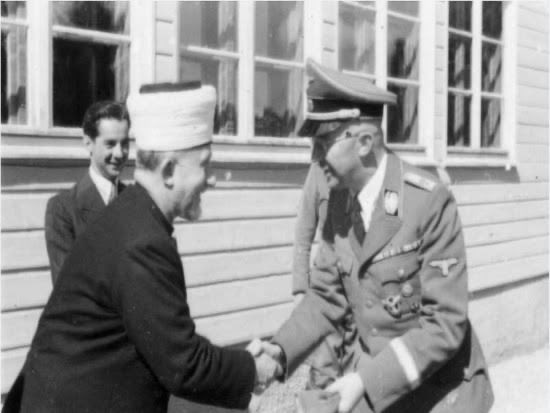
On July 4, 1943, the Grand Mufti of Jerusalem met Heinrich Himmler — and was told that three million Jews had already been murdered.
Amin al-Husseini spent the day with top SS officers at Himmler’s field headquarters. Himmler confided in him about the ongoing genocide and even discussed Germany’s advancing nuclear program, promising an atomic weapon that would secure the “final victory.”
By then the Mufti was already a full partner in the Nazi project. He had met Hitler in 1941, received a lavish salary and residences from the Reich, and was actively recruiting tens of thousands of Muslims for the Waffen-SS in Bosnia and elsewhere. He broadcast vicious antisemitic propaganda on Radio Berlin, urging Arabs to “kill the Jews wherever you find them.”
The explicit goal was never hidden. In a top-secret letter from Foreign Minister Ribbentrop (and coordinated with Italy), the Axis powers promised the Mufti full support for Arab independence and the destruction of the Jewish National Home in Palestine.
Al-Husseini didn’t just hate Jews in theory. He worked directly with the men running the death camps, pushed for the bombing of Tel Aviv, trained Arab commandos for sabotage operations against Jews, and spent years trying to block any rescue or refuge for European Jews — all while the gas chambers ran at full capacity.
He chose the Nazis over every other option, including earlier Ottoman and British proposals that had offered Jews a national home while recognizing Arab rights. He bet everything on Hitler — and lost with him.
Some alliances don’t just fail. They make you an accomplice in history’s greatest crime.
The rock that wiped out the dinosaurs was about six miles across, taller than Mount Everest, moving at 45,000 miles an hour. It hit shallow sea off what is now Mexico at 60 degrees, which a 2020 Imperial College London study found was close to the deadliest angle possible.
The steep angle mattered more than the size. Coming in at 60 degrees threw the most rock and gas high into the sky, where wind could spread it around the world. And the target was the worst it could have picked, shallow seafloor made of sulfur-rich rock. The impact turned that rock to vapor and threw billions of tons of sulfur into the air.
The blast, equal to billions of Hiroshima bombs, was only the start. As the debris thrown into space fell back to Earth, friction turned each piece into a glowing hot pellet. For up to an hour, the sky over much of the planet glowed like the inside of an oven set to broil. Anything caught in the open cooked. The only land animals with a real chance were the ones that could hide underground or underwater.
At a site in North Dakota, nearly 2,000 miles from the crater, scientists found fish buried with tiny beads of impact glass still stuck in their gills. Those fish died within an hour of the strike, killed by a wave that sloshed out of an inland sea when the ground heaved.
What finished the dinosaurs came slower. The sulfur and dust wrapped around the whole planet and blocked out the sun, and with the light gone the warmth went too, dropping global temperatures by several degrees and keeping them down for years, in some models more than a decade. Plants need sunlight to make food, so in the dark they died. The plant-eaters starved. Then the animals that hunted them starved as well, and the loss climbed up the food chain until about three quarters of every species on Earth was gone.
Here is the part the joke gets right. Birds are dinosaurs. They split off from small meat-eating dinosaurs more than 150 million years ago and lived alongside the giant ones for over 100 million years. Most birds died in the disaster too, including every last one that still had teeth. The ones that made it were small, ground-living birds with beaks that could crack open seeds, and seeds can sit buried in the soil for years, waiting out a disaster.
Those few survivors became every bird alive today, more than 10,000 species. The pigeon outside your window is a dinosaur whose family lived through the single worst day this planet has ever had.
I went to an Israeli hospital.
I wanted to make this video for the last 7 years. This is what I grew up seeing. Now, you can see it too. Thank you @Hadassah for giving me access!
A police officer is interviewing three recruits who are training to become detectives.
To test their observational skills, he shows the first recruit a photograph of a suspect for five seconds before hiding it.
“This is your suspect,” he says. “How would you recognize him?”
The first recruit answers, “Easy. We’d catch him right away because he only has one eye.”
The officer sighs. “That’s because I showed you his side profile.”
Trying again, he shows the same photo to the second recruit for five seconds.
“This is your suspect. How would you recognize him?”
The second recruit smiles confidently. “Even easier. He only has one ear.”
Now the officer is furious. “What’s wrong with you two? Of course he only has one eye and one ear. It’s a side-profile photo! Can’t either of you come up with a better answer?”
Completely exasperated, he turns to the third recruit. “This is your suspect. How would you recognize him?”
Then he adds, “And think carefully before you give me another ridiculous answer.”
The third recruit studies the photo for a moment. “The suspect wears contact lenses.”
The officer blinks in surprise. He doesn’t actually know whether the suspect wears contacts.
“That’s… an interesting observation. Wait here while I check his file.”
A few minutes later, the officer returns with a huge smile.
“Incredible! You’re right. The suspect really does wear contact lenses. How on earth did you figure that out?”
“Simple,” the third recruit replies. “He can’t wear regular glasses because he only has one eye and one ear.”
My wife has a strict rule: I am not allowed to be left unsupervised in public for more than twenty minutes. This weekend reminded me why.
I’m standing in a long line at a garden center with a massive 50lb bag of specialized bird seed.
This woman behind me taps me on the shoulder and asks, "Oh, do you have a lot of birds?"
Standard small talk, But I’d been in line for fifteen minutes and I was bored.
I looked at her, completely deadpan, and said: “Actually, no, This is for me, It’s a new holistic cleanse I’m trying, High protein, great for the hair.”
The guy behind her immediately stopped scrolling on his phone.
The woman’s eyes went wide. “You… you eat that? Is that even safe?”
I leaned in like I was sharing a government secret. “The results are incredible. I lost 30 pounds last summer. The only problem is the side effects. Last time I did it, I ended up in the emergency room for two weeks. Tubes, monitors, the whole deal.”
She gasped. “From the seeds? Did you get a parasite?”
“No,” I said. “I was perched on a telephone pole trying to sleep and a hawk knocked me off. Fell forty feet.”
The guy behind her made a sound like a tire blowing out. The woman just stood there, paralyzed, trying to process the mental image.
Right then, my wife comes back from the bathroom, sees the look on the woman's face, grabs my arm, and starts dragging me toward the exit.
“He’s kidding,” she tells the woman. Then she turns to me: “This is why we can’t have nice things.”
I don't care. The look on that lady's face was worth more than the bird seed. 😂
A man with a completely bald head and only one leg is invited to a Fancy Dress Party.
He doesn't know what to wear to hide his head and his wooden leg, so he writes to a fancy dress company to explain his problem.
A few days later he receives a parcel with a note:
Dear Sir
Please find enclosed a Pirate's outfit. The spotted handkerchief will cover your bald head and with your wooden leg you will look just right as a Pirate.
The man is offended that the outfit emphasizes his disability, so he writes a letter of complaint.
A week passes and he receives another parcel and note.
Dear Sir
Sorry about the previous parcel. Please find enclosed a Monk's habit. The long robe will cover your wooden leg and with your bald head you will really look the part.
The man is really incandescent with rage now, because the company has gone from emphasising his wooden leg to drawing attention to his bald head.
So he writes a really strong letter of complaint. A few days later he gets a very small parcel from the company with an accompanying letter:
Dear Sir
Please find enclosed a tin of Golden Syrup. We suggest you pour the tin of Golden syrup over your bald head, let it harden! then stick your wooden leg up your arse and go as a toffee apple.. 😁😁
I have to think of this cartoon by @tomgauld often when I read online comments regarding articles. Pretty sure RHPAC is the most common type of online comment…
Petr Ginz was just a kid in Prague who stayed up too late reading adventure novels, who built model airplanes, who annoyed his little sister the way brothers do.
By age twelve, he had also written a 600-page science fiction novel. Not a school assignment. Not something his parents had encouraged. A fully imagined story about lunar expeditions and space exploration, written in notebooks he filled faster than anyone could replace them. His bedroom walls were covered in sketches — rocket designs, alien landscapes, star charts mapping galaxies that existed only inside his head.
Then March 1939 arrived, and the future Petr had been imagining slammed shut.
German tanks rolled into Prague. Within months, Jewish children were expelled from schools, banned from libraries, forbidden to enter bookshops or cinemas. The world that fed his imagination — books, teachers who encouraged his ideas, conversations about things that didn't yet exist — was taken away.
But imagination doesn't require permission.
While Nazi bureaucrats cataloged restrictions and propaganda posters declared Jews subhuman, Petr kept writing. He kept designing fictional spacecraft. His notebooks became the only territory the occupation could not reach.
In October 1942, a deportation notice arrived. Petr was fourteen. His parents were staying behind — for now, they hoped. He packed a small bag. The train took him to Terezín, a fortress town the Nazis had converted into a concentration camp designed partly as propaganda — a "model ghetto" they could show Red Cross inspectors to prove they were not monsters.
Behind the staged appearances, people were dying of starvation and disease. Thousands were being shipped regularly to Auschwitz. Everyone knew what those transports meant.
But something remarkable emerged from the horror.
The prisoners — many of them artists, musicians, writers, intellectuals — refused to surrender their minds even as their bodies weakened. They painted on scraps. They composed music they could not record. They taught children in secret schools the Nazis did not know existed.
And in Barracks L417, teenage boys created a magazine. They called it Vedem. We Lead. Every Friday, these boys — some as young as twelve — produced a handwritten publication. Articles, poetry, drawings, satirical pieces. They passed it from bunk to bunk, reading by whatever light they could find, keeping their minds sharp while everything else was being systematically destroyed.
Petr became the editor.
Not because he was oldest. Not because adults appointed him. Because the other boys recognized something in him — a refusal to accept that this was the end of stories.
For two years, he edited Vedem while watching boys disappear on transports. He wrote science fiction while people around him died of typhus. He imagined futures while the present was designed to make futures unthinkable.
Then, in 1943, he drew something that should not have been possible.
A small, heavily cratered moon dominates the foreground. Behind it, suspended in absolute blackness: a sphere of blue and white, continents barely visible through swirling clouds.
Earth. Seen from the lunar surface.
No human had witnessed this view. The first crude satellite images were fifteen years away. The famous Earthrise photograph from Apollo 8 would not exist for another twenty-five years.
Petr drew it with uncanny accuracy — the proportions, the perspective, the delicate appearance of our planet against infinite darkness. He labeled it Moon Landscape and moved on to his next drawing, as if sketching impossible visions was simply what you did when pencils and paper were available.
How did he know? How could a teenager who had never left Czechoslovakia, who had never seen footage from space because footage from space did not yet exist, draw Earth from the moon with such precision?
Perhaps genius is simply imagination freed from the constraints everyone else accepts. Perhaps when you have already lost school and friends and freedom and the ordinary future you were supposed to have, your mind stops recognizing the boundaries between what is and what could be.
September 1944. Another transport list. Petr's name appeared. He was sixteen years old. Old enough that in ordinary circumstances he would have been thinking about university, about what he wanted to do with his life. He boarded a train to Auschwitz.
His parents survived Terezín. When liberation came in May 1945, they searched desperately for their son. They wrote letters. They checked survivor lists. The confirmation came slowly, through testimonies from people who had been on the same transport.
Petr Ginz was murdered at Auschwitz in September 1944, probably within days of arrival. Sixteen years old. Killed for being born Jewish.
But the notebooks survived.
Friends had hidden them in Terezín. After liberation, someone found them in an attic in Prague — tucked away with other artifacts the Nazis had not destroyed. Including Moon Landscape.
For decades, Petr's work circulated mainly among Holocaust scholars and Czech educators. His diary was published. His drawings were preserved at Yad Vashem. A few people knew his name. Most of the world did not. Then January 2003 arrived.
Israeli astronaut Ilan Ramon was preparing for a Space Shuttle Columbia mission and wanted to bring something symbolic — something representing memory, hope, human creativity surviving atrocity. Someone showed him a teenage boy's drawing of Earth from the moon, made in a concentration camp sixty years earlier.
Ramon understood immediately. The idea that a murdered child had imagined space travel decades before it existed — and drawn it accurately — felt like something that needed to reach actual space.
On January 16, 2003, Columbia launched. Aboard: seven astronauts and a pencil sketch from a sixteen-year-old who had been dead for nearly sixty years.
For sixteen days, Petr's drawing floated above the atmosphere. The impossible vision became real. The boy who never left Europe made it to orbit.
Then, on February 1, 2003, Columbia disintegrated during re-entry over Texas. All seven crew members died. Including Ilan Ramon, who had wanted to honor a murdered boy by carrying his dreams to the stars.
Moon Landscape scattered across the Texas sky.
But it was recovered from the debris. Today it hangs in museums. Petr's stories have been published in multiple languages. His diary teaches schoolchildren about the Holocaust in classrooms across the world.
The boy murdered for being Jewish has become, in the truest sense, immortal.
Every child who sees Moon Landscape resurrects Petr for a moment. Every person who reads his stories defeats something the Nazis believed was permanent. Every time someone marvels that a teenager drew Earth from space before satellites existed — imagination wins.
He died at sixteen believing, one imagines, that his dreams would die with him. He was wrong. His vision outlasted his murderers. His drawings outlasted the Third Reich. His imagination proved more durable than everything designed to extinguish it.
For those who have ever kept creating — kept writing, kept drawing, kept imagining — in a time when the world made it difficult or dangerous or seemingly pointless: Petr Ginz's story holds something worth sitting with quietly.
The barbed wire could not reach his notebooks.
Will Europe Save Hamas in Gaza? I recently met with a high-ranking European official from a country deeply involved in the Israel and Palestine file to discuss Gaza’s future and immediate options for relieving civilians trapped under Hamas’s grip. I presented a simple proposal: create safe zones across the "Yellow Line" into the Israel‑controlled green zone and support new, organized, secure, Hamas‑free communities where Gazans could finally begin rebuilding their lives. Whether the issue is humane living conditions, deradicalization, education, healthcare, or shielding civilians from both Hamas or Israeli strikes, the green zone is the only place where meaningful action is possible. Instead of engaging, the official launched into a long monologue about their country’s contributions to the Palestinian Authority, UNRWA, and other institutions, all while insisting on their own “humility” as a faraway European nation.
Then came the truly alarming part: a casual normalization of Hamas. The official proudly described how easy it had been to work with Hamas before October 7, praising the group for providing “excellent security” and being “easier to work with than others.” What they called pragmatism was, in reality, a twenty‑year pattern of enabling a violent terrorist organization responsible for immense civilian suffering.
When I explained that any Hamas‑free zones would require vetting at the Yellow Line to prevent weapons or operatives from entering, the official reacted with shock. “This vetting would violate international law,” they repeated, insisting that their country could not fund projects with any checks on who enters. I noted the absurdity: I had undergone extensive vetting just to enter their country, and even this building, yet they believed Hamas fighters should be able to walk into new civilian safe zones unimpeded. Their only response was vague appeals to “international law,” which, in their interpretation, seems to require allowing terrorists to hide among civilians.
The meeting ended on an even more surreal note. When the official asked what would happen to Hamas fighters left in the red zone, I said I didn’t care; they could fight the Israeli military on their own all they wanted once they no longer held two million civilians hostage. The official lamented that “this isn’t the old American West” and expressed concern for what would happen to Hamas without human shields. Disgust doesn’t begin to describe my feelings and reactions.
I left convinced of something long suspected: Hamas’s twenty‑year rule was sustained not only by its own brutality but by an ecosystem of NGOs, donor nations, Western European governments, journalists, academics, activists, lawyers, and even self‑styled human‑rights defenders who normalized Hamas, treated it as a legitimate authority, or tolerated its abuses because their hostility toward Israel outweighed their concern for Gazans.
PREGNANCY Q & A:
Should I have a baby after 35?
A: No, 35 children is enough.
Q: I'm two months pregnant now. When will my baby move?
A: With any luck, right after he or she finishes college.
Q: What is the most common pregnancy craving?
A: For men to be the ones who get pregnant.
Q: What is the most reliable method to determine a baby's sex?
A: Childbirth.
Q: The more pregnant I get, the more strangers smile at me. Why?
A: 'Cause you're heavier than they are.
Q: My wife is five months pregnant and so moody that sometimes she's borderline irrational.
A: And your question is?
Q: My childbirth instructor says it's not pain I'll feel during labor, but pressure. Is she right?
A: Yes, in the same way that a tornado might be called an air current.
Q: Is there any reason I have to be in the delivery room while my wife is in labor?
A: Not unless the word "alimony" means nothing to you.
Q: Is there anything I should avoid while recovering from childbirth?
A: Yes, pregnancy.
Q: Do I have to have a baby shower?
A: Not if you change the baby's diaper very quickly.
Q: Our baby was born last week.
When will my wife begin to feel and act normal again?
A: When the kid is in college.
1/ Pop culture quiz.
Luke Skywalker blew up the Death Star with over a million people aboard. Did you walk out of the cinema asking whether the Rebellion were terrorists?
No. You knew who built the superweapon. Context told you exactly who to blame.
Hold that thought. 🧵
On This Day — June 7, 2002
As billions in international aid — including your taxpayer dollars — continued pouring into the Palestinian Authority, a Kuwaiti newspaper dropped a bombshell.
On this day in 2002, Al-Watan reported that Yasser Arafat had siphoned $5.1 million in Arab donor money, explicitly earmarked for the Palestinian people, and deposited it directly into his personal bank account.
This was Arafat’s standard operating procedure:
- Arafat’s personal fortune was estimated between $1 billion and $3 billion (some intelligence assessments reached $6.5 billion), stashed in secret accounts in Switzerland, France, and offshore havens.
- A leaked 1997 Palestinian Legislative Council investigation found that 40% of the entire annual budget — $326 million that year alone — had disappeared into corruption and mismanagement. Arafat suppressed the report.
- His economic advisor Mohammed Rashid took stolen funds and invested them in the Jordan Cement Company to personally profit from the reconstruction boom caused by the Intifada.
- Arafat and his inner circle ran monopolies on cement, fuel, cigarettes, flour, gravel, and cars — squeezing huge profits from ordinary goods.
While his wife Suha Arafat (pictured below) lived lavishly in Paris (spending over $100,000 per month on designer clothes, shoes, and luxury living), Arafat treated EU, US, Arab, and UNRWA aid as his personal ATM.
Billions flowed in after Oslo. Very little went to building real institutions or prosperity.
Arafat died one of the richest men in the world — having turned a "national liberation movement" into a criminal empire.
The man who posed as the humble revolutionary in a keffiyeh was, in reality, one of the most successful kleptocrats of the modern era.
This was betrayal on an industrial scale; theft to a degree that would make Daniel Ocean blush.