How to duplicate yourself into Claude in a weekend:
(even if you've never written a prompt before)
1. Download the desktop app.
☑ Go to claude .com/download
☑ Set Opus 4.7 as default
☑ Turn ON Extended Thinking
2. Open Cowork mode.
☑ Cowork = where your voice lives
☑ Click the top left tab
☑ Create your "Voice" folder inside
3. Install Wispr Flow (it's free).
☑ Turns your voice → text
☑ Voice = faster and more honest
☑ Typing kills the truth.
4. Run the interview.
☑ Paste Prompt 1 from https://t.co/LyV7feh2TK.
☑ 100 questions, 7 categories
☑ Push past every vague answer
5. Compress the dump.
☑ Paste prompt 2 from https://t.co/LyV7feh2TK.
☑ 20K words → 4K tokens
☑ Save as [your_name] .md
6. Test it in a blank chat.
☑ Open a fresh Claude chat
☑ Run a prompt only you would write
☑ If it sounds like you → ship it
7. Drop it into Cowork.
☑ Move [your_name] .md into your folder
☑ Claude now reads it on every turn
☑ Every draft = your voice, automatically
8. Port it everywhere.
☑ Upload to ChatGPT, Grok, Gemini
☑ Same file = same voice in every AI
☑ Hand it to your team or ghostwriter
9. Edit it forever.
☑ Install Obsidian (free)
☑ Open Cowork as a vault
☑ Update as your taste shifts
Full guide + prompts at https://t.co/LyV7feh2TK.
(save this to clone yourself into any AI)
If you ever doubted that there is alpha on FinX… Leopold Aschenbrenner wrote “Situational Awareness” – the most cited AGI thesis of the last two years – and released it for free.
Then he launched his own fund betting on exactly that thesis.
Although we don’t yet have the details about the motives behind last night's shooting at the White House Correspondents Dinner, it’s incumbent upon all us to reject the idea that violence has any place in our democracy. It’s also a sobering reminder of the courage and sacrifice that U.S. Secret Service Agents show every day. I’m grateful to them – and thankful that the agent who was shot is going to be okay.
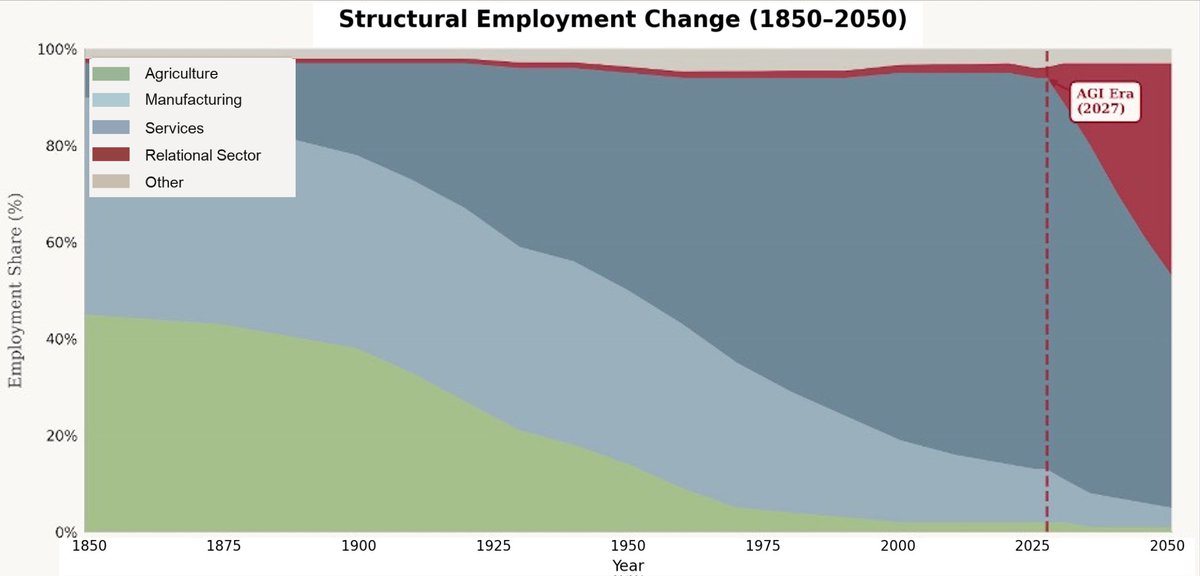
New essay on the economics of structural change and the post-commodity future of work.
1. Almost any question about the impact of advanced AI on the economy needs to start at the same place: what is still scarce? Answer that, and the analysis becomes pretty straightforward. This essay explores what becomes scarce if AI really can replicate most of what humans do in production, and what this mean for the future of jobs.
2. My conjecture, working through the economics: labor reallocates across sectors, and the sector it reallocates to has properties that keep labor a meaningful share of the economy. Ultimately this is about the structure of demand itself. For this, we have to go back to Girard, Augustine and Rousseau: once people's base needs are met, their preferences shift to comparative motives (e.g., status, exclusivity, social desirability). This motive is inherently non-satiated.
4. The key paper is Comin, Lashkari, and Mestieri (Econometrica 2021). As people get richer, they don't buy proportionally more of everything. They shift spending toward sectors with higher income elasticity. They estimate income effects account for 75%+ of observed structural change.
5. The ironic consequence: the sector that gets automated becomes a smaller share of the economy, not a larger one. Agriculture got massively more productive and its share of employment collapsed. Manufacturing too. The "stagnant" sectors absorb the spending and the jobs.
6. So the question is: which sectors have high income elasticity in a post-AGI world? I argue it's what I call the relational sector. Categories where the human isn't just an input into production, it is part of the value.
7. Why does the relational sector have high income elasticity? Because human desire has a mimetic, relational dimension. We don't just want things for their intrinsic properties. We want what others want, and we want it more when others can't have it. Girard, Rousseau, Augustine, and Hobbes all saw this.
8. In work with Kristóf Madarász, we showed this experimentally: WTP roughly doubles when a random subset of others is excluded from the good. And in new work with Graelin Mandel, AI involvement kills the premium. Human-made art gains 44% from exclusivity; AI-made art only 21%.
9. This all comes together for the core argument. The sector that absorbs spending as AI makes commodity production cheap is one where human provenance is part of the value, and demand for it grows faster than income. Exactly the profile that keeps labor meaningful.
10. To be clear about the claim: I'm NOT saying aggregate labor share must rise. It may fall. The claim is about sectoral composition, i.e., where expenditure and employment go once commodities get cheap, and the fact that the sector that will absorb reallocated labor maps to a substantial component of human preferences and desire.
11. If you're interested in the formal model, a linked companion technical note works out all the economics.
Read the essay here: https://t.co/NcjVgn2o8g
If you live in Austin and care about law and order, subscribe for $3 to @AustinJustice
I don’t know who writes this account, but they seem to be doing a solid job of chronicling our DA’s stupidity
Step one: document everything
Step two: recall
This playbook worked perfectly to get Boudin out as SF’s DA
Let’s run it back: step one, document everything stupid over the next 100 days
“Elon’s the best in the world at atoms.”
“Atoms are going to be a decisive factor in the AI race.”
“I think xAI is severely underrated.”
@shaunmmaguire explains why @elonmusk and @xai will win:
“It blows my mind that people don’t understand how fast the company is moving.”
“I believe the bottleneck—at least for inference—is going to be power.”
“Even if you have the best model in the world, if you can only deliver it to 1% of the market demand—you’re heavily limited in your growth rate and expansion.”
“With xAI, they’ve been building the biggest coherent training clusters in the world. They’re just not really focused on monetizing them right now.”
“It’s kinda crazy people don’t understand the pattern yet.”
“I think xAI is going to shock people with the scale it gets to quickly.”







![rubenhassid's tweet photo. How to duplicate yourself into Claude in a weekend:
(even if you've never written a prompt before)
1. Download the desktop app.
☑ Go to claude .com/download
☑ Set Opus 4.7 as default
☑ Turn ON Extended Thinking
2. Open Cowork mode.
☑ Cowork = where your voice lives
☑ Click the top left tab
☑ Create your "Voice" folder inside
3. Install Wispr Flow (it's free).
☑ Turns your voice → text
☑ Voice = faster and more honest
☑ Typing kills the truth.
4. Run the interview.
☑ Paste Prompt 1 from https://t.co/LyV7feh2TK.
☑ 100 questions, 7 categories
☑ Push past every vague answer
5. Compress the dump.
☑ Paste prompt 2 from https://t.co/LyV7feh2TK.
☑ 20K words → 4K tokens
☑ Save as [your_name] .md
6. Test it in a blank chat.
☑ Open a fresh Claude chat
☑ Run a prompt only you would write
☑ If it sounds like you → ship it
7. Drop it into Cowork.
☑ Move [your_name] .md into your folder
☑ Claude now reads it on every turn
☑ Every draft = your voice, automatically
8. Port it everywhere.
☑ Upload to ChatGPT, Grok, Gemini
☑ Same file = same voice in every AI
☑ Hand it to your team or ghostwriter
9. Edit it forever.
☑ Install Obsidian (free)
☑ Open Cowork as a vault
☑ Update as your taste shifts
Full guide + prompts at https://t.co/LyV7feh2TK.
(save this to clone yourself into any AI)](https://pbs.twimg.com/media/HHXeIQ2acAAk5F7.jpg)