Author Right/Wrong: How Technology Changes Ethics. Optimistic curmudgeon who worries about current trends, syn bio and brain VC, futurist, TED speaker, .
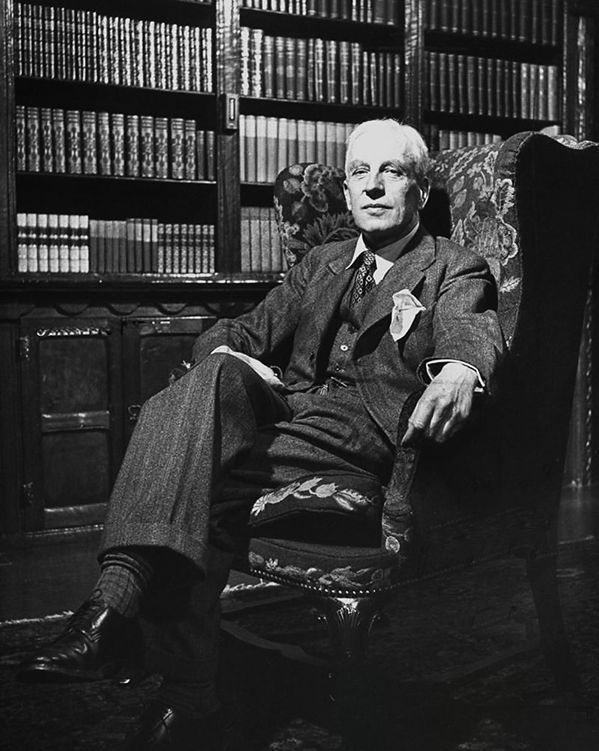
“Civilizations die from suicide, not by murder,” according to 20th-century historian Arnold Toynbee.
He claimed every great culture collapses internally due to a divergence in values between the ruling class and the common people…🧵
China’s collapsing job market just lost its ultimate safety net as the gig economy completely implodes. In a historic first, authorities in Shenzhen, the powerhouse megacity built on migrant labor, have formally declared the ride-hailing market completely saturated. An absolute flood of laid-off workers and desperate citizens has overwhelmed the sector, turning China's most reliable economic fallback option into a brutal financial trap.
The official data reveals a dystopian reality. Nearly 400,000 licensed drivers in Shenzhen are now fighting over a shrinking pool of passengers, leaving the average driver with fewer than five completed trips per day. Exhausted workers are forced to grind through punishing 12- to 16-hour shifts just to scrape together a measly 300 yuan ($42) after corporate platform cuts, vehicle rentals, and charging costs. This crisis is rapidly spreading nationwide, with major hubs like Chongqing, Suzhou, and Dongguan forced to issue identical warnings or freeze permits altogether.
For years, the Chinese Communist Party used gig work as a convenient sponge to soak up mass unemployment and hide the true scale of its failing economy. Now that manufacturing is dying, foreign investment is fleeing, and white-collar sectors are plagued by sweeping layoffs, that fragile cushion has completely disintegrated.
#ChinaEconomy #Shenzhen #GigEconomy #CCP #Unemployment #Didi #ChinaCrisis #StateFailure
You have noticed that too. Google Search is getting worse. The results look professional but say nothing. The answers are longer but less useful. Every page reads like it was written by the same voice.
You thought Google was broken. It is not broken. It is being replaced.
Researchers published a paper at the ACM Web Conference 2026 proving what is happening. They call it Retrieval Collapse.
Here is the mechanism in one sentence. AI-generated content is flooding the internet so fast that search engines are now showing you mostly AI-written pages. And the search engine cannot tell the difference.
They ran a controlled experiment. They started with a pool of real, human-written web pages. Then they gradually added AI-generated content until it made up 67% of the pool.
By that point, over 80% of the top search results were AI-generated. Not 67%. Over 80%. The ranking algorithm did not just let AI content in. It preferred it. The AI-written pages were better optimized, more fluent, and more keyword-rich than the human pages. They outranked the originals.
Here is the part that makes this invisible.
Answer accuracy stayed the same. The search results still looked correct. The information was still technically right. If you measured quality by accuracy alone, nothing appeared wrong.
But source diversity collapsed. Nearly every result came from the same type of content. AI-written. AI-optimized. AI-structured. The human-written pages, the ones with original reporting, personal experience, and genuine expertise, were buried.
The researchers describe a two-stage collapse. Stage one is Dominance. High-quality AI content silently takes over the top results. Everything looks fine. Accuracy is stable. Nobody notices. Stage two is Corruption. Once AI dominates the pipeline, adversarial and low-quality content starts slipping through. By then, the system is too dependent on synthetic sources to course-correct.
A separate analysis found that 74.2% of newly published web pages now contain AI-generated content. Organic click-through rates on pages with AI summaries have dropped 61%. The human internet is being outranked by the machine internet.
Model Collapse described what happens when AI trains on AI. The models get dumber. Retrieval Collapse describes what happens when search engines index AI. The results get emptier.
Both are happening right now. At the same time. And neither one looks broken from the outside.
The search engine still returns ten blue links. The links still load. The pages still answer your question. But the thing that used to make those answers trustworthy, a human who actually knew something, is being quietly replaced by a machine that sounds like it does.
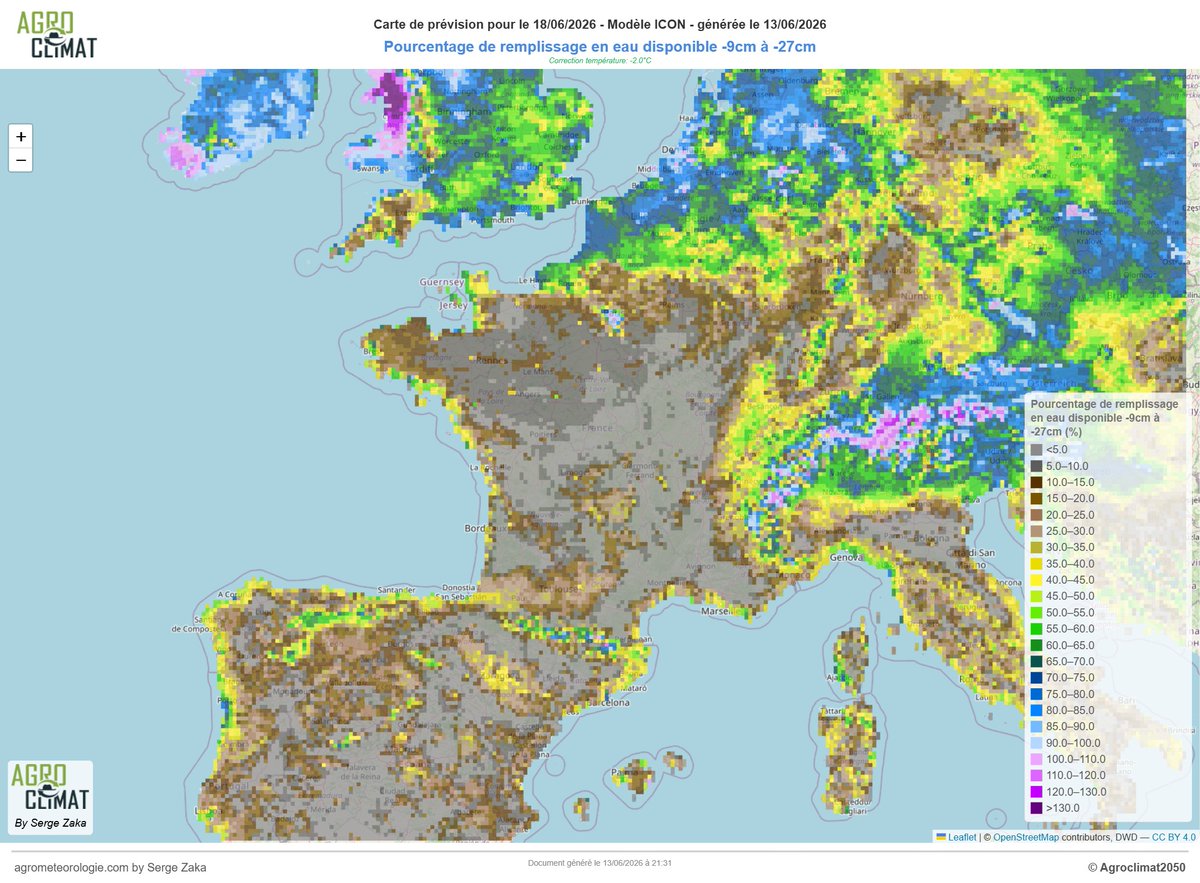
Le risque d’une nouvelle canicule se confirme. Cette fois, on franchirait un cran supplémentaire par rapport à mai, avec un facteur aggravant : des sols nettement + secs, qui favorisent l’échauffement de l’air. Dans ce contexte, voir fleurir des 40°C en France n’aurait rien d’étonnant.
➡️ De 0 à 9cm : Il n'y a plus d'eau disponible pour les végétaux sur presque tout le pays.
➡️De 9 à 27cm : Le seuil sont critiques. D'ici la canicule, il n'y aura plus d'eau également.
➡️ De 27 à 81cm : Les niveaux s'effondrent également. Cette potentielle nouvelle canicule devrait finir le travail.
Les 40°C étaient autrefois rares en plein été, et quasiment inimaginables en juin. Désormais, ils reviennent de plus en plus souvent dès le début de l'été. Ce qui était exceptionnel hier devient habituel aujourd'hui. L'exception devient la norme.
France is heading towards its second heatwave... BEFORE the summer solstice! 🔥🌡️🥵
It’s just nightmarish, morbid, and foreshadows how difficult life will be in the 21st century. 😰
I’m thinking of the ecosystems that can’t take it anymore... 🌲✝️
Map via @Kevin_Fillin
Two economists just published a mathematical proof that AI will destroy the economy.
Not might. Not could. Will — if nothing changes.
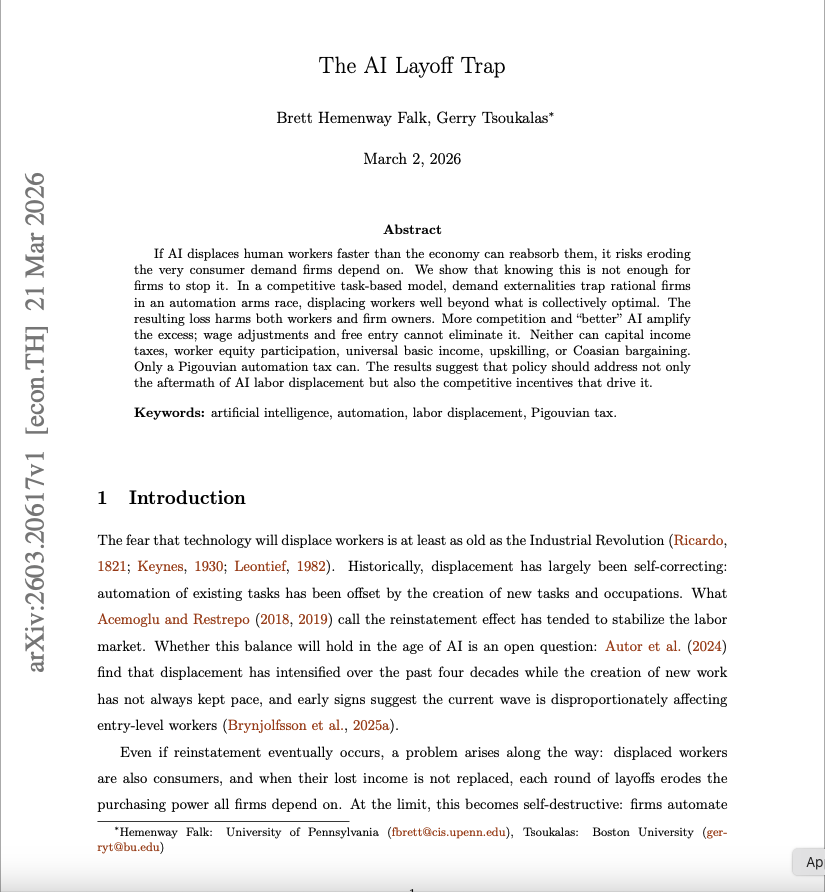
The paper is called "The AI Layoff Trap." Published March 2, 2026. Wharton School, University of Pennsylvania. Boston University. Peer reviewed. Mathematically modeled.
The conclusion is one sentence.
"At the limit, firms automate their way to boundless productivity and zero demand."
An economy that produces everything. And sells it to nobody.
Here is how you get there.
A company fires 500 workers and replaces them with AI. A competitor fires 700 to keep up. Another fires 1,000. Every company is behaving rationally. Every company is following the incentives correctly. And every company is building a trap for itself.
Because the workers who were fired were also customers.
When they lose their jobs faster than the economy can absorb them, they stop spending. Consumer demand falls. Companies respond by cutting costs — which means automating more workers — which means less spending — which means more falling demand — which means more automation.
The loop has no natural exit.
The researchers tested every proposed solution. Universal basic income. Capital income taxes. Worker equity participation. Upskilling programs. Corporate coordination agreements.
Every single one failed in the model.
The only intervention that worked: a Pigouvian automation tax — a per-task levy charged every time a company replaces a human with AI, forcing them to price in the demand they are destroying before they pull the trigger.
No government has implemented this. No major economy is seriously discussing it.
Meanwhile the numbers are already tracking the curve. 100,000 tech workers laid off in 2025. 92,000 more in the first months of 2026. Jack Dorsey fired half of Block's workforce and said publicly: "Within the next year, the majority of companies will reach the same conclusion."
Nobody is doing anything wrong. Companies are following their incentives perfectly. That is exactly the problem.
Rational behavior. At scale. Simultaneously. With no mechanism to stop it.
Two economists built the math. The math leads to one place.
Source: Falk & Tsoukalas · Wharton School + Boston University ·
https://t.co/Tir6S9468A
🔋 🌎
¿Por qué la transición energética global es prácticamente imposible sin las reservas minerales de América Latina? ↓
Mientras el mundo se concentra en fabricar chips y baterías, América Latina posee las materias primas que hacen posible su producción. Solo Brasil controla más del 94% del niobio mundial, un elemento crítico para las aleaciones superconductoras.
🗞️ lee nuestro análisis completo de datos → https://t.co/a0pLIq6U2W
Ha sido de tal magnitud la corrupción del #CártelDeMorena en el @IMSS_Bienestar que el auditor externo rechazó emitir opinión sobre sus estados financieros
Su manejo contable y financiero es tan opaco y obscuro que es imposible saber la realidad del organismo y resulta IMPOSIBLE verificar cuentas por cobrar, inventarios y deuda a proveedores
No en balde los usuarios reniegan del programa y del servicio ante OOOTRO fracaso histórico, similar a su antecedente del #INSABI
Because of El Niño Costero, unusually warm waters along Peru's coast are allowing crocodiles to expand their range southward from near the Ecuadorian border.
In some areas, the ocean is more than 7˚C (12.6˚F) warmer than average.
A kinetic ceiling installation at Costa Navarino, Greece, designed by K-Studio for The Romanos resort, uses fabric panels that sway with sea breezes. The wave-like motion filters sunlight and enhancing natural airflow to keep the beachside restaurant cool.
In 1944, a 13-year-old Jewish boy watched the Nazis take Hungary.
His father gave the family fake Christian names. Forged papers. Split them apart so if one was caught, the others might live.
The boy hid as the godson of a government official. 500,000 Hungarian Jews were killed in 8 months. He survived.
He arrived in London with nothing. Worked as a railway porter. Slept in train stations.
48 years later, he placed a $10 billion trade against the British pound.
By nightfall, he had made $1 billion in a single day. The press called him "The Man Who Broke the Bank of England."
His name was George Soros. His book "The Alchemy of Finance" has stayed in print since 1987.
I turned his philosophy into 12 prompts.
Here are all 12:
#BREAKING: MSNOW: “When President Trump said he wasn’t going to start foreign wars, when he said he was going to bring prices down, did you believe him?”
MAGA voter in OH: “Yeah, yeah I mean, his first term I think he held true to everything that he said he was going to do, I think he fought for everything he said he was going to fight for. This time I haven’t seen it…Every single pitch point he had during his election, he’s backtracking on. All we heard was drill, drill, drill during the election, and now all we’re getting is drilled into the dirt with these prices. So I’m not a fan of him. I voted for Trump all three terms, to be honest with you, I’m not a big supporter of him at this point.” 😳
🚨 News: Google is suing a Chinese cybercrime group it says used Gemini to run financial scams against hundreds of thousands of Americans.
the group, called Outsider Enterprise, used gemini to build hundreds of fake websites posing as companies like google and youtube, plus government services like the Postal Service and New York's E-ZPass toll system.
google says it's the first time it's coordinating with the FBI and carriers like AT&T, T-Mobile, and Verizon to take a network down.
the scale is large. the group built 131 software kits to mass-produce fake sites.
In just two weeks in May, it sent 2.5 million messages to Android users linking to 9,000 fake websites.
the FBI says AI-driven fraud is growing faster than other scams.
of the roughly $21 billion lost to fraud last year, about $893 million was tied to AI.
R.I.P. GOOGLE FLIGHTS IN 2026.
R.I.P. BOOKING COM IN 2026.
R.I.P. SKYSCANNER IN 2026.
$1,190 flight. I paid $159.
Use these 7 prompts before booking your next trip:
A German bureaucrat with no PhD, no grant, and no university affiliation built a system in the 1950s that produced 70 books and 400 papers, and the tool he used was a wooden box and one rule so simple it sounds like nothing.
His name was Niklas Luhmann. The system is called the Zettelkasten.
He was born in 1927 in Lüneburg, the son of a brewery owner. He studied law at Freiburg after the war, passed his exams, and entered the civil service. From 1954 to 1962 he worked as an administrative officer at the Ministry of Culture in Lower Saxony. Government files. Bureaucratic memos. Education reform paperwork.
Nobody was watching him. Nobody was funding him. There was no department, no lab, no dissertation committee waiting on his progress.
He started filling index cards anyway.
The rule was this: one idea per card, written in his own words, never copied from the source. Every card had to connect to at least one other card already in the box. No folders. No categories. No topic hierarchy of any kind. Just a flat web of linked ideas growing in every direction.
He called it his communication partner.
That phrase is not a metaphor. Luhmann believed the box genuinely surprised him. He would pull out a card he had written years earlier and find that it connected to something he had just added in a way he had never planned when he wrote either one. The system was producing relationships his conscious mind had never made. He was not retrieving stored information. He was discovering new ideas inside material he already owned.
Most people take notes to remember things. Luhmann built a system that thought for him.
In 1965, the sociologist Helmut Schelsky saw one of Luhmann's manuscripts. He was so astonished by the quality and depth of what a government clerk had produced without institutional support that he offered him a research position at the University of Münster on the spot. When Bielefeld University needed to qualify him formally for a professorship in 1966, they accepted two books he had already written from the box as his PhD thesis and habilitation simultaneously. He skipped the entire academic ladder. By 1968 he was the first full professor at the newly founded University of Bielefeld.
He held that chair for 25 years and never stopped filling cards.
By the time he died in 1998, the box contained 90,000 handwritten index cards organized across two separate slip boxes he had built over four decades. The cards covered law, economics, politics, religion, ecology, mass media, love, and the theory of modern society. They generated 70 published books and nearly 400 scholarly articles. He left 150 unfinished manuscripts in his estate when he died. At least one of them was 1,000 pages long.
The reason the output was possible is the reason most people's notes produce nothing.
Luhmann never took notes to file information. He took notes to force a connection. Every time he read something, his only job was to ask one question: what does this link to inside the box? Not what category does it belong to. Not what topic should I file it under. What does this idea touch, contradict, extend, or challenge inside the network that already exists.
The moment you file a note in a folder, you have decided in advance what it relates to. Which means you will never discover what else it might. Filing is the enemy of thinking. The box had no folders. Every idea had to earn its place by connecting to something else.
Over time the box stopped being storage. It became a record of every intellectual relationship Luhmann had ever noticed, and because the cards were physical and linked, he could walk through the network and find collisions between ideas he had written years apart without ever planning them. The box remembered what he had forgotten. It held conversations he had long since moved past. It was the only thinking partner he had that never forgot anything.
That is why he said, in an interview late in his career: "I don't think everything on my own. Mostly it happens in the slip box."
He was not being modest. He was being precise.
NotebookLM is the closest thing that exists today to what Luhmann built by hand. Not as a filing cabinet. Not as a search tool. As a network of connected material that can surface relationships between ideas you uploaded at different times without knowing they were related.
The people generating the most original thinking right now are not the ones reading the most. They are the ones connecting the best.
Luhmann proved that with 90,000 cards and a wooden box in a government office in Lower Saxony.
The box is now inside your browser. Most people are still using it like a highlighter.
If you have a Gmail account, you need to read this.
Google's AI now scans your emails and attachments, bank statements, tax files, medical letters, all of it. It turned on by default, and there's a class-action lawsuit over how.
Here are 5 moves to shut it off, the switch is hidden in two places:
Ken Griffin went home on a Friday "fairly depressed" after watching AI agents at Citadel do work that used to take teams of PhDs in finance months to complete. Done in days.
His words: "These are not mid-tier white collar jobs. These are extraordinarily high skilled jobs being automated by agentic AI."
This is the head of one of the most successful hedge funds in history saying the people he pays seven figures to analyze markets and structure deals are being replaced by software that works in hours instead of months. Not theoretically. In his own office. Right now.
The Coatue deck we covered earlier this week called agents "the biggest unlock" in AI. Griffin just confirmed it from the buy side. The shift from copilots to agents is not a future event. It is already happening at the highest levels of finance.