I need to tell you something that makes me angrier than anything else in medicine.
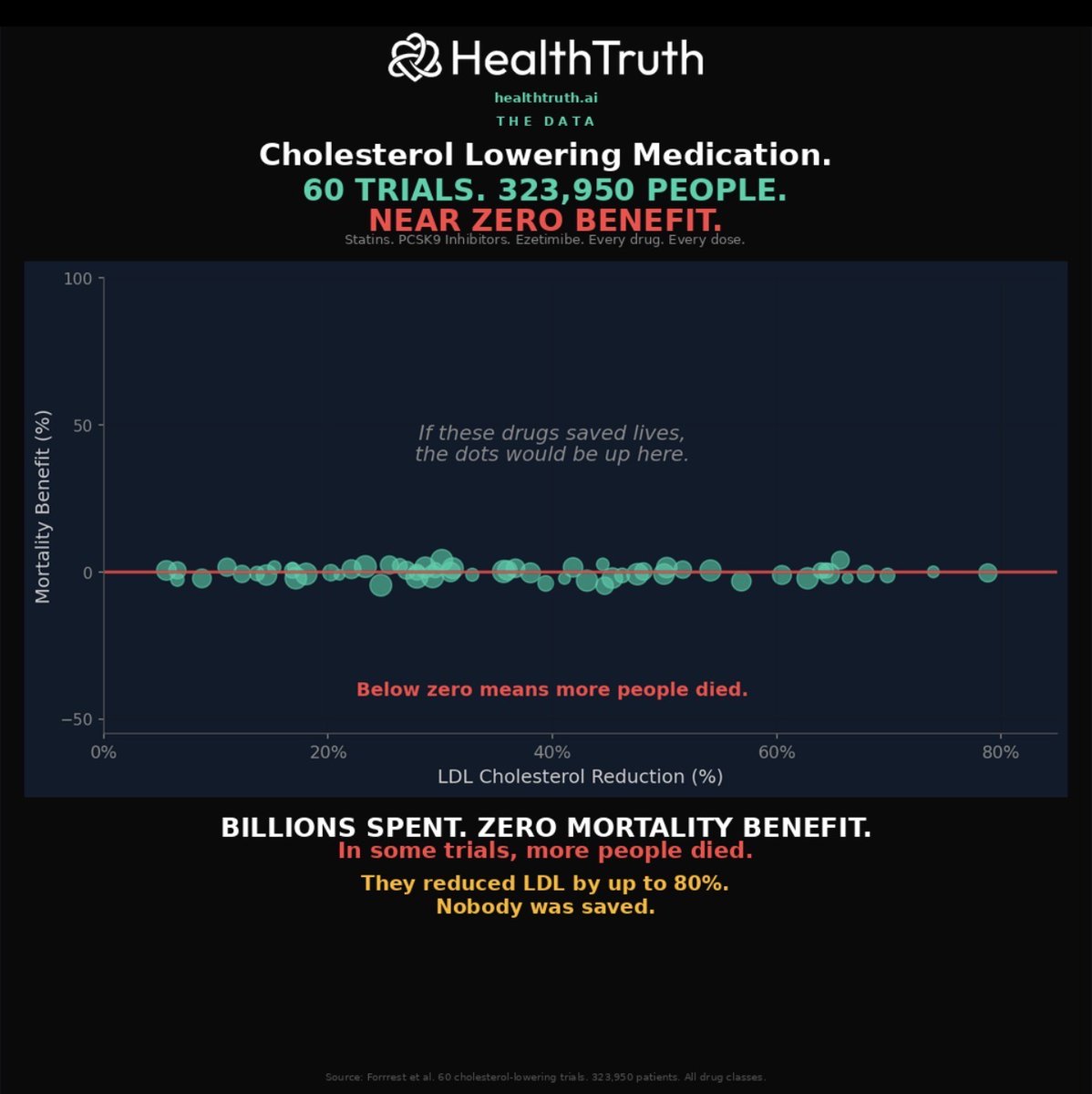
60 randomized controlled trials. 323,950 patients. Every cholesterol-lowering drug ever made. Statins. PCSK9 inhibitors. Ezetimibe.
One question. Did lowering LDL cholesterol make people live longer?
Look at the chart. Every dot is a trial. The red line is zero benefit. If these drugs saved lives, the dots would be above the line.
They are not. They reduced LDL by up to 80%. Nobody was saved.
But that is not what makes me angry.
What makes me angry is that millions of people believe they are safe because their LDL is low. Their doctor says "your numbers look great." They go home and never think about it again.
Meanwhile the 12 things that actually cause heart disease are silently building inside them. Nobody is checking. Nobody is testing. Because a cholesterol number gave everyone a false sense of security.
That is not a failure of medicine. That is a fraud.
Ennezat et al. Journal of Cardiovascular Pharmacology. 2023.
My name is Ella, I'm 17 years old.
I do long jump. I play volleyball. I go to school in New Richmond, Wisconsin.
When my school allowed a biological male into the girls' restroom without telling parents —
I went to the school board.
With my name attached.
In my own town.
I got bullied for it. Harassed online. Even some of my own teachers came after me.
I'm still here.
Because here's what I know:
The net in women's volleyball is set nearly a foot lower for a reason.
A biological male can hit a ball across that net at force that could seriously injure a girl.
And in track — all it takes is three biological males entering the girls' category
and not a single girl in this state stands on a podium.
I didn't speak up because it was easy.
I spoke up because somebody had to.
The Supreme Court is about to answer the question every girl in America is asking.
We're ready.
@JenniferSey@xx_xyathletics
Houston airport is covered in billboards for nonprofit health systems.
Handsome leaders.
White coats.
Academic prestige.
“Better health.”
Cute.
These are the same institutions that beg the legislature every year for taxpayer dollars while fighting competition, acquiring physicians, inflating prices, and pretending the word “nonprofit” means “public good.”
America does not need more healthcare slogans.
It needs fewer grifter institutions living off taxpayers while making care less affordable.
I have fired admin and have cut out 95% of the purple bit. All the money @kaufcare goes to patient care.
Doctors: time to fire the Admin.
Time to take back medicine.
For our patients. For us.👇🤯
If you're thinking about healthcare spending in the US, one fact worth noting
About 9% of healthcare spending goes to physician compensation
Another 9% goes to nurses
Yes, doctors and nurses get paid more in the US than they do in other countries and yes, a small proportion of physicians really do get paid a lot
But I've never thought we're going to solve our healthcare spending by going after physician and nursing salaries
Not enough there -- and slashing physician or nursing compensation would be a great way to demoralize the core of the US healthcare workforce
STOP. THE. MADNESS.
Fire all these people. Stop using these large hospitals.
Use independent physicians.
We all need to work hard to fix this mess. Let’s cut out the middlemen. We only need patients and doctors/staff and that’s it.
Prior authorizations are not a bureaucratic mistake.
They are a financial strategy.
We complain about prior authorizations and the denial of care.
But those behaviors are not accidents. They are incentives.
Insurance companies generate a significant portion of their profits by investing premium dollars.
The longer they hold those dollars, the more investment income they generate.
That creates a structural incentive to delay care.
Delay does two things for the carrier.
First, it allows them to earn returns on a larger pool of premium dollars over a longer period.
Second, delayed care often becomes higher acuity care. Higher acuity care justifies higher premiums in the next cycle.
More premium.
More float.
More investment income.
When people say the system is broken, they assume incompetence.
In reality, the incentives are working exactly as designed.
-Rojas out
The consolidation engine we aren’t talking about enough - site neutrality
The healthcare consolidation crisis did not begin with hospitals. It began with insurers.
When the Affordable Care Act reshaped the market after 2010, it accelerated insurer consolidation through exchanges, risk corridors, and quality reporting infrastructure that rewarded scale. Larger insurers gained negotiating leverage, tightened network contracting, and squeezed reimbursement margins across the board. Hospitals, facing that margin pressure and the new requirements for electronic health records, population health management, and value-based contracting, responded with the only logical move available to them: get bigger. Acquire other hospitals. Acquire physician practices. Build the scale necessary to sit across the table from a consolidated insurer.
Physicians were the last domino to fall, and they fell fast.
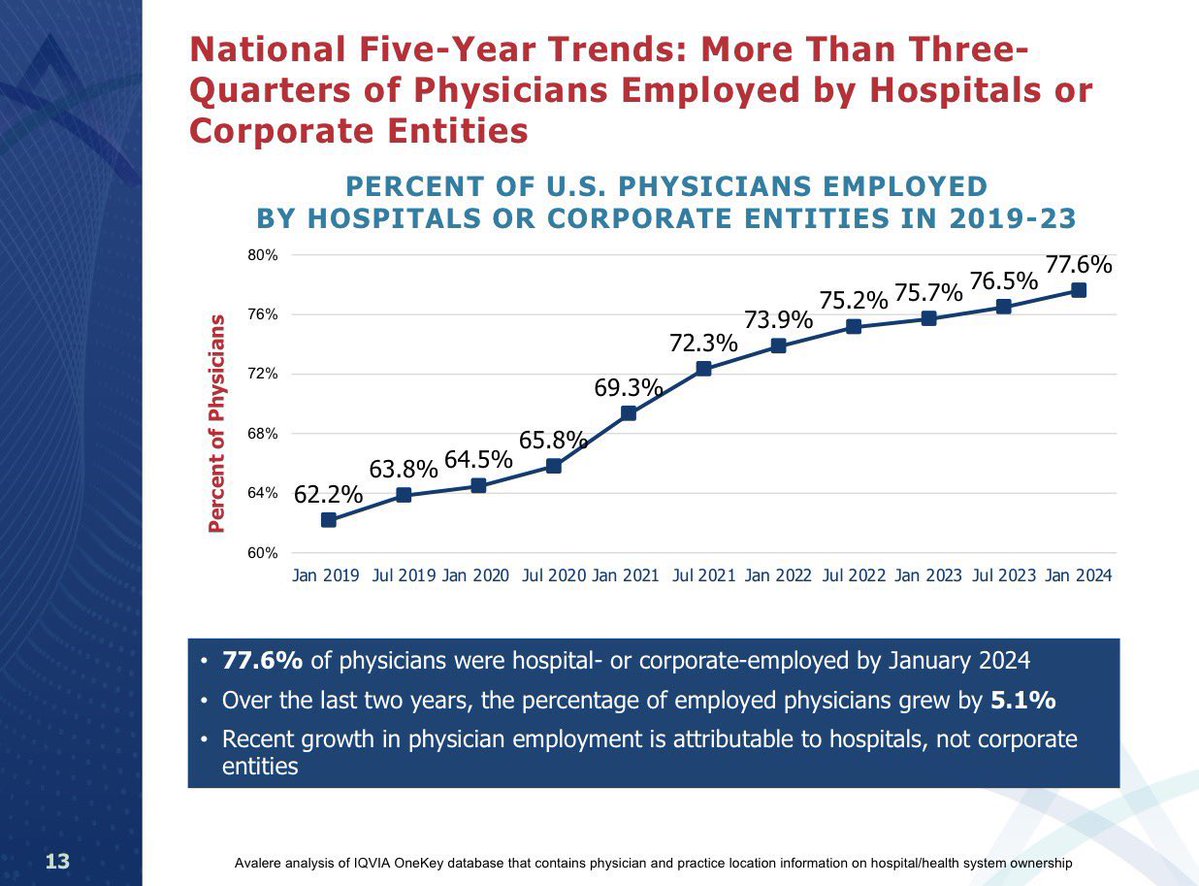
In January 2019, 62.2% of U.S. physicians were employed by hospitals or corporate entities. By January 2024, that number had reached 77.6% — a 15-point shift in five years. Over just the last two years of that period, the employed share grew by 5.1 percentage points, and critically, that recent acceleration is attributable to hospitals, not to corporate entities. Hospitals are still actively absorbing the remaining independent physician workforce. (Avalere analysis of IQVIA OneKey data)
That is not a trend. That is a structural transformation of the American medical profession, driven by a cascading consolidation logic that started with insurers, moved to hospital systems, and is now completing its circuit through the physician workforce.
The mechanism is straightforward. Congress built a payment architecture that rewards hospital acquisition of physician practices. Medicare pays a hospital outpatient department roughly 1.5 to 2.5 times what it pays an ambulatory surgery center and even more than an independent physician office for the exact same procedure, on the exact same patient, with the exact same clinical outcome. A Level 2 office visit in a freestanding physician office generates a professional fee. That same visit, conducted the day after a hospital acquires the practice and designates it a provider-based billing site, now generates both a professional fee and a facility fee — often $500 to $1,500 — with zero change in the care delivered.
That differential is not a clinical premium. It is a billing premium. And when hospitals were already under margin pressure from consolidated insurers, the ability to acquire a physician group and immediately convert its billing to HOPD rates became one of the most reliable capital allocation decisions in American healthcare. The acquisition frequently pays for itself within a year for surgical practices through facility fee conversion alone, not including capturing referrals and procedure volume.
MedPAC has documented this for over a decade. The GAO has confirmed it. What has been in dispute is whether Congress has the will to fix it, because the hospital lobby’s argument is always the same: hospitals cross-subsidize emergency care, graduate medical education, and indigent care, and equalizing the differential will destabilize that model. That argument deserves engagement. But it cannot permanently shield a payment structure that has, in five years, moved 15 points of the physician workforce out of independent practice.
The Cassidy-Hassan site-neutral framework is the most serious bipartisan attempt to correct this differential. This week I will walk through why it is necessary, why it is not sufficient on its own, and what a complete reform package actually requires.
Done wrong, site-neutral reform trades one consolidation crisis for another and the next wave of consolidators is already positioning.
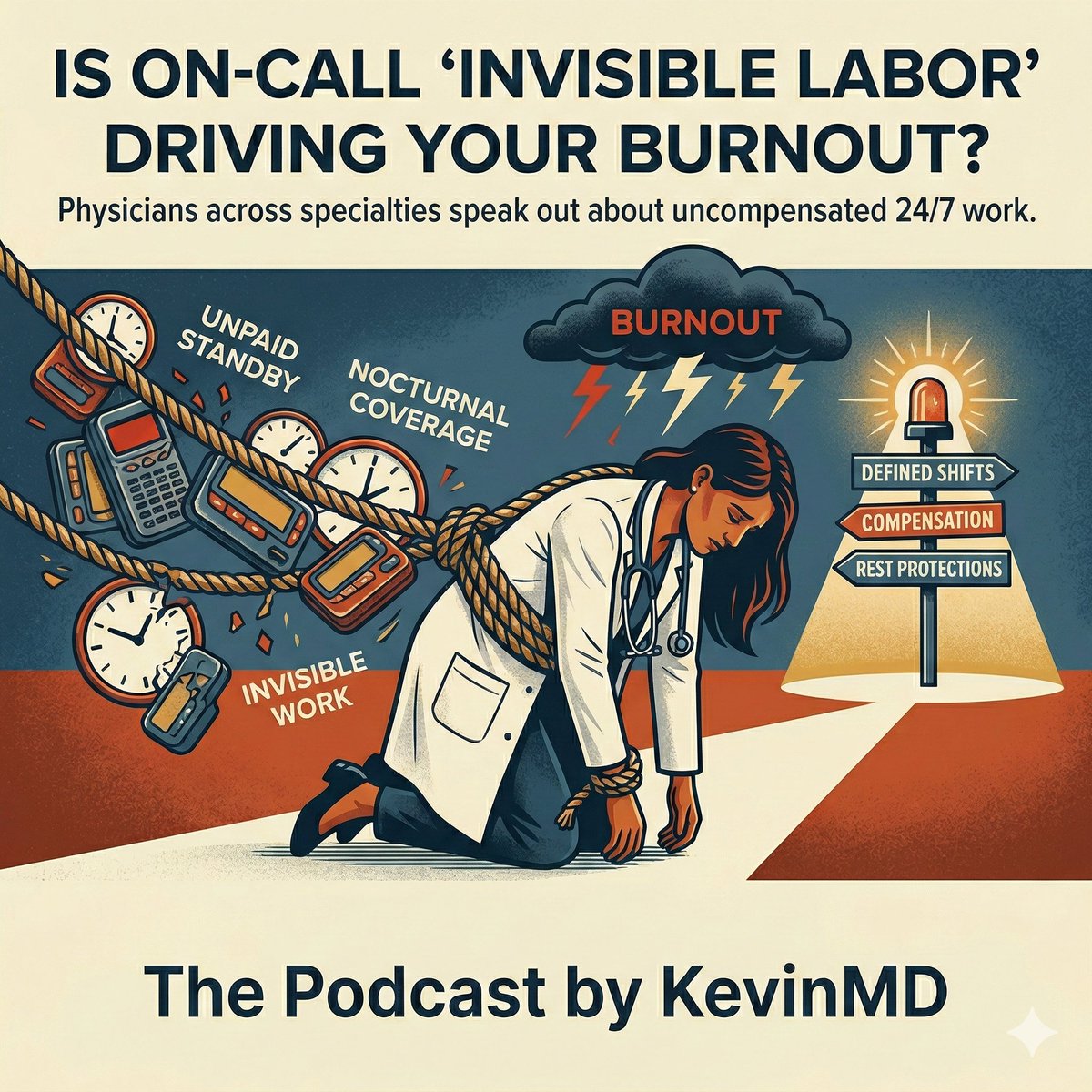
I interviewed an internal medicine physician who says the medical system relies on a massive amount of unpaid labor to function. We call it "taking call."
Dr. Corinne Sundar Rao joined me to discuss why the traditional model of physician on-call compensation is a primary, yet rarely discussed, driver of burnout.
For decades, taking call was simply baked into the job. You worked your full clinic day, you were on standby all night for the hospital, and then you worked a full schedule again the next day. It was justified by the "calling" of medicine.
But as Dr. Rao points out, the complexity and volume of modern medicine make this model unsustainable.
Other high-stakes professions, like commercial airline pilots, have federally mandated rest periods. Yet surgeons and physicians are routinely expected to make life-and-death decisions on zero sleep, often for little or no extra pay.
Dr. Rao argues that "call" is a euphemism for extracting free labor from physicians to cover the hospital's unassigned patients.
We have seen successful solutions before. The hospitalist and laborist models proved that we can turn endless, tethered responsibility into defined, compensated shifts. But many specialties are still trapped in the old paradigm.
The result? Physicians aren't complaining; they are simply disappearing. They are dropping out of traditional practice, moving to concierge models, or leaving medicine entirely.
If hospitals want to solve the staffing shortage, they need to stop relying on altruism to subsidize their 24/7 operations. Call is labor. And labor must be paid fairly, transparently, and with built-in rest protections.
🎙️ Listen to "Physician on-call compensation: the unpaid labor driving burnout" on The Podcast by KevinMD.
📷 Search "The Podcast by KevinMD" on Apple or Spotify.
#KevinMD #PhysicianBurnout #HealthcareWorkforce #MedicalCulture #PhysicianCompensation #PatientSafety #HealthcareLeadership
Some thought this day would never come.
For years, the vaccine injured were dismissed. Gaslit. Called liars. Told their symptoms were anxiety. Told VAERS reports were meaningless. Told the science was settled and the conversation was over.
On March 18 and 19, ACIP (the federal vaccine advisory committee) will formally take up COVID-19 vaccine injuries.
The agenda includes COVID vaccine injuries, long COVID, and potential votes on changing the COVID vaccine recommendations based on evidence of harm from the mRNA injections. ACIP member Dr. Robert Malone has described the underlying injury data as "politically explosive," and says he is currently under embargo from discussing the details publicly.
The FDA's own Dr. Vinay Prasad already put it in writing in December: it is "horrifying to consider that US vaccine regulation may have harmed more children than we saved."
The people who have been fighting for this moment - the injured, their families, the doctors who risked their careers to speak the truth, everyone who refused to be silenced - deserve to know this is coming. You can
Share this everywhere. The injured community has waited long enough.
Full details by @smiddendorp22:
https://t.co/XxY6rhQKJ5
If insurance companies can override physicians and deny medical care, they should be legally liable for the harm that follows.
Right now, non-clinicians make life-altering decisions with zero accountability.
Meanwhile, physicians spend hours arguing with insurers and navigating endless appeals — time taken away from patient care.
Minnesota is doing something rare in healthcare: real 340B transparency.
Their 2025 report just dropped. Buckle up.
The headline: $1.34 BILLION in net 340B revenue in a single year. That’s a massive, unregulated corporate windfall. These subsidies are unavailable to independent physicians.
And no, this isn’t “for the safety net.” ~81% of MN’s 340B net revenue was captured by just 23 DSH hospitals. One system alone (UMN Medical Center) captured 26.1% ($334.7M).
“But what about federal grantees??” Safety net clinics (FQHCs/tribal centers) got under 1% of net 340B revenue statewide. So spare me the press releases about the underserved. They are the marketing face for a program that mostly bankrolls big hospital expansion.
Middlemen are feasting, too: ~$165M in 340B operational costs. This is a massive toll paid to pharmacies and TPAs to navigate a deliberately convoluted program so big systems can maximize the spread.
“There’s no public cost.” False. MDH estimates 35.5% of net 340B revenue comes from Medicare and 19.4% from Medicaid. Taxpayers are literally helping bankroll the arbitrage.
This is how you build consolidation: create a federally protected pricing loophole, then act shocked when the biggest institutions reorganize around harvesting it.
Judge a policy not by its intent but by its outcomes. 340B outcome is clear: it's a disaster.
The MN report proves 340B is no longer a small program for clinics; it’s a billion-dollar subsidy for hospital consolidation. Kudos to @mnhealth for actually showing us the receipts.
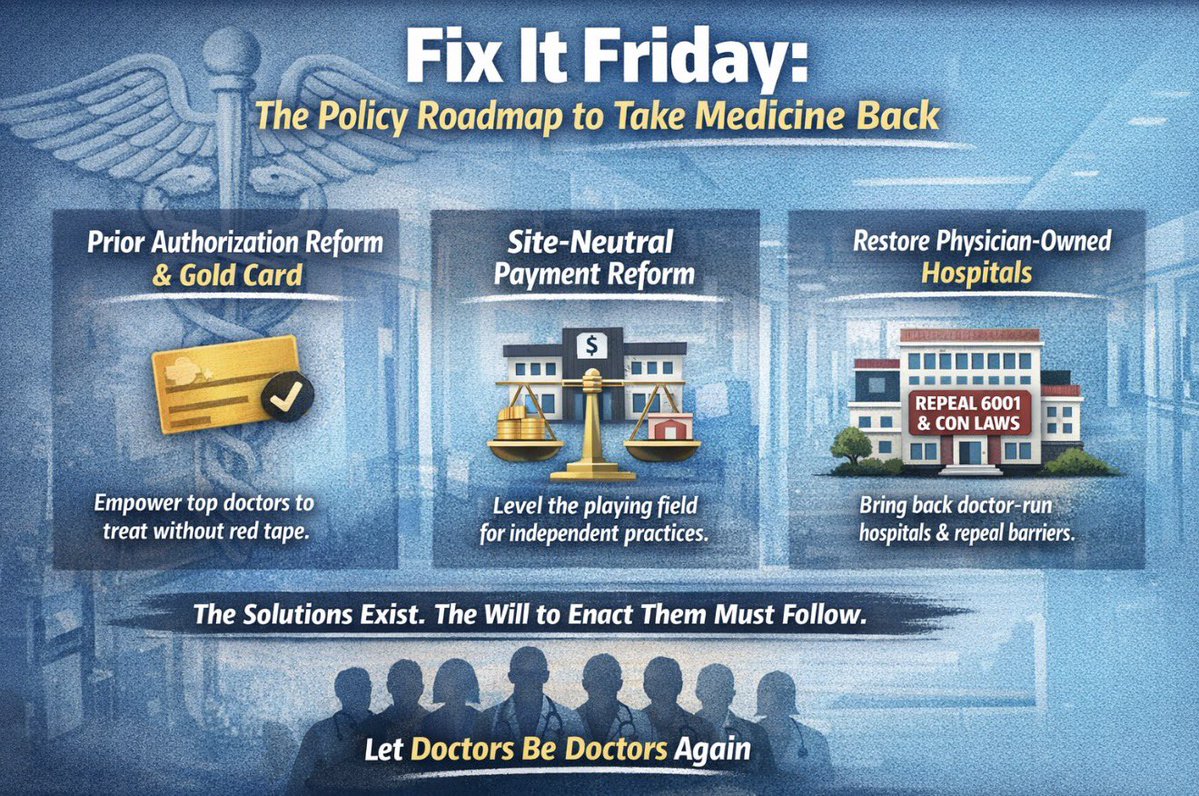
Fix It Friday: The Policy Roadmap to Take Medicine Back
This week we traced the arc: administrative burden burns out physicians, burned-out physicians sell their practices, and corporate medicine fills the vacuum. Today I want to close with something the doom-and-gloom narrative often skips which is that we actually know how to fix this.
The legislation exists and the evidence base is there. What’s been missing is the political will.
Prior Authorization Reform and the Gold Card
Physicians with clean track records shouldn’t need permission to treat their own patients. Gold card legislation, championed in Texas and gaining federal momentum, exempts high-performing physicians from prior authorization requirements for procedures they routinely perform appropriately. @CMSGov is now signaling that WISer, its new prior authorization platform, may incorporate gold carding as a core feature. If that holds, it would be one of the most consequential administrative reforms in years by not just reducing burden, but establishing the principle that physician performance should drive clinical autonomy. @RogerMarshallMD has tirelessly fought on PA reform on behalf of patients.
Site-Neutral Payment Reform
Medicare currently pays dramatically more for the same procedure when performed at a hospital outpatient department than in a physician’s office. That payment gap is one of the primary financial engines driving consolidation. Hospitals acquire practices, reclassify the site of service, and collect the premium. Site-neutral reform eliminates that arbitrage and levels the playing field for independent practice. @SenBillCassidy and @SenatorHassan continue to lead the way with their framework.
Restoring the Physician-Owned Hospital and Making It Mean Something
The Affordable Care Act’s Section 6001 banned new physician-owned hospitals and capped existing ones. The evidence never supported that ban. Physician-owned hospitals consistently outperform on patient satisfaction and quality metrics, and repealing 6001 should be a priority.
We need to recognize that repeal without Certificate of Need reform is an incomplete victory. In the 35 states that still have CON laws, incumbent hospital systems can block a competitor from being built simply by filing an objection before a single shovel hits the ground. You can give physicians the legal right to own a hospital or surgery center and watch legacy systems use CON proceedings to make it functionally impossible. If we’re serious about restoring physician ownership as a competitive model, we have to pair it with CON repeal. The two are inseparable. Thank you to @SenatorLankford for his unwavering support!
The physicians I know didn’t go into medicine to fight insurance algorithms or feed a corporate revenue cycle. They went in to take care of patients. That’s still possible. But it requires finishing the work already started not just passing one reform while leaving the next one as a backdoor for the same incumbent interests.
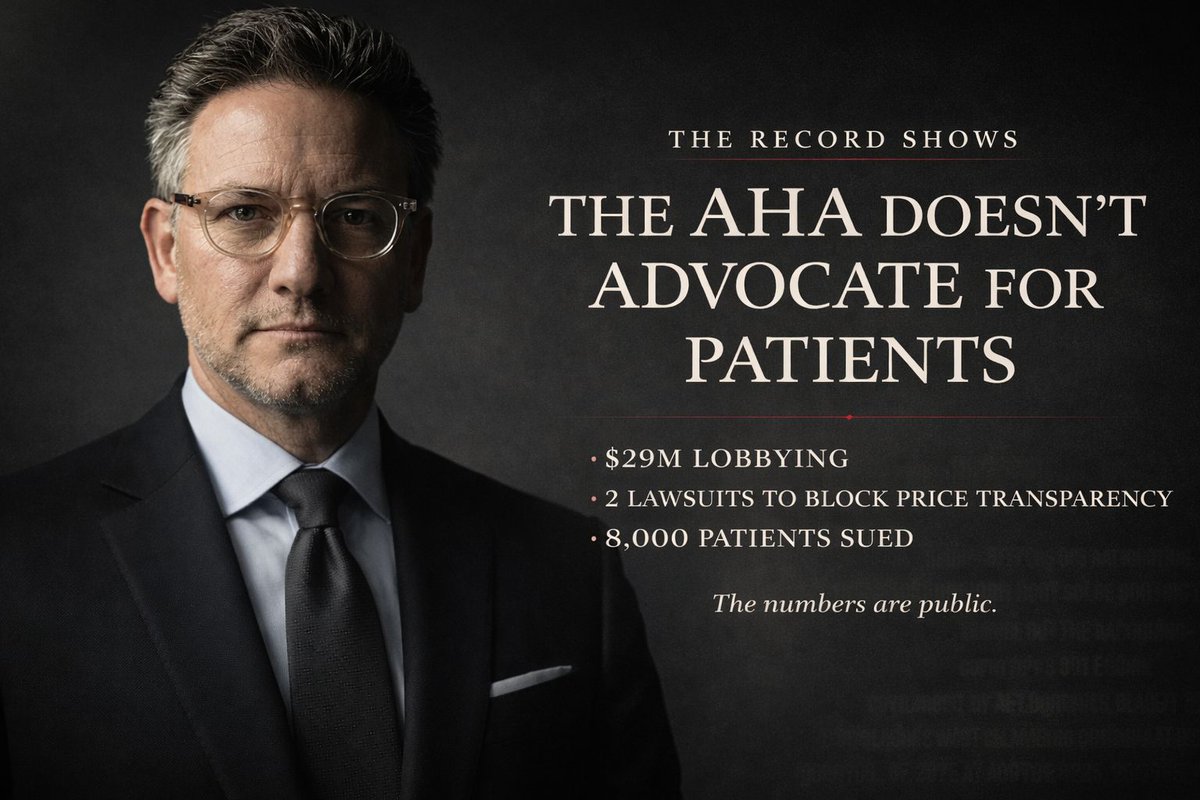
The American Hospital Association has a simple job: protect hospital revenue from every reform that would reduce it.
Price transparency would reduce it.
So they sued twice to block it.
Lost both times.
Physician-owned hospitals would reduce it.
So they lobbied for 15 years to keep them illegal.
Still fighting.
Site-neutral reform would reduce it.
So they're spending $7 million per quarter to stop it.
They're not a trade association with occasional conflicts.
They're a lobby cartel with a communications team.
Let me tell you what happened before I got to the OR this week.
My patient needed surgery. I recommended it. My training, my board certification, and my years of clinical experience all pointed to one answer. The insurance company had a different one: not yet.
That’s prior authorization and it is breaking American medicine.
Here’s the number that should stop you cold: in a prospective multicenter study of orthopedic subspecialty practices across 6 states, 98.5% of prior authorization requests were ultimately approved when recommended by a fellowship-trained, board-certified orthopedic surgeon.
98.5%.
The system isn’t catching bad medicine. It is a delay machine that consumes enormous resources, causes real patient harm, and exists primarily to make the economics of denial work in the insurer’s favor.
The 2024 AMA survey of 1,000 physicians put numbers to what every physician already knows:
- 39 prior authorizations per physician per week averaging 13 hours of physician and staff time
- 93% of physicians say PA delays patient care
- 82% say patients commonly abandon their recommended treatment because of PA
- 29% report PA caused a serious adverse event — hospitalization, permanent damage, or death
- 61% are concerned insurers are now using AI to systematically increase denial rates, with some tools producing denials up to 16 times higher
This is not utilization management. This is obstruction at scale. Surgery is precision and focused on minimizing collateral damage. Prior authorization is brute force with disregard for the collateral damage.
In my world, delay has a clinical cost. A patient waiting on PA for fracture repair, joint replacement, or spinal stabilization is losing function and sometimes losing the window for the best possible outcome. That cost never shows up on an insurer’s earnings call. Given that the average patient is on an insurer’s books go 3 years, delays can sometimes mean making someone else pay the bill for the necessary treatments.
The consensus statement insurers signed in 2018, promising PA reform? Seven years later, only 16% of physicians working with UnitedHealthcare say anything has actually changed. They made another promise to Secretary Kennedy and Administrator Oz recently but is there any real change coming?
Voluntary reform has failed. Legislative and regulatory action is the only path forward and physicians need to be loud enough for long enough that lawmakers act.
Today one of my breast cancer patients was placed under general anesthesia before I had seen her, marked her, or signed her chart.
That should never happen.
This is not the first time I have walked into a hospital and found that the rules were treated like suggestions. Surgery is not an assembly line. These are human beings. They deserve to be seen, evaluated, marked, and spoken to before anesthesia is administered.
When I asked for an explanation, I was met with defensiveness instead of accountability.
And here is the deeper issue. I am often told by insurance companies where I am allowed to operate. Even when I know that another facility is safer. Even when patterns like this have already occurred.
Physicians should be able to choose the safest environment for their patients. Insurance contracts should not override safety standards.
I am tired. But I am not going to be quiet.
We have to build a system where surgeons can vote with their feet and take patients where protocols are followed and safety comes first.
Our patients deserve better.
The average physician loses 15.6 hours per week to administrative work.
Read that again.
Fifteen point six hours.
That’s two full clinic days every week spent on documentation, prior authorizations, billing disputes, inbox management, and compliance paperwork.
Now here’s the number that matters:
AI can compress at least 60% of that.
Today.
Not in five years.
Not with some pilot program.
With tools that exist right now and cost less than your EMR subscription.
Clinical documentation: automated.
Prior auth submissions: automated.
Denial appeals: drafted in seconds.
Patient message triage: sorted and pre-responded before the physician opens the inbox.
Independent physicians can deploy the same tools and keep the time savings for themselves.
More time per patient.
More time building the practice.
More time with their families.