1/ General-purpose robotics is the rare technological frontier where the US / China started at roughly the same time and there's no clear winner yet.
To better understand the landscape, @zoeytang_1007, @intelchentwo, @vishnuman0 and I spent the last ~8 weeks creating a deep dive on humanoid robotics hardware and flew to China to see the supply chain firsthand.
Here's everything we've created + our takeaways about the components, humanoid comparisons, supply chains, and geopolitics👇
why not just raise income tax rates?
because your real intent is not to just “provide healthcare”.
you’re masking that you are proposing the creation of, for the first time in the 250 years of this American republic, an organized government seizure of private property from citizens.
you’re calling it a “wealth tax” or a “billionaires tax” or “millionaires tax” or whatever nom du jour polls well. but at the end of the day, it’s the seizure of private property from citizens by the government. citizens that earned money, paid their fair taxes on those earnings (53% if they live in California) and are now being told they need to hand over after-tax assets because the government has failed to provide promised services with the revenue it’s collected, and are now re-casting their own failure to be a socio-economic inequity that must be justly resolved... a slippery slope that has never gone anywhere good (see economic effects in USSR, Cuba, Venezuela, France and Norway wealth tax etc.)
the American founders fled tyranny in Europe and this amazing nation was populated by immigrants (myself and your parents) from around the world not just looking for a “better life” but for a place where they could have freedom from tyrannical governments that can take what they want from private citizens. a great nation borne of property rights, the rule of law, and endowed freedoms to believe, speak, or act. these principles led to the greatest run of innovations, successes, and widespread increase in prosperity, for all citizens, ever seen.
the citizens, the individuals, not the institutions, delivered this progress. those who invented, who toiled, who bled, who sacrificed, who took risk and persevered, who led, and who changed the world, are not charlatans, kleptocrats, or oligarchs. they’re what made us all better off. prosperity is a measure of america’s success, not its failure.
it is your principle that is so offensive, as evidenced by the broad disdain for your flippant flirtation with the darkest of human fantasy - socialism. you and other neo-socialists have led so many of us to reflect on America’s history and what it is becoming. that now leads so many to consider, so unnecessarily, leaving their homes for a place where everyone stands up to shout down the principle you suggest. because if your ideas are now considered moderate, it’s clear this titanic is sinking.
that a “simple tax” of taking assets that have been earned, through toil and tribulation, rightly taxed, and preserved, should now be unjustly seized, is your solution to a problem of obvious government mismanagement and outright fraud, tells us that your true motivation lies not in giving people healthcare but in cutting down success and deleting the system of prosperity and opportunity for all.
i don’t care, and neither should anyone else, what the sum total market value of a private citizens private assets might be. it is none of my business and should be none of yours. because, again, once you open that pandora’s box, we might as well study Lord of the Flies … there is literally nothing stopping 51% of citizens demanding that their government go out and seize 100% of the private property of the 49%.
want to give healthcare to people in need? do your job and fix healthcare. make it affordable. want to be lazy about it? then do your job lazily and raise income taxes.
want to take private property from private citizens who have paid their fair share of taxes and legally earned their property, then honestly declare that it is envy, not inequity, that you strive to resolve…
Probably one of the most severe flushes I’ve ever seen on alts, I didn’t even imagine alts had this much leverage in them. It feels like someone got hit very hard and will see a large body float to the surface soon, reminds me a little of summer 2021.
Good reminder to myself to own things that I am actually bullish on, and not things I am trying to shift on momentum. Some charts look like they’ll never recover, whereas some things look buyable for the first time in a while.
When everyone is making hilarious amounts of money I am always tempted to start using leverage again. It is almost impossible to fight the feeling that you’re not making enough, or everyone else is outpacing you. Good reminder that fighting that feeling and avoid the wipeouts is worth it in the end.
Check on your friends, likely a bad day for many.
Personally, am concentrating my bags into the things I am happy to own for the next few years, and shedding the fat. Realised I own some assets based on not wanting to miss out, rather than on some actual thesis. Days like today are much easier for me if I think my bags will bounce back, and much worse if I’m losing money owning things I don’t even believe in.
Don’t let a leverage blowup dictate your long-term views. The future is bright, good things to come, patience is rewarded.
嵐の後
I think the best investor of the future will be someone that starts an AI focused fund with a fundamental secular winners/losers orientation. Similar to what tiger cubs were doing during the rise of the internet, mobile, cloud or what Leopold is trying to do now (albeit with way more rigor).
What made tiger cubs successful was:
1) big secular trends to ride on
2) deep technological/product/organizational intuition that allowed them to accurately model the underlying contours of those trends, S-curve/diffusion/adoption dynamics, and value capture at different parts of the cycle
3) having thoughts that the best management teams creating and riding those secular trends actually found novel/helpful.
3) gave tiger cubs real management access (a true peer to peer relationship/thought partnership) and that real management access provided an incredibly good feedback mechanism re: whether they were doing a good job at 2) and if not, what they were misunderstanding. It resulted in a compounding informational and analytical advantage.
Today, the number of people in the professional investing world that have the ambition/youth to become one of the greats and ALSO have this kind of orientation is close to zero.
All the great PMs trained in the pod paradigm over the last 10 years learned a very specific style of investing that doesn’t lend itself to doing 2) or 3) well. Your mental models get overfit on generating measurable returns every month. On the other hand, smart young folks doing IB->PE->Tiger path today are very different then the guys who did it when Ainslie, Mandel or Laffont et al. were coming up. Back then, the experience was very scrappy, pursuing the path looked extremely risky, and breaking in was a lot less about collecting a bunch of the same credentials and a lot more about creativity and non-linear thinking. I think this means MANY (but not all) of the blue-chip SM young guys are probably very risk averse, less creative, and not scrappy enough to do 2) or 3) well.
Both of these archetypes will make an insanely good living, but they aren’t going to generate Mandel style returns or have a Mandel style reputation. In other words, the next Ken Griffin won’t come from Citadel, and the next Stephen Mandel isn’t at Lone Pine.
When the underlying technology/product/diffusion curves become somewhat well understood and the secular trends lose steam, the pod approach to investing becomes much more effective. And I could see that orientation having a very long half life. On the other hand, the regime/trend specific styles, like the traditional tiger style most recently or the “value” style before that, stick around temporarily as a function of the reputation of the institutions that created them, but over time completely fall out of vogue. We saw this with traditional “value” investing ~15 years ago, and have been seeing it with the original “tiger” style over the past 5 years.
There is always a reset, where a handful of young investors pioneer a new evolution of fundamentally oriented investing predicated on understanding the largest secular trends that affect the economy over the next 30-50 years. Not saying Leopold won’t be in this group, but I’m surprised to not see more people throw their hat in the ring.
I expect XPL to exceed everyone's expectations. Looking for an entry around $5b, although I expect this to trade anywhere from $10-20b in the near future.
TLDR:
- Tether is one of the few crypto projects to permeate TradFi mindshare, given that they print money. They likely don't know or care what Plasma is; they just want Tether exposure.
- Plasma is the only pureplay stablechain.
- Float is lower than anticipated (probably ~10% since US investors are locked for a year).
Why I'm Bullish:
> General consensus (TradFi + crypto) is that networks and stablecoins are the best products in crypto. The leftcurve in me says stablechains should be well received as a sort of marriage between the two.
> Plasma is the first liquid pure play for stablechains, while the supply side has become extremely competitive (Stripe, Google, Circle, Paradigm, etc.). The closest proxies are TRX and ETH, although Plasma undercuts these (in the same way TRX undercut ETH) with lower fees and lower latency.
> Plasma is the best form of Tether beta (read the quoted article for more on this). Since Tether just rerated to ~$500b implied val, my expectations for Plasma have rerated as well. For a relative comparison, STBL (new liquid tether beta) jumped 40% in the hours following Tether's announcement.
> Float is lower than anticipated (18% expected, probably more like 7-10% when considering US depositors are locked for a year.)
> Not as relevant, but lots of onchain runners right now (ASTER, AVNT, STBL, 0G). The market seems risk-seeking at the moment.
What are the risks?
> Plasma won't be the only Tether stablechain (e.g., Stable), so the Tether beta play may get crowded in the future.
Mitigation: Plasma is still the name-brand Tether stablechain, and as the first mover, they have an advantage to absorb the most capital.
> Pre-sale investors are up 14x at current valuations. Wouldn't be surprised to see some initial dumping.
Mitigation: An unknown number of US investors are locked for a year. This sell pressure could drag the price down for a bit (like PUMP), but will eventually get absorbed, and then XPL melts faces.
> TradFi may not know or care about stablechains, so this could be pretty much capped at what the liquid funds will buy.
Mitigation: TradFi knows what tether is and that they print money; they likely don't care what Plasma is; they just want exposure. Also, I think ENA as a proxy works here. At the same market cap, this thing would be $22b FDV with an 18% float.
Trillions? Idk. Billions. Very likely.
Tomorrow $XPL goes live with almost poetic timing
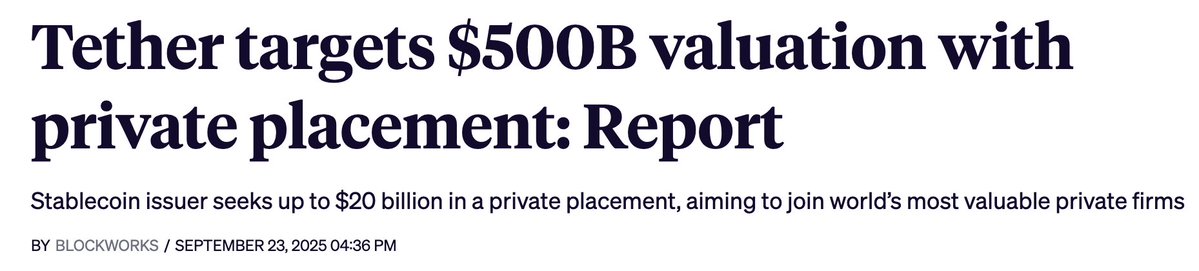
(Tether raising $20B at a $500B valuation, lots of onchain runners, and speculative capital apeing into new launches despite a shaky broader market.)
I think Plasma has a chance to be a massive cook.
Let me break down why I believe this (in a very left-curve, nihilistic way):
First, there is no realistic way to justify its current valuation (7B FDV, ~1.25B circulating) given there is no live product or adoption.
Yes, there is a slick prelaunch product video, tons of day-1 TVL (study $BERA), and the neobank vision.
But that is exactly the kind of story the market loves to attach itself to - the biggest TAM in crypto, all dollars in the world, #stablecoins.
Even though presalers in from 500M FDV are already sitting on ~14x at current pre-market levels, there is a decent chance the market frames Plasma as a long-tail way to get exposure to Tether, which is quickly becoming one of the world’s most valuable companies.
In that sense, a 1.25B circulating valuation at launch does not feel insane.
Look at the other “Tether chain,” $STBL.
It's up ~3x since TGE to 230M circ and 4.6B FDV.
But STBL feels like the weaker bet (less exciting go-to-market, weaker branding, and the team does not seem to have the same pull/connections).
The BSC/Paolo angles could still push it higher, but compared to Plasma it looks like the discount knockoff.
That said, I would not advocate for a long XPL, short STBL pair trade, but from an observer POV, Plasma feels much more legitimate:
- Founders Fund (Peter Thiel) backed
- Tether (Paolo, USDT CEO) backed
- Extremely clean website and branding (more important than you think)
- Impressive GTM
- Every KOL on Twitter tweeting “trillions”
- Founder is also chairman of a publicly traded company with a very nice chart, $ATAI. (Respect the pump)
And finally, fate loves irony.
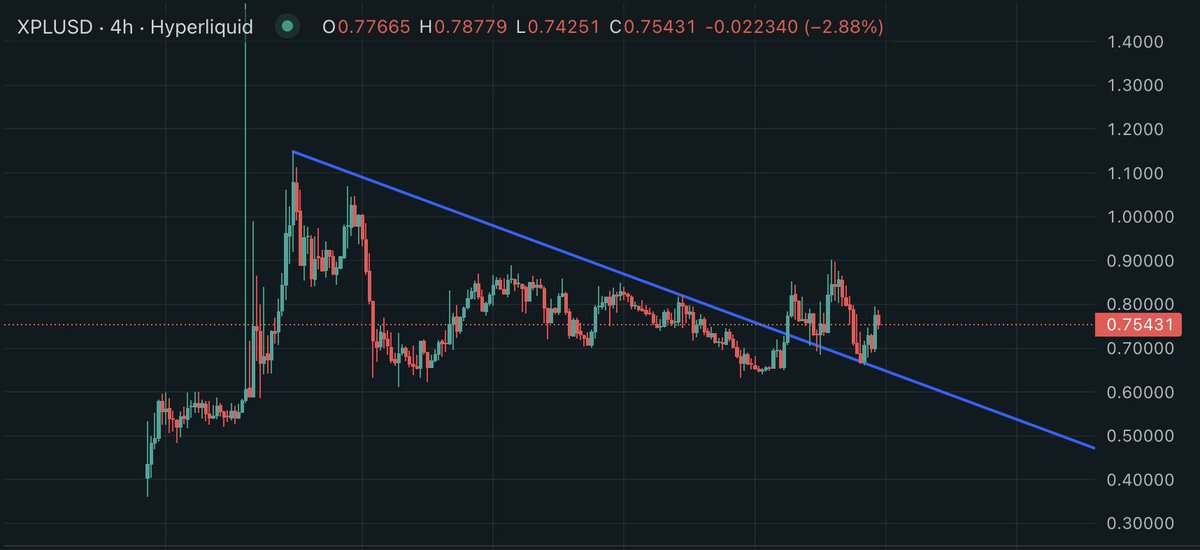
In premarket trading, XPL wicked up to ~18.5B on Hyperliquid, the highest-volume premarket yet, blowing out most shorts.
Most of whom were likely early investors and employees hedging allocations ("lol wtf, I’m rich now and I’m not gambling on my allo still being worth this much when unlocks hit”).
Now, if they want to hedge, they will need to reshort, probably after presalers take some gains of the table.
This could set the stage for market makers to hunt them again and squeeze it higher (only for them to be unhedged before it slowly bleeds down into their vesting ofc).
Add in the fact that recent launches, especially those listed on Binance, have traded extremely well, and that everyone’s first instinct will be to short Plasma as “overvalued governance for another L1 where the token is not even used for gas”…
Trillions?
If anyone remembers the taper tantrum of 2013 this is basically the same general framework for why I believe we’ll have a not great Q1 for equities.
In short, the taper tantrum was the market throwing a fit to ensure that policy actions which were perceived as negative for asset values did not materialize.
With Trump, the single biggest risk to equity prices is simple: any action to cut deficit spending will result in a worse economy. I don’t believe the boost from deregulation would offset this, and I believe history would support that.
Essentially, once the market realizes that Trump *could* be serious about cutting the deficit (through what I am sure will be many different proposed changes), it will become the market’s responsibility to throw a fit when it is discussed. Because that’s how you discourage Trump from actually pushing forward on it, you send the Dow down every time it’s mentioned.
If any of your are doubting whether the next few months will have the highest probability of every Trump proposal being taken seriously, the last 5 hours of the news cycle have been dedicated to whether America can fight a two-front war to annex Greenland.
So…yeah. Volatile Q1. Basic reasoning, doesn’t mean it won’t happen.
My market take: equities in for 4-15 months of pain (I’ll guess 9 months) tied to deflationary government policies (tariffs and mass layoffs mostly). Then it’s a political question - does Trump admin “capitulate” and turn severely inflationary? In vast majority of similar cases in history the answer was yes, but just a low confidence guess to me currently.
What does that mean for crypto? I continue to think crypto and equities are on different cycles rhythms, but that doesn’t negate shorter term correlation. Alts probably follow equities down at least at first (but they’re already down so much, even versus 2021 prices, they may bottom well before equities.) I think bitcoin will continue to act like a blend of gold and s&p 500. If gold remains strong, than that would suggest bitcoin would outperform losing equities, but maybe not by much. A retrace to ~$73k-$77k seems plausible, I’d probably add there.
I remain confident crypto bull market not over, but this is looking increasingly different from prior cycles, maybe substantially slower and longer. My base case is that crypto will lead the general macro inflation turn, so maybe crypto bull run resumes in 6 months and equities turn up in 9. The dates given are just indications of my guesstimates. I place no weight on the exact timeframes.
This is an interesting report. I have some comments as having lived through the 95-99 period in a position of very high responsibility and global access at Salomon Brothers which was a massive participant.
I see 95 as consistent with 2021 and LTCM as consistent with LDI/SVB 🧵