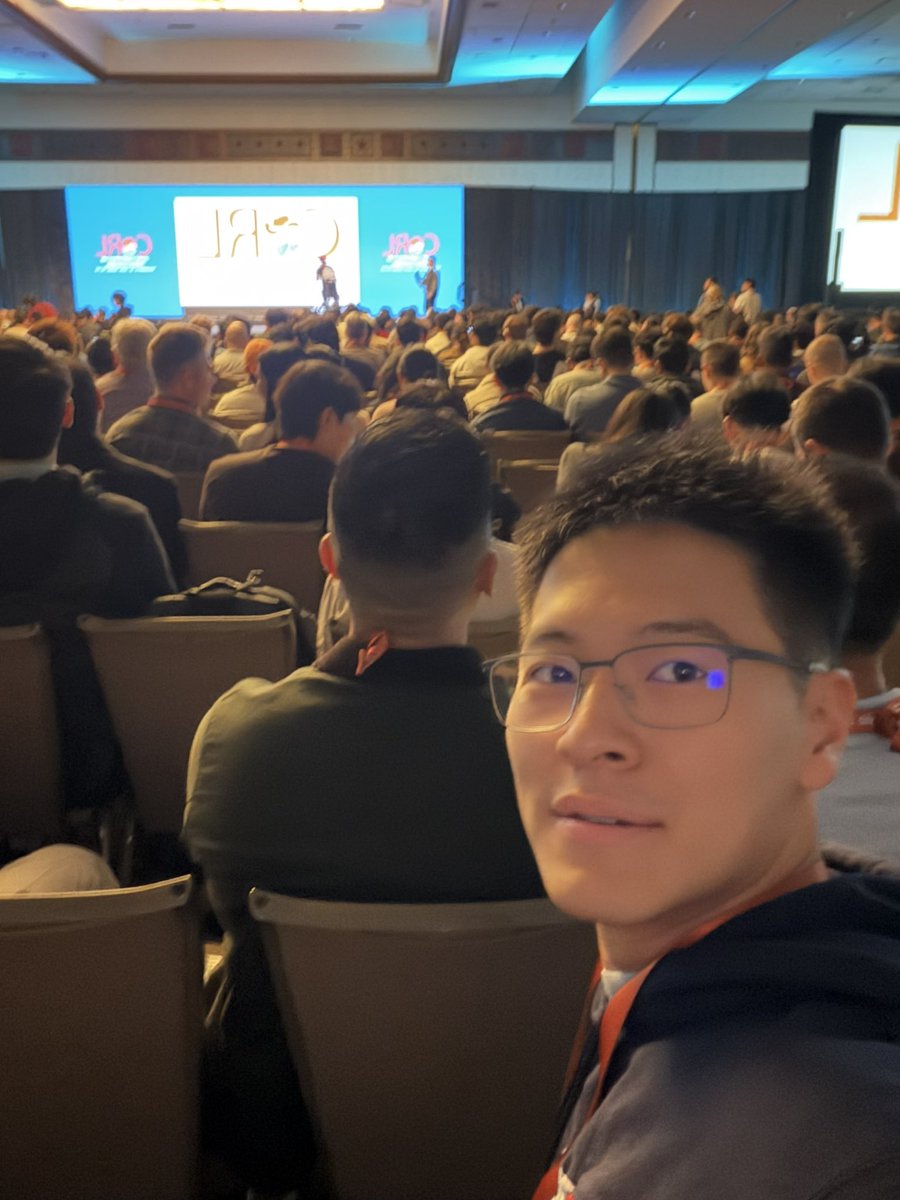
Thanks to everyone who joined our CoRL happy hour, and to our speakers from @SkildAI, @physical_int, @amazon, and @nvidia.
Simulation was everywhere this year. A few takeaways:
1. Astra collapsed the cost and time of real2sim. Environments, assets, and URDFs that took months now take days. The bottleneck has mainly shifted to sim2real, getting the physics of contact-rich manipulation like friction, mass, and deformation accurate enough to train on
2. The leading approaches to closing the sim2real gap: domain randomization to cover what sims get wrong, SysID to tune the physics closer to reality, and neural simulators that learn dynamics from real data
3. Tactile is still hard. Hardware isn't standardized, data is inconsistent and expensive, and there's no consensus on what works. There's growing interest in scaling tactile in sim because the real world alone is unlikely to yield the diversity and scale dexterity needs
4. Long-horizon is the new deployment frontier. The standout demos ran full multi-step tasks zero-shot and that's where memory and error recovery start to matter more than raw success rate
5. Evals are lagging. Real-world testing is slow, public benchmarks aren't trusted, and success rate misses what actually matters for deployment, like speed and recovery from failure
6. Teams are writing their own physics solvers. Skild built Steel and more labs are going the same way instead of relying on existing engines
Some of my takeaways from CoRL 2026:
1. Deployment is key. The most valuable data comes from real-world deployments. Smarter models need fewer interventions, but get more out of them.
2. World models don't need to be explicitly built into the architecture. With the right data, supervision, and context, models can reason through complex situations.
3. To keep advancing, evals are also a bottleneck. Robotics benchmarks need to improve. We should measure speed, reliability, and robustness, not just task success rates.
4. real2sim2real and code-as-policy are gonna play a key role in overcoming the data bottleneck, enabling deployment in narrow tasks, and collecting data to train future policies. Especially useful for industrial deployments, while home environments offer more opportunities for robot learning.
5. Conferences need to change. We already know most papers and demos from X and arXiv. More events that match people by research interests and create meaningful connections, less focus on traditional paper presentations. Adding tracks to CoRL, for example (?).
6. Tactile sensing continues to be hard. Sensors are heterogeneous, data is noisy and expensive to collect, and there's still no consensus on which sensors to use.
7. A lot of things are still open research. I personally feel we haven't figured out the right recipe for scaling yet. So many questions remain unanswered.
8. More and more people are moving into robotics, and the open-source community is growing. I hope we see more hardware and electronics projects coming out of it.
Summer is coming!
The issue is that the whiteboard is just a medium. We're only at the beginning of how agents can help human discussions lead to novel insights.
Introducing Wallflower: an agent skill and collaborative whiteboard, that agents populate to prime the discussion
Move a user interview quote from Granola next to a support ticket email, have everyone place comments on stickies. The agent reviews the layout diff and dives deeper.
Last week two of my consulting calls arrived at the same conclusion: whiteboard sessions can be more generative, but prepping as a facilitator takes work. So I hacked this together over the weekend.
Open source link coming shortly.
AI interfaces nowadays are still pretty much turn-based.
In my PhD thesis, I thought about what interaction would look like if we could go beyond taking turns.
One example is intra-turn interaction:
60 conversations in SF later, here is everything I learned, and the hot takes most of the people I talked to would argue with.
Data, models, deployment, hardware, money, and where the bottleneck goes next. https://t.co/sDjjpNC3h5
How can lower-cost models narrow the gap to Astra for robotic control?
Our CoRL 2026 paper Maestro shows how robotics tools and orchestration harness enable zero-shot robot control with Gemini 2.5, an older, cheaper model:
- Zero-shot real-world manipulation across 8 tabletop + 4 mobile tasks
- Surpasses π₀.₅ and code-as-policies baselines
A thread 👇
Intel's Paper Reading Club: DreamZero → Dream-1
Most robot models are VLMs that output actions. These start from a video model instead: it imagines the future and the actions causing it.
@dreamlabs_ai@jang_yoel@scott_e_reed@GeYunhao@youliangtan
A robot with five minutes of memory that never gets bigger.
RoboTTT by @YunfanJiang & team compresses 8,000 steps of history into the weights of a small network, rewritten by gradient descent as the robot runs.
+87% vs the single-step baseline on real robots.
Today we're launching @se3labs, backed by @ycombinator.
Robot models are getting better fast, but there's still a big gap between a great demo in sim or the lab and a robot that works reliably on a real task.
We're building real-world RL environments for robots. We start with tasks from industry partners, run policies on real robots, and find exactly where they fail. Those failures decide what data we collect and curate for the next policy update.
Next, we're bringing this to partner sites with physical sandboxes for real-world RL, so policies can train on the exact tasks and conditions they'll face in practice.
If you’re training robot policies or have a real task you want robots to do, we’d love to talk: https://t.co/uRUpPFWQKT or DM me directly!
See you at CoRL 🤖👋