@steskalj@ariaupdated How will the built-in Windows Update service on clients use this local repository created with winget?
Moreover with winget one needs to support a database of links to update files, build a service that will pull those off Microsoft pages regularly - that's what WSUS does!
@ariaupdated Oh, yeah, I forgot this:
> capabilities of WSUS that WU doesn't have
Fully local on-prem management - no need to access any host in the Internet to manage our local update service. No need to access the Internet to deploy it. No need to register it with Azure or similar fluff
@ariaupdated 6. PowerShell cmdlets need to be more in style with regular PowerShell cmdlets: currently we have to utilize methods like "GetUpdates()", "GetComputerTargetGroups()" of an object returned by Get-WsusServer, and that's completely out of the PowerShell style.
@ariaupdated@steskalj Full control over what's getting synchronized, what update files are stored locally, what updates/categories are available to my servers.
Here’s a general timeline of events following Israel’s withdrawal from Gaza in 2005 and how a blockade was NOT put in place for almost two years afterward.
Bonus: an International Legal Analysis of the Blockade.
On September 12, 2005, Israel completed its withdrawal from Gaza, including the forcible removal of ALL Jews (seriously, ALL JEWS, since the IDF also dug up Jewish graves and moved them out of Gaza).
Important note: there were zero Jews - alive or dead - in the Gaza Strip from September 12, 2005 until the ground invasion started on October 27, 2023 (20 days after the October 7 Massacre).
So when Israel first left Gaza in 2005, it turned over full control to the Palestinian Authority.
There was no blockade on Gaza at that time.
In fact, while Israel removed all the Jews, it left Gaza with an extremely generous endowment of infrastructure, including Greenhouses that Israel had been using to generate significant income. This would have been a major boost to the PA’s economy in Gaza.
But the Gazans destroyed those Greenhouses almost immediately following Israel’s withdrawal.
In fact, after the last Israelis left Gaza, cheering crowds of Gazans paraded with PLO and Hamas flags while firing gunshots in the air, setting off firecrackers, and chanting slogans.
Then, in addition to destroying the Greenhouses, mobs stormed and desecrated four synagogues across Gaza.
In fact, Hamas leaders held celebratory prayers in a Kfar Darom synagogue, as the mob continued to ransack and loot that and the other synagogues.
The PA did not simply fail to intervene. On the contrary, the PA announced publicly that the synagogues were to be completely demolished.
Less than 24 hours after the withdrawal was completed, the PA had already begun demolishing all Gaza synagogues.
In addition to the synagogues, formerly Jewish homes in Gaza were ransacked for looting.
But ok, was the PA then at least going to use their entirely independent territory to build something positive - a state, even a Dubai or a Singapore on the Mediterranean?
No such luck.
On September 23, 2005 - just 11 days after the withdrawal - Hamas fired 40 rockets at Israeli civilians in Sderot.
But Israel did not panic. No blockade was put in place. The PA was going to be given every chance to show they could live in their own territory next to Israel in peace.
Then came January 25, 2006 - the PA legislative elections. Real disaster began to follow.
In those elections, the Palestinians voted 44% for the genocidal terrorist organization Hamas compared to 41% for Mahmoud Abbas’ Fatah party.
No panic yet, but big time concern. Regardless, no blockade was put in place.
Then, on March 29, 2006, Hamas formed a new PA government under arch-terrorist (and recently departed) Ismail Haniyeh.
Concern began elevating fast, but no blockade was put in place yet.
Then, Hamas - with its newfound political power and control of territory - showed it had no intention of changing its tune.
On June 25, 2006, Hamas terrorists crossed Gaza into Israel, murdered two Israelis, wounded two more, and kidnapped Gilad Shalit (who was held hostage for more than 5 years and was eventually released in a prisoner swap for more than 1,000 terrorist prisoners - including the eventual mastermind of the October 7 Massacre, Yahya Sinwar).
Even at that point, however, Israel did not yet enforce any kind of blockade.
Just over two weeks later, however, (and tell me if this sounds familiar) Israel found itself being attacked not only by Hamas from Gaza, but by Hezbollah from Lebanon.
On July 12, 2006, Hamas ally and direct Iranian Shi’ite Proxy Terrorist Army Hezbollah invaded Israel, murdered three Israelis and kidnapped another two. It was this violent event that kicked off the Second Lebanon War.
And yet, Israel still did not begin to enforce any blockade on Gaza.
Then, on February 8, 2007, Hamas and Fatah agreed to a power sharing deal.
But this was not a sign of Hamas “moderating.” Far from it.
At the very same time this “power sharing deal” was announced, Hamas expressly reiterated it would “never” recognize Israel’s existence and that it would continue to work tirelessly toward Israel’s ultimate destruction.
Even still, Israel did not yet enforce any kind of blockade on Gaza.
Then, on June 10, 2007, that whole “power sharing deal” clearly fell through as bloody clashes between Hamas and Fatah National Security Forces broke out across Gaza.
Some of the most memorable gory images from these battles include Hamas throwing Fatah officials from roofs and tying them to the front of motorcycles as they dragged Fatah officials’ bodies through the streets.
It took four days for Hamas to complete its total takeover of Gaza.
By June 14, 2007, every Fatah official had either been murdered, exiled, or fled. The Hamas terror army now had total, unchecked control of the entire territory of the Gaza Strip.
Making matters worse, just like what we saw occur in Afghanistan with the Taliban taking control of American weapons after America’s withdrawal and the collapse of the Afghan army, Hamas took possession of all of the many U.S.-provided weapons formerly in the possession of the Palestinian Preventative Security Service.
After the completion of what was referred to as a “bloody coup” in Gaza, Abbas dissolved the government.
From that date forward (June 14, 2007), Hamas maintained total control with an iron grip on the Gaza territory and the Gazan people.
It was only then, when the Hamas terror army fully took over Gaza and all of its weapons and infrastructure, that Israel first imposed a land-based blockade (specifically on shipping to prevent the smuggling and infiltration of weapons and terrorists to Gaza).
Importantly, Egypt, which also shares a border with Gaza, also imposed a blockade on Gaza at the very same time.
Egypt unquestionably imposed its blockade on Gaza with an iron fist. As just a couple of examples: in October 2014 and March 2015, Egypt demolished dozens of homes along the Gazan border just to create a buffer zone - allegedly to stop smugglers and terrorists from crossing in and out of Gaza.
Meanwhile, there was a land blockade in place, but the naval blockade of Gaza did not begin for another year and a half (it began in January of 2009).
Effect of the Blockade
It does not take any sort of detailed analysis to determine that the blockade of Gaza was partial-only.
One need only see all of the weapons, missiles, and tunnels Hamas has hoarded/developed in and under Gaza since its takeover.
Legality of Blockade
There is no question that at the time Israel began its blockade on Gaza, Israel had been in a state of war with Hamas for decades.
Since Hamas’ takeover of Gaza (and even before) and prior to the October 7 Massacre, Israel was continuously bombarded by tens of thousands of missile attacks from Hamas in Gaza.
For more than four years, Hamas fired missiles at Israeli civilians with practical impunity.
Israel had no Iron Dome at that time. The constant bombardment led Israel to innovate and create the Iron Dome, which first came into effect in 2011.
Regardless, and based on the foregoing, the rules of the laws of armed conflict apply; and these rules permit Israel to control shipping headed for Gaza.
The rules of a blockade are not fully codified in a treaty, but they can be found in customary international law, relevant manuals of Western armies, and in the San Remo Manual on blockades.
Per the San Remo Manual of 1994: Israel’s blockade was legal because it was: (1) declared and announced; (2) effective; (3) non-discriminatory; and (4) permitted passage of humanitarian assistance to the civilian population.
Other examples of legal blockades include: (1) Korean War from 1950-1953; (2) Indian blockade after Bangladesh tried to secede from Pakistan in 1971; and (3) blockade of Shatt el-Arab from 1980-1988 during the Iran-Iraq War.
To the extent certain people blamed Israel for years (not also Egypt, of course) for an alleged “humanitarian crisis” in Gaza due allegedly to this blockade, it must be noted that any such crisis resulted form Hamas' iron grip on Gaza and its routine diversion of aid, medical supplies, and other resources away from Gazan civilians and toward their own terror objectives (just as we have seen with humanitarian aid provided to Gaza over the last year).
In fact, long before this most recent war, it was well-documented that Hamas had seized hundreds of tons of food and supplies from UNRWA.
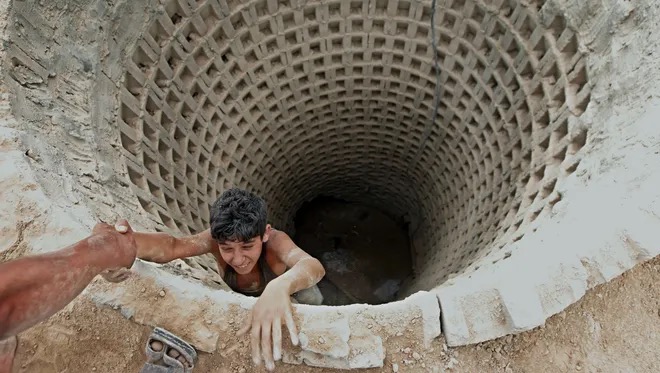
Similarly, even long before before the current war, it is well-documented that Hamas stole the funds and the concrete supplied for construction in Gaza to build a massive underground terror tunnel network (see photo of one such tunnel below) and to make its leaders billionaire-rich.
We had no idea just how massive the Gaza tunnel network had become until recently. Even a year later, Israel is still working to demolish it in its entirety.
One example of how the blockade was effective, however, includes an incident where Israeli security forces and customs officers stopped a massive shipment of rocket and tunnel building supplies headed for Gaza in May of 2016.
The dangerous contraband was found only due to Israeli inspections, since they were hidden in boxes of textiles and jewelry. And similar incidents occurred routinely.
As bad as October 7 was, and as much of a fortified terror enclave as Hamas built in Gaza, it could have been worse - much worse.
Additionally, note that while international law requires Israel to permit the passage of food, clothing, and medicines intended for children under 15, expectant mothers, and maternity cases (which Israel has done), in the event Israel determines Hamas will intercept these goods (which it routinely does) and thereby give the Hamas enemy a windfall, Israel would be permitted under international law to prohibit even these types of provisions from entering Gaza.
Self-Defense and Blockade
Ultimately, the blockade was put in place by Israel in self-defense against an enemy that consistently attempted to destroy Israel and murder as many Jews as possible since its founding.
Once Hamas took control of Gaza, Israel had the right and the obligation to protect its citizens by trying to prevent Hamas from arming itself in ways that could seriously threaten Israel's civilian population and its existence as an independent sovereign Jewish State.
In short, no country is required to provide enemy-controlled territory with resources that will be used against it.
Thus, the blockade on Gaza is/was legal under international law.