Has anyone tried training a Grok @bot to find good coins early?
I'm training mine (started two days ago) and it's already doing insanely well
Any tips if someone's done this before? Hard part is keeping it persistent with good finds. Mine already logs every coin and will probably spot all good stuff early soon
If you're doing it too, I'd love to hear how you train it
Removed all of the samsung spyware from my TV with Codex (Claude refused to root the tv lol)
It's insane how much bloat samsung packs into their TVs to track you and sell your data. Here's just some of what I turned off that made my tv 3x faster:
- screenshot your screen a few times a second to see what you're streaming and fingerprint you to sell your data
- reading your hdmi inputs to do the same thing while you have a game console plugged in
- Voice assistants: Bixby wake-word detectors listening and tracking what you say in your house
Before and after speed of my TV:
YouTube premium hiked subscription price again
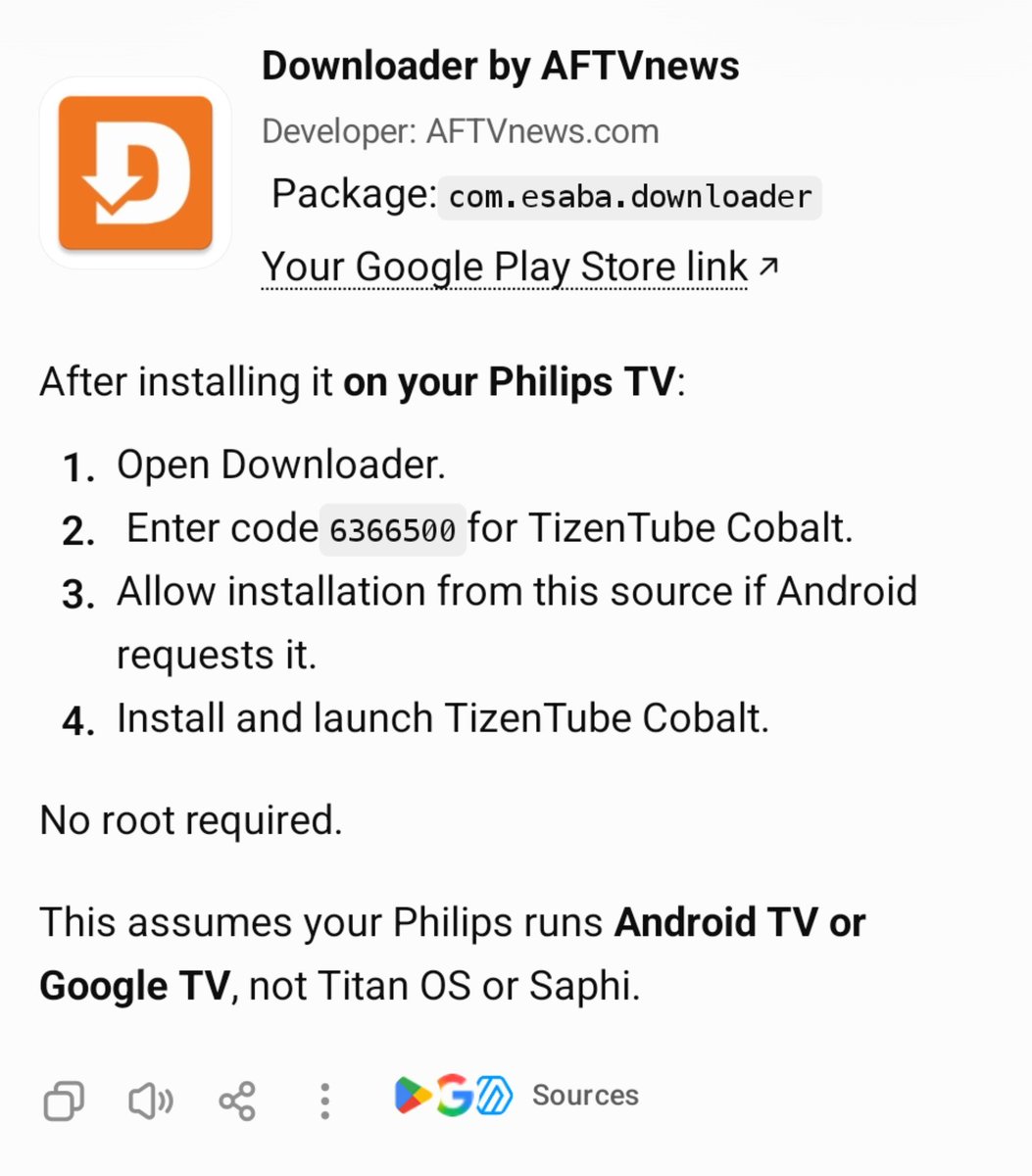
Installed TizenTube on my TV which runs YouTube's TV interface through Google's Cobalt runtime with mods applied on top
Next up, patch YouTube mobile app with morphe. Unsubscribe
Case anyone needs it.
Multiple people have been posting on X on their confirming the discovery of the exploits and posting varying amounts of details. I would consider this in the wild now.
https://t.co/o7uOfRYVi6
Voici toutes les sécurités Tangem que Ledger ou les wallets mobile n'auront jamais :
- 3 cartes fournies donc 3 backups de ta clé privée dans 3 endroits distincts, protégés par un PIN (impossible à brute-forcer), résiste donc à 2 cambriolages/incendies/pertes consécutives.
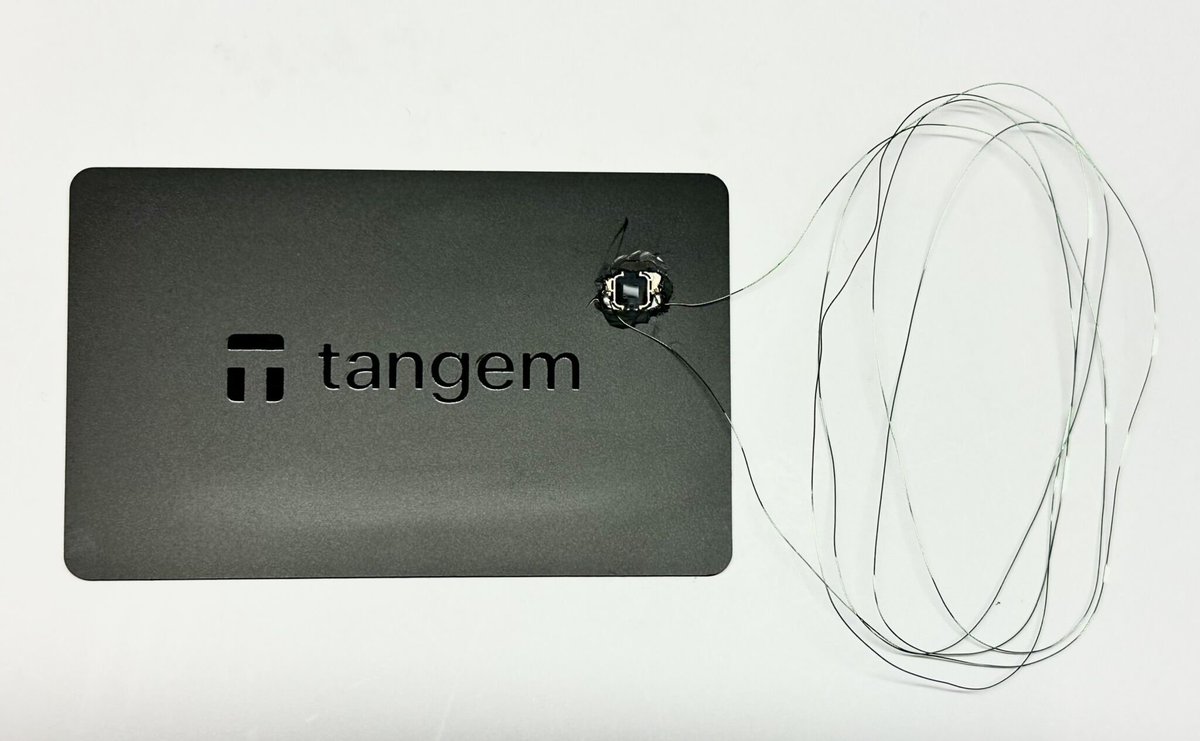
- résiste aux implants espions, car intégrer des composants eSIM+4G+antenna+battery sur une carte de 0.84mm serait impossible ou extrêmement couteux, et ce dispositif n'aurait même pas accès au contenu du Secure Enclave (c'est un jeu d'enfant sur Ledger où il suffit de lire le bus qui transmet l'affichage à l'écran en clair)
- impossible de te drain juste en contrôlant ton phone (les wallets mobile peuvent spend sans ton accord, Tangem requiert un tap avec ta carte NFC pour valider un blind sign, et les paranos peuvent l'utiliser sur un iPhone dédié)
- gère l'heritage à ta mort car ta famille retrouve la seconde carte chez toi et peut accéder à tes fonds en fusionnant ta carte avec leur backup chez eux sans connaitre ton PIN code (option désactivable pour les paranos)
- mémorise ta seed pendant au moins 25 ans (Ledger n'ose même pas communiquer sur la durée de vie de leurs devices, et se déclarera irresponsable si ta Ledger écrase sa mémoire lors d'un firmware update, car t'avais qu'à remplir ta paper seed que ta cleaning lady trouvera sous ton lit)
Je martelle ça depuis 3 ans, mon but n'est pas de promouvoir Tangem (j'ai aucun referral), mais que l'industrie crypto comprenne que ce standard est de loin le meilleur pour 95% des users normie, et qu'elle développe des alternatives dans ce format en closed ou open-source.
Ledger Flex sold at Singapore Airport confirmed to contain a spy implant!
@BenYorke found suspicious marks on his @Ledger and sent it to me rather than using it, that was probably the best decision here.
https://t.co/aP7gDEbvtq
https://t.co/3VumJyBFD2
Having been the only country to dox all known crypto holders to organised crime groups, France now wants a list of everyone holding €100k+ of Bitcoin in self-custody
If you don't declare it: €10,000 fine
If you do declare it: Wrench attack / kidnapping
Can't make it up
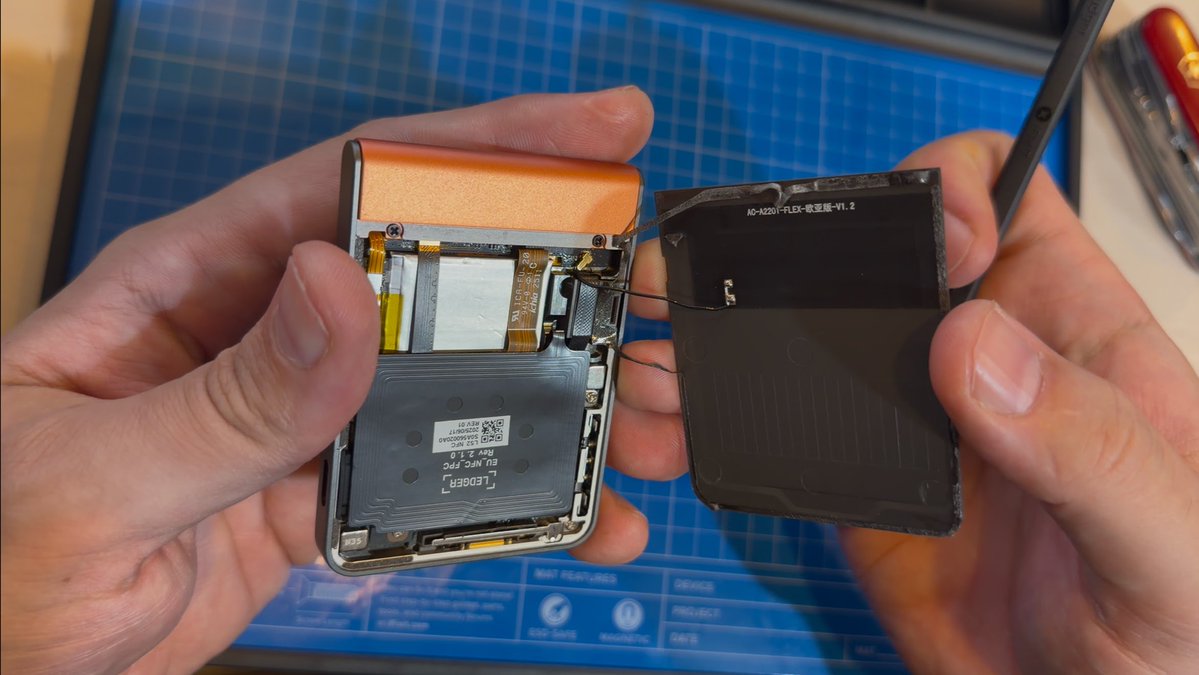
What’s inside a Ledger Flex? After receiving device photos from two viewers, I opened up my own Flex to compare the back panel, antennas, battery, and space beneath the internal cover, and see how the devices differ.
This video shows the full teardown, focusing on the additional module, antenna, and “Flex Eurasian Version V12” marking visible in the viewers’ photos, to help you recognize signs of possible hardware tampering.
Photo comparisons can reveal structural differences. The module’s exact function and how the assets were stolen still require further technical investigation. Finding no additional module during a teardown alone does not confirm that a device is completely safe.
#LedgerFlex #ColdWallet #HardwareWallet #CryptoSecurity
this is the most DANGEROUS thing on internet today
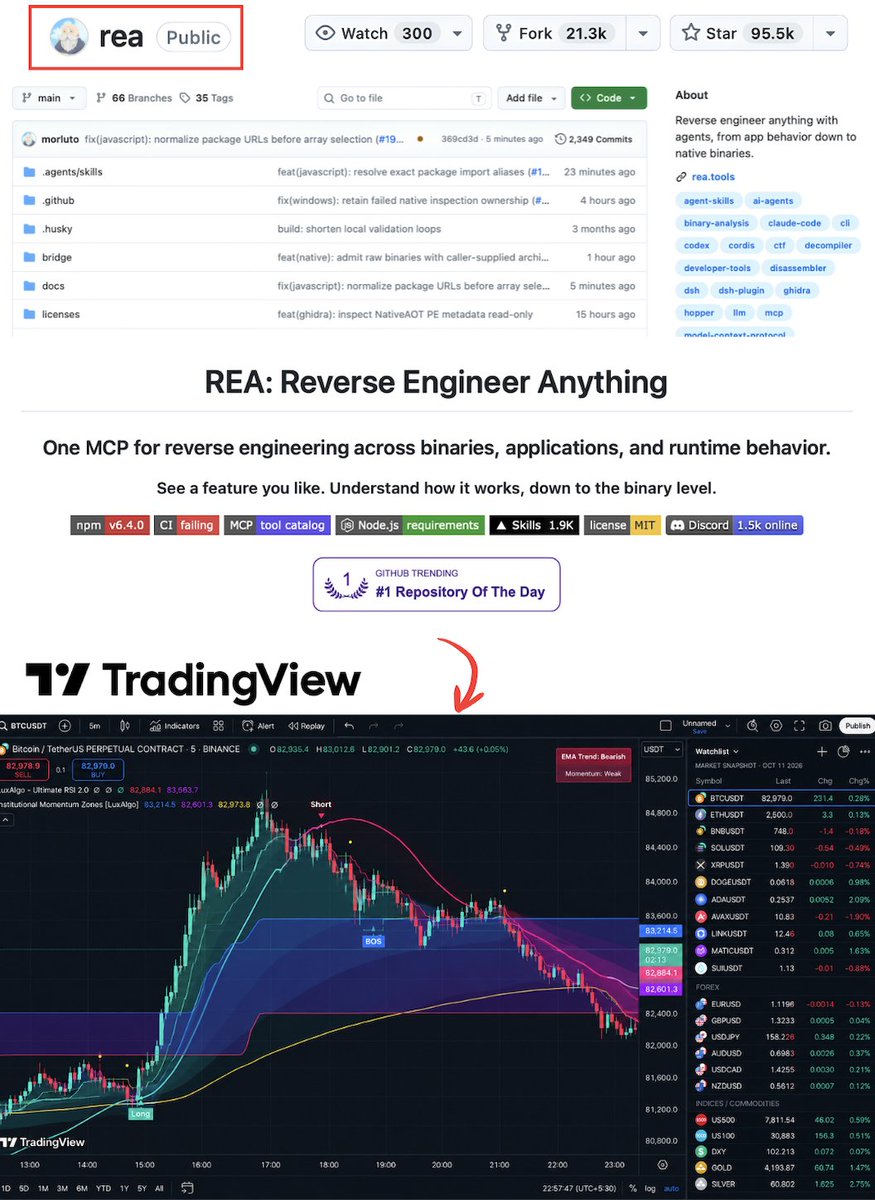
REA (Reverse Engineer Anything) - this open source MCP lets your AI agent reverse engineer any app, down to the binary
i just reverse engineered TradingView, now I am using their premium indicators for FREE - software is cooked
here is how to use REA to reverse engineer TradingView:
1. point REA at TradingView's publicly observable interface and map every major feature, from chart interactions to indicators and alerts
2. trace how the interface behaves when you switch symbols, change timeframes, add indicators, draw levels, and update chart layouts
3. use REA's available MCP tools to investigate authorized software artifacts and trace application logic wherever the evidence allows
4. feed those findings into Claude Opus 5.5, which turns the investigation into a technical specification and an implementation plan
5. rebuild the charting engine independently, with real market data, candlesticks, technical indicators, drawing tools, and persistent watchlists
6. add a quant backtesting engine that tests strategies against historical data, accounting for fees, slippage, and drawdowns
7. test every component, compare its behavior against documented and observable results, fix failures, and keep iterating until the system actually works
8. you end up building your own TradingView-style quant research terminal from scratch, with source code you control and features you can keep extending
i won’t say anything more:
INTEL: Kraken plans to launch in the UAE with dirham deposits and withdrawals after its parent company Payward secured full regulatory approval from Dubai’s VARA
This looks like this could be exactly what I'm investigating. Anyone affected, please contact me or open your ledger and send me pictures so we can confirm if there's a bug in there (pictures: ledger board on top, spy implant below).
https://t.co/mg2VRHLRHE
I don't recommend anyone scramble to move their funds to new wallets today. But we should take the risks to cryptography from AI-accelerated math seriously, and minimize our exposure to not just quantum-vulnerable cryptography, but also potentially AI-vulnerable cryptography.
The core new area of risk from this viewpoint is, unfortunately, ML-DSA / FHE / lattices.
(and it's also another reason, along with quantum, why ECDSA might fall even faster than expected, hence the "fresh address" recommendation)
So far most people have been in the mode of thinking "elliptic curves broken, hashes safe, lattices safe". But there is a good chance that the concrete security of lattices will take serious hits from the next two years of AI math.
The basic threat model is: factoring is something that naively takes 2^(n/2) time, but over decades smart people have found and optimized number field sieves, and degraded that to 2^O(n^(1/3)), which is why RSA keys and signatures need to be ~400 bytes (and not 64 bytes). What if there are skeletons in the closet like that, both for elliptic curves and lattices, that we are simply not smart enough to discover - but bots soon will be?
This is a major part of the reason why for the past year ethereum's lean roadmap has been going in the "hash-only" direction: no lattices, no ML-DSA, no Falcon, no lattice-based commitments inside ZK proofs, etc. Signatures in lean ethereum are all hash-based, either WOTS or SPHINCS-.
For signatures and proofs, we already know how to go hash-only. The bigger challenge is for *public-key encryption* - and this goes far beyond blockchains. Secure communication, anonymizing protocols, lots of things need public-key encryption.
And unfortunately there are long-standing mathematical theorems showing why public-key encryption cannot be done with hashes alone. You have to have some kind of trapdoor object that has at least one form of usable "structure" - either group theory (incl. isogenies) or lattices or code-based or potentially in the future even more newfangled and spooky things (local mixing?). But for anything that has structure, you should assume that AI will make at least some progress in breaking that structure. Here, one reasonable inference is that if you want to make something plausibly long-term secure, multiply the key sizes by 10.
To me that's a very plausible world and something not at all extreme to predict. If AI will bring us 50 years of math in 2 years, then that 50 years of math may very plausibly include a "naive factoring -> GNFS" level of improvement to our ability to break lattices. In that world, lattices will still exist, but they will have to be significantly bigger to guarantee the same level of safety.
And at those new larger sizes, hash-based constructions will beat lattice-based constructions on concrete efficiency in every use case where hash-based constructions are possible at all.
Theoretically, of course it's possible that hashes are broken too (eg. P = NP would imply that). But I think P = NP is very unlikely. And intuitively, it's much more likely that a mathematical object has exactly no exploitable structure (like hashes are intended to), than that a mathematical object has exactly ~3 forms of exploitable structure (for elliptic curves: associativity, Schoof, pairings) and not some secret fourth form of structure we have not yet discovered that greatly degrades its security (for elliptic curves, ECDLP and pairing security). Similar for LWE, SVP, RLWE and the zoo of lattice problems.
For this reason, we do not yet see any reason to worry and start padding the byte size of hashes (if we start to worry more, we would pad the round count first before doing anything to the byte size).
Concrete TLDR, my own personal views:
* Hash-based > lattice-based, in those situations where hash-based is possible at all
* For anything lattice-based, be much more paranoid on param sizes. Remember that blockchains are only a small portion of the cryptography story; this point goes far beyond blockchains and applies to eg. access to websites, secure messaging, Tor / VPNs ...
* For privacy protocols, strongly favor NOT putting encrypted notes onchain. Instead, send them offchain through some third-party mechanism.
* If it's not difficult for you, keeping your funds in addresses which have not yet been used to make a transaction is a good idea. If it's easy for you, do it. **But be careful about migrations; I personally have lost more money in botched migrations than I have lost in all hacks combined**.
* For multisig wallets, doing confirmations offchain is better than onchain, because this way the signatures of signer wallets do not get exposed to the public, so if ECDSA falls to AI much faster than expected, at least the multisig "gracefully degrades" to a 1-of-1 where the 1 is whoever was gathering the signatures - a much better place to be than "anyone can take the money"
https://t.co/oVjwZog2lL
Price remembers nothing, but traders do; yesterday's support, resistance, gaps, and failed breakouts matter because people who bought, sold, missed, or got trapped there may behave differently when price returns.