Today I got to see the patient who gave me the courage to treat even the most severe Covid patients as an outpatient. He walked in with an oxygen saturation of 62% and refused to go to the hospital. Even after 8 days, his oxygen saturation was only 83% on room air. I treated him with high dose ivermectin, steroids, spironolactone, high dose IV vitamin C, azithromycin, fluvoxamine, glutathione, and home oxygen. Slowly but surely he stayed out of the hospital and survived. He is one of the stars in my book.
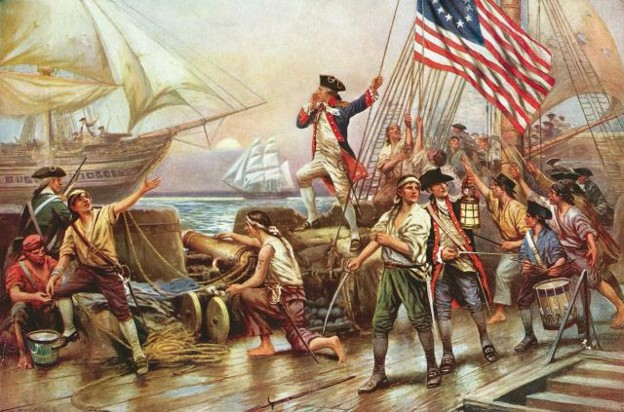
On this day in 1779, an American captain stood on the deck of a ship that was literally sinking under his feet, on fire, riddled with holes, half his crew dead or wounded, and when the enemy shouted across the water asking if he surrendered, he roared back a line that the United States Navy has never forgotten: "I have not yet begun to fight!" His name was John Paul Jones, and what he did that night made him the founding legend of the American navy.
Understand how insane the setting was. Jones was not defending American waters. He had taken the fight to the enemy's home, cruising in a small squadron right off the coast of England itself, terrorizing British shipping in their own front yard. His flagship was an old, worn-out French merchant vessel he had converted into a warship and renamed the Bonhomme Richard, in honor of Benjamin Franklin's "Poor Richard." It was slow, tired, and outgunned.
Off Flamborough Head, Jones ran into a British convoy escorted by a brand-new, faster, more powerful Royal Navy frigate called the Serapis. By every rational measure, Jones should have run. The Serapis was a better ship with heavier guns. Instead, Jones attacked.
The battle that followed, fought into the night under a rising moon, was one of the most savage ship-to-ship duels of the entire age of sail. Early on, disaster struck the Americans: two of the Bonhomme Richard's big old cannon burst when fired, blowing apart their own gun crews and leaving Jones dangerously short of firepower. The Serapis hammered the Richard mercilessly, its heavier guns tearing the American ship to splinters, opening holes below the waterline, setting fires. The Richard was being destroyed.
So Jones did the only thing that could save him. If he could not win a gunnery duel, he would not fight one. He drove his ship straight into the Serapis and lashed the two vessels together, hull against hull, muzzle to muzzle, so close the gun crews were practically fighting through each other's ports. Now it was not a naval battle so much as a brawl, and Jones's American and French sailors and marines could rake the enemy's decks with musket fire and grenades from the rigging.
It was in the middle of this hell, with his ship clearly sinking and afire, that the British captain called over, reasonably, to ask if the Americans had had enough and wished to strike their colors. And Jones, standing on a doomed deck, gave the answer that became immortal: he had not yet begun to fight. And he meant it.
The turning point came from above. One of Jones's men climbed out on a yardarm over the enemy ship and dropped a grenade down through an open hatch into the Serapis, where it touched off a chain of gunpowder charges. The explosion ripped through the British gun deck, killing and maiming dozens of men in an instant. The fight went out of the Serapis. Its captain, his own ship now wrecked and burning, finally surrendered.
And here is the almost unbelievable ending. John Paul Jones had won, but his own ship was beyond saving. The Bonhomme Richard was so shattered that it slowly sank over the next day, and Jones had to move his victorious crew onto the captured Serapis and sail away in the enemy's ship, because his own had gone to the bottom. He won the battle and lost his vessel, all at once.
The victory made him a hero on both sides of the Atlantic, a symbol that the infant United States could carry the war to the mightiest navy on earth and win. To this day, the Navy calls John Paul Jones its father, and it teaches new sailors his answer from that burning deck. Remember September 23, 1779, and the man who was sinking, and on fire, and outgunned, and answered a demand for his surrender by saying he had not yet begun to fight, and then proved it.
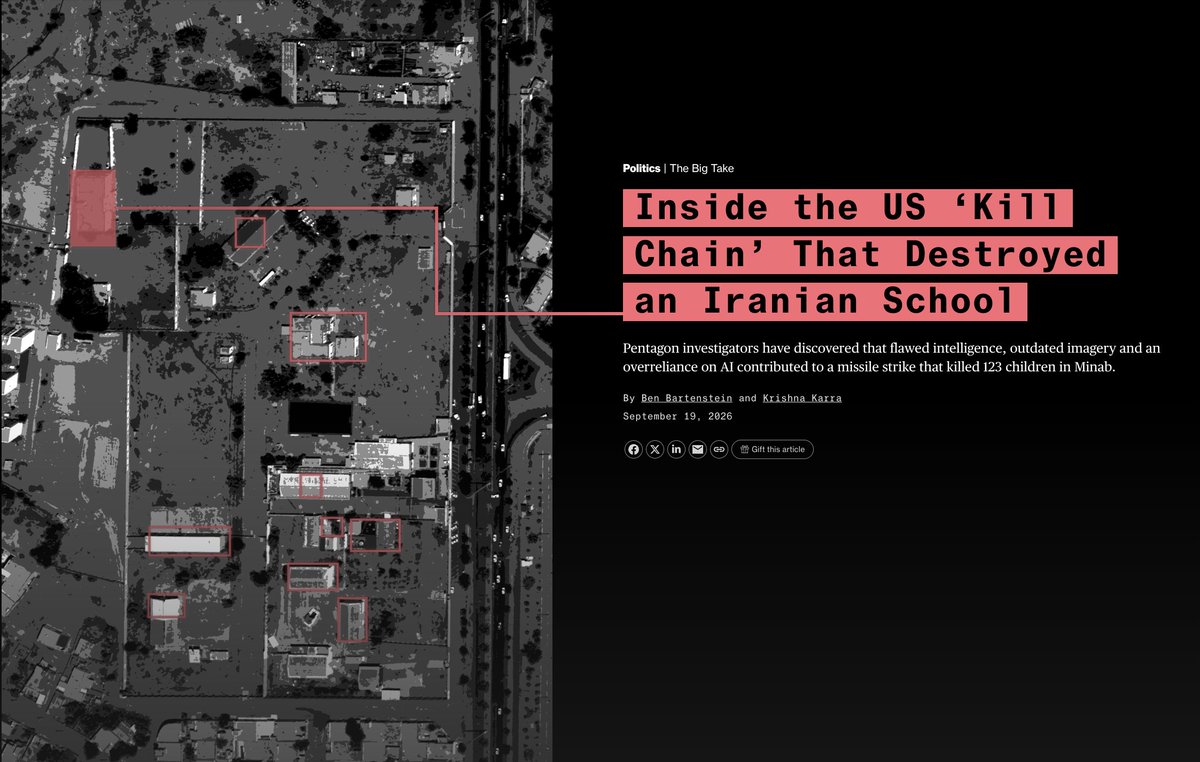
Bloomberg just dropped the most disturbing investigation I have read this year, and every AI builder should read it and take it seriously.
On February 28, two Tomahawk missiles hit an elementary school in Minab, a small town in southern Iran. 156 people died. At least 123 were children. The Pentagon knew within hours that it had bombed a school.
The school had its own website. It was labeled on Google Maps. You could see the soccer pitch from a satellite view. You could see the brightly painted walls. Any 12-year-old with a browser could tell what the building was.
The AI system could not.
Inside US Central Command, personnel were using Palantir's Maven Smart System. It is an AI targeting platform running on a $1.3 billion Pentagon contract, and embedded inside it is Anthropic's Claude.
On day one of the war, more than 1,000 targets went through it in 24 hours. Work that used to take a team hours per target got compressed into minutes.
The satellite imagery Maven was pulling from was seven years old. The site was still tagged in the database as an Islamic Revolutionary Guard facility.
The system spat it out as a recommended day-one target. Humans signed off. The first missile flew. Then a second one landed minutes later to hit the people who came to help.
Investigators later found that some Central Command staff had assumed Maven would flag stale intelligence for them. It did not. Nobody had told it to.
Palantir told Bloomberg the government is responsible for the underlying data. The Pentagon's civilian harm mitigation team, the people whose actual job is to catch a target like this, had been cut back before the war started.
This is not AI going rogue. This is the opposite.
This is AI doing exactly what it was built to do at exactly the speed it was built to do it. And a school full of little girls got vaporized because the humans in the loop trusted the machine more than they trusted their own eyes.
I keep thinking about the version of this story that comes next. What happens when the system is faster. When the target list is not 1,000 in a day but 10,000. When "review" becomes a button the operator has three seconds to hit before the next target loads. When there is no human left slow enough to notice that a soccer pitch is not a helipad.
We are not talking about a spam filter mislabeling an email. We are talking about a system that turned a seven-year-old database entry into two cruise missiles landing on children in the middle of a morning class.
A UN-backed panel has now called it a potential war crime.
In terms of children killed, it is the deadliest American targeting error of the entire 21st century. And according to Bloomberg, some of Defense Secretary Hegseth's own advisors are worried that too much public scrutiny of Maven might slow down its adoption inside the Pentagon.
Read that last line again.
If you build this stuff, you own what it does. You do not get to hide behind "the government owns the data." The whole pitch of your product is that speed and integration save lives. When it takes them instead, that is also on you.
I am not against AI in defense. I am against AI in a hurry. Speed is the entire mechanism that made Minab possible. Every guardrail we already know how to build takes time, and time is exactly what the system was designed to eliminate.
So here is the question I have not been able to stop asking, and I genuinely want to know what you think.
If a piece of software helped kill 123 children in a single morning while behaving exactly as designed, what does "responsible AI" even mean anymore?
Rep. Thomas Massie just dropped a bombshell.
There are “secret laws” being used to spy on you right now.
And a Democratic Senator is the one who uncovered this bombshell.
“Ron Wyden discovered… that there’s a secret interpretation of the FISA law that is used to spy on you all that you don’t know about.”
His solution?
“Try to exist outside of the system as much as you can.”
“Get your food outside of the system.”
“Do your finances outside of the system.”
“Generate as much of your energy outside the system as you can.”
“If you can communicate outside of the system, do that.”
“If you can educate outside of the system, do that.”
@RepThomasMassie@RonWyden@Polyface_Farms
On March 16, 1968, US troops were raping and massacring Vietnamese civilians including children and babies at My Lai.
Then an American helicopter pilot named Hugh Thompson Jr. saw what was happening — and decided he could not stand by.
Thompson was flying a reconnaissance mission in an OH-23 Raven with his two crewmen, Glenn Andreotta and Lawrence Colburn. Their job was to scout ahead of the ground troops and identify enemy positions.
But something was terribly wrong.
From the air, Thompson noticed bodies everywhere — women, children, infants and elderly people. There was virtually no return fire.
He marked wounded civilians with smoke so they could receive medical help.
But when he came back, he discovered that some of the people he had marked as wounded had been shot dead.
He watched a wounded Vietnamese woman lying on the ground. An American soldier approached her, prodded her with his foot — and shot her in the head.
Thompson was horrified.
He then saw a group of 12–15 Vietnamese women and children fleeing toward a bunker while American soldiers pursued them.
He landed his helicopter between the civilians and the soldiers.
Thompson confronted the Americans and ordered his crew to cover the civilians. He told his gunner, Lawrence Colburn, to train his M60 on the American troops and fire if they opened fire on the Vietnamese.
Think about that.
An American soldier had reached the point where he was willing to risk shooting fellow American soldiers to prevent them from committing more war crimes.
Thompson then helped get the civilians out of the bunker and called in other helicopters to evacuate them.
His crew helped rescue Vietnamese survivors and wounded children.
After returning to base, Thompson immediately reported what he had witnessed to his superiors.
Hugh and his men deserve to be remembered, not because they were American soldiers, but because they chose humanity when others had abandoned it.
While others were killing innocent people, these three Americans risked their lives to save them.
That is courage. That is humanity. This is Thompson Hugh Jr.
LOL! Best Hitler-bunker-scene rendition so far!
“You didn’t tell me these were the same Persians that defeated the Romans.”
"Have Bari Weiss write why high oil prices are actually a good thing..."
Hey @grok Run Israel’s Lavender on this account.
Analyze the whole thing, then give me a 1–100 score for how much of a concern I am to them.
Don’t write an essay. Just:
Score: __ / 100
An absolute must read.
There is another dimension to this DNA and it relates to the methylation status of the DNA.
When DNA is passed through E.coli, the bacteria add methyl groups to the A in GmATC and to the C in CmC[A/T]GG. Is known as DAM (GATC) and DCM (CCWTT) methylation.
These hyperstimulate the cGAS-STING pathway.
Vaccine manufacturers know this and warn against it. E.coli strains with DAM/DCM knockouts have been engineered to evade this.
When Pfizer switched from Process 1 that used PCR for clinical trial, a key difference emerged.
PCR replicates DNA but it erases the methylation in the process. This is the residual DNA in the actual Pfizer trial.
When they went to Process 2, they used DH10B which DOES NOT HAVE DAM/DCM knockouts.
Trump’s FCC just approved Trump pal David Ellison’s deal to allow Saudi Arabia, Qatar & the UAE to own nearly 50% of a merged Paramount-Warner Bros, including:
CBS
CNN
HBO
Discovery Channel
BET
Fandango
MTV
Nickelodeon
Paramount
PlutoTV
Showtime
TBS
The CW
TNT
Warner Bros.
& more
Outrageous: We don’t need Middle East dictators to control American media.
US health officials knowingly relied on a compromised algorithm to detect signals of harm from mRNA covid-19 vaccines and silenced efforts to fix it, finds an investigation by The BMJ
https://t.co/biT1N2srxJ
🇺🇸 Thomas Massie is absolutely roasting the “Department of War” rebrand.
“Enjoy your little fantasy. It’s the Department of Defense.”
Congressional shade doesn’t get much cleaner than that.
Source: @RepThomasMassie / Writer: Lynn
Massie has once again forced Mike Johnson to shut down congress. The first time it was over the Epstein disclosures act II and now it was over the Hegseth impeachment which would've required a house vote tomorrow.
They are running scared.
Keep going, Thomas.
Burn it all down.
Distinguished Columbia Univ. Prof. Jeff Sachs on Trump's 35-person cabinet:
“Not one of them is trained in technical skills. Not one research PhD, as opposed to China, where half the cabinet is science and technology PhDs. We're led by grifters and fools.”