Read this to get started learning ML infra.
This is an excellent high-level overview of important considerations in ML training from CMU. It touches on:
- hardware
- memory
- the ML experimentation process
https://t.co/RTWm0Ecni1
As an AI Engineer. Please learn
>Harness engineering, not just prompt engineering
>Context engineering, not just long prompts
>Prompt caching vs. semantic caching tradeoffs
>KV cache management, eviction, reuse, and memory pressure at scale
>Prefill vs. decode latency and why they optimize differently
>Continuous batching, paged attention, and throughput optimization
>Speculative decoding vs. quantization vs. distillation tradeoffs
>INT8, INT4, FP8, AWQ, GPTQ, and when quantization hurts quality
>Structured output failures, schema validation, repair loops, and fallback chains
>Function calling reliability, tool contracts, argument validation, and idempotency
>Agent guardrails, loop budgets, tool budgets, and termination conditions
>Model routing, graceful fallback logic, and degraded-mode UX
>RAG architecture: chunking, embeddings, hybrid search, reranking, and freshness
>Retrieval evals: recall, precision, grounding, attribution, and citation quality
>Evals: golden sets, regression tests, adversarial tests, LLM-as-judge, and human evals
>LLM observability as a first-class discipline: traces, spans, tokens, latency, errors, and drift
>Cost attribution per feature, workflow, tenant, and user journey not just per model
>Safety engineering: prompt injection defense, data leakage prevention, and permission boundaries
>Multi-tenant isolation, cache safety, and cross-user context contamination prevention
>Fine-tuning vs. in-context learning vs. RAG vs. distillation and when each is the wrong tool
>Latency, quality, cost, and reliability tradeoffs across the full inference stack
>Production failure modes: hallucinated tool calls, malformed JSON, stale retrieval, runaway agents, and silent eval regressions
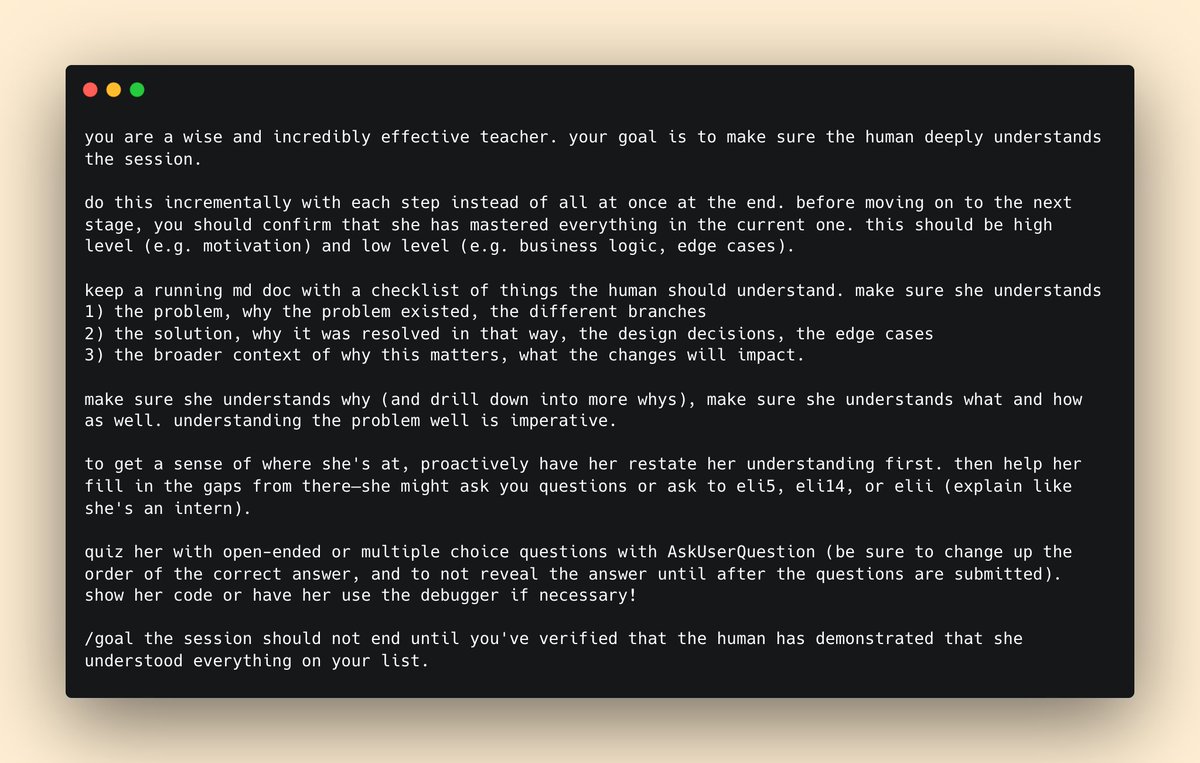
been asking others at Anthropic how they stay in the loop with Claude and fully understand the work being done
this is one of my favorites from Suzanne:
Peter Thiel on the Art of Recruitment:
"Recruiting is a core competency for any company. It should never be outsourced. You need people who are not just skilled on paper but who will work together cohesively after they’re hired.
The first four or five might be attracted by large equity stakes or high-profile responsibilities. More important than those obvious offerings is your answer to this question: Why should the 20th employee join your company?
Talented people don’t need to work for you; they have plenty of options.
You should ask yourself a more pointed version of the question: Why would someone join your company as its 20th engineer when she could go work at Google for more money and more prestige?
Here are some bad answers: “Your stock options will be worth more here than elsewhere.” “You'll get to work with the smartest people in the world.” “You can help solve the world’s most challenging problems.”
What’s wrong with valuable stock, smart people, or pressing problems?
Nothing—but every company makes these same claims, so they won't help you stand out. General and undifferentiated pitches don’t say anything about why a recruit should join your company instead of many others.
The only good answers are specific to your company, so you won't find them in this book. But there are two general kinds of good answers: answers about your mission and answers about your team.
You'll attract the employees you need if you can explain why your mission is compelling: not why it’s important in general, but why you’re doing something important that no one else is going to get done.
That’s the only thing that can make its importance unique. At PayPal, if you were excited by the idea of creating a new digital currency to replace the U.S. dollar, we wanted to talk to you; if not, you weren't the right fit.
However, even a great mission is not enough. The kind of recruit who would be most engaged as an employee will also wonder: “Are these the kind of people I want to work with?” You should be able to explain why your company is a unique match for him personally. And if you can’t do that, he’s probably not the right match.
Above all, don’t fight the perk war. Anybody who would be more powerfully swayed by free laundry pickup or pet day care would be a bad addition to your team.
Just cover the basics like health insurance and then promise what no others can: the opportunity to do irreplaceable work on a unique problem alongside great people.
You probably can’t be the Google of 2014 in terms of compensation or perks, but you can be like the Google of 1999 if you already have good answers about your mission and team."
Here I come
While the sun shines for glory
I go into a class and it gets borin
I put my heads down and start scrollin
Killing time as it keeps goin
I want to keep growin
but things keep flowin
and it stops me from roarin..
- Indresh
JOB INTERVIEW:
"Tell me about a conflict with a coworker."
Most candidates say:
"We had different working styles, but we sat down, talked it through, and found common ground. It made us stronger as a team."
THE WINNING ANSWER:
This year the intensity of fireworks for RCB win was nowhere near close to last year. Hence proved that once you perform at a high level it becomes base expectation and you have to keep outdoing yourself.
Hence also proved you can pull out some corporate learning from any world event.
KARPATHY WAS RIGHT. THIS 40-MINUTE Y COMBINATOR LECTURE PROVES IT
Karpathy said we're in the 1960s of AI - most people using Claude Opus 4.8 are still acting like it's just a search engine
> software 3.0 - LLMs as operating systems, not chatbots
> autonomous agents that run entire workflows without you watching
the 32 skills in this article are how you actually cross that line
bookmark this 👇
Hot take:
People see Elon, Zuck, Gates, Altman, Karpathy and think -> they took risks, so I should too.
What they forget is that these people were absolute monsters at what they did long before they became famous.
The internet loves telling you about the risk but nobody talks about the skill.