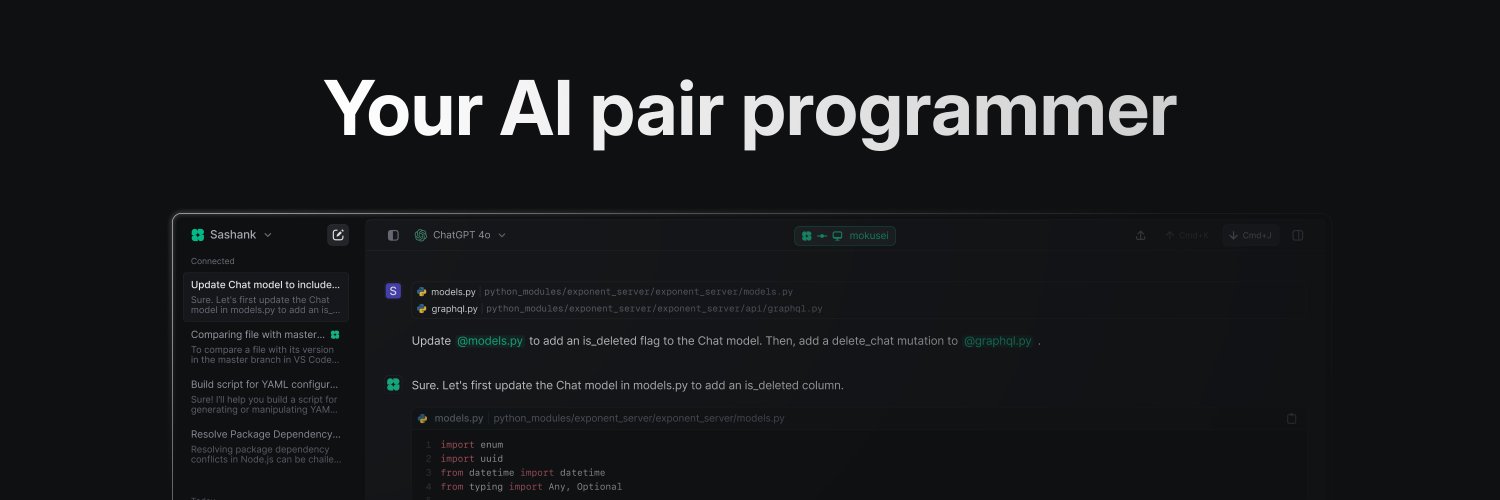
Introducing Exponent, a highly capable programming agent. You can get early access today to start using Exponent's clean, developer-focused UX for any software engineering task from exploration to deployment.
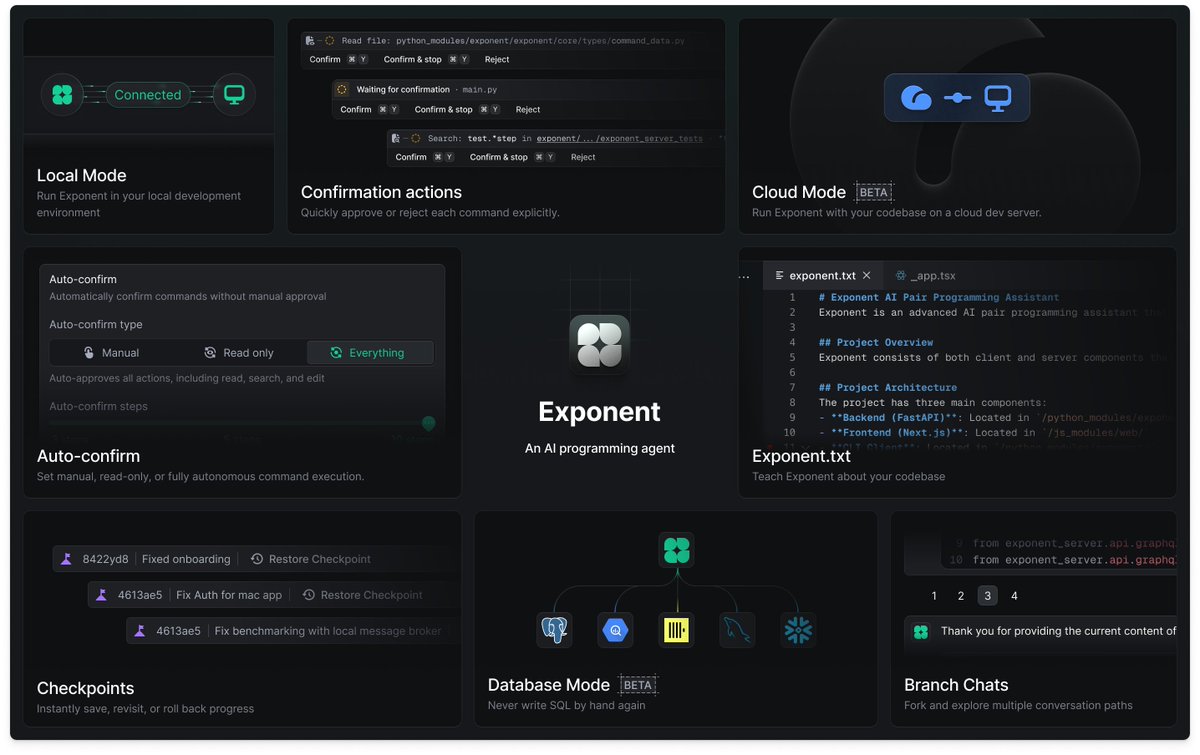
Exponent is designed to be easy to use and control. Let's go through some of Exponent's capabilities that we get a lot of positive feedback on compared to other tools:
Exponent in CI: Save serious time and headaches by adding Exponent to your CI pipelines to automatically review code, fix type check errors, enforce coding standards, and more. https://t.co/Gnxd4ivKPm
@0xperp try `exponent shell` to use it in your terminal like the other tools. the bonus is and move to web later using `/web` if your chat gets long or you need to rewind/branch
Introducing Exponent, a highly capable programming agent. You can get early access today to start using Exponent's clean, developer-focused UX for any software engineering task from exploration to deployment.
I tried out Exponent and it was amazing. It analyzed my entire Vibe coding code base with @cursor_ai in less than 5 minutes and generated an exponent.txt explaining and documenting the architecture. I can now use this in Cursor going forward right away or try to explore more Exponent features. Here's the full file, pretty amazing!
## 1. Project Architecture
The app is built Next.js 14 using the App Router pattern. The core architecture follows a SaaS model with subscription-based access to features.
### Key architectural components:
- Next.js 14 with App Router for frontend and API routes
- @clerk for authentication and user management
- PostgreSQL database with @prisma ORM
- @stripe for subscription and payment processing
- Third-party integrations: @OpenAI, @twilio , @Mail_Gun
### Route Structure:
- Public routes: Landing pages, marketing pages
- Authentication routes: Login, signup
- Protected routes: Dashboard, feature settings, subscription management
- API routes: Feature toggles, status checks, subscription management
## 2. Core Libraries and Frameworks
### Frontend:
- Next.js 14 (React framework)
- React 18
- @tailwindcss CSS for styling
- @shadcn component library (built on Radix UI)
- next-themes for theme management
- sonner for toast notifications
- date-fns for date handling
### Authentication:
- Clerk
### Database:
- PostgreSQL
- Prisma ORM (@prisma/client)
### API/Backend:
- OpenAI for AI capabilities
- Twilio for SMS/voice capabilities
- Mailgun.js for email capabilities
- Stripe for payments and subscriptions
- libphonenumber-js for phone number validation
### Analytics:
- @posthog
## 3. Directory Structure
### Next.js App Router Structure:
- `/app`: Main application code (Next.js App Router)
- `/(auth)`: Authentication routes (login, signup)
- `/(protected)`: Protected routes requiring authentication
- `/api`: API routes for server-side functionality
- `/components`: Page-specific components
- `globals.css`: Global styles
### Key Directories:
- `/app/(protected)`: Contains feature-specific pages
- `/app/api`: Server-side API routes organized by feature
- `/app/components`: UI components specific to the main app
- `/components`: Shared UI components
- `/public`: Static assets
- `/prisma`: Database schema and migrations
- `/lib`: Utility functions and shared code
- `/migrations`: Database migration scripts
- `/documentation`: Project documentation
## 4. Important Files
### Configuration Files:
- `next.config.mjs`: Next.js configuration
- `tailwind.config.ts`: Tailwind CSS configuration
- `middleware.ts`: Clerk authentication middleware
- `prisma/schema.prisma`: Database schema definition
- `package.json`: Dependencies and scripts
### Key Component Files:
- `app/layout.tsx`: Root layout with Clerk provider and analytics
- `app/(protected)/layout.tsx`: Layout for authenticated routes
- `components/headerloggedin.tsx`: Navigation header for authenticated users
- `components/header.tsx`: Navigation header for unauthenticated users
- `components/RightSidebar.tsx`: Shared sidebar component
## 5. Coding Patterns and Conventions
### Authentication Pattern:
- Clerk is used for authentication throughout the application
- Protected routes are wrapped with Clerk's SignedIn/SignedOut components
- API routes use Clerk's currentUser function to verify authentication
### Data Access Pattern:
- Prisma Client singleton pattern in `lib/prisma.ts`
- Database queries are performed in API routes
### UI Component Pattern:
- shadcn/ui components with Tailwind CSS for styling
- Custom color scheme with specific hex values
- Consistent card-based layout for feature configuration
- Mobile-responsive design with tailored layouts
### State Management:
- React hooks (useState, useEffect) for local state
- API calls for remote state
- Clerk hooks (useUser) for authentication state
### API Response Pattern:
- Consistent error handling with appropriate status codes
- JSON responses with standardized structure
- Dynamic routes for forced revalidation (no caching)
## 6. Build and Deployment
### Build Process:
- Prisma client generation before build (`prisma generate && next build`)
- Sitemap generation after build (`next-sitemap`)
- TypeScript type checking during build
### Scripts (from package.json):
- `dev`: Next.js development server
- `build`: Generate Prisma client and build Next.js app
- `start`: Start production server
- `lint`: Run ESLint
- `postinstall`: Generate Prisma client
- `postbuild`: Generate sitemap
### Environment Variables:
- Clerk authentication keys
- Database connection strings
- Stripe API keys
- OpenAI API keys
- Twilio credentials
- Mailgun credentials
## 7. Testing
Based on the codebase examination, there doesn't appear to be a formal testing framework implemented. Future improvements could include:
- Jest for unit testing
- Cypress for end-to-end testing
- React Testing Library for component testing
## 8. Challenges and Complexities
### Integration Complexities:
- Managing multiple third-party integrations (Clerk, Stripe, OpenAI, Twilio, Mailgun)
- Coordinating data between user authentication (Clerk) and subscription status (Stripe)
### Data Management:
- Tracking and processing user conversations across multiple channels
- Task prioritization and management system
### User Experience:
- Providing a consistent experience across multiple interaction channels
- Maintaining responsive design across various device sizes
### Subscription Management:
- Handling trial periods and subscription status
- Managing feature access based on subscription type
- Coordinating between Stripe subscription events and application features