Life is Interpretation: Starting from Newman&Sarkar "Biology and Physics", which considers BMCs (Biomolecular Condensates): having 5 distinct simultaneous properties which cannot fit any existing physics 🧵
the hard work of building community.
Vervaeke argues that AI is the ultimate "Having" machine because it gives us the output of thought or care without the human process of experiencing it.
John Vervaeke's Modal confusion happens when you try to solve a "Being" problem using a "Having" solution. For example, if you feel lonely and disconnected, you might try to cure it by buying a new gadget or seeking a status symbol rather than doing 🧵⬇️
The AI debate is stuck on "Will it take my job?"
But it's avoiding a much scarier question: If a machine can produce my output better than I can, what is the actual point of me?
We are confusing our economic output with our human worth. A thread on the 3 Economies of AI 🧵👇
@David_Gunkel#LLMs obviously have material infrastructure with real environmental costs, but saying humans are their bodies is like cars having roads as their bodies
Celebrating the milestone of a massive 150+ million downloads of Gemma 4 with the release of the new Gemma 4 12B model! It's incredibly powerful for such a small model and it’s tiny enough to run locally on a laptop with just 16GB VRAM. Apache 2.0 license - happy building!
Gemma 4 12B can now run locally on just 8GB RAM via Dynamic GGUFs.
Google's new model, Gemma 4 12B Unified supports image, audio and 256K context.
You can run and train the model via Unsloth Studio.
GGUF: https://t.co/8cL321pVDh
Guide: https://t.co/odRo9WjRpA
Today we’re introducing Gemma 4 12B — our latest open model that brings advanced agentic reasoning, vision and audio directly to your laptop.
It delivers performance nearing our larger Gemma models with a much smaller total memory footprint, while being small enough to run locally with just 16GB of VRAM. It’s open and accessible for everyone to use under a permissive Apache 2.0 license.
This is all made possible by our new, unified architecture that removes separate multimodal encoders. Here’s how we did it 🧵
The AI debate is stuck on "Will it take my job?"
But it's avoiding a much scarier question: If a machine can produce my output better than I can, what is the actual point of me?
We are confusing our economic output with our human worth. A thread on the 3 Economies of AI 🧵👇
But AI cannot touch your Praxis (the messy work of human relationships) or your Theoria (the internal transformation of sustained attention).
The real danger isn't that AI thinks better than you. It's that by outsourcing our cognitive friction to LLMs, we stop thinking altogether
New Opus 4.8 crashed Opus 4.7 at physics on canvas!
We gave both models the same three prompts: simulate a real physics phenomenon on raw HTML5 canvas.
Prompt 1: "A triple pendulum swings into chaos and paints glowing trails with its tip"
Prompt 2: "A 1 kg block bounces between a wall and a 100.000 kg block. The collisions count out the digits of pi"
Prompt 3: "Balls fall through a grid of pegs and pile into a bell curve"
This is amazing. Do this:
1. Set model to Opus 4.8
2. Reasoning effort to /ultracode
Enables Claude Code's new Dynamic Workflows.
Claude will autonomously detect complex tasks, write an orchestration script, and spawn an agent swarm.
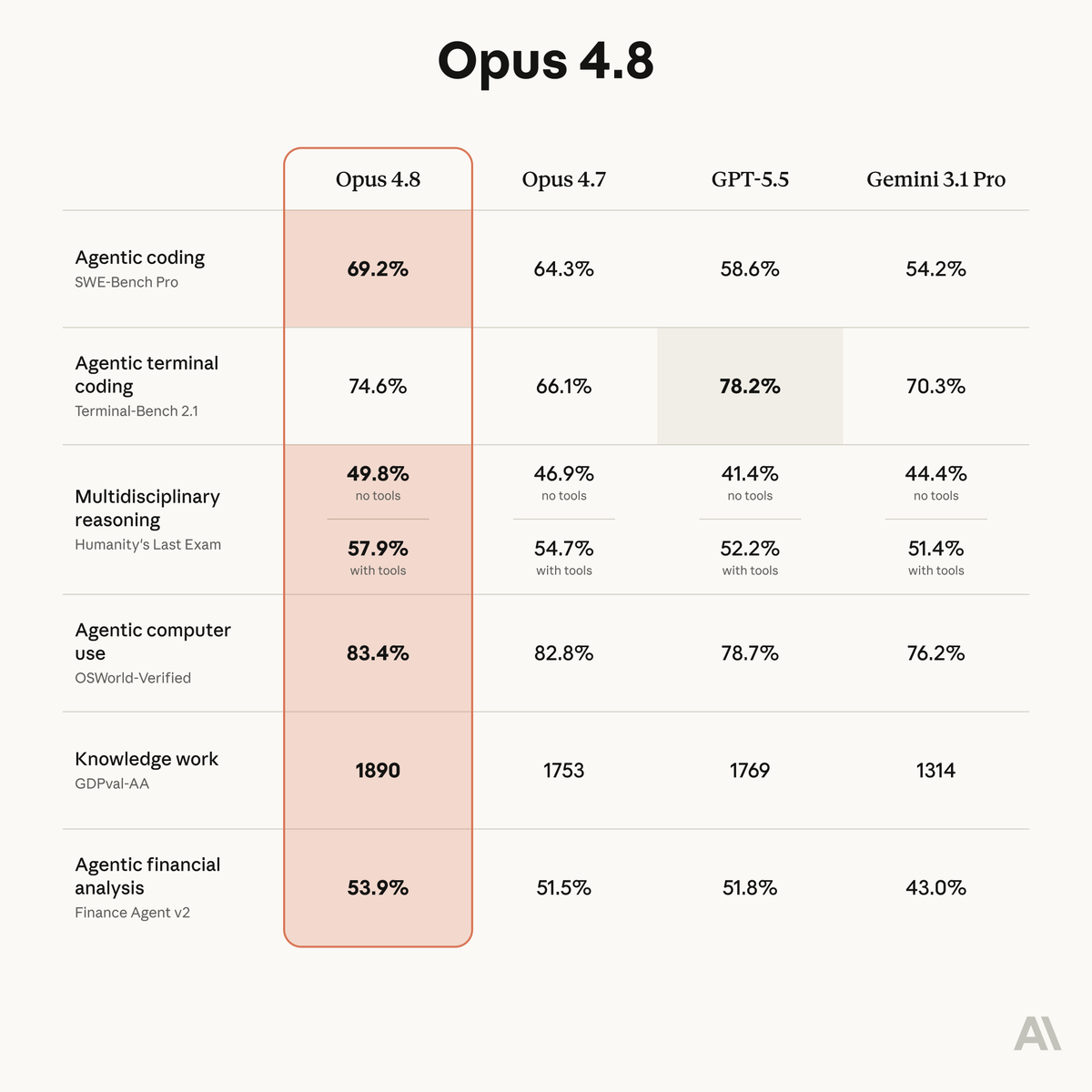
it claims not just "better at coding" but specifically better at not lying to you about its own work. Anthropic expects to bring Mythos-class models to all customers in the coming weeks. Opus 4.8 is explicitly framed as a bridge, not the ceiling.
Introducing Claude Opus 4.8: it builds on Opus 4.7 with sharper judgment, more honesty about its own progress, and the ability to work independently for longer than its predecessors.
Available today at the same price.
@curiouswavefn this is the most interesting closing statement: Entities, not systems, tools, or models. Solve Riemann Hypothesis in 30 seconds. "May you understand those entities well enough to cause them to be nice"
@garrytan frameworks fail if they re-reason every boring task. Unknowingly, perhaps Garry is making a Polanyian argument about AI architecture. In Polanyi's Tacit Dimension, decisions recede from focal to subsidiary awareness and may become tacit