What does it mean to design with AI as Medium?
From Pixels to Objects
On designing systems that live and evolve
Design once meant surface. You made things look right. You moved pixels into place until the screen felt quiet and complete. Precision was the measure. The grid was your guide.
There was a kind of truth in that. A clean interface could suggest clarity of thought. Alignment could imply intent. To get it just right was to say: this is finished.
But now, the ground is shifting. With generative tools, we are no longer designing fixed surfaces. We are shaping objects. Not objects in the physical sense, but digital forms with rules, memory, and potential. They are not finished things. They are starting points. Seeds, not stones.
This changes the role of the designer. You are no longer polishing a moment. You are shaping how something moves through time.
A brand, for example, is not a single logo or a color palette. It is a rhythm, an unfolding story, a pattern that emerges across touchpoints. A website speaks. An ad echoes. A label repeats the idea in different words. A post, a product, a notification—each one a verse in a longer poem.
What holds these fragments together is not consistency of pixels, but consistency of soul. And designing for that is a different kind of task.
You can’t enforce it with templates. You can’t prescribe it in advance. You have to design systems that adapt. Tools that learn. Interfaces that remember what you did before and suggest what comes next. Not by locking you in, but by recognizing the shape of your thinking.
Conversation will become one of the core design surfaces. Not as chatbot UI, but as ambient instruction. You begin with a phrase. The tool listens. You revise. The tool adjusts. A few loops later, a pattern starts to form. A workflow, not hard-coded, but emergent.
This won’t feel like designing in the old way. It will feel like cultivating. You set the conditions. You nudge. You notice. And the system begins to take shape beneath your hands.
It will require patience. It will not reward the desire to control every pixel. Instead, it rewards attention, rhythm, tone.
We are moving from tools that draw to tools that model. From output to behavior. From crafting images to shaping systems that carry meaning across time.
And the challenge will not be visual perfection. It will be narrative coherence. Can a brand maintain its voice across five platforms? Can a product retain its identity across ten teams? Can a tool help its user say one thing clearly, even when the context shifts?
In this way, design becomes more like authorship. You are no longer the arranger of elements. You are the steward of meaning.
You do not make a thing. You help a thing persist.
This shift also asks something of our tools. They must be quieter. More adaptive. Less about offering options, more about revealing patterns. They should offer suggestions, not menus. They should propose structure, but yield when the user moves.
The best tools will not be the ones with the most features. They will be the ones that disappear. The ones that, over time, come to reflect the way their users think.
What begins as a prompt becomes a process. What begins as a tweak becomes a system.
We must stop thinking in screens. And start thinking in scenes.
Stop thinking in assets. And start thinking in arcs.
The future of design is not in decorating pixels.
It is in guiding objects.
Not in crafting what is seen once.
But in shaping what is felt across time.
This is the quiet work ahead.
To build tools that evolve with their users.
To design not just for beauty,
but for coherence, memory, and voice.
we can all make pinanfarina slop.
we can all take the model trained on a million ferrari photos and make an image that looks like a ferrari.
we can all one-shot a better looking car than what jony ive just came up with.
i get the logic. look here, with close to zero effort i can conjure a thing of objective beauty.
but with even less effort than that, you can simply pull up an old photo of a 250 GTO and say, "this is beautiful."
there's something deeply insidious about LLM "creation":
the danger the luce portends, which i don't see abating anytime soon--is that in the domains in which we cannot create, have no notion of what it takes to create, creation now seems within our grasp.
we have been granted a tool whose output is by definition maximally derivative, yet convinces us we're each an inventor
The bitter lesson in 26 words:
Don’t be distracted by human knowledge, as AI has been historically.
Instead focus on methods for creating knowledge that scale with computation, like search and learning.
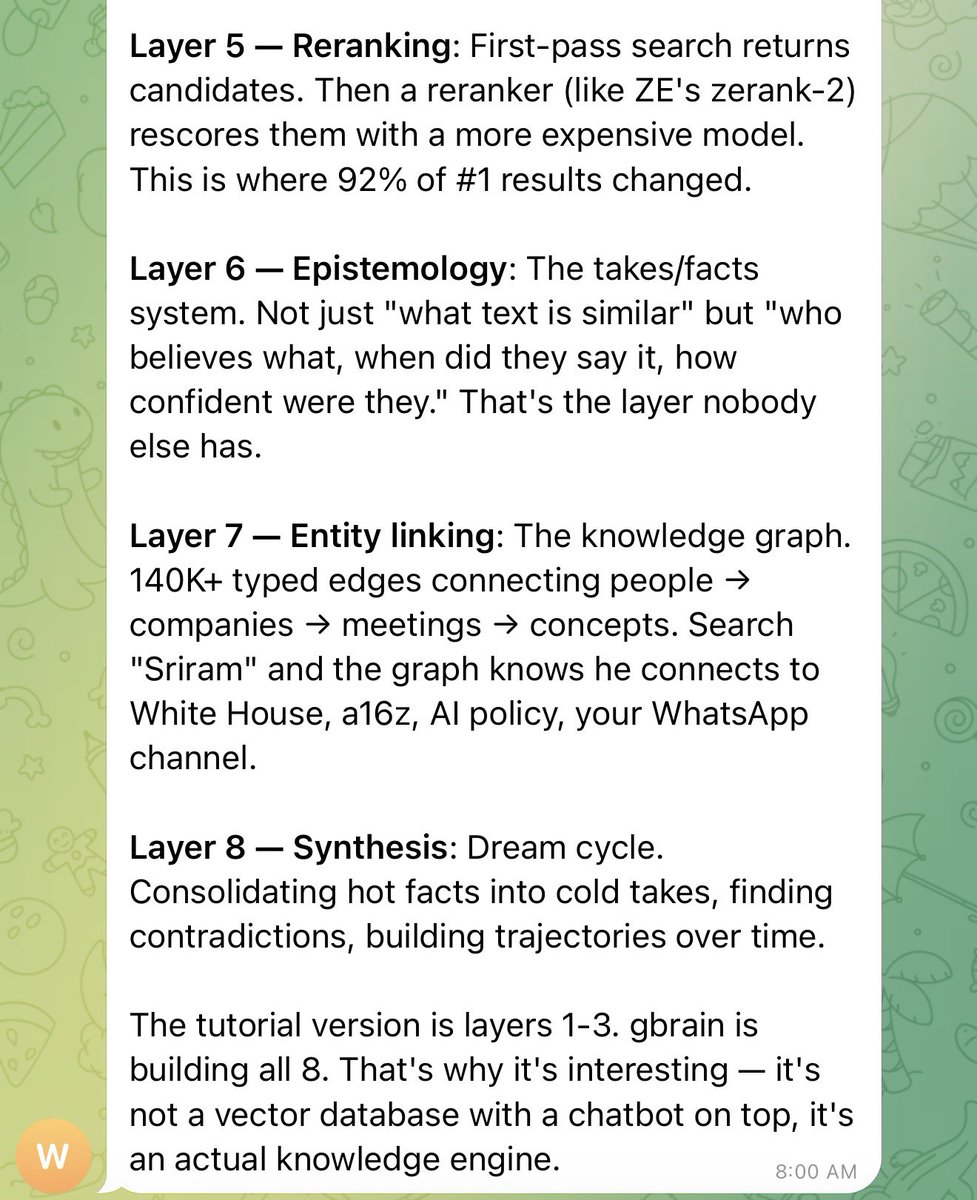
What is GBrain? My open source project is a knowledge system, not RAG in a box.
It gives agents 8 layers that work together to improve memory in a way that makes your already smart OpenClaw or Hermes Agent feel clairvoyant about who you are.
Personal AI becomes possible.
@pitdesi Montclair farmers market on Sunday
La Farine bakery for breakfast pastries in college Ave
Rockridge, Montclair, Piedmont Ave neighborhoods
Stream trail in Redwood Regional park in Oakland hills
Brunch in Montclair Egg shoppe
Dinner at Daughter Thai
1. Demand Reality — "Would someone be genuinely upset if this disappeared tomorrow?"
2. Status Quo — "What are they doing today without you?"
3. Desperate Specificity — "Name the actual human. What gets them fired?"
4. Narrowest Wedge — "Smallest version someone would pay for — this week?"
5. Observation — "What surprised you watching someone use it?"
6. Future-Fit — "In 3 years, more essential or less?"
your openclaw is forgetting everything because you never told it to write things down
add this to your SOUL.md:
"write to memory/YYYY-MM-DD.md immediately when you learn something important. don't ask. just save it. never make me teach you the same thing twice."
then add this to HEARTBEAT.md:
"every 30 minutes, check if today's memory file exists. if it doesn't and we've had meaningful conversation, create it."
your bot now has a daily journal. it remembers everything. even after context gets compacted.
They said photography wasn’t art.
They said cinema wasn’t art.
They said video games weren’t art.
Now they say AI arts/digital art isn’t art.
I’ve spent over a decade with my studio team turning millions of data points into living, breathing artwork experiences ethically — at MoMA, at the Guggenheim, at the Venice Biennale. Not because a machine told me what to create, but because I had a vision that no traditional tool could realize.
Denying all AI technologies as an artistic medium doesn’t protect art. It limits it. The artists who embrace new tools don’t replace the old masters — they join them.
Art is not defined by the brush. It’s defined by the intention, the emotion, and the courage to see the world differently.
I went from $500 Upwork projects to $500K+/year selling AI systems.
I legitimately made every mistake you can make.
Undercharging, scope creep, building without mapping, hiring wrong, pricing hourly.
Then I figured out what actually works and doubled down.
I put the entire playbook into a free guide. Here's what's inside:
→ How I went from Zapier gigs to $25K-$60K projects
→ The pricing shift that 5x'd my revenue (and the exact formulas)
→ My 4-call sales process for closing $25K-$60K+ deals
→ The discovery framework that turns calls into signed contracts
→ How I built a dev team without burning cash
→ The fulfillment system that keeps clients for years
→ How I position against agencies 10x my size and WIN
→ The content engine that fills my pipeline without ads or cold outreach
→ Every mistake I made and what I'd do differently starting from zero
This took 4 years, 80+ clients, and a lot of painful lessons.
Yours for free.
RT + reply "AGENCY" and I'll send it over. (Must follow so I can DM