Aizah Azam and I penned down our analysis of the clandestine culture of intellectual appropriation in the Pakistani social sciences academia, and the epistemological decay that these practices signify, through a case study of a 'Star Professor'.
Read 👇
https://t.co/5jjibebT08
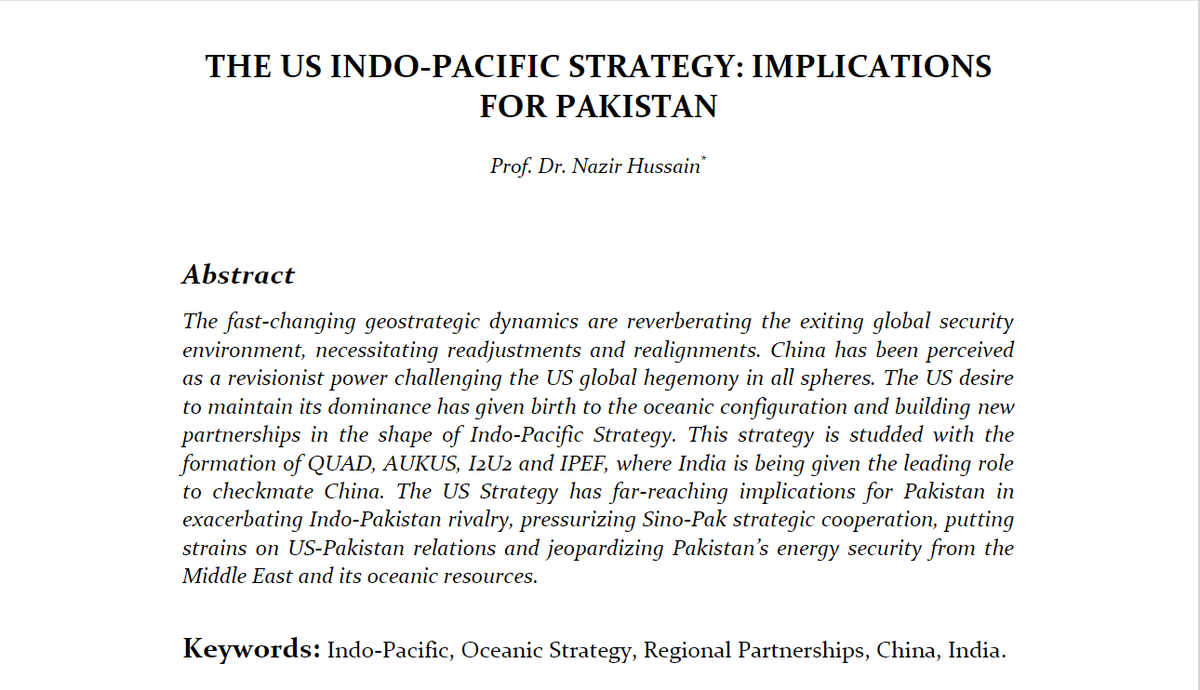
Just after we submitted our piece on academic theft and plagiarism in Pakistan's higher education, I came across a similar case studying the Indo-Pacific.
Right: Reema Shaukat’s article.
Left: Prof. Nazir Hussain’s paper in an NDU journal.
The parallels are striking!
This insightful observation by @ArsimTariq underscores the need for critical media literacy, as it highlights a discernible pattern of bias against Palestinians, particularly within Western media outlets, with a notable focus on the United States.
@ArsimTariq argues that careful textual analysis of news reports and analysis reveal an unequivocal exposition of discernible biases against Palestinians in the Western media, notably, but not exclusively, in the United States.
Read more at
https://t.co/sGOOzH2hlL
Thank you, @TalhaIbr, for inviting me to represent @RoadsInitiative and for arranging this brilliant discussion. It was so refreshing to see a lot of critical perspectives and meet like-minded researchers.
The decision to increase 60% hostel fees at Kinnaird College has caused students to protest. The abrupt fee increase from 90k to 150k is seen as unfair but the authorities are not giving any satisfactory response.
#KinnairdHostelFeeHike#FeeHike
Disciplinary Gangs 2.0: Authorial Theft
Are you familiar with the authorship of this article? Who wrote it? Of course, my name on it is a clear indication that I, Arsim Tariq, wrote this article. Is it important to you that I wrote this piece? (1/n)
https://t.co/fyioEeQC5A
In this article, I argue that unlike mainstream approaches of IR, Gramscian scholars provide alternative accounts on hegemony that underscore the role of class alliances, power and consent, and elite-driven ideologies in the forging of hegemonic relationships and discourses.
The ruling class secures the consent of the subordinate classes through the dissemination of its own ideology and values, leading to the establishment of a dominant hegemonic discourse.
@ArsimTariq writes: https://t.co/mQkhm9PDbN
We sat down with Senator Mushtaq Ahmad Khan to discuss political instability in Pakistan. He expressed some interesting and bold opinions on the topic. He believes that new Administrative Units should be established.
Watch the full interview here: https://t.co/X43xyUbMPE
Delighted to be a part of this interesting cohort. I'll be in the committee discussing Pakistan's identity and how it is temporally constructed.
Looking forward to meeting like-minded scholars!
#YRC2023
Happy to see my review of the book ‘Political Conflict in Pakistan’ by Muhammad Waseem in @IAJournal_CH. Thank you @mariana_vieir1 for being such a wonderful editor. Congrats to the Guest editors on this special issue @AyseZarakol . Its open access : https://t.co/FnMVGzBQhv
Politics does not merely encompass the actions of legislative assemblies, electoral contests, and the other formal trappings of a modem government. To speak of violence in the political process is to speak of the political process. Funny how leftists are peaceful all of a sudden.