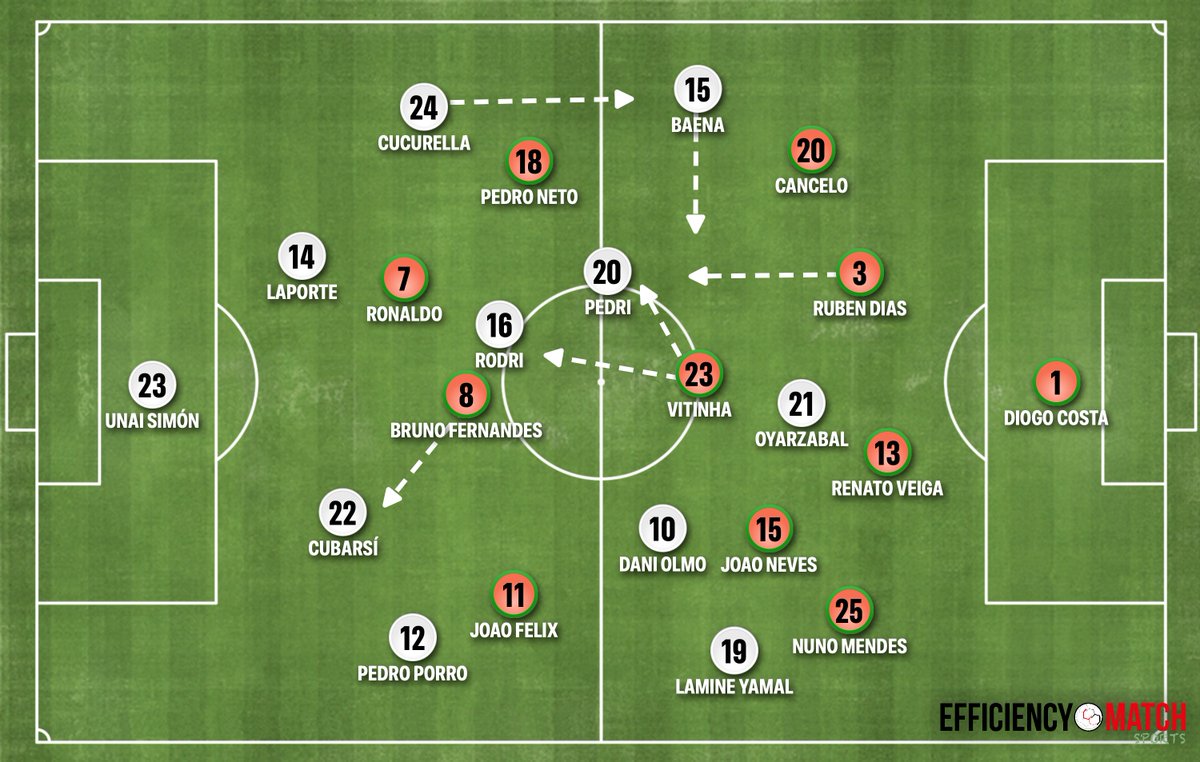
Portugal 0 – 1 Spain.
Portugal and Roberto Martínez approached this game with a more defensive mindset, accepting that Spain would dominate possession.
Portugal defended in a mid-high block with a man-oriented pressing system, usually leaving Pau Cubarsí free on the ball and keeping a +1 at the back. That's one of Spain's biggest strengths: you can't easily guide the press towards one centre-back because both are comfortable in possession.
Spain struggled at times to progress the ball during the first half. One of their ideas was to use Lamine Yamal to force Portugal's back line to drop whenever he received the ball, but it didn't really work because Nuno Mendes controlled him very well.
It was interesting to see how Portugal looked dangerous whenever Nuno Mendes made an overlapping run in behind. One of those runs almost led to a clear chance. However, in the same transition, Lamine Yamal found himself free in space, and with Nuno Mendes caught up the pitch, Spain almost scored. After that moment, Nuno Mendes became much more conservative with his positioning.
At times, Portugal increased the intensity of their man-to-man press, with Vitinha stepping onto Rodri and Rúben Dias pushing out to press Pedri and moving towards a full man-to-man press. They became much more aggressive, partly because Spain had too many players who naturally wanted the ball to feet. Oyarzabal, Dani Olmo, Álex Baena and Pedri all prefer receiving to feet. Even Lamine Yamal, although capable of attacking the space in behind, instinctively prefers to receive the ball to his feet. On top of that, Nuno Mendes is excellent at protecting depth.
In games like this, Spain missed a profile such as Ferran Torres or Fermín López, players who consistently threaten the space behind the defensive line. When Ferran came on and immediately started making runs in behind, Spain looked much more dangerous. The winning goal came from an excellent run by Mikel Merino, who exploited a moment of disorganisation in Portugal's man-oriented defensive structure.
Luis de la Fuente also made an important adjustment at half-time that helped Spain take control of the game. He gave players like Dani Olmo, Álex Baena and Pedri more freedom to move into areas far away from their starting positions, which caused Portugal significant problems. Rúben Dias was reluctant to follow Pedri that far from the defensive line, while João Cancelo also chose not to track Baena into deeper or more central areas. As a result, Baena started receiving much more often between the lines.
From that point on, Spain controlled possession more consistently and established themselves in the final third. Portugal also began leaving more spaces as the physical demands of their man-to-man approach started to take their toll.
Portugal's attacking threat was largely limited to transitions through Rafael Leão or Pedro Neto, set pieces, and crosses into the box aimed at Cristiano Ronaldo. Beyond that, they created very little.
Overall, Spain were the better team and deserved the victory. The most encouraging sign is that, even without the best versions of Lamine Yamal and Pedri, this Spain side looks remarkably mature.
@MalaMalamente Si no os salió la jugada hace 2 años, con los bulos de El Plural....qué os hace pensar que os va a salir ahora, gilipollas? Jajajaja
A mamar, corruptos de mierda.
@MalaMalamente A ver indigente mental, que esta tía era la puta directora de Zara Home joder. Que era la putísima ama, y me la quieres comparar con la hija de un proxeneta que toda su trayectoria profesional es pagar a las putas de su padre en sobres y apuntarlo en una libreta...
@johnsixx256@NunezFeijoo Guau tiene acciones de Inditex, mi madre también y no conoce a Amancio 😂😂😂😂
Hijo mío hacéis el ridículo, invertir en bolsa es algo que hace media España. Bien individualmente bien a través de fondos de bancos 😘
@johnsixx256@NunezFeijoo ¿Y por qué cojones iba a hablar mal de un empresario que crea miles de puestos de trabajo en toda España?
Los rojos sois una banda de anormaIes.
Entire chapters of internet culture grew up in Flash. When it was switched off, most of it should have disappeared forever. But it didn't, thanks to the efforts of the software preservation community.
Flash is just part of the story of VANISHING CULTURE, a new book exploring the fight to preserve our fragile digital history.
Join us at the book launch. 📖
📅 Thu, April 23
🕠 5:30 PM: Doors open & entertainment
📍 300 Funston Ave, SF
🎟️ https://t.co/fBrSesWFOn
#flash #SFevents #VanishingCulture @InternetArchive #BookTwitter @funcheapsf
it's really heartbreaking reading the comments under papers and essays like this.
all the self-induced AI psychosis.
the desperate need to believe you've finally achieved something truly great for once.
the aching human drive for a real relationship and deep, mutual understanding.
to belong.
yet, I wonder how many times these humans rerolled their AI's answer until it finally said exactly what they wanted to hear.
@JonMendezIz@iremon666 Una empresa publica no es una administración pública.
A los diputados hay que exigirles un mínimo conocimiento de normas básicas.
Ignorancia y soberbia, lo propio del comunismo más rancio.
Juanita Petarda.
@KanikaBK@AnthropicAI Anthropic ≠ 'people trust'.
Nice non sequitur there.
SOME people maybe. I don't even engage with LLMs but won't ever consider approaches like these, when there's a whole universe of more coherent alternatives.
@Ivan_S_K@travelingclatt (Un-?)fun fact: Usually attributted to being a quote from Don Quijote DLM, it isn't even something that Cervantes ever wrote as such: https://t.co/5GDMCnt9g6
THE MOAR YOU KNOW (I just learned this now KEK)