We have a new paper from a multi-year, multi-disciplinary effort lead by @PrincetonSPIA, @UCBerkeley, and @rff out in @Nature that estimates the Social Cost of Carbon (SCC) as $185, more than 3x larger than current U.S. federal estimate.
Read the paper: https://t.co/LgrUAGZteR
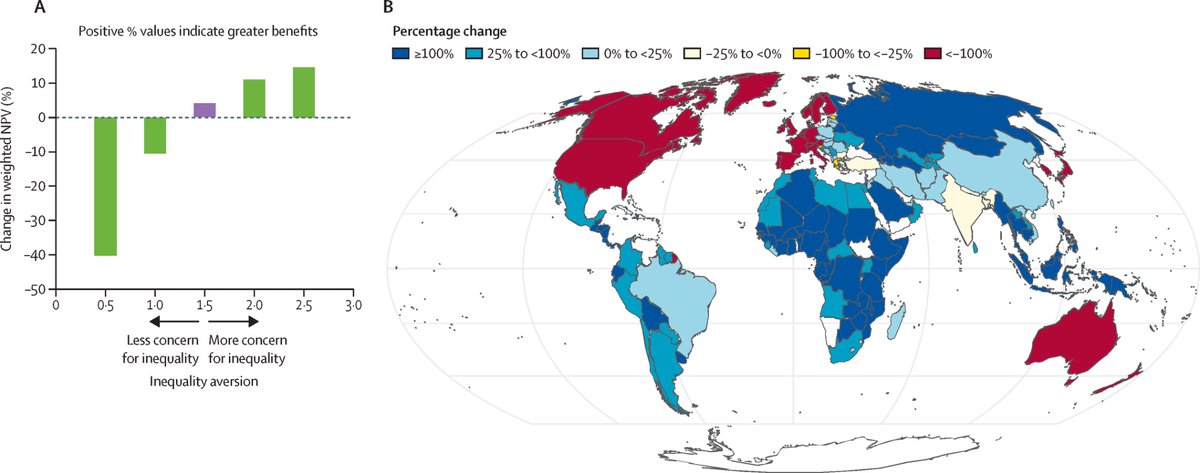
The least-cost climate mitigation scenario is not always the one that maximises global wellbeing. When benefits to lower-income countries are given greater weight, the preferred mitigation scenario shifts from least-cost to an equitable allocation of mitigation effort.
New(ish) paper out in Lancet Planetary Health. TLDR: Limiting warming to 2°C could avoid ~13.5 million premature air pollution deaths by 2050. More equitable burden sharing lowers costs for LMICs but shifts some near-term health benefits away from them.
https://t.co/35CXrb6Uxw
The intuition behind this: an extra $ contributes less to your wellbeing as you get richer. Income (or equity) weighting captures this by placing greater weight on climate impacts affecting the poor. Since these impacts & global incomes are highly unequal, we get a higher SC-CO2.
We have a paper out in @ScienceMagazine today showing how new guidelines allowing for income weighting in federal cost-benefit analysis would affect the social cost of carbon. Main takeaway, the SC-CO2 increases nearly 8x to ~$1300/ton. @rff@ERGBerkeley
https://t.co/iL15hhmW8x
🆕 New article in the Winter 2024 volume of @ReepAere:
"Inequality Aversion for Climate Policy" by Stellio Del Campo (@StDelCampo), David Anthoff (@davidanthoff), and Ulrike Kornek
Read it here (open access!): https://t.co/LLHOtXFmF3
Registrations to become a GAIN mentor are now open!
GAIN mentors are assigned to help guide a mentee one-on-one through the entire graduate application cycle in economics or related fields.
➡️ Register here: https://t.co/wBoXQTYGtx
🗓️ Deadline: April 21st
Please share widely!
How to better represent institutions in sustainability models?
Check our new @PNASNews paper that compares:
- integrated assessment model (led by me)
- engineering-economic optimization (@east_winds )
- agent-based model (@TanjaFilatova)
A thread:
https://t.co/3pN9OaU3uf
🚨 New publication 🚨 "Inequality Aversion for Climate Policy," w. @davidanthoff and U. Kornek in the @ReepAere! 📰 We review & synthesize estimates of inequality aversion for climate modeling.
@MCC_Berlin@uni_lu@UCBerkeley@kieluni https://t.co/1Ps3e4Zwql
New publication alert!📜 Racial/ethnic and socioeconomic characteristics influenced counties’ changes in air pollution emissions in the 40 years following the Clean Air Act.
@NatureComms@ColumbiaMSPH
https://t.co/37iPOfgX25
How can justice considerations be more fully incorporated into climate scenarios? See our new publication on a novel framework enabling a more holistic and multidimensional investigation of justice - https://t.co/kVvowsajuY
What unfolds when ecosystems shift across national borders due to climate change?
Thrilled to share our latest paper in @nature, which delves into the consequences of these climate-driven biome migrations on human well-being.
https://t.co/3WiRisNCoL
A thread 🧵