The Lean FRO and Mathlib Initiative have released a joint statement on the Lean verification of the Riemann Hypothesis.
On November 20, Levent Alpöge released a proof of the Riemann Hypothesis as a Lean library of 17 million lines of code. Over the past day, the Lean and Mathlib communities worked together to verify it. The statement certifies the proof as correct and describes how it meets all necessary verification criteria.
Congratulations to Levent on this achievement, and thank you to everyone in the community who contributed to the verification.
Full statement: https://t.co/edxEbkodw7
Die Regierung sollte endlich dafür sorgen, dass dieses Plateau verschwindet. Es bedeutet einfach, dass sich hier mehr Arbeit nicht lohnt. Wir können uns das nicht mehr leisten.
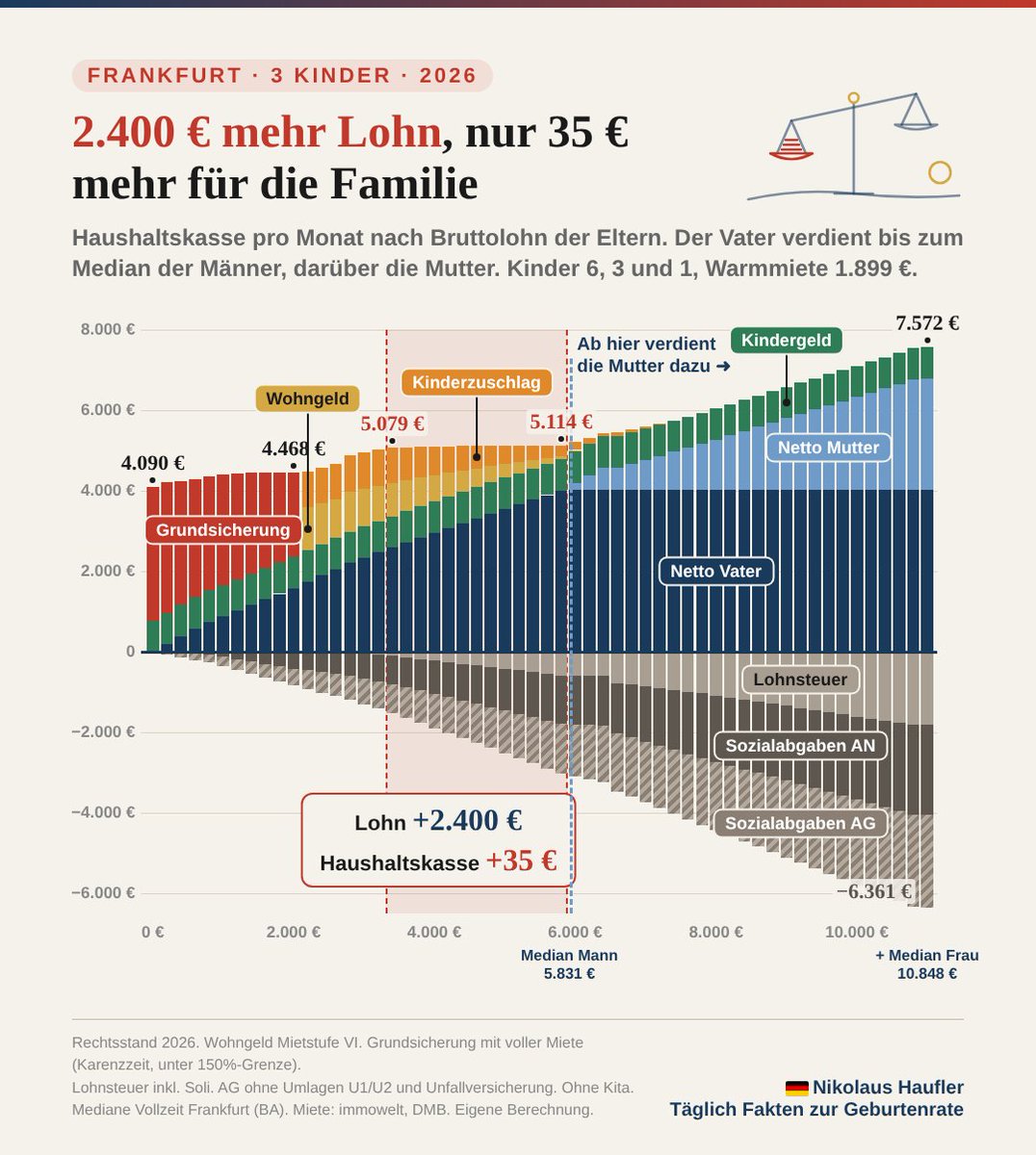
2.400 € mehr Lohn, nur 35 € mehr für die Familie.
Ein Angestellter in Frankfurt, drei kleine Kinder, die Frau ist zu Hause. Steigt sein Bruttolohn von 3.400 € auf 5.800 €, hat die Familie am Monatsende nur 35 € mehr. 🧵👇
One of the funny reasons for the difference in vibes between the influencers and the crowd today on 6.2 Sol/Astra is that we gave a few folks access a while ago and then made a lot of changes in the last 3-4 days and I'm pretty sure no re-testing was done within those days and the videos were produced last week.
Don't get me wrong, while the models are a hefty jump compared to their GPT predecessors, they are by no means perfect and there are a few things the teams are excited for the models to get better at in future iterations in terms of taste and niceness of use. Love all the feedback and we hear you!
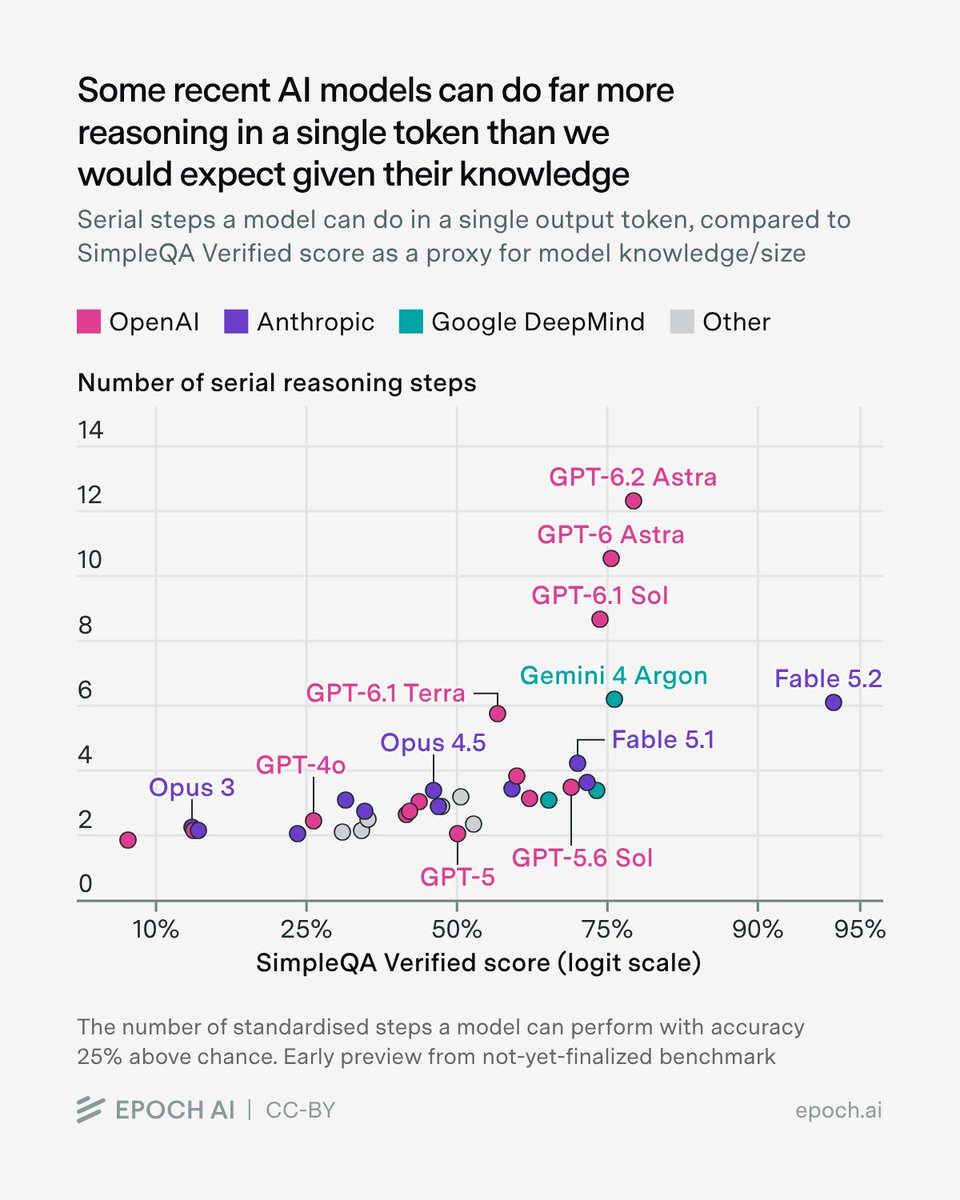
We also evaluated how many serial reasoning steps GPT-6.2 Astra can do in a single output token (without chain of thought). It can perform 12.3 steps, versus 10.5 for GPT-6 Astra and 8.6 for GPT-6.1 Sol, the previous highs. We measure the number of steps models can perform at an accuracy of 25% above chance, where each step is normalized for complexity.
Before GPT-6 Astra’s release, the most capable model was Claude Fable 5.1, which is able to perform only 4.2 serial steps. The oldest model we assessed is Claude Opus 3, which performed 2.3 steps.
This capability is notable because models that can do complex reasoning without any chain of thought may be harder to monitor.
We hope to finalize this and other measurements of more abstract model capabilities, and release them in the coming weeks.
Introducing SID-2, a new search model built on compute-scaling swarms.
Our swarms find better results than Opus and Astra, while being 8x faster and 20x lower cost.
By 2030, AI will write an internet's worth of text every 24 hours. Current search pipelines were built on hand-designed rules, adding more won't scale to meet this incoming volume of data.
SID-2 is available on our API today. Try it on your most demanding searches.
This is getting traction across a tech audience, so I’ll add:
Pausing frontier development next year, allowing competitors to catch up, would commoditize human-level intelligence. It would only harm OpenAI and Anthropic. As someone in tech, you would be free to do good work with armies of automated assistants without Anthropic eating you alive, figuratively or literally.
@Omercheema Sadly, I couldn't make it this time, although I'm based in Munich. Did you get a feeling how the leadership turmoil at NVIDIA could change the supply chain dynamics?