I see index rebal is in the news again. One question we've covered both sides of over the years:
Do the profits come at the expense of index investors?
Thread 🧵👇
We only write 1-2 primers a year because we want them to be durable. It’s simple to publish something market relevant for 6 months, but our goal is a piece you can return to years later and still derive value.
Our Robotics primer meets that standard.
https://t.co/qPSAXaLgYN
NEW: Earlier this year, an obscure startup in Texas announced that it had received at least $100 mil from one of the richest men in Asia.
We dug into the backstory. We discovered a saga involving Donald Trump Jr., Russian oil, and an Indian billionaire family’s private zoo.
“Value investing with legends” is a great finance-specific podcast with a mix of celebrities and dedicated professionals. Here are some of my favorite episodes.
Kent Daniel: from physics to finance
https://t.co/gF4zywCWyd
Cliff Asness: quant investing, inefficiencies, being Cliff
https://t.co/SK0hGGKUHR
Nicolai Tangen: intuition, fundamental investing
https://t.co/YfTLwEAAxe
Michael Mauboussin: biases (and also learning from a master financial communicator)
https://t.co/ZKppJsGxok
12 of the most powerful capitalists on Earth flew to Beijing today with the US president as their chaperone
To beg the Chairman of the Communist Party of China for deals
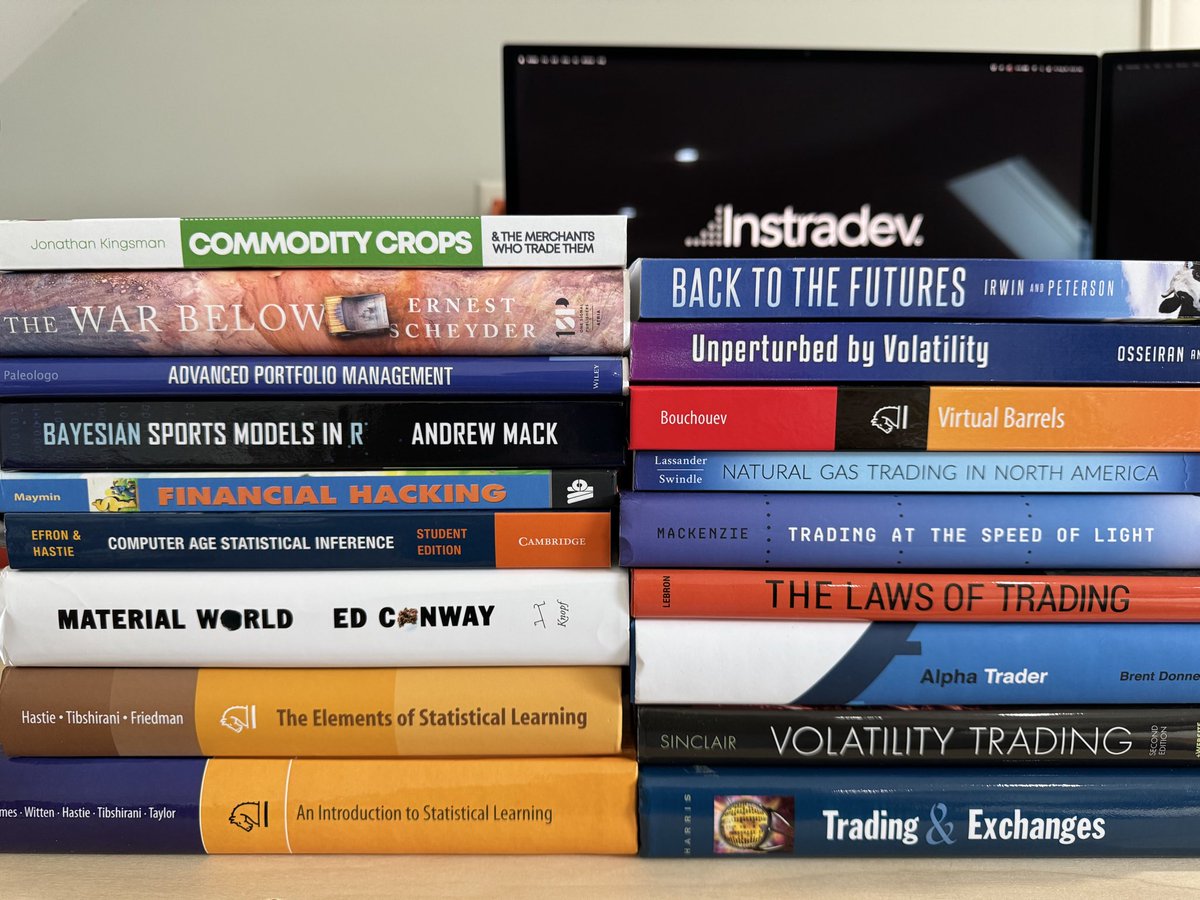
Here is a list of more recent (and recently purchased by me) books that were highly recommended by respected members of the trading community. I’ve not read them all yet, unfortunately, but will post about the relative merits of each as I work through them. The list:
Commodity Crops
The War Below
Advanced Portfolio Management & Elements of Quantitative Investing by @__paleologo
Bayesian Sports Models in R by @Gingfacekillah
Financial Hacking
Computer Age Statistical Inference
Material World by @EdConwaySky
The Elements of Statistical Learning
An Introduction to Statistical Learning
Back to the Futures by @ScottIrwinUI
Unperturbed by Volatility
Virtual Barrels by @IliaBouchouev
Natural Gas Trading in North America
Trading at the Speed of Light
The Laws of Trading by @AgustinLebron3
Alpha Trader by @donnelly_brent
Volatility Trading by @SinclairEuan
Trading & Exchanges
It is not inevitable that India be poor. Its people are certainly capable of being extremely productive. Indian immigrants to the United States and elsewhere have been very successful. India’s government has been stable since independence, and largely democratic throughout. While their growth rate has picked up, they have not had the booming success of China. India was socialist for a long time; but then, so was China. Why isn’t India a developed country yet?
To suggest a monocausal explanation would be an exercise in arrogance. India has many problems, and there is no one simple trick to growth. Nevertheless, I hold that much of India’s stagnation is due to its judicial system. Its slowness and inefficiency has far reaching consequences, making it impossible to efficiently run a business.
The facts are simple. There are at least 50 million cases pending — nobody knows how many for sure. The Supreme Court has 69,000 piled up, waiting for resolution. Of these, 18,000 have been pending for more than thirty years. Every family has a horror story. I have a friend whose dad, near the beginning of his career, was named in a suit involving a bank. Growing up, every few years his dad would be called to appear in court. My friend is 40 now. His dad has retired. The suit remains ongoing.
The Indian government estimated that, at current capacity, it would take 324 years to clear all of the cases. That was in 2018. Since then the number of pending cases has doubled. India has one of the lowest ratios of judges to population in the world, with 21 judges for every million people. Surprisingly, this is an improvement over the past — in 2002 the ratio was 10 for every million. The EU average is 200 per million, and the US 150 per million. One reads with grim amusement concern that a low number of judges — say, 100 per million — will endanger the rule of law in Ireland or Denmark. If that is what it takes to endanger, then rule of law in India is positively extinct.
Nobody knows the average time it takes a court case to be resolved for sure, but it is somewhere around five years for it to be resolved by the high courts (the second tier of courts) and 13 years for the Supreme Court. 40,000 new civil suits are filed every day, covering everything from land disputes to layoffs to bankruptcy. 66% of all pending civil cases involve claims and counterclaims over who owns what land. The upshot of this is that firms cannot resolve disputes through the courts. They must instead turn to extrajudicial methods, and the most common of them is keeping the business in the family.
In the late 2000s a team of researchers – Bloom, Eifert, Mahajan, McKenzie, and Roberts – conducted a randomized controlled trial on management quality in Indian textile mills. Prior work by Bloom and Van Reenen had shown that family run firms in the West, in particular those run by an eldest son, were poorly run compared to professionalized businesses. We would not be able to tell in India, however. Of the 126 firms they surveyed — a comprehensive census of the firms in the towns near in and around Mumbai — every single one of them was family run. The single strongest predictor of firm size was not productivity, revenue, or profitability. It was simply the number of male family members in the family. These are not simple mom-and-pop shops either, with but a few employees. As Bloom et al write, “These firms are also complex organizations, with a median of two plants per firm (plus a head office in Mumbai) and four reporting levels from the shop floor to the managing director. In all the firms, the managing director was the largest shareholder, and all directors were family members. Two firms were publicly quoted on the Mumbai Stock Exchange, although more than 50% of the equity in each was held by the managing family.” (p. 9)
The experiment by Bloom et al was to test how much management mattered by randomly assigning some firms to receive management training. They found that a firm receiving the management training increased their annual profits by 17%, or almost $300,000 a year. Since these are extremely simple interventions — things such as “write down what types of yarn you have and how much” and “have a schedule for repairing machines”, one wonders why the companies never adopted them on their own.
You can read the rest here: https://t.co/J1TQsQ2Kn2
The difference in Strait activity from when #3 first arrived / began observing the strait about 4-5 days ago to today is stark. Traffic has meaningfully picked up - there are still “dark” runs and ships transiting without AIS turned on, but there’s a lot more going along the coast of Oman. At least 15 ships have crossed, including at least 3 VLCCs.
When we arrived, virtually none were going through. Then a trickle through the Qeshm channel. It’s meaningful now, could be talking low double digit percent of pre-conflict volume. Meanwhile, expectations for a US operation involving “boots on the ground” within the next week or two are still high among locals.
When analyst #3 first got to the strait we were hopeful we’d get a clear cut answer - bullish or bearish, open or closed, war or deal. It soon became clear that was the wrong framework through which to view this trip. On the same day that we learned it was the broad expectation of nearly everyone in the region - from locals to informed parties - that US ground troops would be launching an operation (“boots on the ground!”), we also observed multiple ships beginning to cross the strait. Soon they weren’t just limited to the Qeshm channel.
It is clear to us that this isn’t as much a story in isolation as it is a story about the multipolar world and how it’s rapidly changing from what we’re used to. It’s a story about parallel warfare and diplomacy, US promises for the “Stone Age” in tandem with Allies’ seeking new venues for negotiation, and the changing global climate that necessitates this balance.
Before, it would have been unlikely to imagine a world where Japan, the EU and other US allies were negotiating with a country the US is directly in conflict in to secure passage and work on agreements while the US still maintained footing for an escalation of kinetic warfare. Now, that’s simply how the world works. These countries must deal with the issues imposed, as the US won’t be sorting it out on their behalf.
It’s undeniable the world is very different now and viewing this conflict through the lens of the past 50 years is a flawed approach. On Sunday, we will release our report that covers in depth what we’ve learned, how complex the situation is and what investment implications and nuances exist that have longer term implications than the next 100 points on SPX.
In Franz Kafka’s letter to his father, he wrote “I know it is my father's first time on this Earth, too. And I know He had it worse when he was little. But I was little too”
I love my life!! I am having the coolest time, I am having so much fun. I am enjoying every second of it. I barely do anything I don’t really wanna do. It’s phenomenal. Little kid me could not have conceived of me now. Completely unrecognizable.
Larry Wasserman blogged for a short period of time about statistics. The blog has the highest signal-to-noise ratio of all quantitative data science blogs (Ben Recht comes close). Inactive since 2013. Has not aged.
https://t.co/oNvUnLa3cv
So, I don’t know how these trade come Monday but the play certainly has gotten more interesting. We’ve removed the paywall from our more in-depth exploration of the VENZ bond opportunity sent to institutional clients on December 2nd.
It’s a good read:
https://t.co/8kvnKRUoaT
I got a lot of messages regarding materials for perpetual swaps (and CFD). Let's focus more on perps and what to do and read to better understand this instrument.
I provide you with articles, exercises and plan to work on perpetual swaps. 🧵
What books would you recommend for a smart high school senior who wants a basic introduction to:
1) fundamental investing (yeah, yeah, I know)
2) trend following
3) stat arb