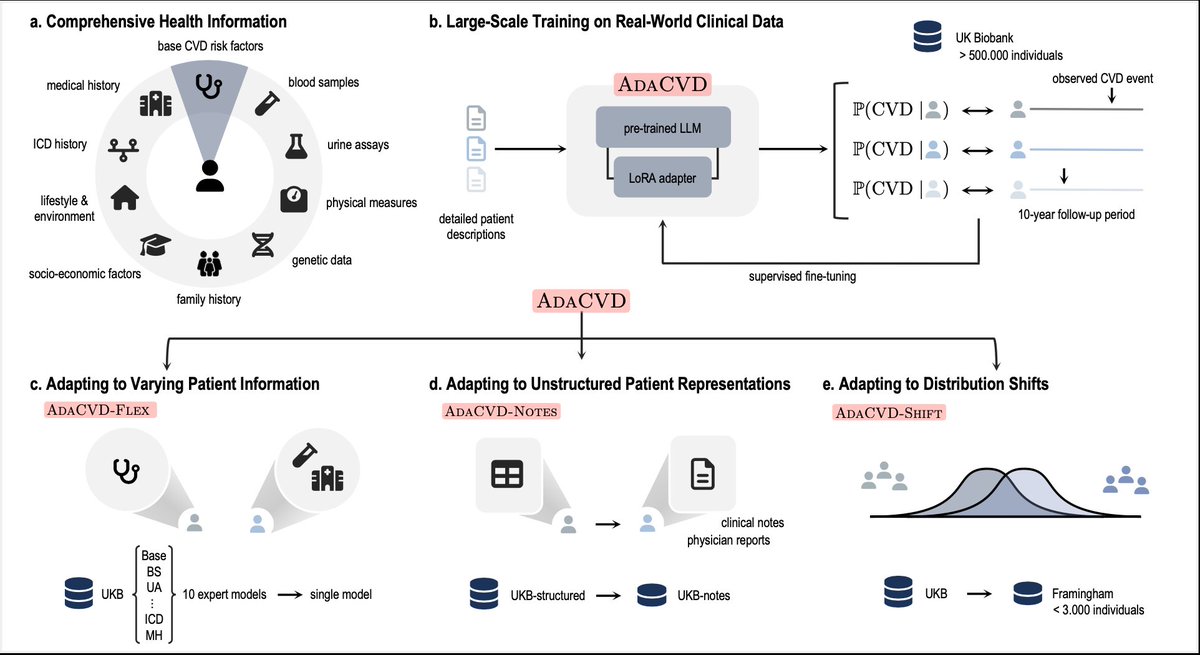
Clinical notes are messy, inconsistent, and unstructured—yet they hold some of the most valuable signals in real-world clinical practice.
Join us today at ICML at the Foundation Models for Structured Data workshop to see how we can make sense of these notes!
📍 West Ballroom D
Easily one of the biggest and most fascinating projects I’ve ever worked on—huge thanks to @schwabpa and the whole team for having me and the opportunity to collaborate during my time @GSK. Check out all the details in this summary!
Preprint: https://t.co/6DAJW2RWDu
Understanding human biology across scales - from molecules to cells to entire organisms - remains one of biomedicine's greatest challenges in the fight against disease.
Today, we are announcing Phenformer - a multi-scale genetic language model that learns to read and interpret human genomes by connecting DNA, cell and tissue context, molecules and clinical outcomes.
Phenformer is a generative model of molecular mechanisms that enables researchers to unravel the mysteries underlying disease, and could thereby accelerate the development of precise future therapeutics.
Introducing our #ICLR2023 paper:
DCI-ES: An Extended Disentanglement Framework with Connections to Identifiability🚀
We propose a new notion of disentanglement based on the functional capacity required to use a representation
https://t.co/9c3WGeeajS
https://t.co/9MYWmbTJMY
1/12
Creating a map of gene interactions is a fundamental step in drug discovery that generates ideas on what mechanisms may be targeted by future medicines
Today, we announce the CausalBench challenge at https://t.co/yyLDX9yR1b and invite you to contribute to this important problem!
Discrete Key-Value Bottleneck (Updated)
Compresses the information of a pre-trained model in learnable "key-value" codebook such that knowledge can be quickly adapted in a continual learning fashion.
https://t.co/RdgOaBStDJ
Many countries employed an age-ranked vaccine allocation strategy to combat COVID-19. How effective was this strategy at preventing infections and severe cases? We study this and other questions using simulation-assisted causal modelling. 🧵 1/
preprint: https://t.co/PJPvM53lua
Only 1 week left until the 1st Workshop on Causal Representation Learning at @UncertaintyInAI
Lists of accepted papers & reviewers, additional information on how to attend, and a detailed schedule incl. speakers are now available on the workshop website: https://t.co/G8UJGdzTfe
“Discrete Key-Value Bottlenecks”
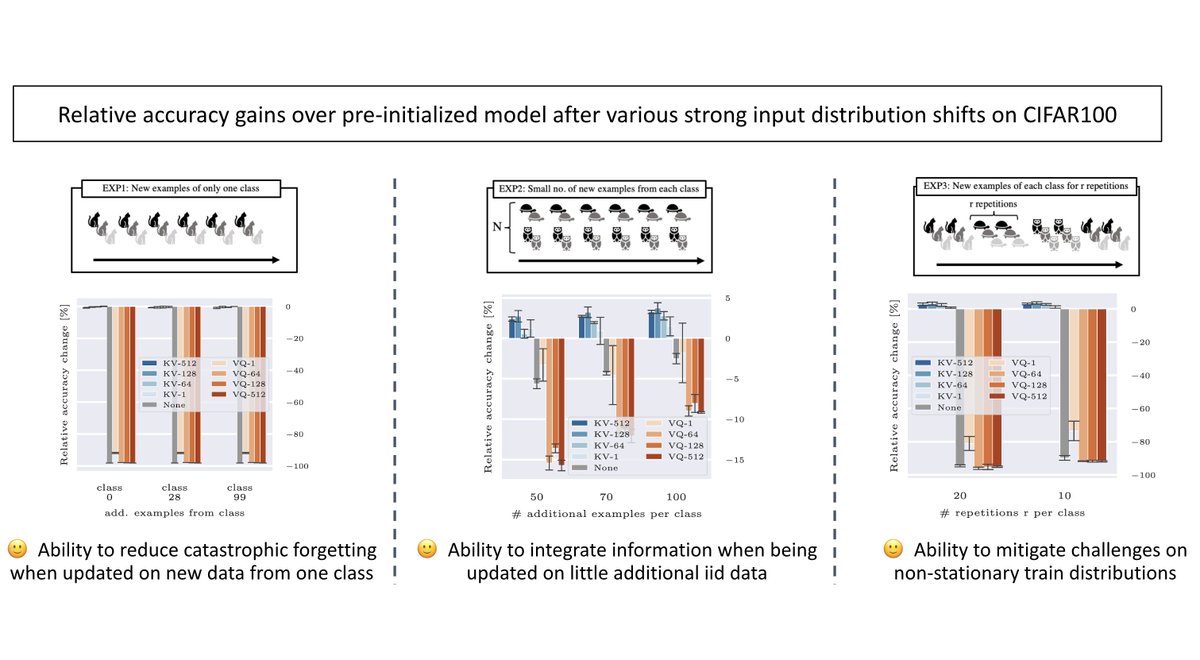
Amortizing information via a discrete bottleneck such that the knowledge is localized and results in flexible adaptation to distribution shifts such as non-stationary or imbalanced data streams.
https://t.co/o7jSAIpiHx
1/6
By freezing all model parameters except for the value codes, we can keep learning under various distribution shifts. This is enabled via localized, input-dependent model updates, which don't affect the prediction from (key, value) pairs retrieved from unalike train samples.
5/6
Look forward to presenting our work! 🚀
We connect the DCI disentanglement scores to identifiability, and propose a new complementary notion of disentanglement based on the *functional capacity required to use a representation.*
🔗https://t.co/RyVRcjUUil
🧵Short thread below
Check out our latest work if you have ever struggled with learning RL agents that can solve dexterous object-manipulation tasks in multi-object robotics settings! 🤖
https://t.co/HKkof5I2p7
Joint work with @mambelli_davide, Stefan Bauer, @bschoelkopf and @FrancescoLocat8
"Compositional Multi-Object Reinforcement Learning with Linear Relation Networks": new module with linear cost and an object-centric compositional bias for training RL policies that generalize zero shot to arbitrary number of objects in robotics. [1/2]
https://t.co/gcDkq1b0df
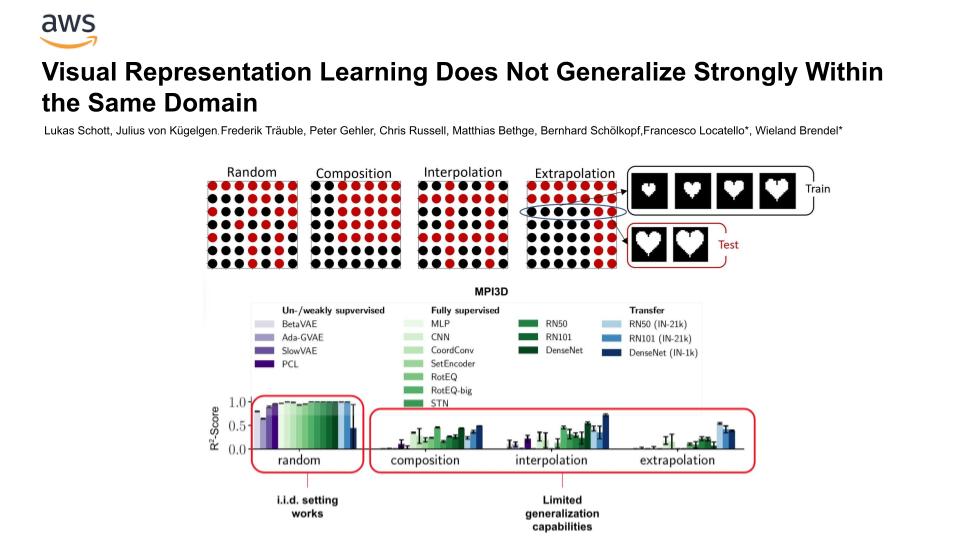
“Visual Representation Learning Does Not Generalize Strongly Within the Same Domain”: regardless of architecture and training signal, deep nets struggle to generalize strongly to existing factors of variation in the training data.
https://t.co/9Xz2VvaO6U
Happy to announce our large-scale study on representation learning and generalization in reinforcement learning! https://t.co/h9fSpw54Iw
How do properties of pre-trained representation backbones affect the robustness of downstream RL policies in simulation and real world?
1/5
My recent talk at the NSF town hall focused on the history of the AI winters, how the ML community became "anti-science," and whether the rejection of science will cause a winter for ML theory. I'll summarize these issues below...🧵







![FrancescoLocat8's tweet photo. "Compositional Multi-Object Reinforcement Learning with Linear Relation Networks": new module with linear cost and an object-centric compositional bias for training RL policies that generalize zero shot to arbitrary number of objects in robotics. [1/2]
https://t.co/gcDkq1b0df https://t.co/hk95F0S2bj](https://pbs.twimg.com/media/FKlKfBYXwAo6FFB.jpg)