Independent UK organisation set up by people with face blindness (prosopagnosia). Working to develop awareness, understanding, information and support.
This is an anecdote from a Face Blind UK member. “After nearly an hour, I realised that the people on the screen were me and the people around me… and the video was a livestream of the carriage I was sitting in."
#faceblinduk#prosopagnosia
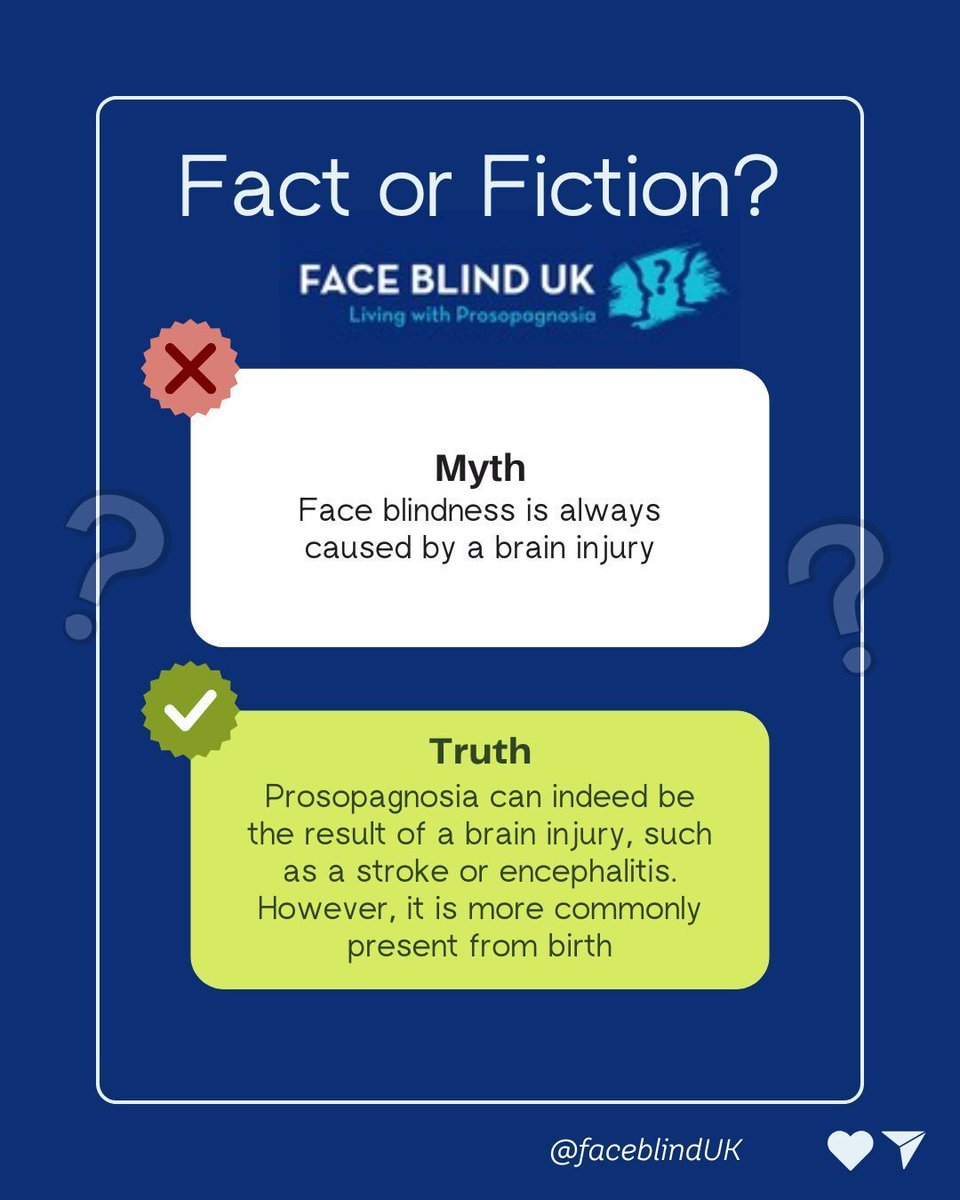
Prosopagnosia can indeed be caused by a brain injury, such a stroke, encephalitis or traumatic brain injury but face blindness is more commonly present from a young age without brain injury. This is called developmental prosopagnosia.
#faceblinduk#prosopagnosia
If you struggle to recognise faces, walking into a busy cafe or bar and trying to find your friends is hard work! If you’re meeting a prosopagnosic and you’ve already sat down, sending a quick text describing the table location can be a huge help.
#faceblinduk#prosopagnosia
People with face blindness, or prosopagnosia, may recognise others by using non-facial identifying features. These include a person’s voice and hairstyle. They may also rely on other distinguishing features like what clothing they usually wear.
#faceblinduk#prosopagnosia
“I am currently at a conference and wished I had one of your badges with me to help other people to understand I’m not being rude if I appear to blank them after chatting to them earlier! I have written an explanatory message on my delegate name badge: it seems to be helping”
Face blindness is a spectrum. Some people with prosopagnosia are able to recognise their close friends and family, but may struggle with acquaintances. Some people may struggle to identify anyone, including themselves in the mirror or in photos.
#faceblinduk#prosopagnosia
Meeting in busy places, like train stations or shopping centres, can present significant difficulties for prosopagnosics. It can help to choose a very specific location to meet, and to describe your clothing or accessories ahead of the meeting time.
#faceblinduk#prosopagnosia
Estimates for how common face blindness is vary by study, but the generally quoted statistic is 2% of the population. Some studies have suggested that it is even more common. The population could be greater than we currently realise.
#faceblinduk#prosopagnosia
Chuck Close (1940-2021) was an American artist who made massive-scale photorealistic and abstract portraits. Surprisingly - given his chosen subject matter of portraiture - Close had prosopagnosia.
Speaking to BOMB Magazine in 1995, Close said “I was not conscious of making a decision to paint portraits because I have difficulty recognizing faces. That occurred to me twenty years after the fact when I looked at why I was still painting portraits, why that still had...
No, face blindness (prosopagnosia) is not simply being bad with faces. It is a neurological condition that impairs a person’s ability to recognise familiar faces, sometimes even those of family, friends or even themselves.
#faceblinduk#prosopagnosia
Have you ever struggled to find your friend in a crowd? If so, you might have prosopagnosia! Prosopagnosia is a neurological condition which can be a problem when trying to find your friend outside the toilets in a public place!
#faceblinduk#prosopagnosia
We are sharing today a brilliant Telegraph article by @fayboundalberti on her experience with prosopagnosia.
Fay Bound-Alberti is a historian, academic and author of many works, including The Face: A Cultural History which examines our human relationships with faces
While researching for this book, Fay became aware of how prosopagnosia has impacted her. The article is an honest and well articulated personal account of face blindness, with an excellent cover image by Felicity McCabe.
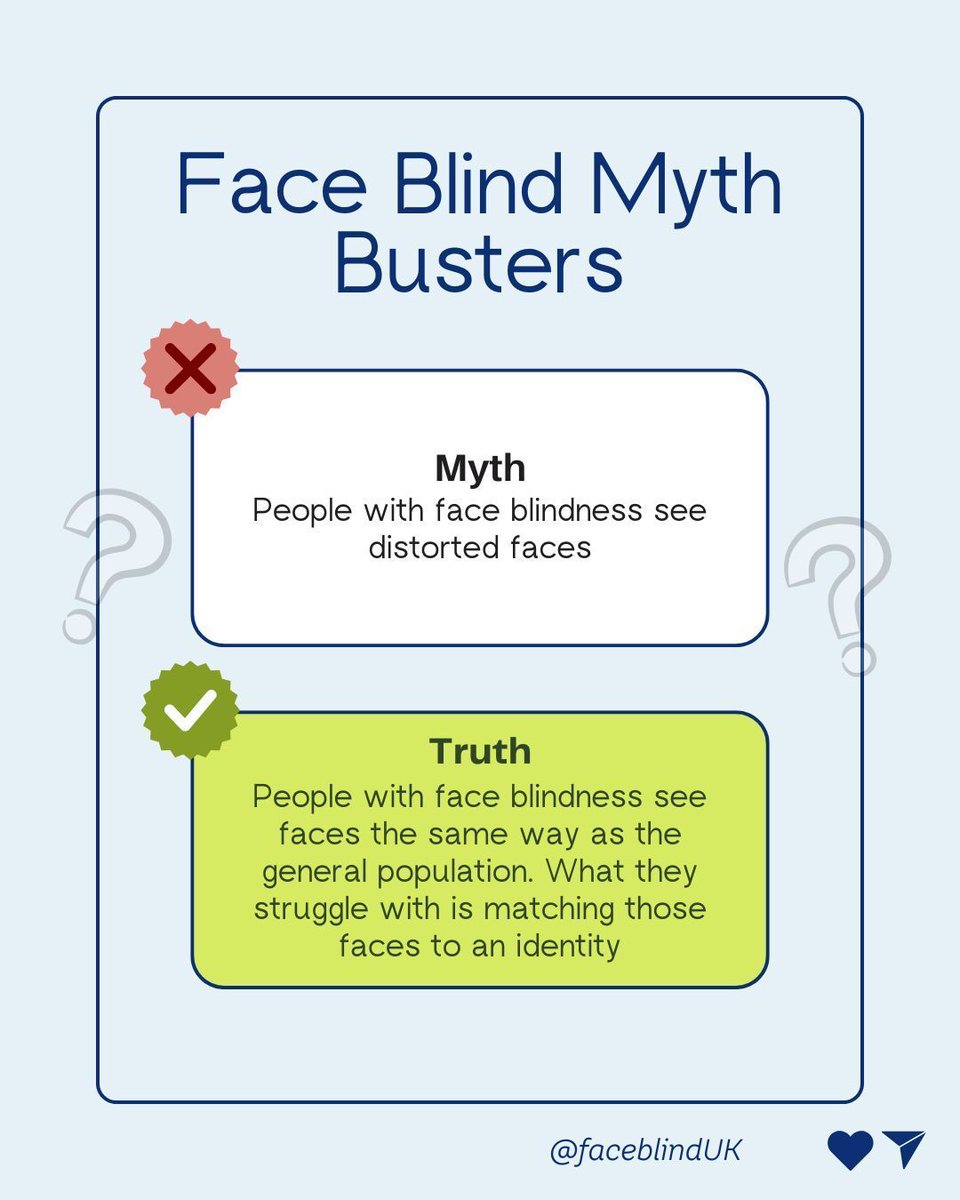
No, face blindness (prosopagnosia) is not seeing distorted faces. Prosopagnosia affects a person’s ability to recognise familiar faces, whether they are a close friend or family member, a famous actor in a film or sometimes even their own face.
#prosopagnosia#faceblinduk
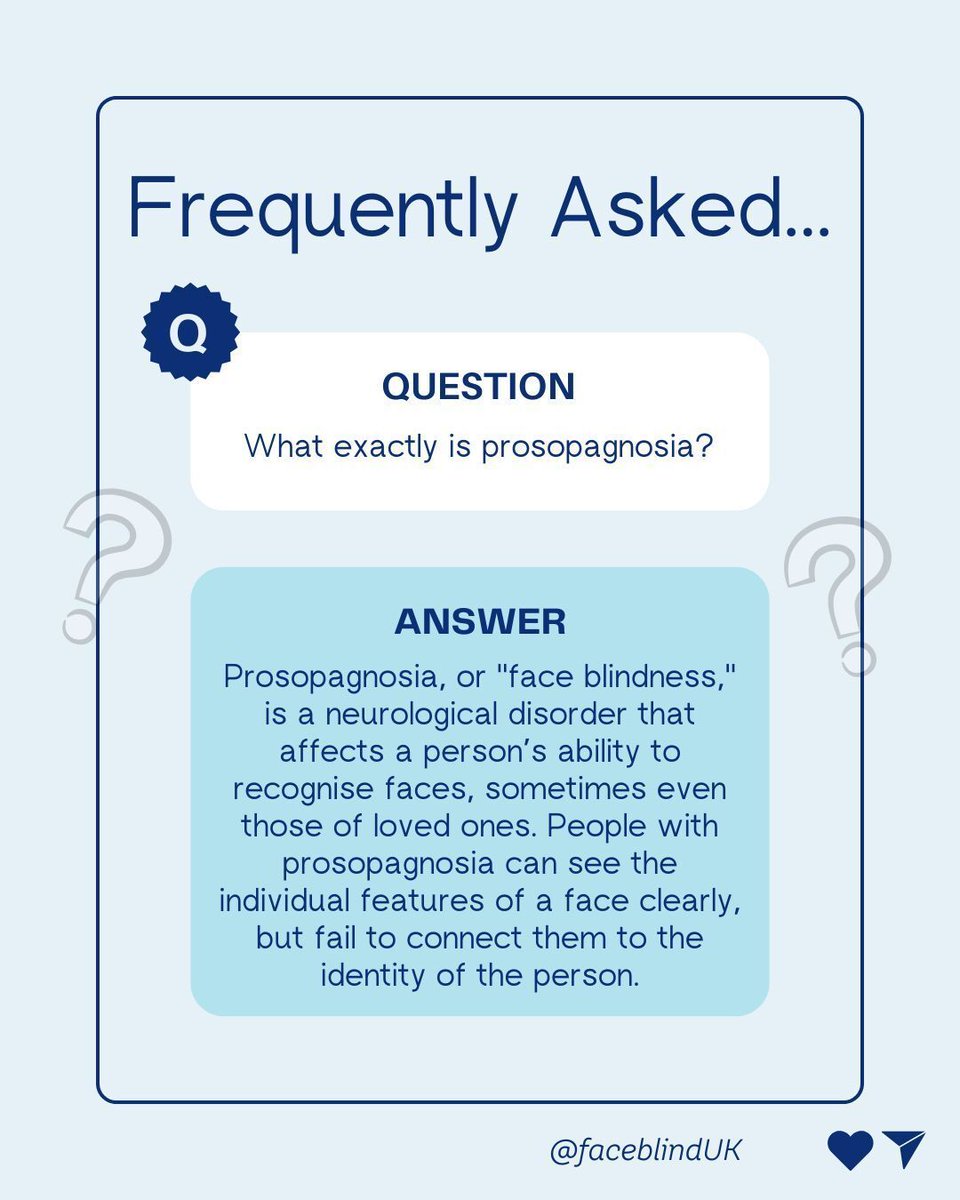
Prosopagnosia, or "face blindness," is a neurological disorder that impairs a person's ability to recognise familiar faces. People with prosopagnosia can see a face's individual features but fail to connect them to the identity of the person.
#prosopagnosia#faceblinduk
A common misconception is that people with face blindness don’t see faces the way everyone else does. The truth is that we see faces clearly, without distortion, but the brain has difficulty connecting those features to a specific person.
#prosopagnosia#faceblinduk
Brad Pitt’s career has spanned more than 3 decades and he has been a household name for most of that time. He has often discussed his challenges with recognising people and his worries about offending people when he can’t recognise them.
#prosopagnosia#faceblinduk#bradpitt