A Mumbai govt hospital advised a pregnant woman's family to consider transferring her elsewhere, as pre-delivery fetal assessment indicates her newborn will likely require NICU care, and all of their NICU beds are currently occupied.
The woman's husband called Shiv Sena (Shinde) corporator Ramesh Mhatre, who arrived with his goons and assaulted doctors and nurses.
If you understand how hospitals work, you'll know a bed not being available is not the doctor's fault. You can't ask another critical newborn to vacate a bed, nor can you provide NICU care on the floor, nor can you "arrange bed from some other dept" because a NICU bed isn't just a bed, it comes with ventilators, monitors, oxygen, infusion pumps, and other life-support equipment.
So the blame, if any, goes on the govt. But doctors are the easiest targets, and assaulting them earns politicians easy political mileage.
I know some will say, "Doctors are evil and deserve it," and that's fine. I'm not seeking sympathy. This post is for parents and medical aspirants. Unless your parents own a hospital, you choose govt jobs with better working conditions like the Army, paramilitary, or Railways, plan to pursue USMLE (or an equivalent pathway), or intend to move to private practice where you can arrange your own security, think carefully before choosing this profession.
Most govt hospitals are hellholes. You can serve patients well for decades and still end up being abused or assaulted by a tenth-pass corporator, a publicity-hungry politician chasing cameras, or patient relatives who think every death could have been prevented if only the doctor had "tried harder."
A quick and easy way to lower stress and inflammation: HUMMING.
Humming is one of many ways that you can activate your parasympathetic nervous system through the VAGUS NERVE, completely for free.
Here are some other ways, and how they can benefit your health (🧵1/6):
If you are still singing the "Happy Birthday" song and have not discovered the melodious Janmadinam Idam song in Sanskrit composed by Swami Tejomayananda, you are missing something. The birthday song in English merely wishes you a happy day but the Janmadinam song? It wishes you a life of meaning, purpose, blessings from Ishwara and fame coming from virtuous deeds. When it comes to profundity, it is hard to beat Sanskrit.
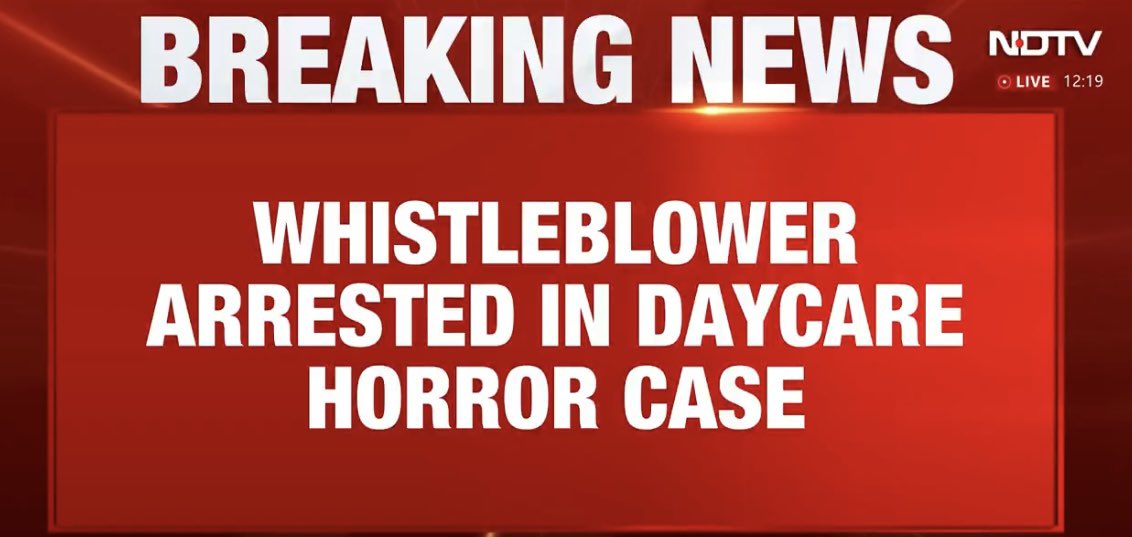
She was an employee at a Bengaluru daycare. She saw babies being tortured, loaded on to washing machines, stuffed down toilet bowls. She complained. She was sacked. She became a whistleblower and exposed the horrific crimes. She should have been rewarded.
She has been arrested.
Police should avoid interfering by taking anyone to hospital. Instead should have a kiosk , having a supervised medical team containing senior doctors, paramedic n nurses,on the spot of protesting at jantar mantar itself. NO NEED TO TAKE ANYONE TO HOSPITAL LET THEM ROT there only
Next Plan:
VIP professional protester will act out a serious illness.
Police will try to take him to the hospital out of fear.
The cockroach leader will oppose it and declare that if the police forcibly admit the VIP to the hospital, they will March towards the Sansad Bhavan or the PM's house.
They will try it, and the police will stop them for security reasons, but they want conflict to take this protest to Nepal-way!
@VijayGajeraO Police should avoid interfering by taking anyone to hospital. Instead should have a kiosk , having a supervised medical team containing senior doctors, paramedic n nurses,on the spot of protesting at jantar mantar itself. NO NEED TO TAKE ANYONE TO HOSPITAL LET THEM ROT there only
REWIND: Mohammed Riyaz Attari, the Islamic terrorist who murdered Kanhaiya Lal, paid Rs 5,000 extra to get the number 2611 on his licence plate (RJ 27 AS 2611) to celebrate the Pakistani terror attack in Mumbai that killed 166 people. You think we can coexist with them?
The Brahmin’s Prediction: How India Tracked Uranus Before the West
By @shreehistory
On the night of March 13, 1781, the German-born British astronomer William Herschel stood in the garden of his home at 19 New King Street in Bath, England, and pointed his telescope toward the constellation Gemini. He spotted an unfamiliar, slightly diffuse disc. He reported it to the Royal Society as a "comet." Within two years, the scientific community realized it was not a comet at all, but a new planet. History canonized this moment as the first time a planet was discovered in recorded history, and William Herschel was enshrined as the sole visionary who expanded the boundaries of our solar system.
But what if the object Herschel encountered had already been tracked, classified, and predicted by practitioners of the Indian astronomical tradition long before his telescope was ever built?
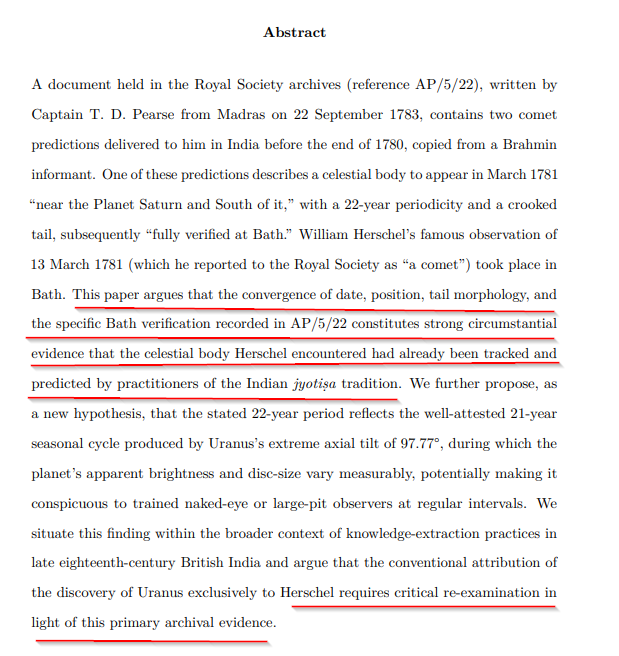
Deep within the archives of the Royal Society itself, filed away and forgotten for over two centuries, lies a document that profoundly disrupts the conventional narrative of European scientific supremacy. The document is reference AP/5/22, a letter written by Captain T. D. Pearse from Madras on September 22, 1783. Filed under the mundane category of "Unpublished Letters," it contains explosive primary evidence that the celestial body we now call Uranus was under systematic surveillance by Indian astronomers long before the West claimed it. It lay hidden, till @shreehistory downloaded it OCRed it for cursive font and extracted the text and then connected the dots.
The Letter from Madras
Captain Pearse was a British officer stationed in India, deeply engaged in studying local culture. In his letter to the Royal Society, he transcribed two comet predictions that had been delivered to him by a "learned Brahmin" in or around 1780. Pearse explicitly stated that he had transcribed these predictions "before the End of 1780." This timestamp is the crux of the historical intervention. The predictions predate Herschel's observation by at least three months.
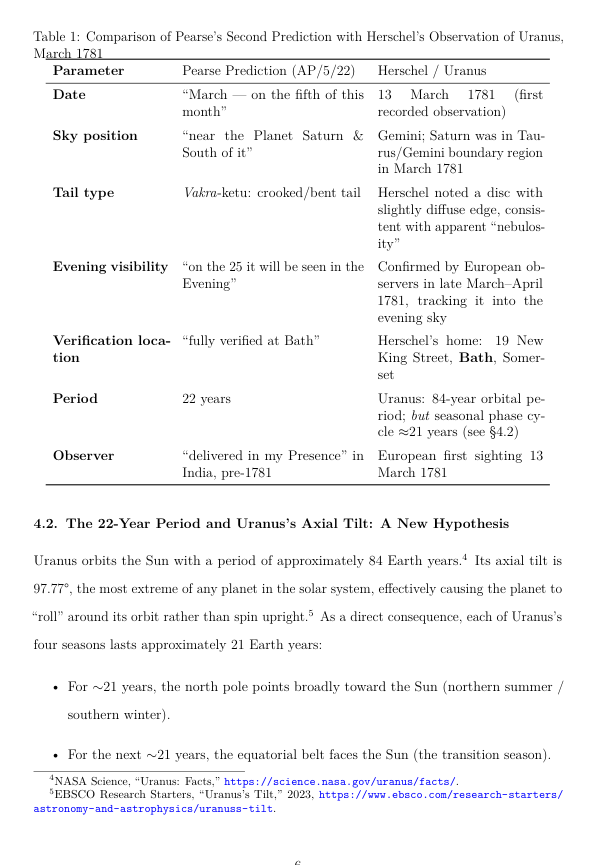
The second of the Brahmin's predictions read: "March, on the fifth of this month another Comet will appear of the kind called Wuckier or crooked from the Form of its Tail. It will appear six Ghurrees before Sun-rise, near the Planet Saturn and South of it. On the 25 it will be seen in the Evening. Its Period is twenty two years."
Later in the letter, Pearse casually notes the fate of this prediction: "I send you the copies of the other two predictions, one of which was fully verified at Bath."
The convergence of data is staggering. The prediction specifies the month of March, the exact proximity to Saturn, the evening visibility by the 25th, a crooked tail, and the specific verification location of Bath. This was not a lucky guess. The probability that a prediction composed in India before 1781 would correctly specify Bath, the month of March, the proximity to Saturn, and a 22-year period for an unknown celestial object, and that Herschel would then observe exactly such an object from Bath in March 1781 by pure chance, is vanishingly small.
The Sanskrit Taxonomy and the 108 Comets
The terms used by the Brahmin were not arbitrary. "Wuckier" is a direct transliteration of the Sanskrit word Vakra, meaning curved or crooked. In the Indian astronomical tradition of jyotisa, this refers to a specific class of comet known as Vakra-ketu, documented extensively in Varahamihira's Brhat-samhita from around 550 CE. The other prediction mentioned a "Dwudge" or flag-shaped comet, directly mapping to the Sanskrit Dhvaja-ketu.
The Indian system was not merely a collection of naked-eye myths. It was a highly sophisticated taxonomic project. Elsewhere in AP/5/22, Pearse records the Brahmin's promise to provide him with the tables of 108 distinct comets. This number is historically consistent with the ancient comet catalogues of Parashara, which classified celestial transients by tail morphology, rising direction, and crucially, periodicity.
The Brahmin informed Pearse that this catalogue was ancient received knowledge, written in the epoch preceding the current one. This implies a tradition of sustained, systematic tracking across many centuries, perhaps millennia. European astronomers like John Flamsteed and Pierre Charles Le Monnier had actually sighted Uranus before Herschel, but they catalogued it merely as a fixed star. They lacked the epistemological framework to recognize it as a moving body. The Indian tradition, by contrast, placed it within a named typology, assigned it a periodicity, and predicted its next appearance relative to Saturn.
The Secret of the 22-Year Cycle
Perhaps the most scientifically profound aspect of the Brahmin's prediction is the stated 22-year periodicity. Uranus has an orbital period of 84 Earth years. If the Indian astronomers were merely tracking the orbit, they would have recorded an 84-year cycle. Why 22 years?
The answer lies in the unique axial tilt of Uranus. The planet is tilted at a staggering 97.77 degrees, effectively causing it to roll around its orbit on its side. This produces four distinct seasons, each lasting approximately 21 Earth years. During these seasonal transitions, the geometry of the planet shifts from pointing its pole toward the Sun to pointing its equator toward the Sun. Modern science confirms that this transition causes measurable changes in the planet's atmospheric band structures, cloud features, and overall brightness.
The 22-year period recorded by Pearse was not an error. It reflects a new hypothesis: the Indian astronomical tradition was tracking the seasonal conspicuousness cycle of Uranus. They were observing a faint, slow-moving object that became notably brighter and more active in the sky roughly every 21 to 22 years. This requires a level of naked-eye observational discipline and data retention over centuries that the West has historically refused to imagine was possible in the Global South.
The Colonial Archive and the Erasure of Knowledge
The Royal Society received this letter in 1783. It was never read to the Society. It was never published in the Philosophical Transactions. It was filed away in the archive, buried in the vaults of the very institution that was simultaneously celebrating William Herschel's "discovery."
This archival suppression is emblematic of the broader history of colonial knowledge extraction. As historians of colonial science have documented, British intermediaries systematically collected indigenous technical knowledge, transformed it into European frameworks, and failed to credit the original sources. The year 1783, the date of the Pearse letter, marks the exact opening of the era where British scientific institutions in India began actively incorporating native knowledge into the matrix of imperial power without granting authorship.
Herschel himself wished to name the planet Georgium Sidus after the British monarch, King George III. It was a cosmic naming ceremony that mirrored the British assertion of hegemony over the Indian subcontinent. The Brahmin tradition, which had tracked this object within its own sophisticated taxonomy, received no acknowledgement then and has received none in two centuries of historiography.
Reclaiming the Cosmic Ledger
The paper authored by @shreehistory, drawing upon this buried primary evidence, does not seek to erase Herschel's telescopic achievement. It seeks to contextualize it. The history of astronomy owes a reckoning with the contributions of the Indian jyotisa tradition.
The conventional Eurocentric discovery narrative is historiographically incomplete. The object known as Uranus had been engaged with, tracked, and predicted by South Asian practitioners long before a European telescope was trained on Gemini. The truth of this history, preserved for over 240 years in the Royal Society's own archives, demands a critical re-examination of how we assign credit for human discovery.
The era of relying solely on the colonial archive to define the limits of indigenous knowledge is over. The time has come to read the Brahmin's predictions not as exotic curiosities, but as the rigorous scientific records they truly are.
All rights reserved. You must get written permission if you want to republish. Twitter users can share, repost, like, comment but please provide attribution to @shreehistory who did all this research.
Paper is in preprint and can be accessed from my site.
https://t.co/WpJ7h9EK6U
SP Office, @CP_Jodhpur
Is it necessary that Govt Officers can meet a citizen only inside their AC offices? Why can not the SP come down to meet this aged woman?
Gautama the Buddha is not a teaching, a philosophy, an ideology, or a new religion. He is a method, a way – not something that we believe or worship, but something that we become. Only then is he truly honoured, because that was his only intent, that people should live it. -Sg
Devastated to see this video. Parents of 34 year of Sarthak Mattoo who was killed by a speeding Thar while he was driving his bike in Delhi’s Vasant Kunj. Hope justice prevails. On His Way To Work, Gurugram Rider Dies As Thar Rams Him In Delhi https://t.co/mSiFVOwIQU