POV: first date. She orders everything on the menu.
The bill lands. You panic.
"Do you guys… do cashback?" "We do better."
1 in 100, the whole dinner comes back. Paid in seconds, on @solana.
Cashback is dead. 🪦
Our pitch for @colosseum's Crypto World's Fair 🎬👇
@vijaymichalik@itstuyo Fair comparison, but there is a key difference: Fade is an open protocol, not a card product. Any card issuer can plug in, with rewards backed by a shared liquidity pool.
We're building the infrastructure, not another card
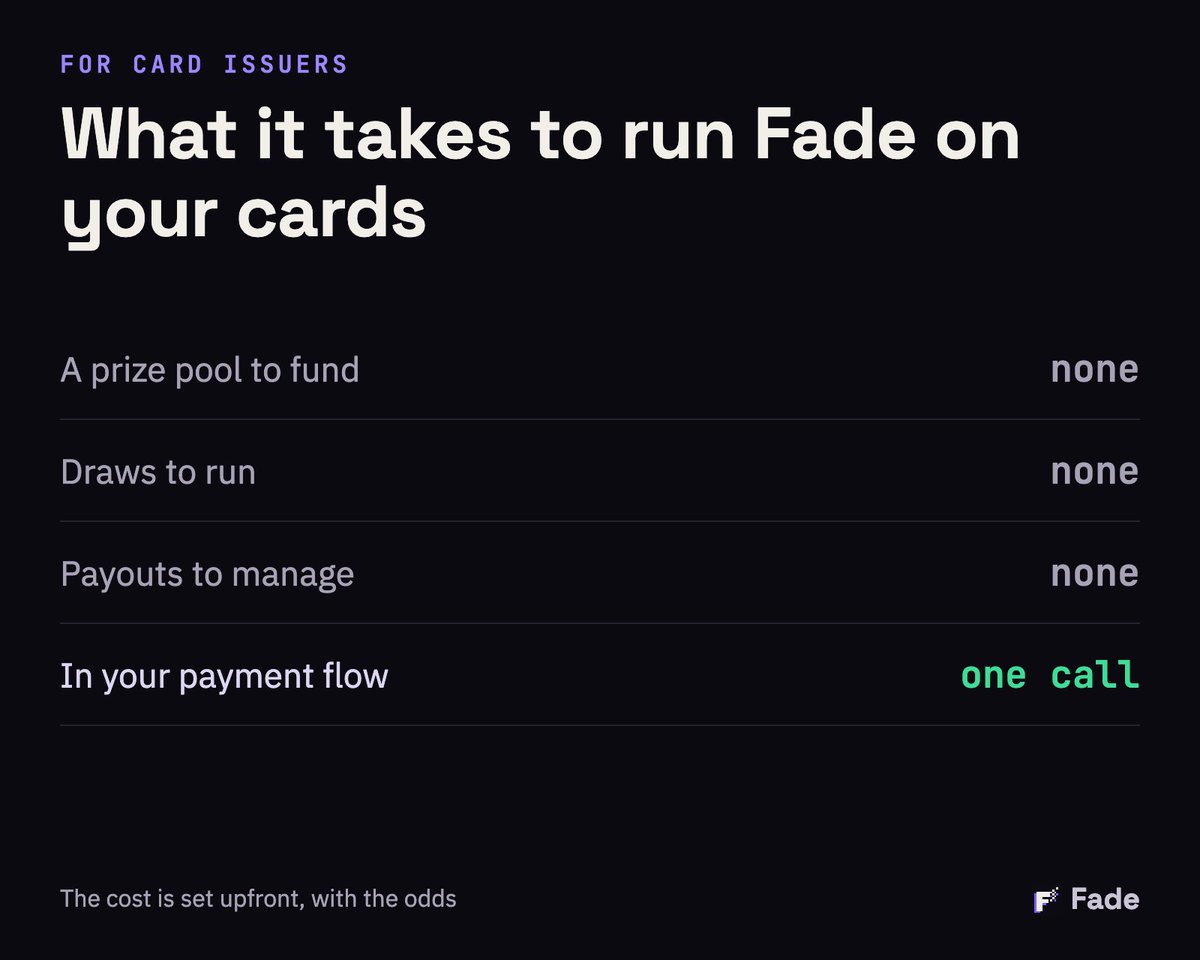
What a card issuer needs to offer free purchases with Fade: one call, added to the payment it already makes.
No prize pool to fund, and no draws to run. The issuer pays a cost set upfront with the odds, out of the budget it already spends on cashback. Our shared vault on @solana pays every win in full, and the issuer credits the card as it does a cashback.
Three winners in a row change nothing for the issuer.
The issuer sets the odds and can change or stop them at any time. Building or running a stablecoin card? Our DMs are open.
Card issuers ask us one thing before anything else: whether this is legal.
Most legal systems treat a draw as a lottery when the customer pays for the chance. With Fade, the customer never does. The issuer funds the chance from the rewards budget it already spends on cashback, and the customer pays the normal price.
A promotion, by design.
In the major markets we reviewed, that is a recognized form of sales promotion, run by the issuer like the ones it runs today. The formalities vary by country, from no permit in France or Germany to a free entry route in the US. No card data reaches Fade. The odds are published before launch, and anyone can check a draw on-chain.
How Fade works, from the cardholder's side.
You pay with your card, as usual, and pay nothing extra. The card's reward budget pays for a chance on that purchase, with odds that were public before you paid. Fade draws on-chain, and anyone can check the draw.
Lucky? It's all back. Your $40 dinner comes back as a credit on your card.
For the issuer, it's one call added to the payment it already makes, and our shared vault pays the win.
We turn cashback into free purchases.
It's the same budget a card already spends on cashback, split differently: a real discount fairly often, and now and then the whole purchase back. How it works, and why we're building it now, below.
Why now: stablecoins moved $482B in payments between January and September, 45% more than a year earlier, according to Allium. Issuers moving to stablecoin cards can run their rewards on-chain too.