🖤#RIP Klaus Schorn 🖤
Klaus hat sich verabschiedet...🥀
Es ist unerträglich, schon wieder ein #MECFS Tod!💔
Wir brauchen politischen u. gesellschaftlichen Druck, damit endlich lebensrettende Medikamente für #MECFS zugelassen werden!
https://t.co/jgvqefd7tb
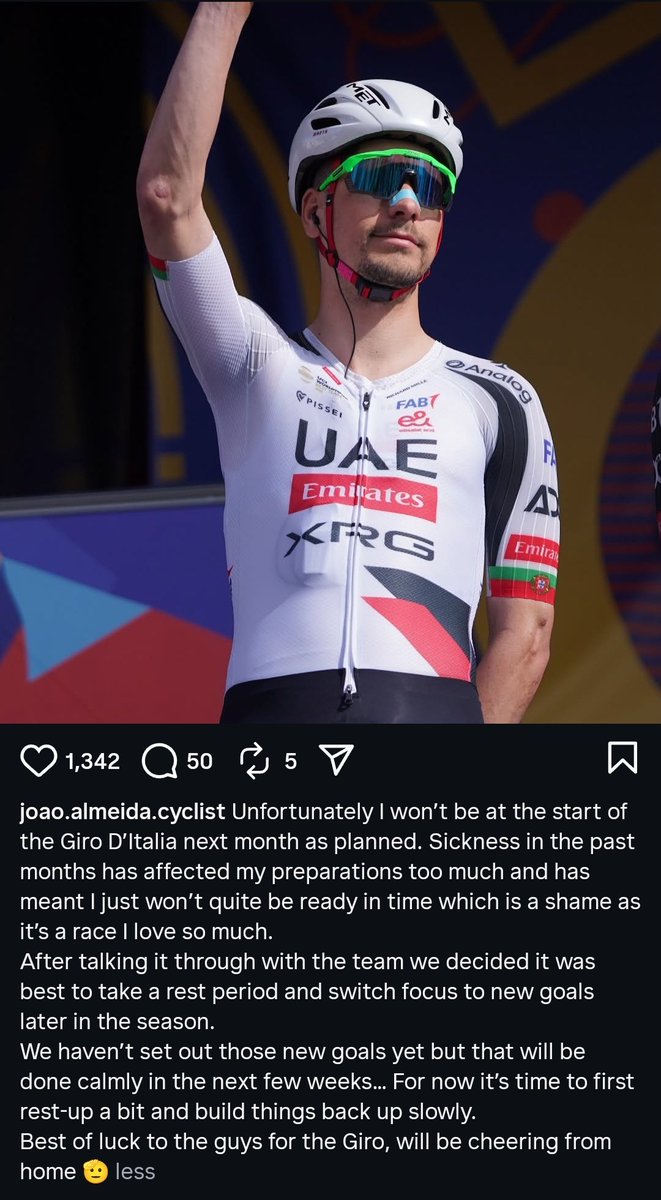
Laut radsportaktuell zufolge „kämpft der UAE Team Emirates - XRG-Profi seit Saisonbeginn mit den Folgen eines viralen Syndroms. Statt abzuklingen, führte das Problem zu Komplikationen, die weitere medizinische Untersuchungen erfordern, um seinen Status präziser zu beurteilen.“
❌ Very bad news for Il Giro d'Italia: Joao Almeida just confirmed he won't be at the start after his preparation was ruined by sickness, he was supposed to be Vingegaard's biggest threat next month. Tadej Pogacar could now make the funniest move ever...🤪
#GirodItalia
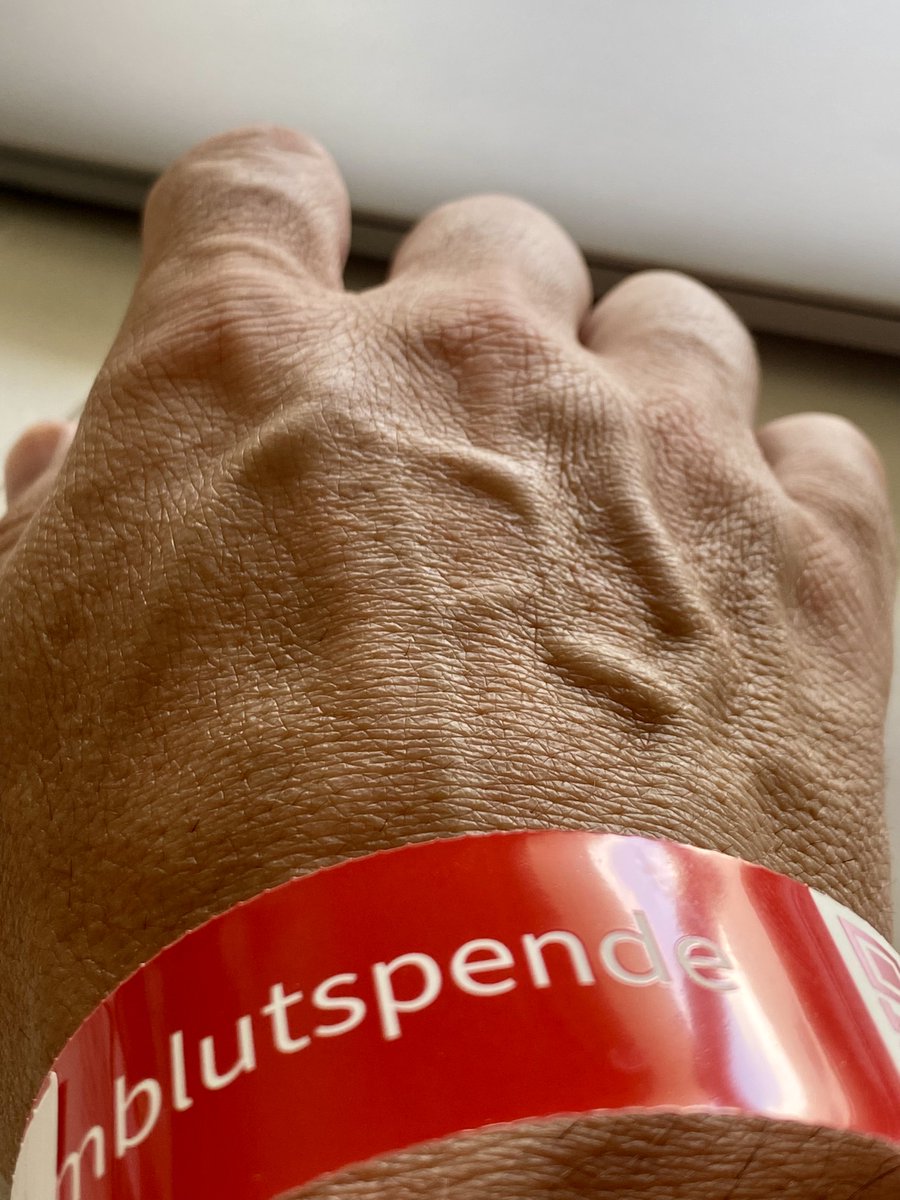
Ich habe heute zum 42. mal Blut gespendet. Solange ich gesund bin, möchte ich diesen Beitrag für meine Mitmenschen erbringen, in dem Gewissen, hier helfen zu können. Bedenkt immer: machen ist besser als brauchen. Also mach auch du mit. Jetzt! #Blutspende#BRK#DRK
@neurostingl@Tireless_Dave@HansOttoWagner1@mecfsotss@martinruecker@derfreitag So ist es. Der Missbrauch infolge der psychosomatischen Zuschreibung (Verweigerung EMR, GdB usw.) wird abgelehnt. Man kann gerne psychotherapeutisch unterstützen. Es ist ein Strohmann zu behaupten, das würde apodiktisch abgelehnt werden.
(4/6)
So in a chronic post-infectious disease with flares, PEM, inflammation, dysautonomia, and possible immunometabolic dysfunction, exertion can be an additional biological burden. It can increase oxidative stress, energy demand, sympathetic activation, and symptomatic worsening in certain patients.
It is not fear of exercise.
It is physiological intolerance to exertion.
And when thousands of patients say that exercise makes them worse, they are not “reading too much on the internet.” Many have tested it in their own bodies before they even knew what PEM was.
Another very problematic point:
“Talking about psychology can destroy your career.”
No. The problem is not talking about psychology.
The problem is using psychology to cover up medical ignorance.
Patients do not reject psychological support. They reject being told that their symptoms come from childhood trauma, anxiety, depression, false beliefs, or fear of movement when they have postural tachycardia, orthostatic intolerance, PEM, viral reactivations, autoantibodies, immune abnormalities, or muscle damage after exertion.
One thing is psychologically supporting a person with a chronic illness.
Another thing is turning the illness into something psychological.
CBT can help someone cope with a real disease. It can help with insomnia, adaptation, loss of a previous life, grief, secondary anxiety, boundary-setting, pacing, or the understandable fear that comes after worsening many times.
But CBT does not remove autoantibodies.
It does not eliminate viral reservoirs.
It does not clear persistent antigens.
It does not repair endothelial damage.
It does not cure exertion-induced myopathy.
It does not turn autoimmune dysautonomia into health.
It can be support. Not causal cure.
And that nuance is everything.
The same applies to reducing stress, resting, or pausing work.
If a patient improves after resting, taking beta-blockers, reducing workload, doing very gradual walks, and receiving cognitive support, that does not prove Long COVID is psychological. It may prove exactly the opposite: that their autonomic nervous system was overloaded and that by reducing sympathetic load, controlling heart rate, and spacing activities, they can tolerate activity better.
That is biology.
If a patient with dysautonomia improves by reducing stimuli, sleeping better, avoiding heat, controlling heart rate, using beta-blockers, or spacing tasks, it does not mean “the mind cured it.” It means you reduced physiological triggers.
🔵Continued in the next post.👇🏻
I received my day 21 RNA seq back yesterday and ran it through my pipeline. I'm not going to deep dive it too much until the end, but I'll just share a few interesting things.
My protocol started with sofosbuvir, daclatasvir, biktarvy, plus high dose thymosin alpha 1. Sof/Dac is a Hep C medication that can in theory target the RdRp of sars-cov-2. Biktarvy was chosen because it can suppress LINE1 which might help with HERV/RE elevation, which I've noticed in my blood. And TA1 was chosen because it helps increase thymic output, which should help T cells differentiate.
I spent a lot of time thinking about this protocol. I think the problem with antivirals alone in long covid would be you are removing the antigen on top of an already broken immune system. And using TA1 on its own might help T cells improve, but if the antigen burden is too high, it would be like spraying water on a large fire, largely ineffective. So my reasoning was that both would be needed - augment the immune system at the same time you're dropping viral load. Let the immune system then finish the job the antivirals have started.
The transcriptions themselves between day 0 and day 21 haven't changed in super meaningful ways, certainly not enough to say it was obvious what was going on with the antivirals. But I actually didn't think I would see much effect in these first few weeks, I just wanted to set a baseline before I added the other antivirals.
What did happen though is I saw massive T cell expansion and improved class switching. Here are some rough metrics - total clones increased 2.17 times, the diversity metrics have improved (I have a much broader response pool now), both TCR and BCR diversity has improved. Basically I had a very contracted clonal pool on day 0 that has started to resolve by day 21.
Crucial paper on #NeuroCovid just published! #LongCovid patients with neurocognitive symptoms showed increased antibodies against the nervous system that correlated with several neurological symptoms. Targeting these antibodies might offer therapeutic benefits for some patients
@Farbtastisch Bei welcher LDN-Dosis?
Gibt es Symptome neben Kopfdruck die zur Hypertension passen würden? Augenprobleme?
Ich habe auch fast immer Kopfdruck. Hypertension habe ich bisher nicht abklären lassen.
Hatte aber nicht den Eindruck dass LDN mit dem Kopfdruck bei mir korreliert.
1/
Feiertag: Gutachtertätigkeit.
Ich lese Psychotherapie-Anträge.
Und bei geschätzt 40 % (!)sehe ich dieselbe Konstellation:
In der GKV-Beilage finden sich Hinweise auf somatische Erkrankungen.
Der Konsiliarbericht: o.B.
Das Thema trug ich bei einer @kbv4u - Gutachtertagung vor.
I have a covid19 persistence panel in my RNA pipeline. It's basically a combination of all the genes that sars-cov-2 would disrupt if it were present, including all the various immune escape proteins and how they would react or cloak itself from the immune system.
I'm going to be shortly looking at my own longitudinal data with this, but as a test I ran some publicly available covid19 RNA seq data through the same pipeline. These were people that were covid positive, and their RNA seq was tested at various time points.
Here is a rough snapshot of one person on day 1 of their infection, day 7, and day 21. As you can see, all panels except two are out of range on day 1. Day 7 most of them are still high but slightly improving. By day 21, only one panel is still elevated, essentially showing the infection, or what a typical infection would do to transcription, seems to have subsided.
I'm running this on all the other patients as well, but I'm hoping I can use these same pipeline stages against myself to see what's still active and what's improving, assuming of course I still have viral persistence somewhere (which my positive IgM against the nucleocapsid seems to support). But running this sequence helps gives me some confidence I might see real signals here.
@derspiegel Man hört gleiche Erfahrungen z. B. bei Vaskulitis, Autoimmunenzephalitis.
Übrigens auch ein gutes Beispiel: der Film „Eine unerhörte Frau“ - empfehlenswert
@derspiegel Wieviele der F-Diagnosen sind in Wahrheit nur „wir wissen nicht was“, „zu komplex“-Diagnosen? Bei Long COVID dürfte es nach meiner eigenen Erfahrung und die viele anderen (s. z. B. Facebook-Gruppen tausender Betroffener) viele falsche Diagnosen geben, ich schätze > 50 %.
Ich mache nun auch einen Versuch mit Trimetadizin. Bin jetzt seit bald 3 M im Keller, brauche einen Hoffnungsanker.
Tagebuch (entspricht nicht Bell)
> 6 gut, Radfahren
>= 4 Spazierengehen mit Benommenheit
1-3 stark benommen, Schwindel
0 nur noch Bett
Nach nun knapp 4 Wochen sulodexid und trimetazidin: keinerlei Wirkung, keinerlei Nebenwirkung.
Ich gebe den beiden medis noch weitere 4 Wochen. Wenn ich dann nichts merke wars wohl nur ein weiterer verzweifelter Versuch mit Medikamenten. Habe dann langsam echt alles durch…