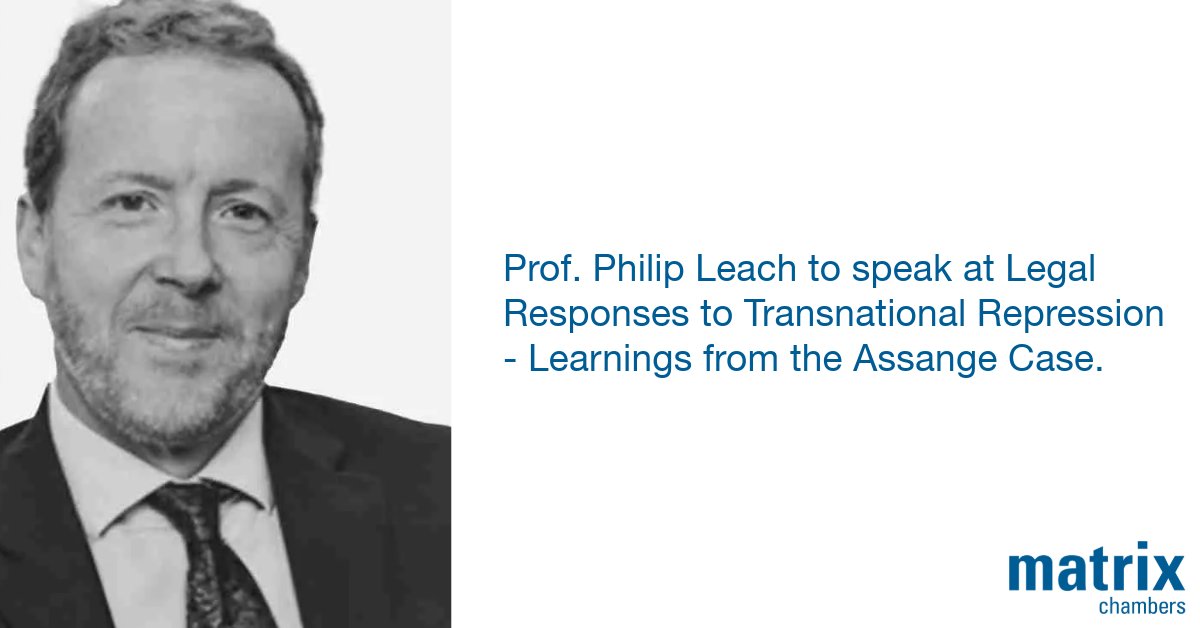
Prof. Philip Leach is participating in the @fairtrials webinar series Legal Responses to Transnational Repression - Learnings from the Assange Case.
Philip will be speaking at the webinar on 27 March, exploring the role of Article 18 ECHR.
Register: https://t.co/YHBPKu85IW
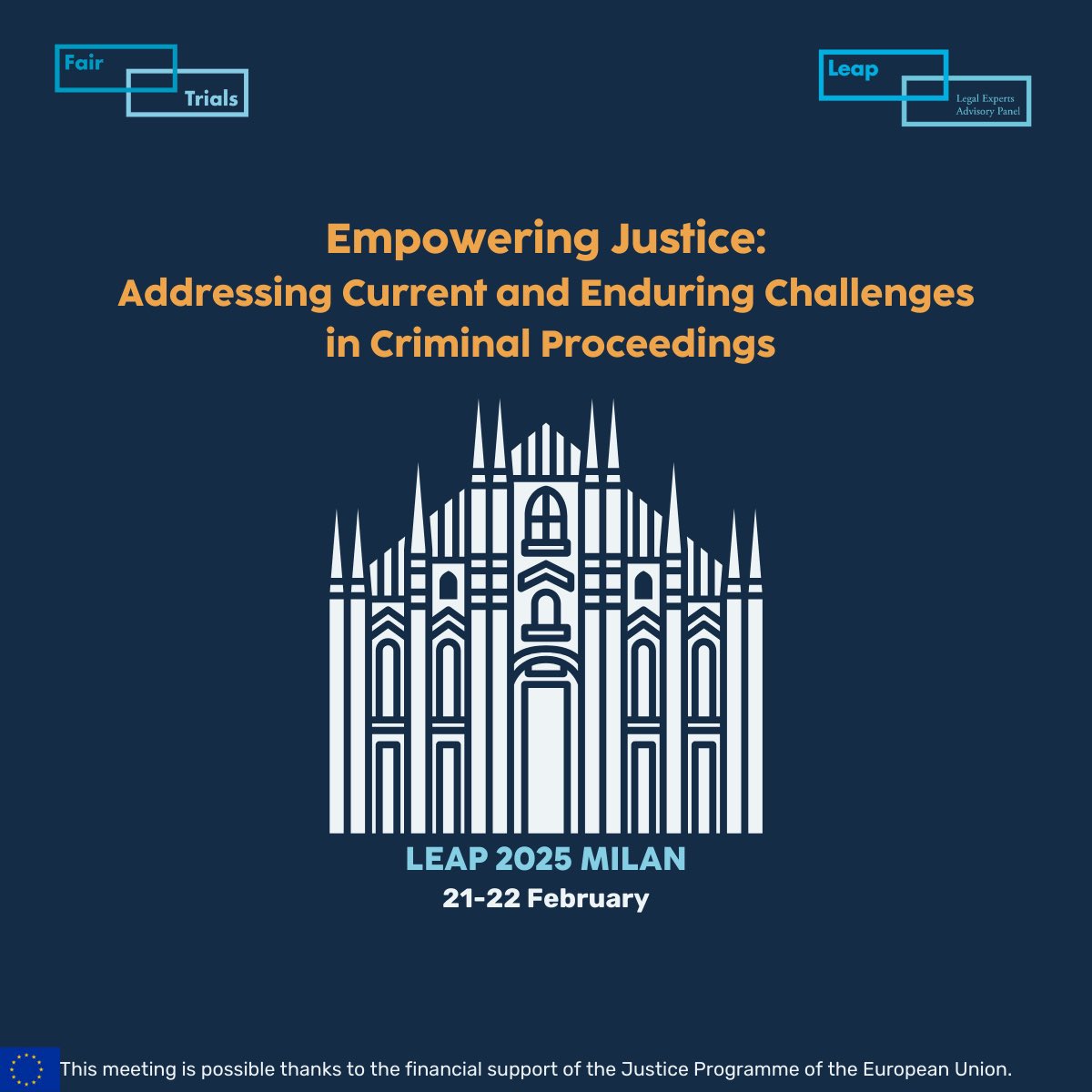
We're also looking forward to having you next year. Thank you for coming and for your contribution to the conference @CLoedden@Bojana2711 and @JustusReisinger
Today our member @JustusReisinger spoke about the fair trial challenges in EncroChat and SkyECC-cases, with @CLoedden & @Bojana2711 also attending this very important conference of the Legal Expert Advisory Panel of @fairtrials
@fairtrials the leading NGO advocating for fair and equal criminal justice systems, announced the release of a comprehensive analysis examining artificial intelligence regulation in European law enforcement. This detailed study presents a thorough assessment of regulatory frameworks across multiple jurisdictions, evaluating the implementation of AI technologies in police and criminal justice systems.
The report provides an authoritative analysis of current safeguards protecting fundamental rights, examines the deployment of emerging surveillance technologies, and offers evidence-based recommendations for harmonising security requirements with civil liberties.
https://t.co/GsbNsAxMPN
#CriminalJustice #AIGovernance #JudicialReform #LawEnforcement #EuropeanLaw #HumanRights #Privacy #DataProtection #Surveillance #PolicingTechnology #DigitalRights #FairTrials #EuropeanUnion #LegalTech #TechRegulation #PublicSafety #CivilLiberties #LawAndTechnology
Rediscover this 2009 report: "Consular assistance and trial attendance: a comparative examination of the American, Australian, British, Dutch and German ministries of foreign affairs" by Katerina Mantouvalou, published by @fairtrials and @NuffieldFound: https://t.co/1FmJDhOCEd
After 11 years, Interpol updated its Repository of Practice about interpretation and application of Articles 2 and 3 of its Constitution.
Here's a detailed breakdown of the major updates in this release:
1. Inclusion of Article 2 (UDHR Compliance)
A significant addition to the third edition is the inclusion of Article 2, which directs that INTERPOL's activities be conducted in the "spirit of the Universal Declaration of Human Rights" (UDHR).
This section provides guidelines to ensure that data processing is consistent with international human rights standards and takes into account the principles of dignity, equality and justice.
The updated Article 2 content supports a structured approach to compliance review, requiring that all activities and data exchanges respect the rights outlined in the UDHR.
In the third edition, there is an enhanced emphasis on aligning compliance assessments with international human rights treaties. This edition explicitly references key instruments such as the ICCPR and the Convention Against Torture (CAT), underscoring their relevance in evaluating data processing activities.
2. Revised Framework for the Interpretation of Articles 2 and 3
The interpretation of Articles 2 and 3 now incorporates guidance from the Vienna Convention on the Law of Treaties, which establishes "good faith" as the basis for interpretation. This aligns the data processing requirements with international treaties and recognized norms of human rights law. The revised framework introduces a compliance approach that assesses data requests against both the principles of the UDHR and INTERPOL's mandate to operate independently of political, military, religious, or racial influences.
3. Expanded Subject Matter Analysis
Cases Involving Politicians and Senior Officials: The revised edition now explicitly includes cases involving high-level officials in addition to politicians, recognizing the unique complexities such cases can present in terms of international relations and power dynamics. Freedom of assembly and association: In a global context of increasing civil protests and political dissent, the updated Guidelines emphasize careful analysis to ensure that INTERPOL channels are not misused against individuals exercising these freedoms.
State security offenses: Expanded guidelines address state security offenses, with special attention to cases involving unconstitutional power shifts and civil unrest, and emphasize the need for neutrality in such situations.
Terrorism and Sanctions Violations: Given the sensitive nature of terrorism and sanctions, additional criteria are included for assessing data requests in these areas to ensure careful consideration of the political context and legal framework.
4.Enhanced Compliance Review Mechanisms
Dual compliance with Articles 2 and 3: Requests are now assessed under both Articles 2 and 3, taking into account national legislation, international human rights standards and INTERPOL's internal policies.
Widened screening criteria: The revised edition lists several criteria, such as the nature of the crime, the status of the individuals involved, and the broader international context.
5. The third edition includes updated examples and case studies that illustrate common scenarios encountered by INTERPOL. @BenCAKeith@rednoticemon@rednoticeabuse@fairtrials@MichaelPolakLaw
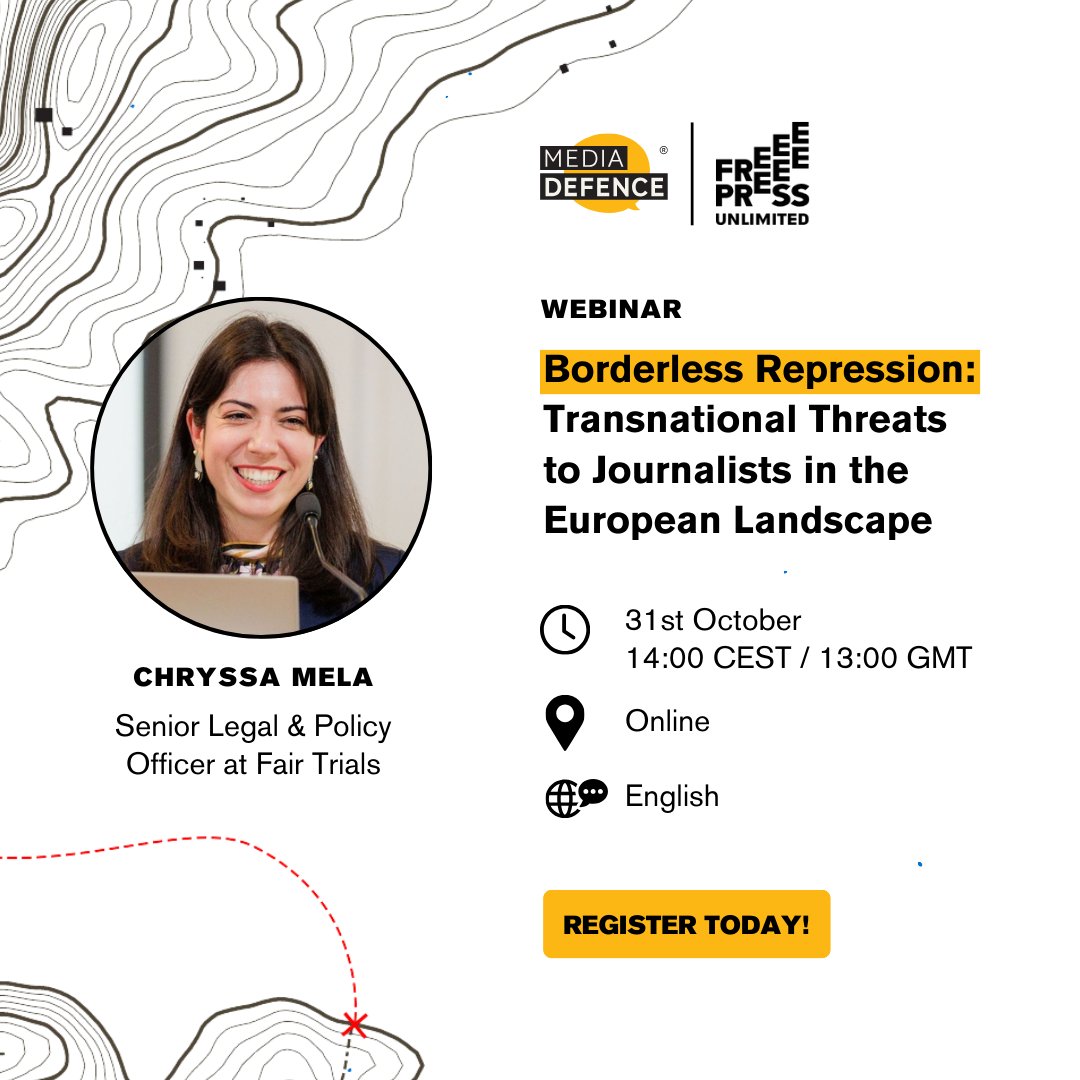
Fair Trials' @ChryssaMela speaks today at 14:00 CET at the "Transnational Threats to Journalists in Europe" webinar, discussing our campaign for #INTERPOL to prevent abuse of its systems to target journalists, refugees, and activists.
Register here: https://t.co/aDyUzJFm0z
Our Senior Legal Officer, @ChryssaMela, will speak tomorrow about our work on #INTERPOL and Red Notices at the "Transnational Threats to Journalists in the European Landscape," webinar, organized by @mediadefence and @freepressunltd.
Register here👉🏼: https://t.co/4LGyMShUM7
We’re excited to announce that Fair Trials' @ChryssaMela will speak about our work on INTERPOL Red Notices at the "Transnational Threats to Journalists in Europe" webinar. Don’t miss this event on October 31st—register here: https://t.co/HcgwJNhDEG #PressFreedom#HumanRights
🚨 Speaker Announcement! Join us on 31st Oct for our webinar with @freepressunltd: Transnational Threats to Journalists in Europe. Hear from our panel on Interpol Red Notices, extradition, Pegasus, and more.
🕐 1PM GMT / 2PM CET
🔗 Register: https://t.co/5FQCJmTC9o
I am pleased to join prominent human rights lawyers and legal experts in publishing this report on the recent (@ECHR_CEDH) Yasak v Turkey judgment, which the report presents as containing many errors, omissions and misinterpretations.
Read Fair Trials new report on the use of artificial intelligence (AI)-based systems in public security and the criminal justice system in Latin America. We are grateful to @mozilla for its support to this work.
📖 Report in English (PDF) https://t.co/pUKBvxqWRG
Fair Trials, con el respaldo de @mozilla, ha publicado un informe sobre Inteligencia Artificial en la seguridad pública y en el sistema penal en América Latina. El informe disponible en inglés y español plantea que 🧵:
Fair Trials defiende que la población general tiene derecho a conocer, en un lenguaje que comprenda, la forma en que operan los sistemas basados en inteligencia artificial.
Become a Trustee of Fair Trials International 🤝 This is a fantastic opportunity to help us achieve our vision of a world where every person's right to a fair trial is respected. Read more (PDF): https://t.co/nPplvqxyYQ
You can read the full report "Assessing Flight Risk in pre-trial detention decision-making: a European comparative study" here: https://t.co/I8LR3kwOuQ
Flight risk is a common justification for pre-trial detention, disproportionately affecting foreigners, homeless people, and those in precarious socio-economic conditions. Watch the full video 👉🏼https://t.co/66JOheviCC
1/3
This video is part of the EU project “Improving Judicial Assessment of Flight Risk,” funded by the @EU_Commission, led by Fair Trials and in cooperation with the Ludwig Boltzmann Institute of Fundamental and Human Rights, @ICCLtweet, @hfhrpl, @bg_helsinki , and NICC/INCC
2/3