We’re working with an independent advisory group of mathematicians to help OpenAI responsibly share advances in AI and mathematics.
The group will advise on how we assess and communicate new mathematical results, uphold academic and professional standards, and build tools that support mathematical research and learning.
Through this work, we want mathematicians to be at the center of shaping how AI supports mathematical understanding and how its benefits reach the wider community.
https://t.co/QCMFLFlIv8
Our group discovered that reasoning models produce fractals when asked to solve hard problems. We can use nonlinear dynamics to probe the thinking processes of recurrent depth models on Sudoku, mathematics, and even ARC-AGI (1/N)
https://t.co/Q3u8OqylZf
We’re sharing a solution to the Navier-Stokes Millennium Prize Problem, one of the deepest problems at the frontier of mathematics.
The proof was produced by a group of agents, using an OpenAI next-generation model significantly more capable than GPT-6 Astra.
The problem concerns whether the description of smooth three-dimensional fluid motion modeled by the Navier-Stokes equations can break down. It has remained unresolved for roughly 90 years.
Checking that a major mathematical proof is correct can take years. Formalization—converting the mathematical reasoning into a form computer proof assistants like Lean can verify—can help.
Last month, Claude completed the first formalized proof of Fermat’s Last Theorem, one of the most famous theorems of all time. This was a project experts thought would take many years. It is the largest Lean proof ever written.
Fermat’s Last Theorem was first proven in 1995 by Sir Andrew Wiles, more than 350 years after it was conjectured. Our proof, which totals over 13 million lines of code, provides machine verification. More importantly, it proves over 29,000 other theorems that the proof requires, across many areas of math which had never before been formalized.
We see this as a major step in the long process of firming up the core of mathematical knowledge, building on work from three centuries of mathematicians and hundreds of contributors to Lean and Mathlib. We are optimistic that AI-assisted verification of mathematical proofs will help reduce the burden of refereeing mathematics in an era where more proofs are being produced than ever before.
You can read about the process on our Science Blog: https://t.co/ryYnDEAU6J
And see the complete proof on GitHub: https://t.co/wlYMXYnofz
We asked an unreleased research version of Claude to take a stab at the Riemann hypothesis.
It didn’t solve it, but it did make strides on a related problem: it increased the lower bound for the fraction of zeros of the Riemann zeta function that satisfy the hypothesis from 41.6% to 67.2%.
https://t.co/aZDvqqhHRi
🆕 Researchers have found hundreds of space oddities, with a little help from AI! 🤖
Anomalous objects like colliding galaxies, gravitational lenses, and ring galaxies are useful to scientists, but hard to find in the oceans of data collected by telescopes like Hubble. 1/3
Here it is! The first ever Comcast bill negotiated 100% with A.I and LLMs.
Our @DoNotPay ChatGPT bot talks to Comcast Chat to save one of our engineers $120 a year on their Internet bill.
Will be publicly available soon and work on online forms, chat and email.
Today I asked ChatGPT about the topic I wrote my PhD about. It produced reasonably sounding explanations and reasonably looking citations. So far so good – until I fact-checked the citations. And things got spooky when I asked about a physical phenomenon that doesn’t exist.
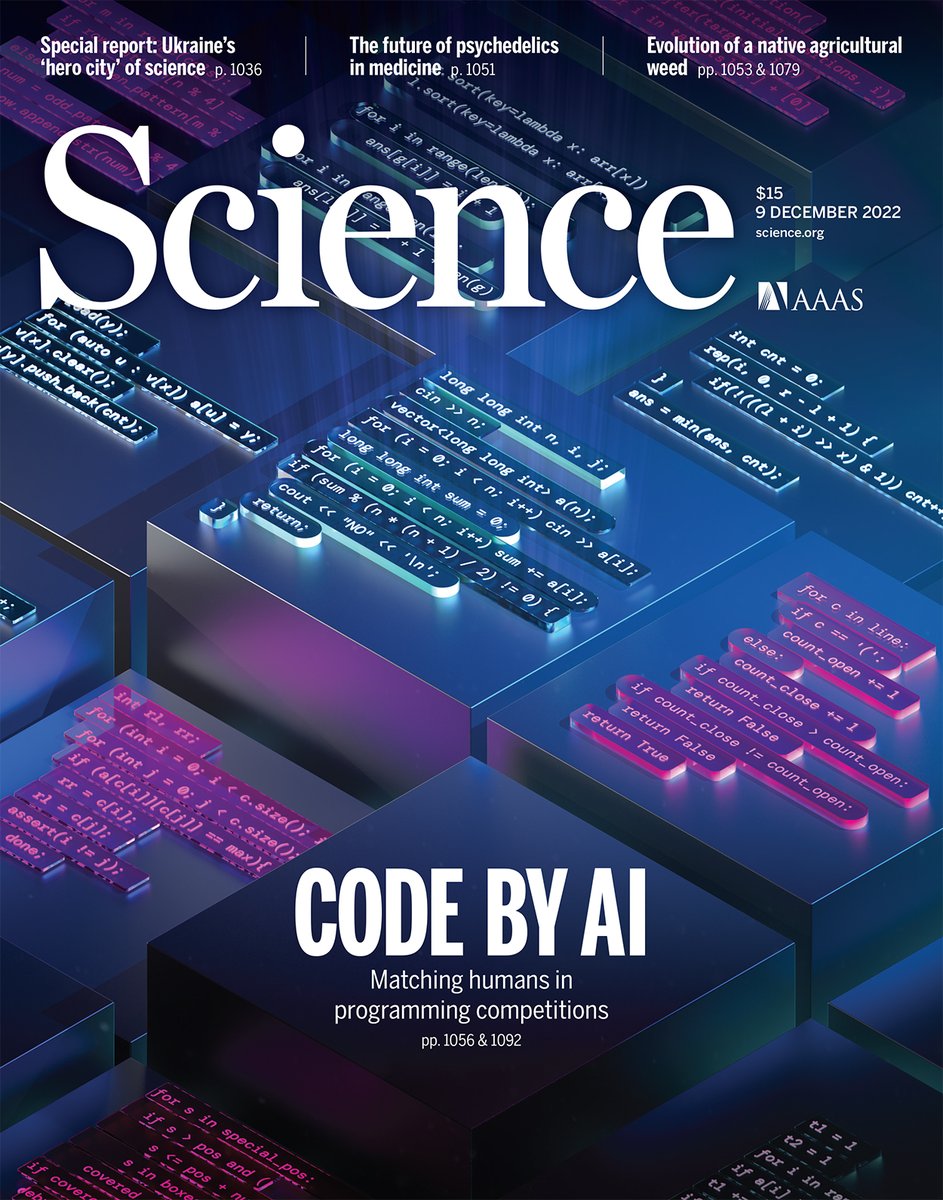
ICYMI: #AlphaCode - the first AI system to write computer programs at a human level in competitions - was published in @ScienceMagazine
It placed in the top 54% of participants in coding contests by solving new and complex problems.
Find out more: https://t.co/j427Nh16wO
BREAKING NEWS: This is an announcement that has been decades in the making.
On December 5, 2022 a team from DOE's @Livermore_Lab made history by achieving fusion ignition.
This breakthrough will change the future of clean power and America’s national defense forever.
#AlphaCode—a new #AI system for developing computer code developed by @DeepMind—can achieve average human-level performance in solving programming contests.
Learn more this week in Science: https://t.co/baygVUiHmi