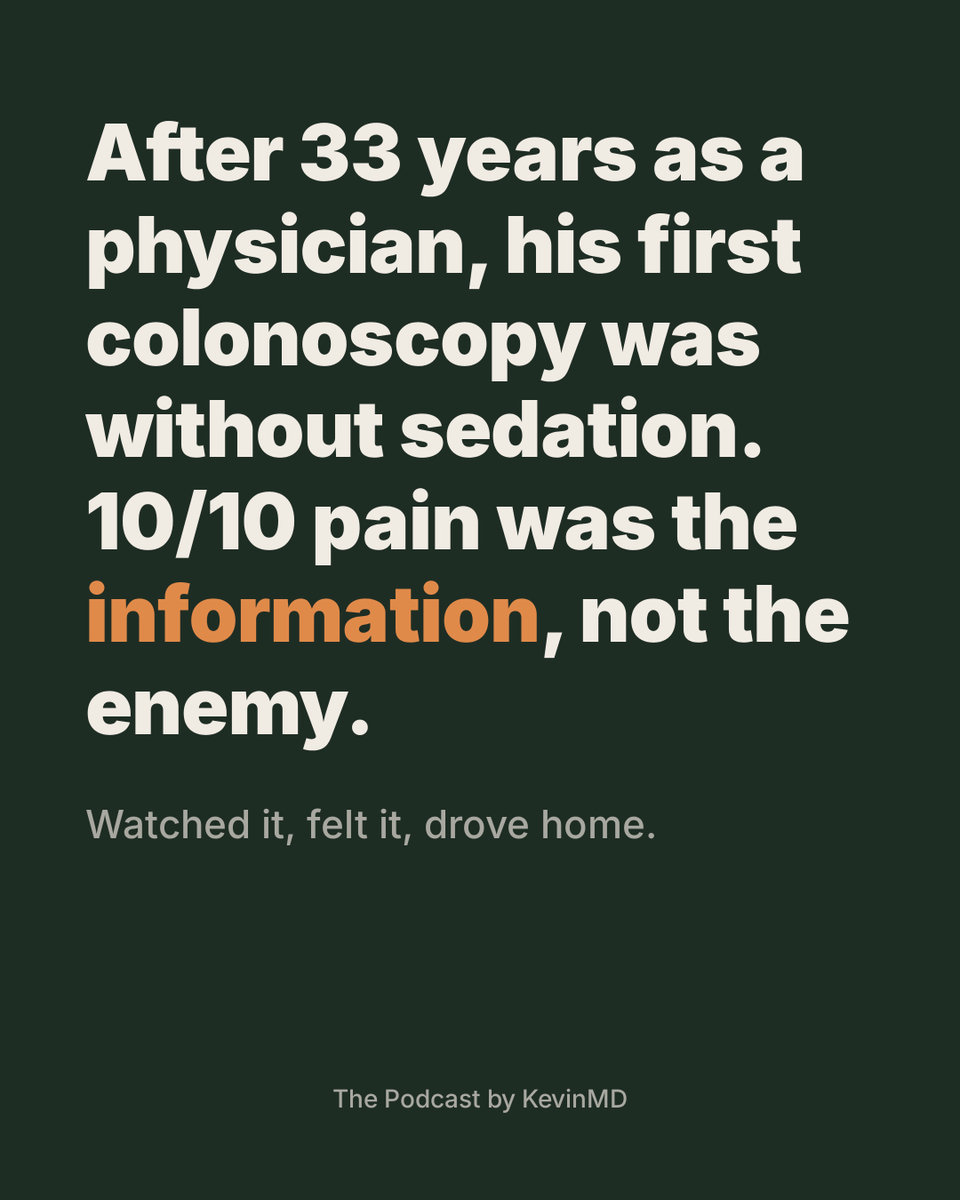
A 69-year-old family physician walked into his colleague's endoscopy suite and asked for a colonoscopy with zero medication. No Versed. No Demerol. No Propofol.
He stayed awake for the entire procedure and described what he felt at each anatomic landmark.
Mike Neskovic has practiced family and geriatric medicine in California for 33 years. Took the Hippocratic Oath in 1977. Has run 31 Los Angeles marathons. Hiked Kilimanjaro. Had a laparoscopic inguinal hernia repair and refused a single pill afterward.
So when his wife and sons pressured him into his first colonoscopy in his sixties, he negotiated his own terms.
The pain map he gives from inside the procedure is the part that should make every clinician stop and read.
Scope going in: 1 or 2 out of 10. Discomfort.
Splenic flexure: 10 out of 10. Tears in his eyes. Moaning. Begging the gastroenterologist to slow down.
Transverse colon: drops back to 6 or 7.
Hepatic flexure: another 10 out of 10. Almost unbearable.
Each peak lasts about 30 seconds. Then it passes.
He watched his cecum and appendiceal orifice on the monitor. Saw the biopsy taken. Heard his colleague tell him three times that he had the colon of a 20-year-old. Stood up afterward, declined the wheelchair the staff insisted on, declined the ride home his colleague insisted on, and drove himself out of the parking lot.
Total procedure time: about 15 minutes.
The thing worth saving from this conversation is the specificity of his pain map. Most patients cannot give us this account because we have given them medication that erases the memory. Splenic and hepatic flexure peaks at 10 out of 10, lasting roughly 30 seconds each, with discomfort dropping into the 6-7 range across the transverse colon. That is data we almost never collect, from a population we almost never collect it on.
Both standard sedation options produce amnesia. Conscious sedation with midazolam plus meperidine gives an anterograde amnestic effect. Propofol produces full unconsciousness. The patient may have moaned, may have moved, may have asked for the scope to slow down. The patient does not remember it 20 minutes later.
Which means most of what we know about intra-procedural colonoscopy pain comes from indirect signals: vital sign changes, body movement, sedation top-ups. A first-person account at each anatomic landmark, from an experienced clinician who can still tell you what he felt, is a kind of data we have effectively designed out of the procedure.
He also notes that his gastroenterologist was moving fast, the way you move when you have ten more on the schedule. An awake patient can ask you to slow down. A sedated patient cannot.
Listen to the full conversation on The Podcast by KevinMD. Link in the replies.
For clinicians who have done a lot of these: does his pain map at the flexures match what you would expect physiologically?
#ThePodcastbyKevinMD
Today, my family went on a family trip to Flagstaff. We walked into a quaint sandwich shop, and a young woman approached to take our order.
She was wearing a sports bra and crack-sucking leggings.
It was the kind of outfit our grandmothers would see as lingerie.
Had I not been with my family, I would have said something like, “Ma'am, do you not know how inappropriate your outfit is? Are you not ashamed to be wearing that in public?”
So, when I got home, I wrote the owner.
This won’t change until we make it change. Make sin shameful again. Remember, shame pushes people to see their need for forgiveness—in Christ.
A friend went to the funeral of an ER doctor. In addition to photos of the doctor and his family, there was an interactive table displaying various objects the surgeon had pulled out of people’s asses over the years. My friend said it was the best funeral he had ever attended.