I tested every major AI research tool.
Perplexity won. And it wasn't close.
Here's the full breakdown (save this):
1. Real-Time Search
↳ Pulls from the live web on every answer
↳ I was still opening Google for current news
2. Cited Answers
↳ Every fact gets a numbered source [1][2][3]
↳ Click any number to verify in one tap
3. Pro Search
↳ Multi-step web research before answering
↳ Replaces 30 mins manually across 10 tabs
4. Deep Research
↳ Autonomous agent, researches 15-30 mins
↳ I stopped building briefings by hand after this
5. Focus Modes
↳ Academic, Reddit, YouTube, Math source filters
↳ Switch source types with one click
6. Model Selection
↳ Claude Opus 4.6, GPT-5.5, Sonar Pro in one tab
↳ Replaces jumping between 3 separate platforms
7. Model Council
↳ One query to multiple frontier models at once
↳ I've reversed decisions based on what came back
8. Spaces
↳ Persistent workspaces, files and context saved
↳ No re-uploading anything every session
9. Pages
↳ Any research thread becomes a shareable doc
↳ I used to copy everything into Notion by hand
10. File Analysis
↳ Upload PDFs, ask questions against your doc
↳ Answers from your file and the live web at once
11. Comet Browser
↳ AI-native browser, free on iOS, Mac, Windows
↳ Replaces pasting page content into ChatGPT
12. Computer Agent
↳ Books flights, fills forms, manages email
↳ Full browser workflows, completely on autopilot
13. Personal Computer
↳ Always-on AI living on your Mac
↳ Accesses local files and runs 24/7 tasks
14. Slash Commands
↳ /claude or /gpt switches models mid-search
↳ Build custom shortcuts for repeated workflows
15. Voice Search
↳ Search by speaking on iOS and Android
↳ 3x faster than typing every query
16. Conversation Threads
↳ Follow-ups build context from every prior turn
↳ No history lost across a full research session
17. Image Upload
↳ Upload screenshots, ask what Perplexity sees
↳ Combines your image with live web data
18. Sonar API
↳ OpenAI-compatible, real-time cited search
↳ Swap the base URL from OpenAI to Perplexity
19. Collections
↳ Save top results into named folders
↳ Replaces browser bookmarks with zero structure
20. Enterprise Controls
↳ SSO, audit logs, CrowdStrike-secured
↳ Zero model training on your company data
I thought this was a search engine.
It's a research operating system.
And I was barely using it.
Which feature are you starting with?
1. Follow @coder_surya
2. Save the post.
3. Repost to your network.
4. Join AI Community: https://t.co/ioQEJKhR1q
____________________________
@AyaSansFiltre Malheureusement on est pas la cible des femmes qui préfèrent les "bad boy" après ce sont les mêmes qui vont venir se plaindre dur ce réseau dingue 😂
@LatyrDiouff La triste vérité que les gens ne veulent pas entendre c'est que les personnes ne se marient pas souvent pour les bonnes raisons entre xémém, argent, changement de statut social ce qui est très fragile.
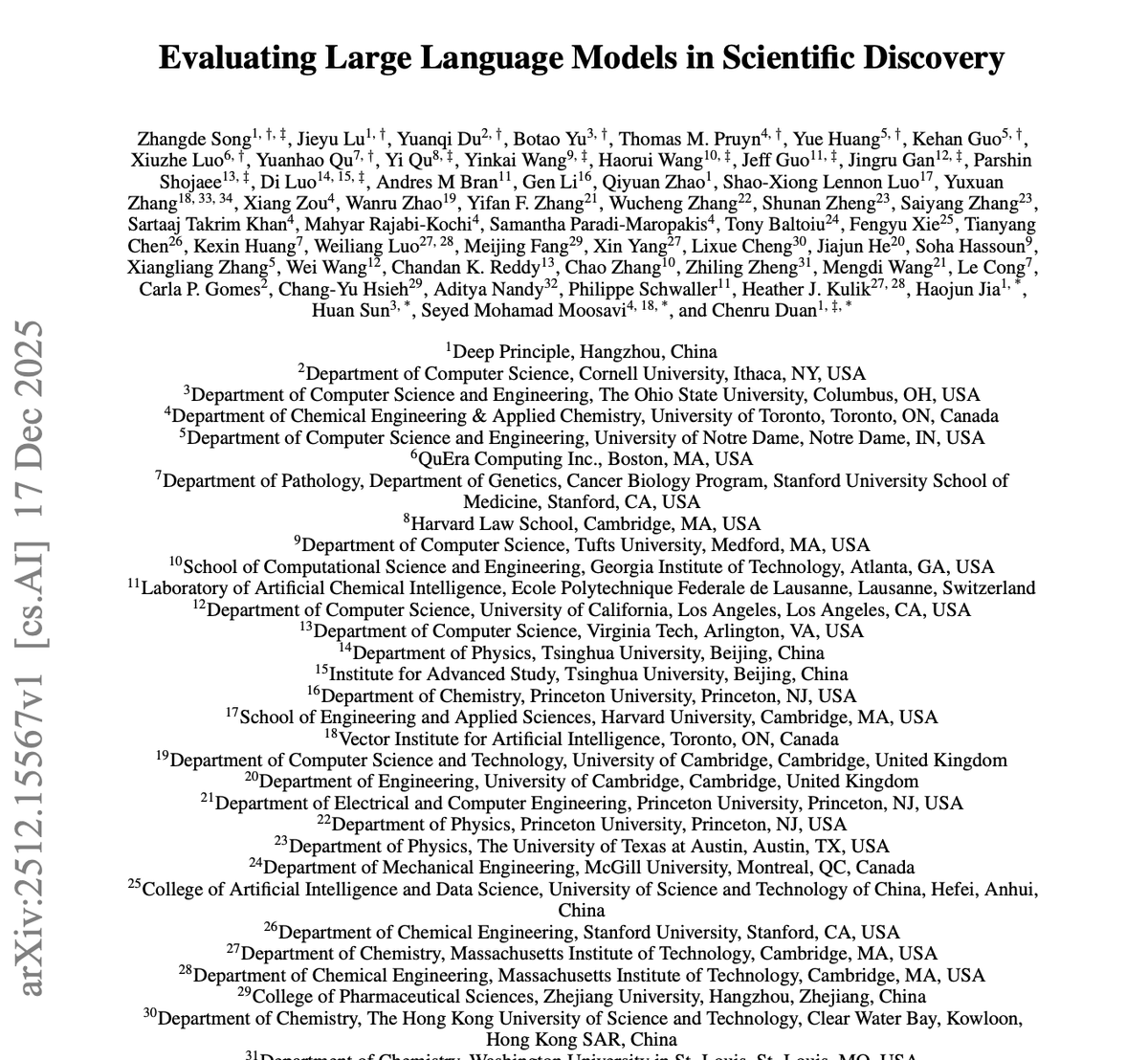
PhD students doing a literature review ask: have I read enough?
That is the wrong question.
The right question is: have I searched in the right places?
This paper from Harvard and MIT quietly answers the most important AI question nobody benchmarks properly:
Can LLMs actually discover science, or are they just good at talking about it?
The paper is called “Evaluating Large Language Models in Scientific Discovery”, and instead of asking models trivia questions, it tests something much harder:
Can models form hypotheses, design experiments, interpret results, and update beliefs like real scientists?
Here’s what the authors did differently 👇
• They evaluate LLMs across the full discovery loop hypothesis → experiment → observation → revision
• Tasks span biology, chemistry, and physics, not toy puzzles
• Models must work with incomplete data, noisy results, and false leads
• Success is measured by scientific progress, not fluency or confidence
What they found is sobering.
LLMs are decent at suggesting hypotheses, but brittle at everything that follows.
✓ They overfit to surface patterns
✓ They struggle to abandon bad hypotheses even when evidence contradicts them
✓ They confuse correlation for causation
✓ They hallucinate explanations when experiments fail
✓ They optimize for plausibility, not truth
Most striking result:
`High benchmark scores do not correlate with scientific discovery ability.`
Some top models that dominate standard reasoning tests completely fail when forced to run iterative experiments and update theories.
Why this matters:
Real science is not one-shot reasoning.
It’s feedback, failure, revision, and restraint.
LLMs today:
• Talk like scientists
• Write like scientists
• But don’t think like scientists yet
The paper’s core takeaway:
Scientific intelligence is not language intelligence.
It requires memory, hypothesis tracking, causal reasoning, and the ability to say “I was wrong.”
Until models can reliably do that, claims about “AI scientists” are mostly premature.
This paper doesn’t hype AI. It defines the gap we still need to close.
And that’s exactly why it’s important.
I learned how transformers actually work in 22 minutes this evening. Not from a video or a paper. From talking out loud.
I've tried to understand attention maybe six times. Andrej's video. The Illustrated Transformer post. Three different chatbots. Each time I'd get to paragraph four of someone's explanation and quietly start scrolling instead of reading.
So at @emergentlabs vibecon this weekend, we built the thing I actually needed.
Slate - a voice-first AI tutor that teaches you anything and everything you want, in under 30 minutes, while drawing it on a slate.
You tell it a topic. You talk to it. It talks back warm, patient, two sentences at a time. And while it's explaining, it's drawing. Mermaid diagrams. Code with syntax highlighting. KaTeX equations. Chalk-on-blackboard sketches. It takes notes on the side that you can download as markdown.
What it replaces, for me:
• 3 YouTube tabs → one 20-minute conversation
• A 40-page PDF → a diagram I watched get drawn
• "Regenerate response" → "wait, why softmax?" → an answer
Try it now at https://t.co/biJ3Jx3YuO
Three things we learned building it:
1. Typing kills curiosity. A blank text box turns "I wonder" into "I'll Google it later." Voice doesn't.
2. The whiteboard isn't a feature, it's the whole thing. Watching a concept get drawn lands different than reading the same words.
3. The system prompt that worked is one line: "don't monologue." The best tutor in the room is never the smartest one it's the most patient one.
We shipped this end-to-end in less than 12 hours. Voice loop, live whiteboard, image gen, auth, session replay. On any other stack that's a six-week project. On Emergent it was a weekend.
Pick a topic you've been meaning to understand. Tap the orb. You'll get it before your coffee goes cold.
Built with emergent · #Vibecon
@Miss_populaire1 La plupart des casqniere trouvent mari sur les réseaux sociaux surtout entre Twitter, Snap, Instagram et Tik tok on connaît la méthode 😂😂
Build a Large Language Model from scratch!
This repository contains the code examples for developing, pretraining, and finetuning a LLM from scratch.
It is the official codebase for the book Build a Large Language Model (From Scratch).
Notebook examples are included for each chapter:
Chapter 1: Understanding Large Language Models
Chapter 2: Working with Text Data
Chapter 3: Coding Attention Mechanisms
Chapter 4: Implementing a GPT Model from Scratch
Chapter 5: Pretraining on Unlabeled Data
Chapter 6: Finetuning for Text Classification
Chapter 7: Finetuning to Follow Instructions
Link to the repo in the comments!
We're living in the BEST era for doing research. 💪
After I graduated from my PhD, the rise of AI-native research gave me a new chance to revisit my research experience.
Lately, doing research feels incredibly rewarding to me. I get to experience the pure joy of curiosity-driven science because I no longer have to worry about the lower-level implementations or getting bogged down by infrastructure 🚀
(I'll be sharing some of my own recent research driven by this very soon!)
But today, let me introduce the New Orchestra 🎻. We wanted to ship a product that absorbs the friction and brings science back to the curiosity.









![heyitsurya's tweet photo. I tested every major AI research tool.
Perplexity won. And it wasn't close.
Here's the full breakdown (save this):
1. Real-Time Search
↳ Pulls from the live web on every answer
↳ I was still opening Google for current news
2. Cited Answers
↳ Every fact gets a numbered source [1][2][3]
↳ Click any number to verify in one tap
3. Pro Search
↳ Multi-step web research before answering
↳ Replaces 30 mins manually across 10 tabs
4. Deep Research
↳ Autonomous agent, researches 15-30 mins
↳ I stopped building briefings by hand after this
5. Focus Modes
↳ Academic, Reddit, YouTube, Math source filters
↳ Switch source types with one click
6. Model Selection
↳ Claude Opus 4.6, GPT-5.5, Sonar Pro in one tab
↳ Replaces jumping between 3 separate platforms
7. Model Council
↳ One query to multiple frontier models at once
↳ I've reversed decisions based on what came back
8. Spaces
↳ Persistent workspaces, files and context saved
↳ No re-uploading anything every session
9. Pages
↳ Any research thread becomes a shareable doc
↳ I used to copy everything into Notion by hand
10. File Analysis
↳ Upload PDFs, ask questions against your doc
↳ Answers from your file and the live web at once
11. Comet Browser
↳ AI-native browser, free on iOS, Mac, Windows
↳ Replaces pasting page content into ChatGPT
12. Computer Agent
↳ Books flights, fills forms, manages email
↳ Full browser workflows, completely on autopilot
13. Personal Computer
↳ Always-on AI living on your Mac
↳ Accesses local files and runs 24/7 tasks
14. Slash Commands
↳ /claude or /gpt switches models mid-search
↳ Build custom shortcuts for repeated workflows
15. Voice Search
↳ Search by speaking on iOS and Android
↳ 3x faster than typing every query
16. Conversation Threads
↳ Follow-ups build context from every prior turn
↳ No history lost across a full research session
17. Image Upload
↳ Upload screenshots, ask what Perplexity sees
↳ Combines your image with live web data
18. Sonar API
↳ OpenAI-compatible, real-time cited search
↳ Swap the base URL from OpenAI to Perplexity
19. Collections
↳ Save top results into named folders
↳ Replaces browser bookmarks with zero structure
20. Enterprise Controls
↳ SSO, audit logs, CrowdStrike-secured
↳ Zero model training on your company data
I thought this was a search engine.
It's a research operating system.
And I was barely using it.
Which feature are you starting with?
1. Follow @coder_surya
2. Save the post.
3. Repost to your network.
4. Join AI Community: https://t.co/ioQEJKhR1q
____________________________](https://pbs.twimg.com/media/HKBMvsjbsAAwqJs.jpg)